















...
Home / Service / Metal Roof Retrofit & Recover Systems

Metal Roof Retrofit & Recover Systems

A metal roof retrofit installs a new panel system over the roof you already have, so the building stays dry and occupied while the work happens.

Houston roofs fail from fastener movement, seam corrosion, and humid-night condensation long before the structure gives out. A recover system addresses all three without a tear-off, and a documented roof assessment starts at $150

Watch How We Deliver Quality

How Do You Know a Houston Metal Roof Is Ready for a Metal Roof Retrofit?

Fasteners Backing Out Along the Ribs

Houston's daily swing between overnight humidity and afternoon roof-surface heat expands and contracts exposed-fastener panels thousands of times a year. Screw holes elongate, gaskets flatten, and heads sit proud of the panel. Once a field of fasteners has loosened, re-screwing buys a season; a recover system carries the load on new framing instead.

Rust Blooming at Panel Laps and Endlaps

Sidelaps and endlaps hold moisture against bare steel edges long after the rain stops, and Gulf humidity keeps them damp overnight. Red staining that spreads outward from a lap line means the coating has been breached. If the corrosion is confined to laps and the deck still gauges sound, the panels can stay in place as a substrate.

Damp Insulation With No Rain in the Forecast

Water staining that appears on clear mornings is usually condensation, not a leak. Warm interior air meets a cold panel underside and gives up its moisture. A leak detection scan separates the two before anyone commits to a scope, because a condensation problem needs an insulated retrofit, not a patch.

What Actually Sits Between the Old Roof and the New One?

The Retrofit Assembly, Layer by Layer

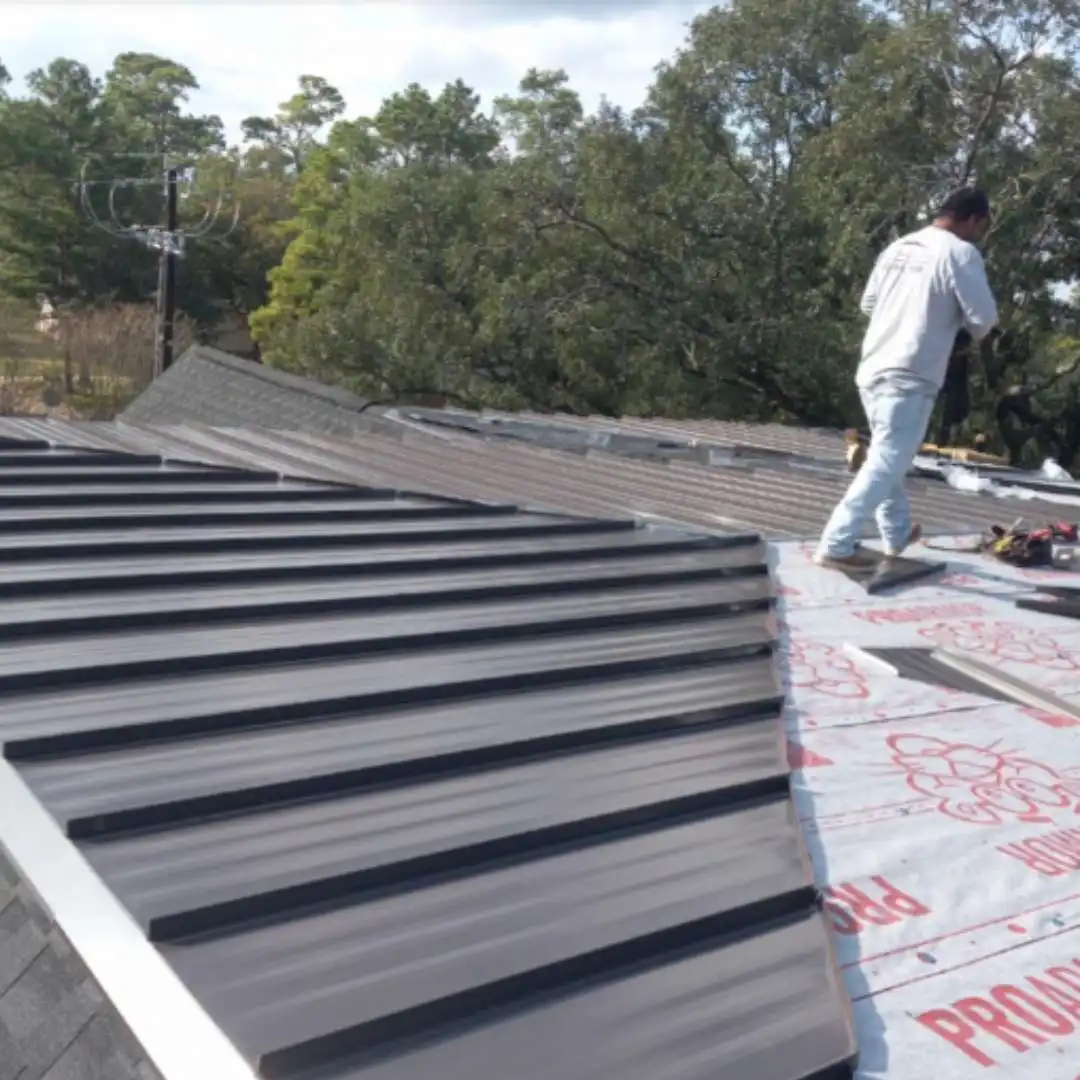
✔ Sub-purlins or hat channel anchored through the existing panel into the structural purlins below, not into the old sheeting
✔ Unfaced insulation laid into the cavity the framing creates, thickening the thermal envelope without touching the ceiling
✔ A new standing seam panel with concealed clips, so nothing penetrates the weather surface

The framing is what makes a recover system structural rather than cosmetic. Loads pass through the sub-purlin into the original purlin line, which means the corroded panel below is carrying nothing. That is also why the assessment matters more than the panel selection: we gauge remaining steel thickness and verify purlin spacing before any material is ordered. Where the existing roof is a low-slope membrane rather than metal, a metal roof retrofit can also introduce positive slope to drain water that has been ponding for years.

Wind Uplift Is the Detail Houston Owners Underestimate

A metal roof retrofit has to be engineered for the uplift pressure at this address, not the pressure at a generic one, and corners and perimeters carry the highest loads on the roof.

✅ Clip spacing tightened at perimeters and corners, where uplift pressure runs highest during a Gulf storm
✅ Attachment calculated against the wind loads that International Code Council model codes apply to coastal-influenced sites
✅ Existing curbs, HVAC stands, and ventilation components re-flashed to the new plane rather than reused in place

Houston sits close enough to the coast that hurricane-force gusts are a design condition, not an outlier, and NOAA’s local forecast office tracks those events every season. A panel that performs well in the field can still peel at a corner if the clip layout was copied from a flat inland job.

Does a Metal Roof Retrofit Lower a Houston Cooling Bill?

Where the Energy Savings Actually Come From

✔ Reflectivity: a light, factory-finished panel sheds solar gain that a faded roof absorbs and pushes into the building
✔ Insulation: the sub-purlin cavity accepts new insulation that the original roof never had room for
✔ Air movement: an above-sheathing gap lets heat leave the assembly instead of soaking into the deck

Cooling season here runs most of the year, so the reflective surface is doing work in March and October, not only in August. The U.S. Department of Energy and the ENERGY STAR roof products program both document how surface reflectance changes rooftop temperature, and the EPA covers the same effect at neighborhood scale. Pairing the panel with upgraded roof insulation is what turns a reflective surface into a measurable difference on the utility bill.
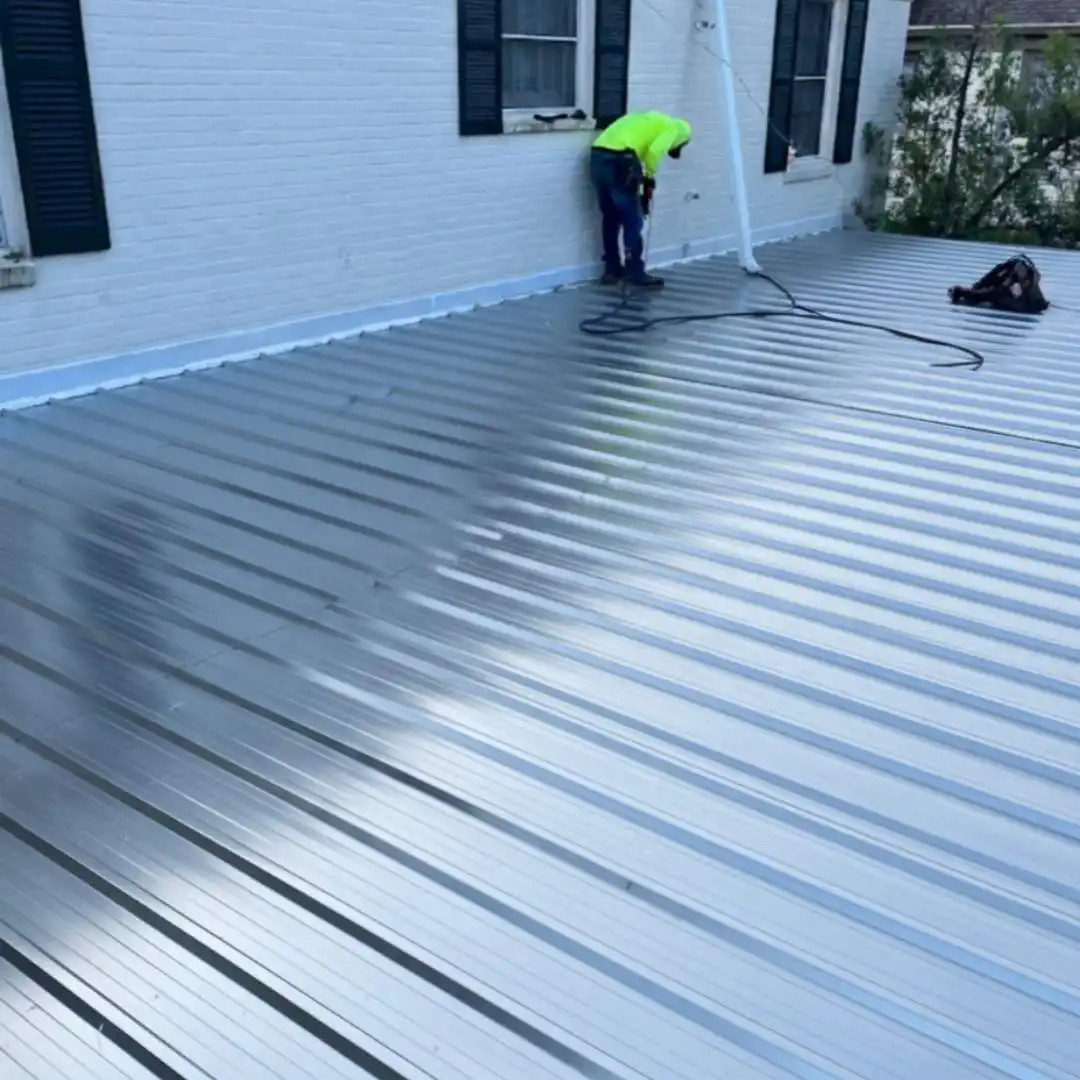
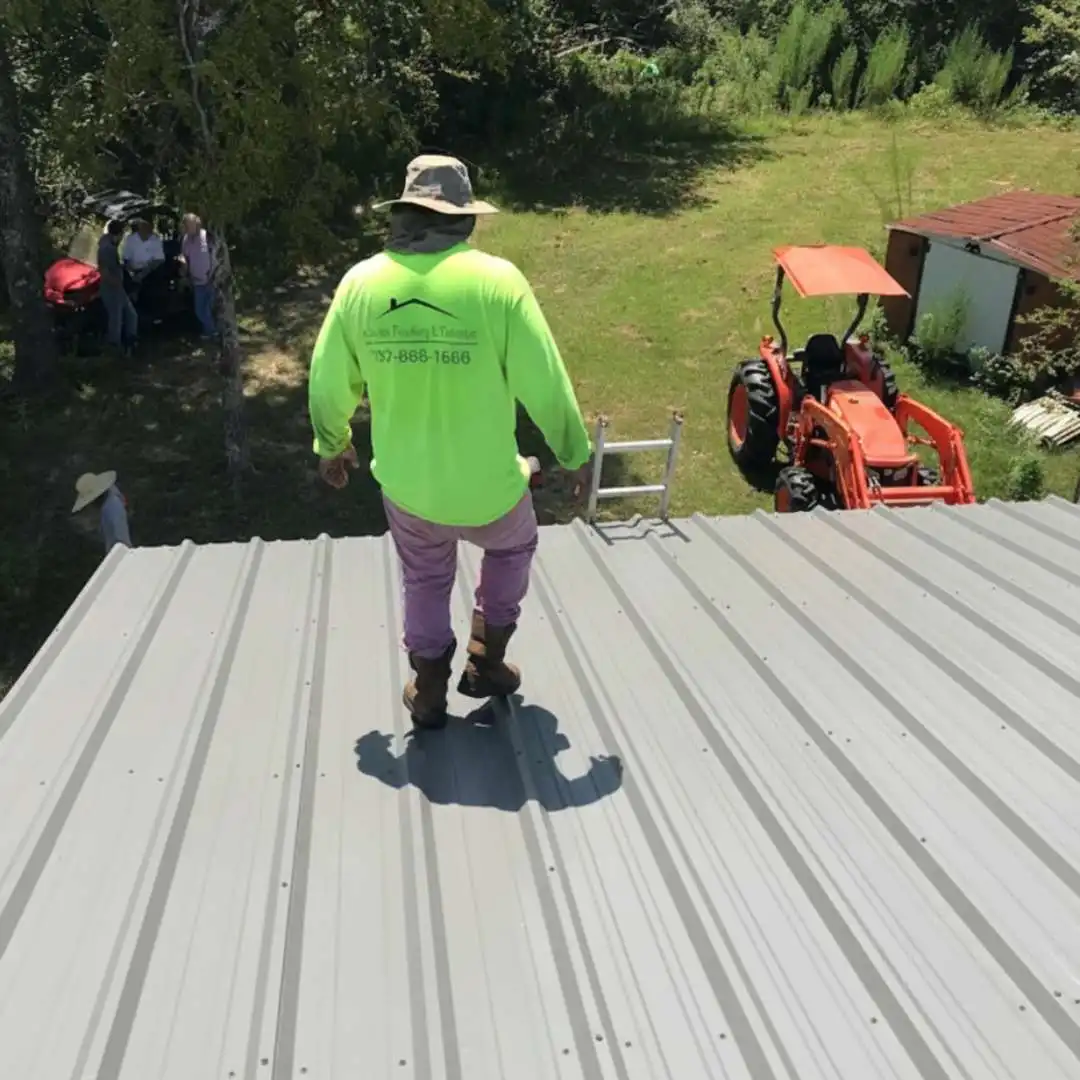
This image shows the team completing a R-Panel Metal Roofing project, ready to withstand Texas weather.

Common Questions About: Metal Roof Retrofit & Recover Systems

What is a metal roof retrofit, and how is it different from a roof replacement?

A retrofit leaves the existing roof in place and builds a new metal roof above it on sub-purlin framing. A replacement removes everything down to the deck first. The practical difference in Houston is exposure: a tear-off opens the building to whatever the sky does that afternoon, while a retrofit keeps a weather surface overhead the entire time. Retrofits also avoid landfill disposal of the old panels and let occupants keep working underneath.

Can a new metal roof really be installed over an existing metal roof?

Yes, and metal-over-metal is the most common recover we do here. The old panel becomes a substrate rather than a load-bearing element once sub-purlins transfer weight into the original purlin line. What disqualifies a roof is not surface rust but structural loss — perforated panels over rotted or deflecting purlins, or a deck that no longer holds a fastener. We gauge the steel and probe the framing before committing to a recover scope.

Will my building’s structure carry the extra weight?

Usually, because the added assembly is light — framing, insulation, and a new panel typically add roughly one to three pounds per square foot, which is far less than a tile or built-up system. The relevant question is not total weight but where it lands. Loads must be routed into purlins and structural members, not into old sheeting. On older Houston warehouse and light-industrial frames, we verify purlin gauge and spacing during the assessment and bring in structural review when the numbers are close.

How do sub-purlins and hat channel actually work?

Sub-purlins are light-gauge members run perpendicular to the existing ribs and fastened through the old panel into the purlins underneath. Hat channel does the same job with a different profile. Either way, the framing creates a level plane above an irregular surface and opens a cavity for insulation. New panel clips attach to that framing, so nothing structural depends on the corroded roof below it.

Why do fasteners back out on Houston metal roofs so often?

Thermal cycling. Panel surfaces here can climb well past ambient on a summer afternoon and drop sharply after sunset, and that expansion and contraction repeats daily for most of the year. Exposed fasteners resist that movement until the hole elongates and the neoprene washer flattens. A concealed-clip standing seam panel is designed to float with thermal movement instead of fighting it, which is why retrofits usually specify one.

Does a retrofit meet current wind uplift requirements?

It has to, and that is a design step rather than an assumption. Attachment is calculated for the uplift pressures at the building’s own address and exposure, with tighter clip spacing at perimeters and corners where pressures peak. Because Houston sits within reach of Gulf storm systems, uplift governs the fastening layout on nearly every retrofit we design. Ask any contractor for the attachment calculation, not just a panel brochure.

How does a retrofit handle condensation in Houston humidity?

Condensation forms when humid interior air reaches a cold panel underside, and it is one of the most misdiagnosed roof problems in this climate. A metal roof retrofit addresses it by adding insulation in the new cavity so the underside of the panel never drops to dew point, and by ventilating the assembly where the design allows. Patching a roof that is actually sweating solves nothing — the water was never coming from above.

Can insulation be added during the retrofit?

That is one of the main reasons to choose a metal roof retrofit over a repair. The framing cavity accepts unfaced insulation that the original roof had no room for, and the work happens entirely from above, so ceilings, lighting, and interior finishes are never opened. For buildings that were built with minimal roof insulation, the thermal upgrade is often worth more over time than the new panel itself.

How long does a metal roof retrofit take?

Most projects run in phased sections rather than opening the whole roof at once. A small building may take under a week; larger low-slope structures run several weeks depending on framing complexity, curb count, and how much rooftop equipment has to be re-flashed. Because the existing roof stays intact until the new plane is above it, the building generally stays open and operating throughout.

What time of year is best to schedule this work in Houston?

Framing and panel work tolerate weather better than coating or membrane work, so the season is less restrictive than it is for a roof coating. Still, scheduling ahead of peak Gulf storm months gives the crew stable dry windows for detail work at curbs and penetrations. Booking the assessment months before the intended start also leaves room for material lead times on custom panel lengths.

What does a metal roof retrofit cost, and is financing available?

A documented roof assessment starts at $150, and commercial roof projects at Achilles Roofing & Exterior start at $20,000, with the final figure driven by square footage, framing complexity, insulation depth, and how much rooftop equipment needs re-flashing. Because a metal roof retrofit skips tear-off, disposal, and interior protection, it usually lands below a comparable full replacement. GreenSky financing is available for qualified owners.

How do I know if the roof is too far gone for a recover system?

Three findings usually rule out a metal roof retrofit: widespread perforation through the panel field rather than at laps, purlins or decking that have lost enough section to hold a fastener, and trapped saturation in the existing insulation across large areas. A drone survey paired with core sampling settles it quickly. If the roof does not qualify, metal roof replacement is the honest recommendation, and we say so.

General Company & Process FAQs

About Achilles Roofing & Exteriors

  • Are you a licensed and insured local roofing company?

    Yes. Achilles Roofing is fully licensed, bonded, and insured in the state of Texas. We are a locally owned and operated company based in Houston, proudly serving homeowners across Houston and all surrounding areas. Our commitment is to our community, and we stand by the quality and safety of every project we undertake.

  • Can I see examples of your past work or speak to previous clients?

    Absolutely. We are proud of our work and have an extensive portfolio of before-and-after project galleries. We are also happy to connect with previous clients in the Houston area who can speak to their experience with our team

  • What makes Achilles Roofing different from other Houston roofers?

    We’re roofers, not just salesman. Our reputation is built on honest work, transparent communication, and treating every Houston family we work with like our own. We focus on providing the right solution for your home and budget, backed by robust warranties and a commitment to exceptional craftmanship.

  • Do you use subcontractors for your roofing projects?

    No. We believe in accountability and consistency quality, which is why your roof is installed by our own trained, in-house Achilles Roofing crews. We don’t outsource our work, ensuring that every project meets our high standards from start to finish.

  • How long have you been in business?

    Our leadership team has decades of combined experience in the Texas roofing and storm restoration industry. As a company, we have succesfully completed hundreds of roof replacement and repairs in Houston neighborhoods, building a strong reputation for quality and reliability.

Pricing, Estimates & Financing

  • What’s your emergency tarp fee?

    $300 minimum for a 5×5 area, covering emergency leak protection until permanent repairs begin.

  • Do you replace skylights?

    Yes. Velux skylight replacement is $2,000, double dome is $1,500, and labor/installation-only is $600. All skylight work carries a 5-year labor warranty.

  • How much does shingle roofing cost per square?

    GAF HDZ runs $127.50/square, GAF NS is $109/square, and OC Duration is $127/square. Pricing varies by roof size and complexity — call (832) 888-1666 for a free estimate.

  • What roofing packages does Achilles Roofing offer?

    Three tiers: Good (Builder Grade shingles, 2-year labor warranty, no material warranty), Better (GAF NS shingles, 5-year labor warranty, manufacturer material warranty), and Best (GAF UHDZ shingles, 10-year labor warranty, enhanced manufacturer warranty). Call (832) 888-1666 to find the right fit for your budget.

  • How much does a new roof cost in Houston?

    The cost of a new roof is a significant investment, and the final price depends on several factors, including the size, pitch (steepness), and complexity of your roof, as well as the specific materials you choose. 

    While every home is unique, we want to provide some general price ranges for a typical 1,500 sq. ft. home in the Houston area to help you budget:

    • Architectural Shingles (Most Popular): $5,500 – $8,500
    • Impact-Resistant/ Designer Shingles: $9,000 – $14,000+
    • Standing Seam Metal Roof: $15,000 – $25,000+

    For a More Accurate Quote: Get Your Instant Estimate Now

    These are ballpark estimates for planning purposes only. The best way to get a precise and instant quote for your specific property is to use our free instant estimator tool. It uses advanced satelite imagery to measure your roof and provide a detailed, accurate estimate for your replacement and installation.

  • Do you offer financing options?

    Yes, we make it easy to get the roof you need now with the affordable and flexible financing. We have partnered with Greensky® Financing, a leader in home improvement loans, to offer our customers excellent payment options. Through this partnership, qualified homeowners can get a brand-new roof with $0 Down and low monthly payments, starting at just $199/month.

    This program allows you to protect your home immediately without the stress of a large upfront payment. You can learn more about the benefits and get pre-qualified in minutes on our financing page.

    Learn More About Greensky® Financing.

  • What is included in your roofing estimate?

    We believe in 100% transparency. Every written estimate from Achilles Roofing includes a detailed breakdown of all costs, including materials, labor, tear-off and disposal of the old roof, and thorough site cleanup, You will also receive clear start and completion timelines, payment schedules, and full warranty details. There are no hidden fees.

The Roofing Process

  • How will you communicate with me during the project?

    We believe in constant communication. You will be assigned a dedicated project manager who will be your single point of contact. They will provide daily updates, including photos and progress reports, and are always available to answer your questions via phone call or text.

  • How do you protect my home and property during the installation?

    Your property’s protection is a top priority. Our crews use heavy-duty tarps and protective boards to cover your landscaping, windows, AC units, and driveway. We conduct a thorough cleanup at the end of each day and use magnet sweeps to collect any stray nails or metal debris, leaving your property spotless.

  • Do you handle city permits and inspections?

    Yes, we manage the entire process for you. This includes pulling all necessary permits with the City of Houston or your local jurisdiction and scheduling the final inspection upon completion. We ensure your new roof is fully complaint with all local building codes and manufacturer standards.

Materials & Warranty

  • Do you install attic or roof vents?

    Yes — we install Attic Breeze and Remington Solar vent systems for improved attic ventilation and energy efficiency.

  • What shingle colors are available?

    Builder Grade comes in Brown, Gray, or Black. GAF shingles offer Slate, Weathered Wood, Charcoal, Barkwood, Mission Brown, Hickory, and Pewter Grey.

  • Why do different roofing options have different prices and warranties?

    Your roof is a complete system, and the materials you choose play the biggest role in it’s long-term performance, durability, and the level of protection you receive. We offer several options to ensure we can provide the perfect solution for every home and budget.

    • Standard Achitectural Shingles offer excellent value and protection, backed by our 5-year workmanship warranty and solid manufacturer warranties. 
    • Premium GAF System often include impact-resistant technology and come with enhanced, non-prorated warranty coverage for the ultimate peace of mind.

    During your free assessment, our team will walk you through the specific benefits of each option, helping you choose the right balance of performance, longevity, and price for your situation.

  • What are the best roofing materials for the Houston climate?

    Houston’s unique combination of intense sun, high humidity, and severe storms demands durable and well-ventilated roofing systems. We typically recommend:

    • Impact-Resistant Shingles: These are designed to withstand hail and high winds, which can often lead to insurance discounts. 
    • “Cool Roof” Shingles: These reflective shingles can lower your roof’s temperature, reducing your energy bills during hot Texas summers.
    • Proper Attic Ventilation: This is critical in our humid climate to prevent moisture buildup and extend the life of your entire roofing system. We always ensure your ventilation is up to code.
  • What kind of warranties do you offer?

    We provide a powerful, dual-layer warranty system to give you complete peace of mind. Your new roof is protected by two separate warranties: one for the installation quality (our workmanship) and one for the materials themselves.

    1. Our 5-Year Workmanship Warranty: This is our direct promise to you. For a full five years after your installation, we cover any issues related to the quality of our work. If there’s a problem caused by our installation, we will fix it, no questions asked. This guarantees the quality and skill of our certified crews.
    2. The GAF Manufacturer’s Warranty: As GAF Certified roofers, we are able to offer robust warranties direclty from the manufacturer. This warranty protects you against any defects in the roofing materials themselves. Depending on the GAF System you choose, this can include long-term, non-prorated coverage that provides an exceptional level of protection for your investment.

    By combining our workmanship guarantee with a top-tier manufacturer’s warranty, we ensure that every aspect of your new roof is covered for years to come.

Find Out Whether Your Houston Roof Qualifies for a Recover System — Before the Next Storm Season.