














Copper Metal Roofing Services.
Houston’s specialist in Copper Metal Roofing. Zero-Rust Guarantees. Humidity-Accelerated Defense. Gulf-Storm Armor. When looking for copper metal roofing in Houston, you need an installer who understands thermal expansion.
Free Replacement Estimate. No credit card required.
Featured Partners and Achievements


Copper is the only roofing metal that develops its own corrosion shield — no paint, no coating, no re-treatment. In Houston’s coastal humidity, that patina forms faster than in arid climates, reaching the protective blue-green verdigris stage within 8–15 years. Achilles Roofing & Exterior installs standing seam copper, flat-lock panels, and custom architectural details with on-site fabrication and a 5-year workmanship warranty. Call (832) 346-8021.
We Specialize in:
TILE ROOFING
TILE ROOFING
COMMERCIAL SERVICES
OUTDOOR LIVING
COMMERCIAL SERVICES
METAL ROOFING
The Pinnacle of Copper Metal Roofing
Prestige That Outlives the Mortgage.
Copper metal roofing is the only roofing material that becomes more protective over time without any intervention. Through natural oxidation, exposed copper forms cupric oxide (the brown-black intermediate stage) and eventually cupric carbonate — the blue-green verdigris that functions as a corrosion barrier. No paint. No coating. No re-application. The patina is the protection.
Standard contractor-grade roofing materials are specified in 16 oz copper (approximately 0.021″ thickness) for most residential applications. Architectural projects with higher foot traffic, heavier snow loads, or greater spanning requirements specify 20 oz copper. At Achilles Roofing & Exterior, Ahmad Faiz reviews gauge requirements on every project before fabrication begins — under-gauging copper causes oil-canning (visible surface waviness) that is nearly impossible to correct after installation.
One critical factor most Houston homeowners overlook: copper cannot make direct contact with aluminum, galvanized steel, or untreated wood without causing accelerated galvanic corrosion. Proper isolation — using lead-coated copper flashing at transitions, EPDM isolation tape at fasteners, and neoprene-backed clips — is non-negotiable for longevity. We include isolation detailing in every copper installation scope.
Why Homeowners Choose Copper Metal Roofing
-
Increased Natural Light & Brighter Interiors
Develops its own corrosion shield — no coatings, no re-treatment, ever. -
200+ Year Proven Service Life
Historic copper metal roofs across the U.S. remain structurally sound after two centuries with proper installation. -
Highly Malleable for Complex Geometry
Bends, folds, and wraps around dormers, turrets, and custom rooflines that defeat rigid materials. -
Class A Fire & High Wind Resistance
Metal roofing's highest fire rating and resistance to wind uplift common in Houston tropical systems. -
Lightweight vs. Tile or Slate
At 1–1.5 lbs per sq ft, copper adds negligible load vs. concrete tile (8–12 lbs) — no structural modifications needed.
The Living Surface
Houston's Humidity Works for You.
This isn't cosmetic deterioration. Each stage of the patina is more protective than the last. By the time a Houston copper metal roofing reaches full verdigris, it has formed a dense mineral barrier that repels moisture, resists UV, and will not corrode further under any conditions the Gulf Coast produces.
75%
Avg. Houston Summer Humidity
8–15
Years to Full Verdigris, Gulf Coas
200+
Year Proven Service Life
16–20 oz
Gauge Specs for Houston Installs
Stage 1: Bright Penny (Day 0 – Month 6)
Fresh copper metal roofing arrives with a warm, lustrous orange-red finish. No surface treatment applied. Natural brightness will begin fading as surface oxide forms within weeks of first rainfall.
Stage 2: Dark Brown Oxide (Month 6 – Year 3)
Cupric oxide forms across the surface. Darker, richer tone. Houston’s humidity accelerates this stage vs. dry climates. Some homeowners prefer this deep mahogany finish and seal it at this point — though unsealed copper continues evolving naturally.
Stage 3: Blue-Green Transition (Year 3 – Year 10)
Cupric sulfate and carbonate compounds begin appearing near seams, valleys, and drainage paths first. The distinctive muted teal appears in patches before spreading uniformly across the surface.
Stage 4: Full Verdigris (Year 8–15 in Gulf Coast)
Complete patina coverage — the iconic blue-green that signals full protection. At this stage, the copper surface is inert and self-maintaining. No further treatment or maintenance required under normal conditions.
What Most Installers Miss
Three Ways Houston Copper Metal Roofing Projects Fail Early.
Galvanic Corrosion at Dissimilar Metal Contact
Copper in direct contact with aluminum fascia, galvanized gutters, or steel fasteners creates an electrochemical reaction that destroys both metals. Houston’s humidity speeds this reaction. Proper isolation using EPDM tape, lead-coated copper flashing, and stainless steel or copper-compatible fasteners is essential.
Thermal Expansion Not Accommodated at Panel Clips
Copper expands approximately 1/8 inch per 10 feet of panel length for every 100°F temperature change. Houston’s 140°F+ summer roof surface temperatures (vs. cooled interior) demand floating-clip fastening systems, not fixed screws through the panel face. Fixed fasteners cause buckling, “oil-canning,” and eventually seam failure.
Wrong Underlayment Causing Oil Staining
Standard felt underlayment reacts with copper’s tannins during the early patina process, causing dark oil staining that bleeds through seams and onto fascia boards. Only high-temp, slip-sheet underlayment (typically HDPE or coated polyester) should be used under copper panels — a detail commonly skipped by contractors unfamiliar with copper work.
Runoff Staining Adjacent Surfaces
Copper runoff in the early oxidation phase (months 1–18) carries copper ions that cause blue-green staining on concrete, masonry, and painted wood siding below the roof line. Drip-edge detailing and properly sized gutters prevent runoff from tracking across exterior surfaces. We design drainage paths before installation begins.
Copper Options We Provide
Custom Solutions for Distinctive Properties.
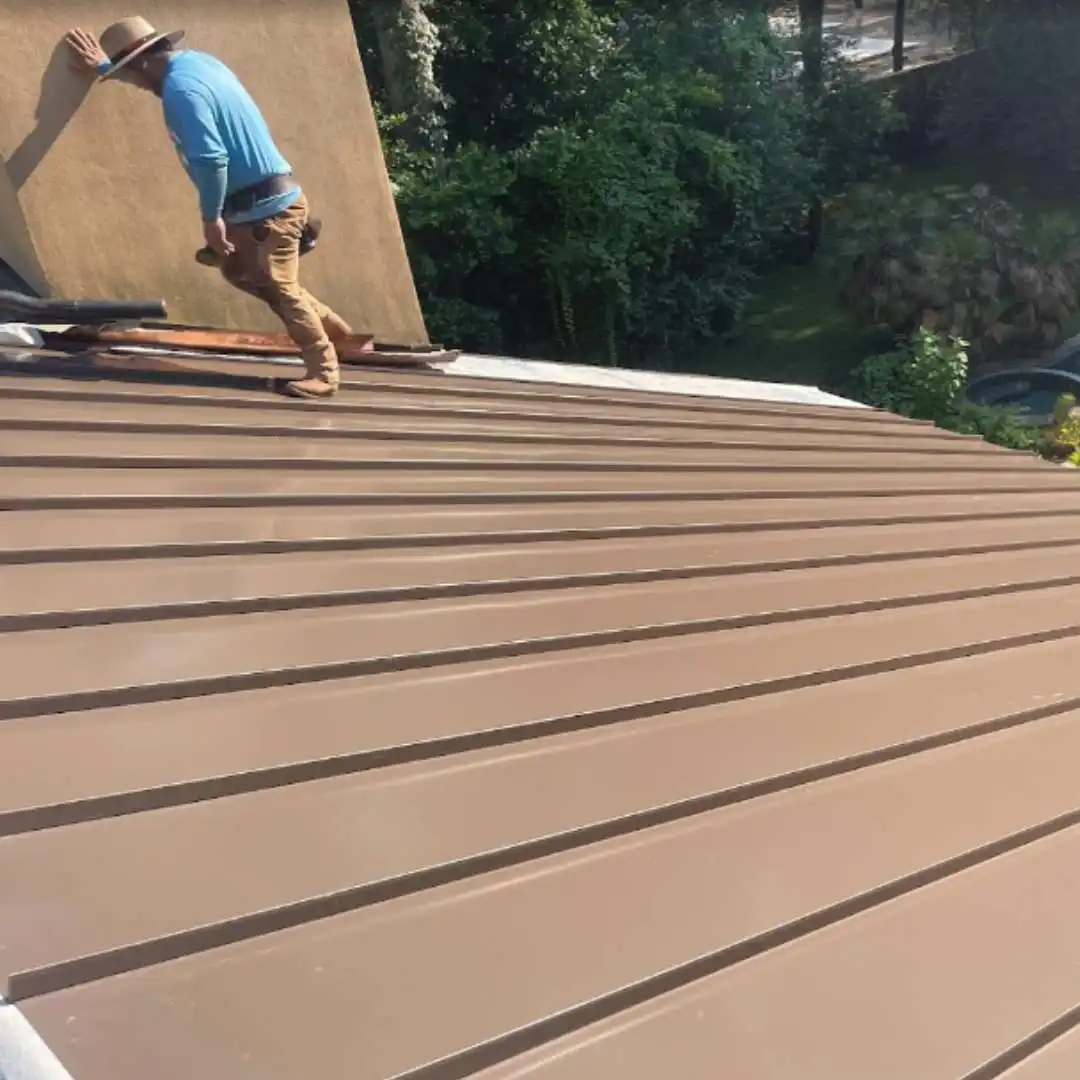
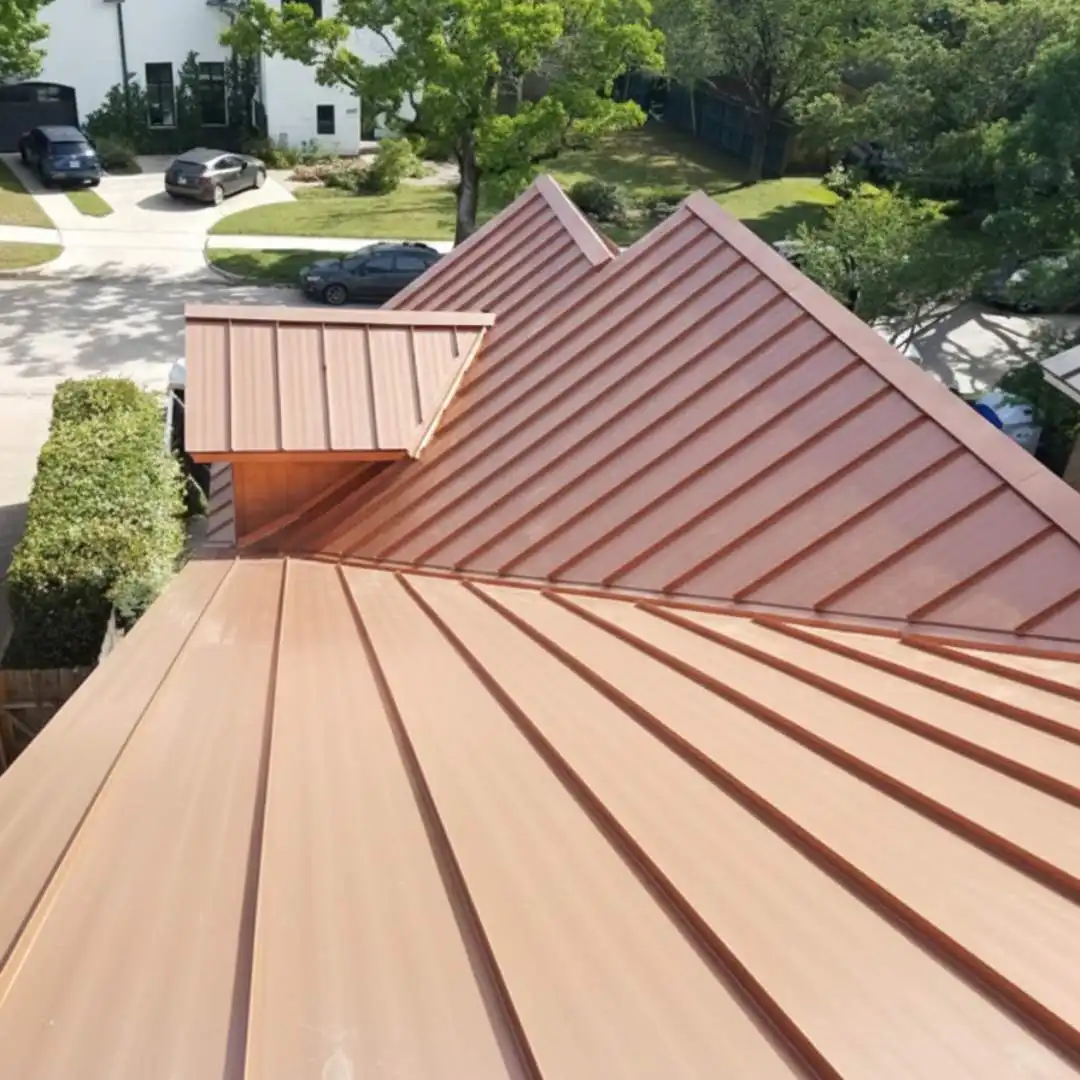
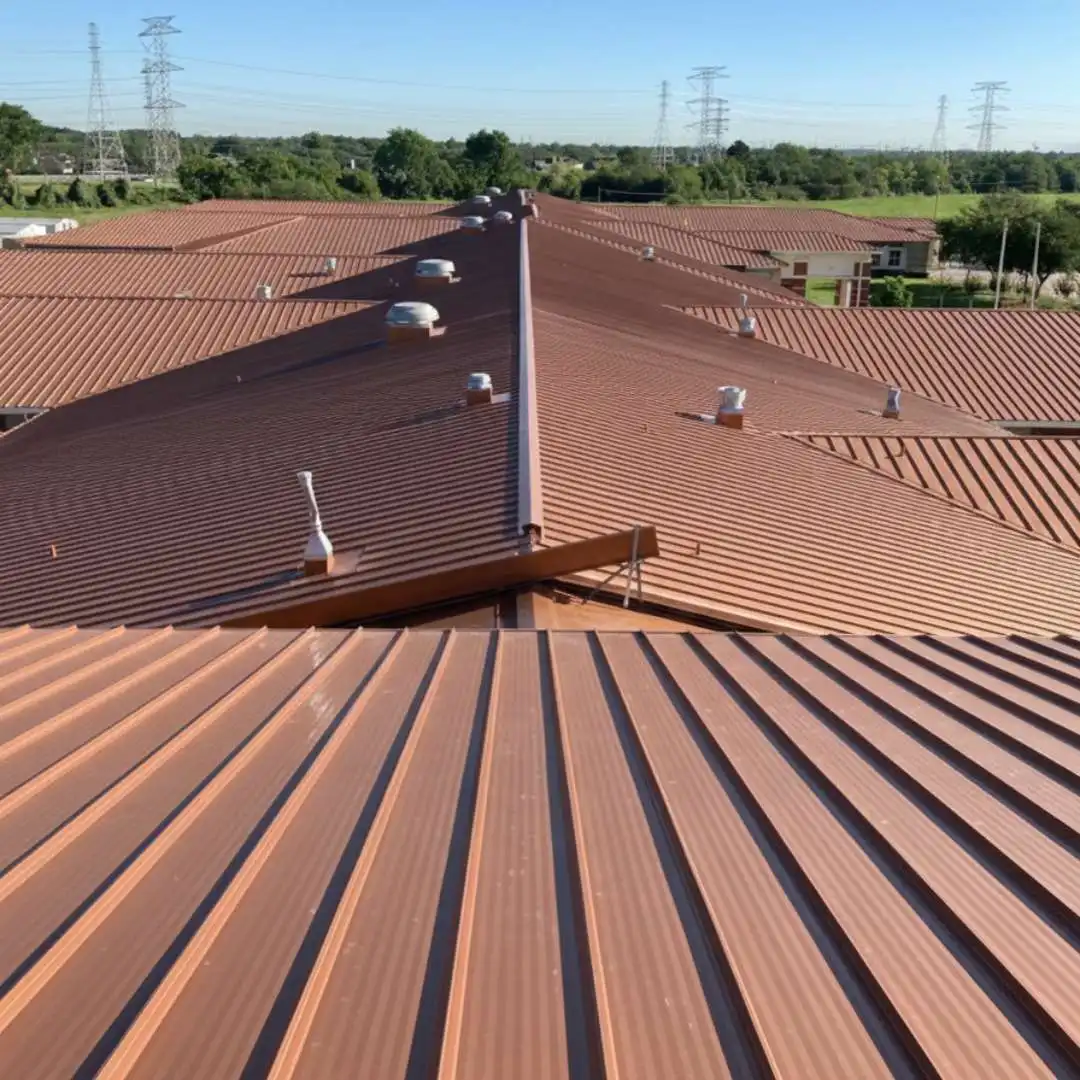
Long, continuous panels with raised mechanically-seamed joints — the gold standard for copper metal roofing waterproofing. Floating clip attachment accommodates thermal expansion. Clean, architectural profile suited to modern and traditional homes alike.
Interlocking flat panels soldered or seamed at all edges. Ideal for low-pitch sections, domes, turrets, and curved geometries where standing seams cannot follow the surface form. Produces a seamless, armor-like finish.
Individual copper tiles with the visual character of traditional shingles and the permanence of metal. Each piece is hand-cut and formed on-site. Particularly effective for dormers, accent sections, and historic restoration work.
Half-round and K-style copper gutters fabricated to match the roof profile and patina age naturally alongside the roof system. Copper gutters properly sized for Houston's 60"+ annual rainfall require larger-than-standard cross-sections.
Architectural copper details hand-fabricated for cupolas, dormer caps, ridge lines, and decorative transitions. These elements define a property's visual identity and cannot be replicated in any other material with the same weathering character.
Used at all transitions where copper meets dissimilar metals or masonry. The lead coating neutralizes galvanic risk and prevents staining of adjacent surfaces. Required at chimney step flashings, parapet cap contacts, and skylight curbs.
Our Proven Installation Process
Precision Craft. No Shortcuts.
All panels are custom-fabricated on-site using brake-forming equipment. We don't stock pre-cut panels for copper work — every dimension is measured, cut, and formed to fit your specific roof geometry.
Full roof geometry survey. For every copper metal roofing project, Ahmad Faiz reviews pitch, span, and architectural details to specify 16 oz vs. 20 oz copper gauge, clip spacing for thermal movement (critical for Houston's 140°F+ summer surface temps), and panel run direction.
HDPE or coated polyester slip-sheet installed over the deck — not standard felt. This prevents oil staining from early-stage copper oxidation and allows the panel system to move thermally without friction-induced buckling at seam points.
All panels cut and formed on-site using brake-forming and folding equipment. Dimensions verified against actual roof measurements — not against plans. Each panel is inspected for uniform gauge thickness before installation begins.
Copper or stainless steel floating clips secured to the deck at calculated intervals. Panels rest in clips and expand freely without fasteners through the panel face. This is the critical difference between a copper roof that lasts 50 years and one that oil-cans in 5.
Raised seams mechanically locked using hand seamers or power seaming tools. All transitions to dissimilar metals receive lead-coated copper flashing and EPDM isolation tape. Galvanic isolation confirmed at every fastener point and material contact.
Valleys, ridge caps, and all penetration flashings hand-finished. Drainage paths verified against roof geometry. Ahmad Faiz conducts the final walkthrough and issues the 5-year workmanship warranty documentation with full photographic record.
Our Proven Installation Process
18 Years. One Observation per Installation.
Material Behavior
Oil-Canning is an Installation Failure, Not a Material Defect
Oil-canning — the visible waviness across flat copper panels — is almost always caused by fixed fasteners that prevent thermal movement, improper gauging on wide spans, or panels cut too tightly at seams. It is not caused by the copper itself. We’ve been called to assess copper roofs installed by general contractors who used standard roofing screws through panel faces — every one showed oil-canning within two Houston summers.
Houston Conditions
Salt-Air Proximity Accelerates the Patina — and Requires Larger Gutters
Properties within 20 miles of Galveston Bay experience mild salt-air exposure that meaningfully accelerates the copper oxidation process — a benefit from an aesthetic standpoint, but one that also increases early-stage runoff volume carrying copper ions. Houston’s 60″+ annual rainfall combined with this accelerated runoff means undersized gutters stain driveways and brick within the first two years. We specify gutter cross-section before installation.
Homeowner Behavior
Homeowners Who Pressure-Wash Copper Strip Years of Patina Development
The most common maintenance mistake we see on Houston copper roofs is pressure washing during the brown-oxide phase — when the homeowner thinks the roof looks “dirty.” High-pressure water strips the patina layer, resetting the oxidation clock. Copper requires no cleaning, no sealing, and no treatment after installation. The only maintenance is keeping debris from obstructing drainage paths.
See Our Work:
Quality Copper Metal Roofing in Action.
Who Does the Work
Experience With Accountability at Every Stage.
Ahmad personally manages every copper metal roofing project consultation and scope development. Copper work is not delegated until he has reviewed gauge specifications, thermal expansion requirements, and all dissimilar metal contacts in the project scope.
Achilles Roofing is a member of the Roofing Contractors Association of Texas (RCAT), Member #208834 — the professional body that sets workmanship, insurance, and continuing education standards for Texas roofing contractors. We carry full liability insurance and are available across Harris County and surrounding areas.
Project Manager & Owner
Ahmad Faiz
Roofing Consultant & Storm Restoration Specialist
18
Years Industry Experience
2017
Company Founded, Houston
RCAT
Member #208834
BBB
A+ Rated Accredited
Achilles Roofing & Exterior
RCAT Member #208834 · Licensed & Insured · Founded 2017 · Houston, TX · Harris County & Surrounding Areas
Invest in Timeless Value.
Secure Your Property Today.
Elevate your home with the unrivaled beauty and resilience of copper metal roofing. Contact Achilles Roofing & Exteriors now for a free consultation and custom fabrication quote.
I would like to post a positive review for Achilles Roofing & Exteriors team. It is second time we are doing minor work on our house and I'm very satisfied with quality of work, dedication and enormous progress on a transformation they made in both times. I do not foresee any roof repairs on my house in future but if you are looking for someone trustworthy, punctual, caring to do your roof work, I would totally trust them.
Achilles Roofing & Exteriors did an exceptional job with our residential roofing project, providing top-notch roof repair services and professional work done at a reasonable cost. Their experienced roofer team handled the quick roofing service with care and attention to detail, ensuring our new roof exceeded our expectations.
We really needed a new roof and we got 5 different quotes from 5 companies and Achilles gave us the best quote by thousands of dollars! Very professional work and service and very flexible to help meet our busy schedules.I would highly recommend this company to anybody who needs roofing services.
Great price · $2,000–4,000
To cool down my attic, I decided to install a solar attic fan. I got proposals from four different vendors and evaluated them based on customer service, experience, implementation, and price. Achilles Roofing & Exteriors, led by Ahmad Faiz, was the standout choice.
Great price · $10,000–12,000
Ahmad is very professional. The process was very simple. Price was affordable and the quality of work is amazing. Thank you for the new replacement and previous rook repairs.
Quick turnaround on some roof repairs we needed for the sale of our home. Everything was documented on the invoice and with photos. Very professional.
Great job on my Atrium cover. Used them before for my roof. Well done and very reasonable.
Who Does the Work
Invest in a Roof That Outlives Everything Around It.
Starting Pricing Reference
Roofing Consultant & Storm Restoration Specialist
- Roof Inspection & Report Starting at $150
- Copper Metal Roofing Accent / Repair Work Starting at $300
- Residential Copper Metal Roofing Starting at $9,000
- Free Estimate $0 · No Obligation
- Workmanship Warranty 5 Years, All Copper Metal Roofing Work
Starting prices shown. Final cost varies by roof complexity, copper gauge, and architectural detail scope. Discounts available for veterans, military, seniors, and persons with disabilities ($150 off replacements).
Copper Metal Roofing FAQs
Specific questions about copper behavior, installation, and Houston climate — not generic contractor answers.
How long does it take for copper metal roofing to turn green in Houston?
In Houston’s Gulf Coast humidity — averaging 75% relative humidity through summer — copper begins developing the dark brown oxide layer within 18–36 months of installation. The full blue-green verdigris stage typically arrives between 8 and 15 years. This is considerably faster than arid climates like Phoenix, where full patina can take 20–30 years. Each stage of the patina is more protective than the last.
Why do some copper metal roofing develop visible waviness (oil-canning) while others don't?
Oil-canning is caused by installation error, not material failure. Copper expands approximately 1/8 inch per 10 feet for every 100°F temperature change. Houston’s 140°F+ summer roof surfaces demand floating-clip fastening systems that allow this movement. Roofs installed with fixed screws through the panel face will buckle and oil-can within 2–3 Houston summers.
Can copper metal roofing be installed next to the aluminum fascia common on Houston homes?
Not without galvanic isolation. Copper in direct contact with aluminum creates an electrochemical reaction that corrodes both metals — accelerated by Houston’s humidity. Houston homes from the 1980s–2000s commonly have aluminum fascia. We use lead-coated copper flashing, EPDM isolation tape, and stainless steel fasteners at all contact points. This is included as standard in every copper installation scope.
Will my copper metal roofing stain the brick or concrete around my house?
During the first 12–24 months, copper runoff carries copper ions that create blue-green staining on masonry, concrete driveways, and painted siding below the roof line. Proper drip-edge design and correctly sized gutters route runoff into downspouts before it contacts adjacent surfaces. We design drainage paths as part of every copper installation — staining is a detailing failure, not an inevitable outcome.
Does a copper roof make interior temperatures hotter in Houston summers?
Bare copper is reflective and actually performs better thermally than dark asphalt shingles under direct sun. As the patina develops, the surface becomes slightly less reflective but the thermal mass of the assembly helps moderate temperature swings. The dominant factor for interior comfort is attic ventilation — a properly ventilated attic under copper performs no worse than under architectural shingles.
Is a copper roof noisy during Houston's heavy thunderstorms?
Standing seam copper over a solid deck with proper underlayment is not meaningfully louder than asphalt shingles during rain. The high-temp slip-sheet underlayment and continuous wood deck below the panels absorb sound. Homeowners who report loud metal roofs typically have exposed fastener metal panels over open purlins — a completely different assembly than standing seam copper over solid sheathing.
Can I mix copper metal roofing with other metals on the same roof?
Copper cannot make direct contact with aluminum, galvanized steel, or standard carbon steel without causing galvanic corrosion at both metals. However, copper works safely alongside lead-coated copper, stainless steel, and terne-coated stainless when properly detailed at transitions. Mixing copper with aluminum gutters on the same drainage system will eventually corrode both — a common problem we encounter during inspections.


