














What does custom sheet metal fabrication actually include on a house?
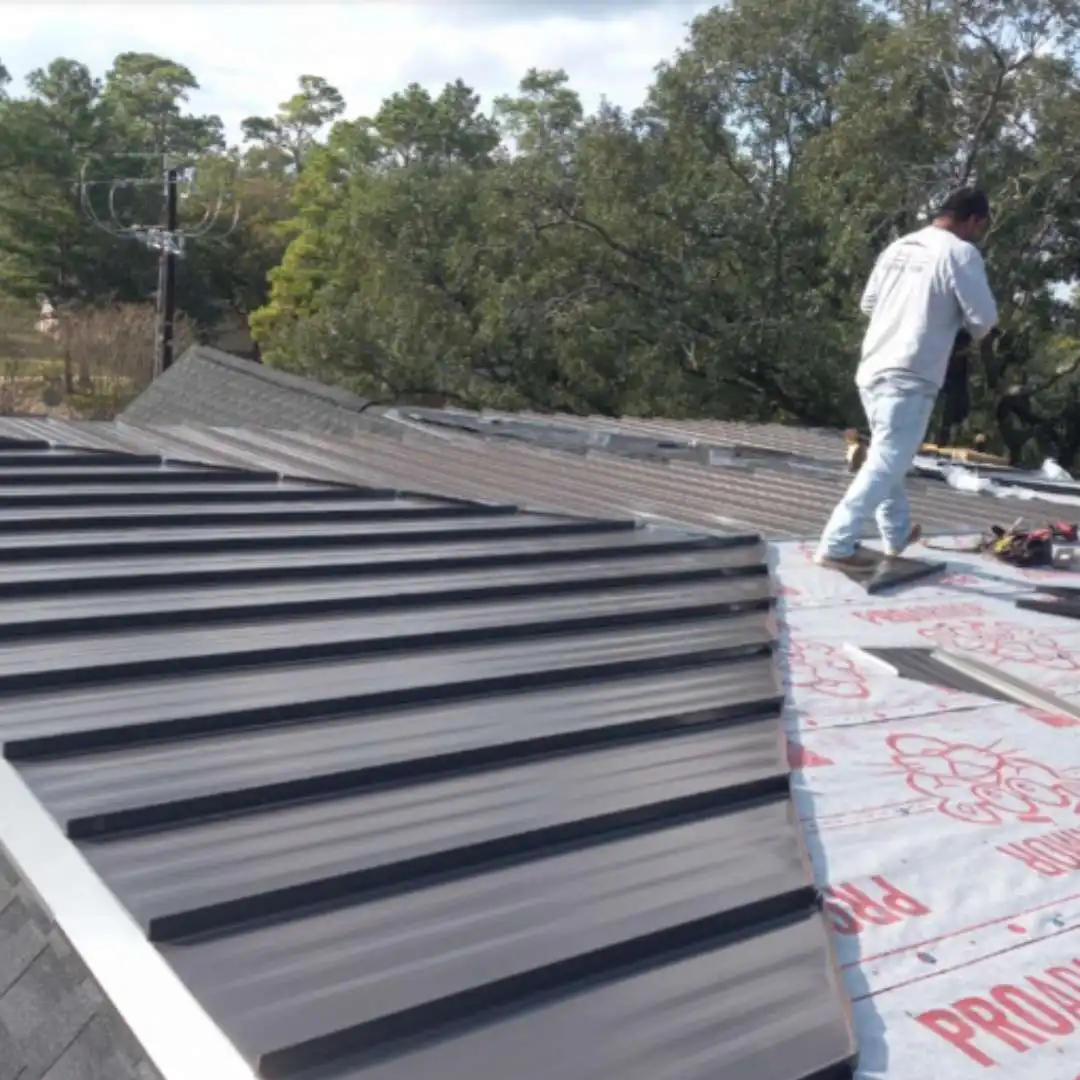
On a residential roof, custom sheet metal fabrication covers the formed metal components that manage water at every interruption in the roof plane: valley pans, step and counter flashing at walls, chimney aprons and crickets, drip edge and gutter apron, equipment curbs, pipe collars, headwall and sidewall transitions, and custom trim at rakes and eaves. Fabrication means these pieces are cut and bent to your roof’s measured dimensions rather than pulled from a stock bin.
Why choose custom sheet metal fabrication over stock flashing from a Houston supply house?
Stock pieces work when the condition matches the catalog: a common pitch, a square corner, a standard wall offset. Many Houston roofs have hip returns, dormer cheeks, added patio tie-ins, and chimneys that fall outside those dimensions. Forcing a stock piece into an odd angle leaves a gap that gets filled with sealant, and sealant becomes the weakest part of the assembly within a few summers.
Which metal holds up best in Houston’s humidity?
Copper and factory-finished Galvalume both perform well here. Copper is essentially immune to the moisture load and develops a stable patina. Galvalume’s aluminum-zinc coating resists cut-edge creep better than plain galvanized, which matters in a climate with long dew periods. Bare mild steel is the poor choice locally; once the coating is scratched, humid air starts working on it quickly.
Does Houston heat make roof metal expand enough to cause problems?
Yes, and poor installation is one of the most common causes of premature flashing failure locally, which is why proper custom sheet metal fabrication accounts for thermal movement. Aluminum expands about 0.0013 inch per foot for every 10°F change, so a 20-foot run can move close to half an inch across a full seasonal swing. Long pieces need expansion joints, slip cleats, or intentional gaps at laps. Pieces fastened rigidly at both ends buckle, then split at the fasteners.
What gauge should flashing be on a residential roof?
For most Houston homes, 26-gauge coated steel is the practical minimum and 24-gauge is the better choice for valleys, long edge runs, and anything walked near during maintenance. Copper is specified by weight rather than gauge, with 16-ounce standard for pans and 20-ounce for larger or more exposed pieces. Thinner material dents during installation and telegraphs every deck irregularity.
Can copper and aluminum touch on the same roof?
They should not. Copper in direct contact with aluminum, galvanized steel, or zinc sets up a galvanic cell, and in Houston’s damp air the less noble metal corrodes measurably faster. Runoff matters too: water shedding off copper onto an aluminum gutter will pit it over time. Where the two must meet, we separate them with a compatible membrane or use stainless fasteners and a non-conductive break.
How long does custom sheet metal fabrication last compared to the shingles around it?
Longer, usually by a wide margin. Architectural shingles on a Houston roof typically give 18 to 25 years in this heat and UV load, while 24-gauge coated steel flashing commonly runs 30 to 40 years and 16-ounce copper well beyond that. That mismatch is the argument for good metal at replacement time: quality flashing installed once can outlive two shingle cycles. See roof replacement for how the two are sequenced.
Do I need a permit in Houston for flashing or metal work?
Scope decides it. Isolated flashing repairs are generally maintenance, while re-roofing, deck replacement, and extensive custom sheet metal fabrication for structural changes fall under permitting. The Houston Permitting Center is the authority for current residential requirements. Regardless of permit status, the flashing provisions in the International Residential Code adopted by the city apply, and the International Code Council publishes those sections.
Is fabricated metal painted on site or finished at the factory?
Factory-finished coil is the durable route. Kynar-class PVDF finishes are applied to the coil before forming and hold color under Houston’s UV load far better than any field-applied paint, which is why we form from pre-finished stock whenever a color is specified. Copper, stainless, and mill-finish Galvalume are left uncoated and allowed to weather. Field painting is reserved for touching up cut edges and small penetrations.
How can I tell whether a leak is a flashing problem or a shingle problem?
Location and timing give it away. Flashing leaks show up at chimneys, walls, valleys, and penetrations, and proper custom sheet metal fabrication is usually required to fix them permanently since they often appear only during wind-driven rain when water is pushed sideways. Shingle-field leaks tend to correlate with visible damage and steady rain. Stains that reappear in the same spot after a patch usually mean the metal underneath is the actual path. Start with roof leak repair to trace it.
Can custom sheet metal fabrication be color-matched to my existing roof?
In most cases yes. Coil comes in a wide standard palette, and we match new flashing to the existing shingle blend or trim color so an isolated repair does not read as a patch from the street. Exact matches to a discontinued finish are not always possible, in which case choosing a deliberate contrasting accent usually looks better than a near-miss. We confirm the selection before anything is formed.
What maintenance does roof sheet metal need in Houston?
Very little, but not none. Check exposed fasteners and sealant joints annually, clear the debris that collects in valleys and behind chimney crickets, and rinse salt-laden and organic buildup off finished surfaces so it does not hold moisture against the coating. Most issues we find are debris dams rather than metal failure. A maintenance plan puts that check on a schedule, and industry guidance from the National Roofing Contractors Association covers inspection intervals in more detail.