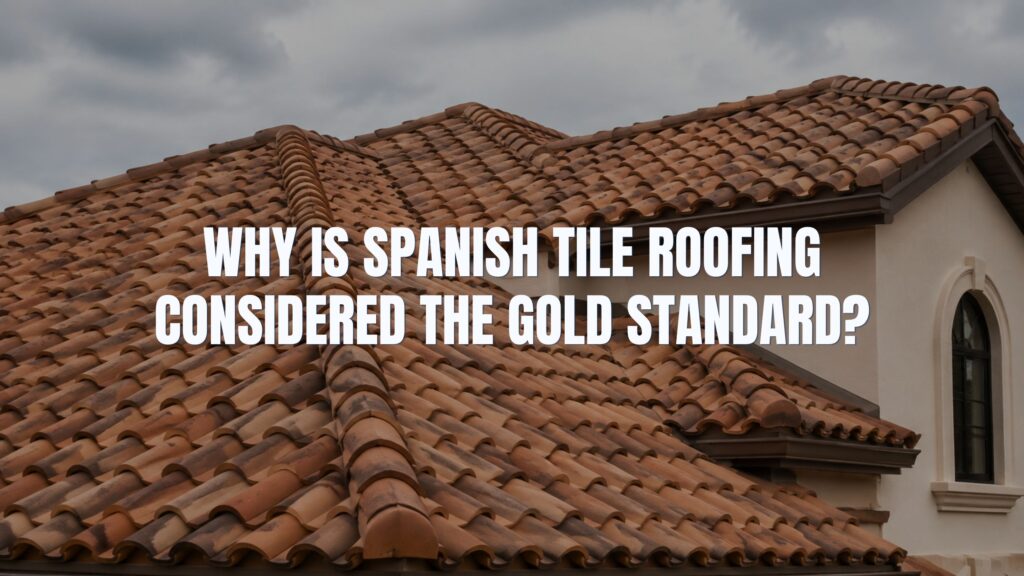
Quick Answer: Why Is Premium Spanish Tile Roofing Considered the Gold Standard?
Spanish tile roofing earns its “gold standard” status because it is the only widely available residential roofing material that simultaneously achieves 100+ year structural longevity, Class 4 hail resistance, passive thermal regulation, and zero VOC off-gassing — without relying on synthetic coatings that degrade in UV exposure. In Houston’s coastal-humid climate, no other material matches it across all four of these dimensions at once.
Houston’s climate is not average — and national roofing guides are not written for it. The Texas A&M University Office of the State Climatologist documents Houston’s annual precipitation average at approximately 49–50 inches per year with relative humidity consistently above 75% for the majority of the calendar year. The city sits within 50 miles of the Gulf Coast salt air corridor. Any roofing material evaluated for Houston must be assessed against all four stressors — extreme heat, sustained humidity, recurring hail, and tropical wind — simultaneously, not in isolation.
Source: Texas A&M University Office of the State Climatologist
What Is Spanish Tile Roofing?
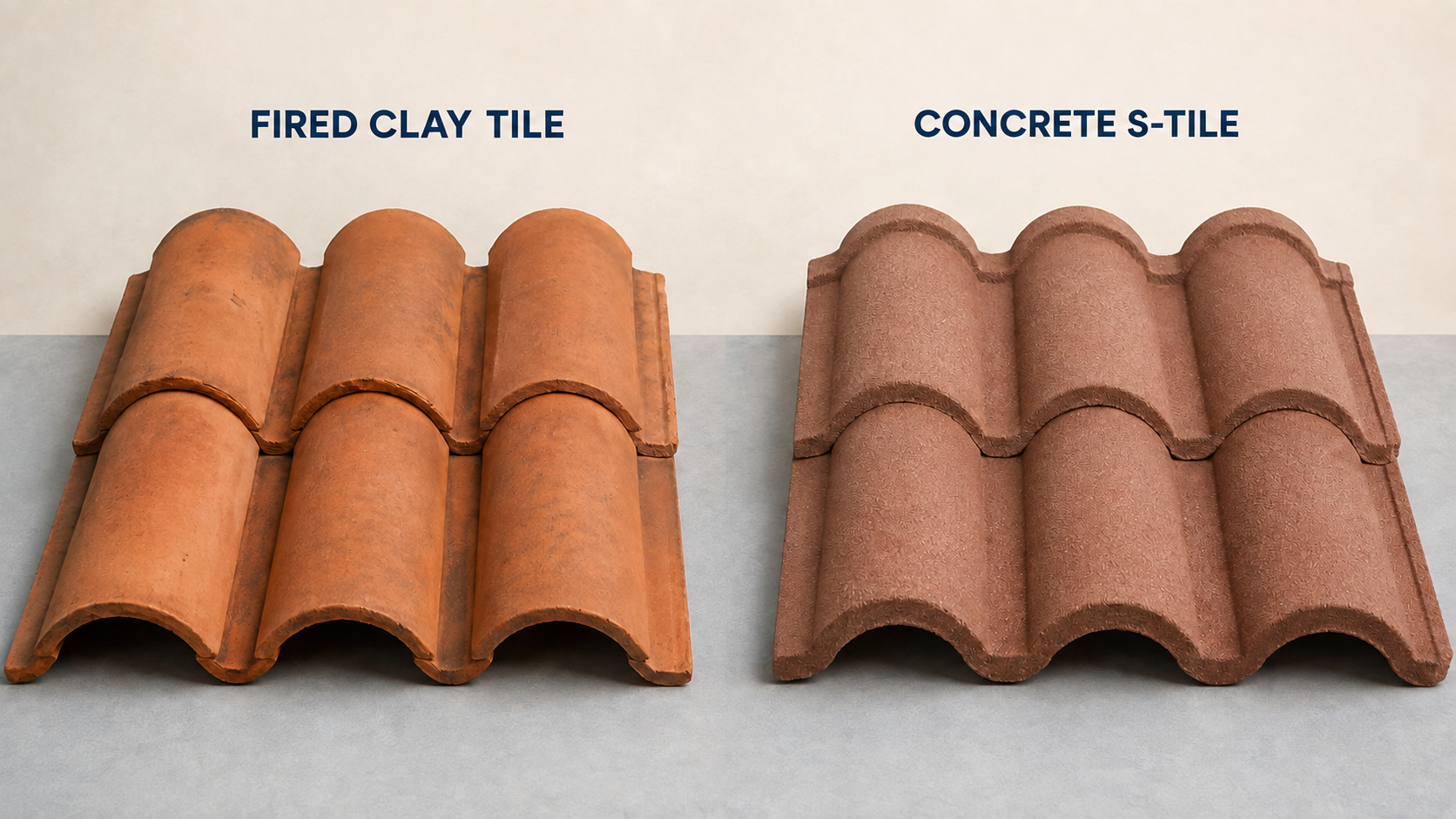
Premium Spanish tile roofing — also called S-tile or mission tile — is a fired clay or concrete roofing system defined by its distinctive curved, barrel-shaped profile. It originated in Mediterranean architecture and has been the dominant premium roofing material across coastal and subtropical climates for over 500 years. The “S” cross-section of each tile creates an interlocking channel system that manages water, airflow, and thermal mass simultaneously.
Two variants dominate the Houston market:
- Fired clay tile — made from natural terracotta clay kiln-fired at temperatures exceeding 2,000°F. Denser, more thermally stable, longer service life. Classified under ASTM C1167, the Standard Specification for Clay Roof Tiles. Typical lifespan: 50–100+ years with no coating degradation.
- Concrete S-tile — Portland cement blend classified under ASTM C1492. Lower upfront cost, heavier per square foot, requires periodic recoating of the pigment layer. Typical lifespan: 30–50 years before major maintenance is required.
This post focuses primarily on fired-clay premium Spanish tile roofing, which Achilles installs for homeowners who prioritize lifetime performance over initial cost minimization.
The Tile Roofing Institute (TRI), the North American trade authority for clay and concrete tile roofing, classifies properly installed fired clay tile as capable of exceeding 100 years of service life when installed over a correctly specified underlayment system — the only residential roofing material category TRI places in this durability tier without qualification.
Source: Tile Roofing Institute (TRI)
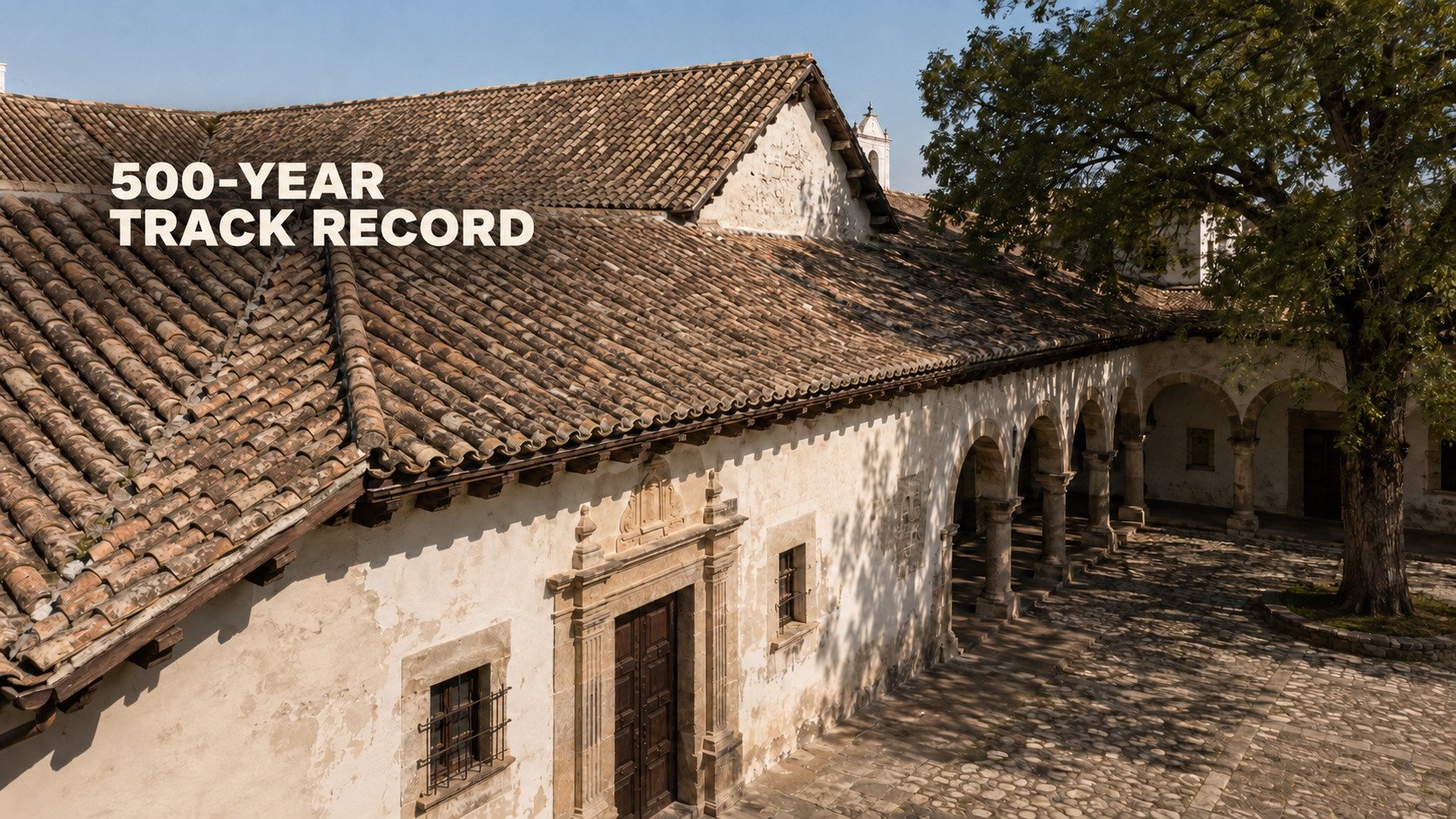
The 500-Year Track Record: Why Spanish Tile Has Dominated Premium Roofing
Premium Spanish tile roofing is not popular because of marketing. It is popular because structures roofed in clay tile from the 16th and 17th centuries are still standing and weathertight today — in Florida, California, Spain, Mexico, and the Caribbean. That is not a claim any synthetic material can make. Longevity at this scale is a function of material chemistry, not maintenance discipline.
The National Trust for Historic Preservation recognizes clay tile roofing as one of the primary heritage materials warranting preservation in historic district guidelines precisely because of its proven multi-century durability record — a designation no asphalt, synthetic, or coated metal product has earned.
The National Trust for Historic Preservation’s Preservation Briefs series specifically identifies clay tile roofing as a historically significant material requiring in-kind replacement rather than substitution in designated historic districts — a recognition of both its architectural authenticity and its demonstrated longevity in real-world exposure conditions spanning multiple centuries.
Source: National Trust for Historic Preservation
Here is what makes fired clay tile categorically different from every other roofing product:
- Inorganic composition. Clay is fired at temperatures exceeding 2,000°F, transforming raw earth into a ceramic matrix. There is no organic material to rot, no binder to degrade, and no coating to peel. UV radiation — Houston’s most consistent long-term stressor — has essentially no effect on fired clay.
- Non-reactive surface chemistry. Unlike metal roofing, clay tile does not expand and contract with temperature cycling in ways that stress fasteners. Unlike asphalt, it does not oxidize or off-gas volatiles under solar heat. Unlike wood shake, it does not support mold or fungal growth in high-humidity environments.
- Passive drainage architecture. The S-profile creates a natural rain channel that directs water away from the roof deck without relying on sealants at lap joints. On flat-profile systems, those lap points are failure zones. On Spanish tile, they are structural features.
In Houston’s context, where every roofing material faces heat, humidity, UV, hail, and salt air simultaneously, this combination of inorganic chemistry and passive drainage architecture is why premium roofing specialists consistently rank Spanish clay tile above every alternative on a 40+ year performance horizon.
How Premium Spanish Tile Roofing Performs Against Houston’s 4 Climate Stressors
Houston’s climate produces four simultaneous roofing stressors that no single national standard addresses together. Premium Spanish tile roofing is the only material that scores positively against all four without requiring supplemental coatings or scheduled replacement within a 40-year window.
Stressor 1: Extreme Heat and UV Load
Premium Spanish tile roofing manages heat through thermal mass — a mechanism that outperforms reflectivity in Houston’s mixed cooling-and-heating climate in ways that most roofing guides fail to address.
Asphalt shingles absorb radiant heat and transfer it directly to the roof deck and attic space. Metal roofing reflects heat but conducts it rapidly at contact points. Premium Spanish tile roofing, by contrast, absorbs daytime solar energy slowly — its thermal mass delays heat transfer into the building envelope by 4 to 8 hours, meaning peak outdoor temperatures translate to interior heat gain during cooler evening hours when HVAC loads are lower.
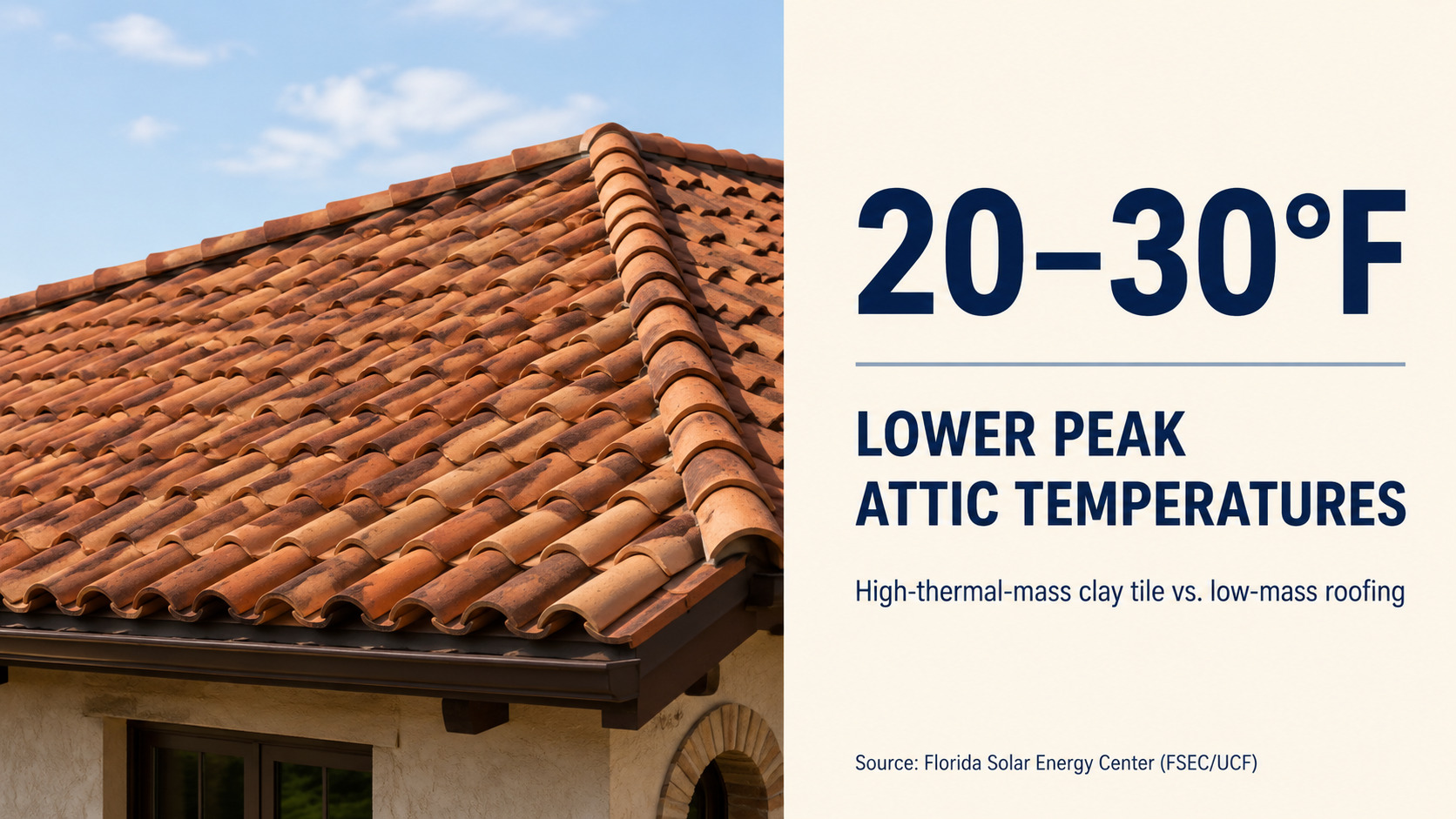
Research from the Florida Solar Energy Center (FSEC) at the University of Central Florida — one of the most rigorous independent bodies studying building envelope thermal performance in hot-humid climates — documents that high-thermal-mass roofing assemblies can reduce peak attic temperatures by 20–30°F compared to low-mass alternatives in subtropical conditions equivalent to Houston’s. This translates to measurable reductions in HVAC runtime during peak summer months without any active system or coating.
Source: Florida Solar Energy Center (FSEC/UCF)
Oak Ridge National Laboratory’s Building Envelope Research program independently corroborates this finding, documenting that clay tile’s thermal capacitance creates a time-lag effect that decouples peak solar gain from peak interior temperature load — a passive energy management mechanism no thin-profile roofing material can replicate.
Oak Ridge National Laboratory’s whole-building energy simulations demonstrate that thermal mass in steep-slope roofing assemblies reduces annual cooling energy use by 8–14% in Climate Zone 2 (which includes Houston) compared to equivalent low-mass roofing systems. No additional coating or active system is required to achieve this reduction.
Source: Oak Ridge National Laboratory (ORNL)
Stressor 2: Sustained Humidity and Salt Air
Fired clay tile is immune to humidity-driven degradation because it contains no organic material and no metal components in the tile body itself. At 75%+ annual relative humidity, organic roofing materials — wood shake, certain composites — are continuously at risk for mold growth and fiber breakdown. Asphalt granules absorb moisture, accelerating granule loss and blistering. Metal roofing requires a protective coating that degrades at breach points under sustained salt air exposure.
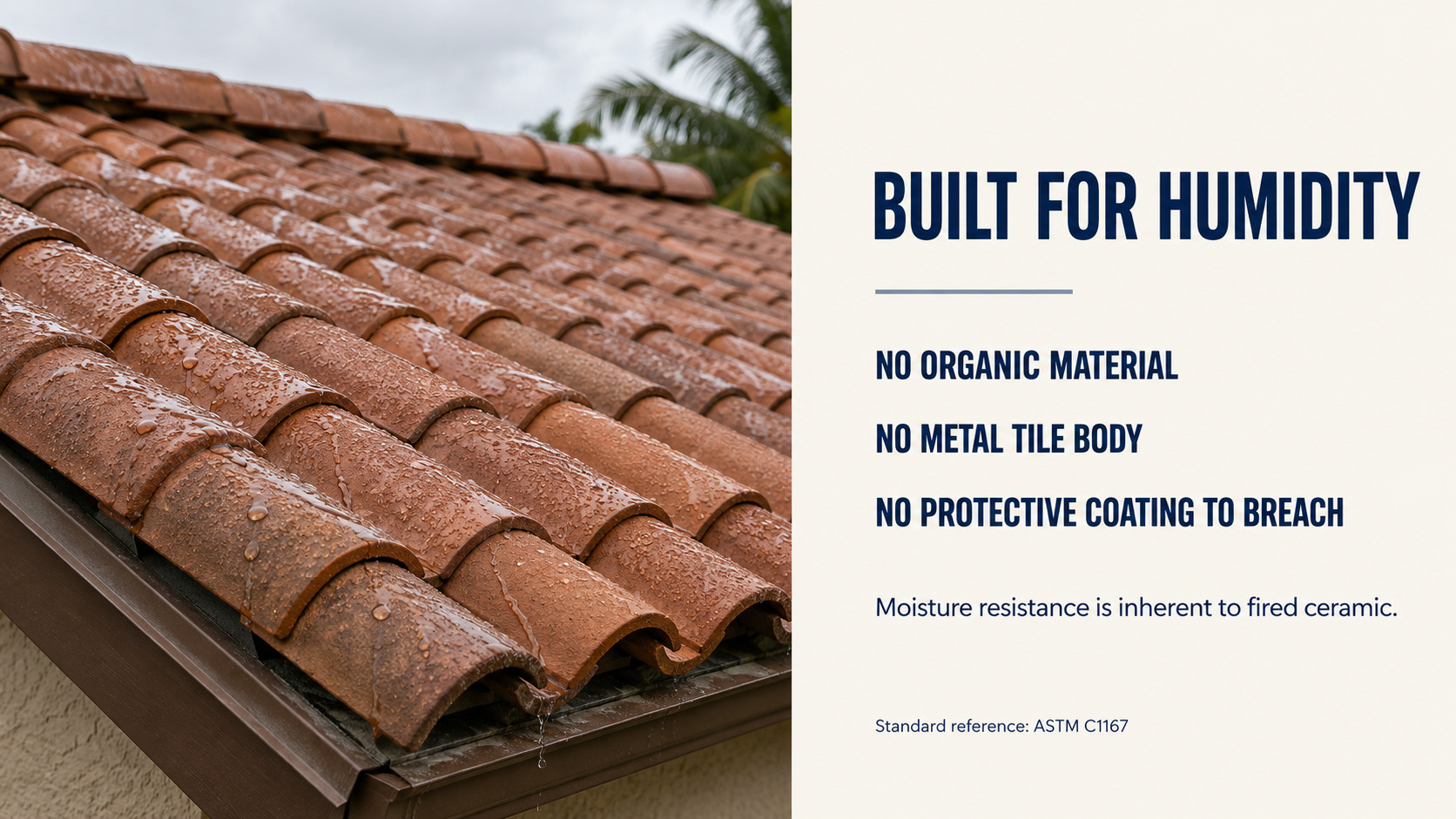
Clay tile has no coating to breach. Its surface chemistry is ceramic — the same material used in industrial applications precisely because of its resistance to moisture, acid, and salt environments. ASTM C1167 requires clay roof tiles to demonstrate zero water absorption at specific test points and zero dimensional change after freeze-thaw cycling, establishing a minimum ceramic density standard that ensures this resistance is not brand-specific — it is material-inherent.
For Houston properties within the 50-mile Gulf Coast salt air corridor specifically, fired clay tile’s corrosion immunity is a defining advantage over every metallic roofing alternative. If you are comparing metal roofing options within that zone, our detailed analysis of Spanish tile roof performance against aluminum and steel covers this in depth.
Stressor 3: Hail — The Houston-Specific Risk
Premium Spanish tile roofing achieves UL 2218 Class 4 impact resistance — the highest rating available — without any supplemental coating or membrane. More importantly, it retains that rating permanently. No other Class 4 roofing product can make that claim.
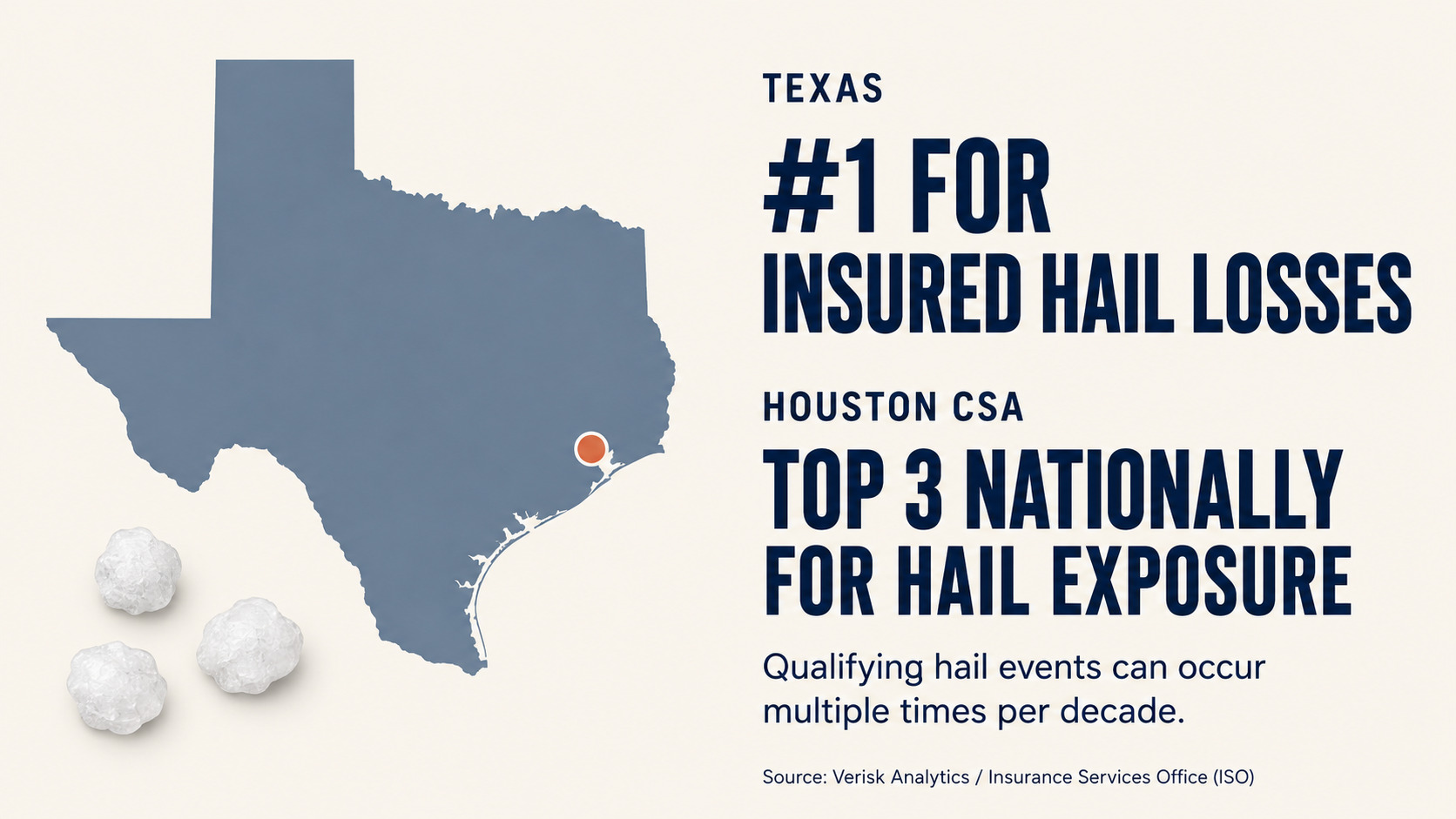
Verisk Analytics’ annual hail report documents Texas as the highest-volume state for insured hail losses in the United States, with the Houston-Galveston-Brazoria Combined Statistical Area (CSA) ranking among the top three most hail-exposed metro areas nationally in frequency-weighted loss data. A Houston homeowner statistically faces a qualifying hail event — one capable of causing functional roof damage — multiple times per decade.
Source: Verisk Analytics / Insurance Services Office (ISO)
A critical nuance: clay tile’s Class 4 rating is inherent to the material’s ceramic body density. Unlike impact-resistant asphalt shingles — which achieve Class 4 ratings through a rubber polymer modifier that degrades under Houston’s UV load over 10–15 years — clay tile’s impact resistance does not diminish over time. A 40-year-old Spanish tile roof carries the same UL 2218 Class 4 rating as a newly installed one.
The National Roofing Contractors Association’s Roofing Manual specifically distinguishes between “inherent” and “treatment-dependent” impact resistance classifications — a distinction that matters enormously in Houston’s recurring hail environment, where the roof must perform at Class 4 level not once, but repeatedly over a multi-decade service life.
The NRCA Roofing Manual notes that clay tile’s impact resistance is a function of its fired ceramic body — a physical property that does not degrade with age, UV exposure, or thermal cycling. This distinguishes it from polymer-modified asphalt products, where the impact-resistant modifier is subject to oxidative degradation under sustained solar exposure.
Source: National Roofing Contractors Association (NRCA)
Stressor 4: Tropical Wind and Hurricane Exposure
Properly installed premium Spanish tile roofing achieves wind ratings of 130–150 mph under FM 4473 testing, meeting or exceeding requirements for Houston’s wind zone without supplemental strapping on most residential pitches.
The key word is “properly installed.” Spanish tile’s wind performance is installation-dependent in ways that asphalt and metal are not. The Florida Building Commission’s High-Velocity Hurricane Zone (HVHZ) standards — the most rigorous residential wind testing protocol in the United States — have extensively validated clay tile wind performance under standardized installation conditions, including specific fastener patterns, underlayment requirements, and hip and ridge attachment methods.
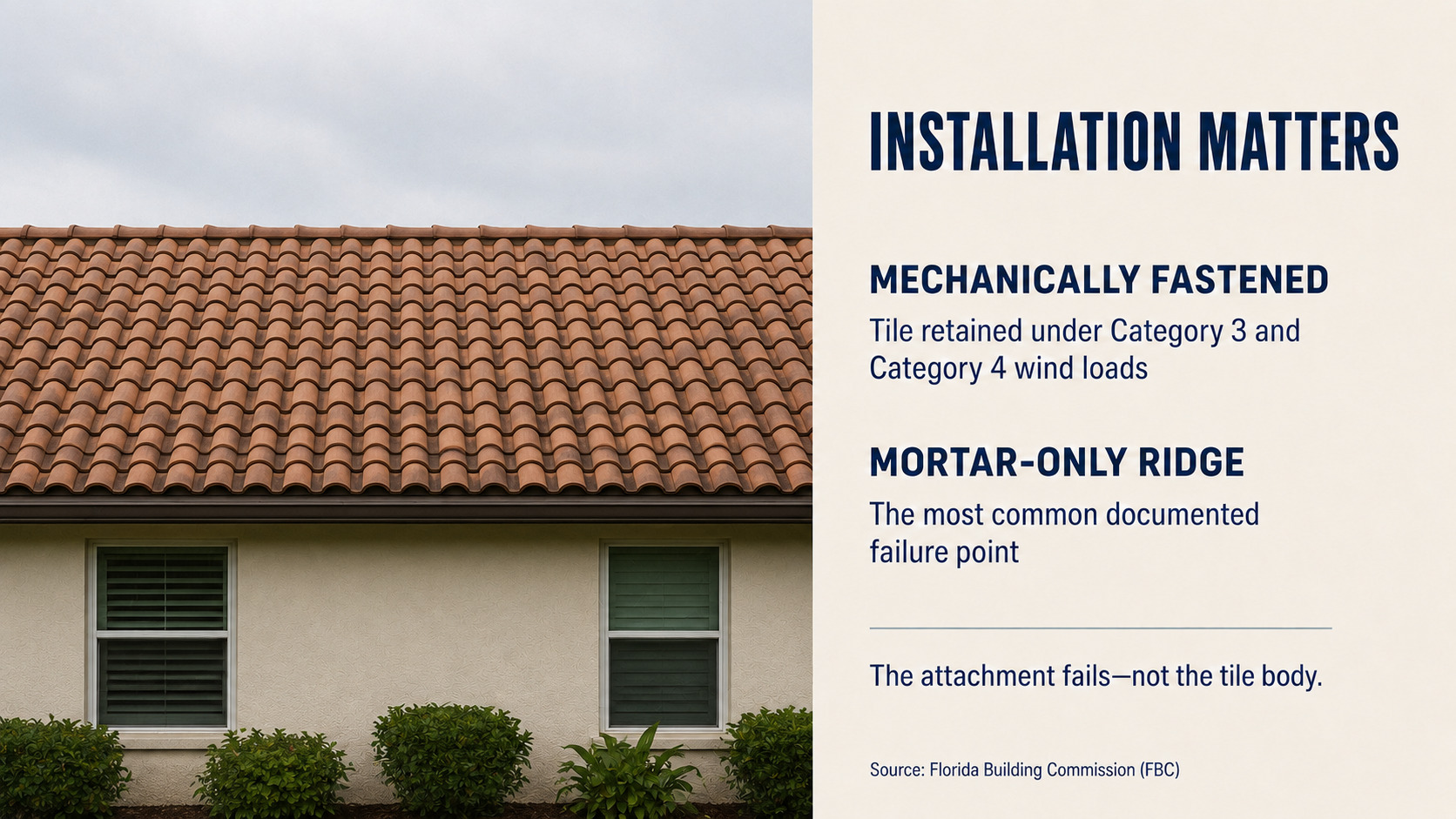
Florida Building Commission HVHZ testing of clay S-tile under simulated Category 3 and Category 4 wind loads consistently demonstrates tile retention when installed per TRI mechanical fastening specifications. Failures documented in post-storm assessments by FBC investigators are attributable to mortar-only hip and ridge installation — not tile body failure — in the overwhelming majority of documented cases.
Source: Florida Building Commission (FBC)
This finding mirrors Achilles Roofing’s own post-storm field assessments in Houston: mortar-only hip and ridge installation by contractors who lack tile-specific certification is the single most common installation defect we identify. It is also the most preventable.
Premium Spanish Tile Roofing vs. Other Premium Roofing Materials — Houston Performance Matrix
This table compares the four premium roofing materials most commonly specified for Houston homes against five performance dimensions that matter most in this climate. Ratings reflect Achilles Roofing’s field assessment based on 4.9 stars, 610+ reviews.
| Material | Lifespan (Houston) | Installed Cost / sq ft | Class 4 Hail Rating | Humidity / Salt Air Resistance | Thermal Performance | Overall Houston Fit |
|---|---|---|---|---|---|---|
| Fired Clay Spanish Tile | 50–100+ years | $15–$25 | Inherent — permanent | ⭐⭐⭐⭐⭐ Immune (ceramic) | ⭐⭐⭐⭐⭐ Thermal mass, 4–8 hr delay | ⭐⭐⭐⭐⭐ Best |
| Aluminum Standing Seam | 50–70 years (coastal) | $12–$18 | Inherent | ⭐⭐⭐⭐ Self-healing oxide | ⭐⭐⭐⭐ High reflectance | ⭐⭐⭐⭐ Excellent |
| Galvalume Steel | 30–50 years (coastal) | $10–$16 | Inherent | ⭐⭐⭐ Coating-dependent | ⭐⭐⭐ Moderate reflectance | ⭐⭐⭐ Good |
| Concrete S-Tile | 30–50 years | $10–$18 | Inherent | ⭐⭐⭐⭐ Good (ASTM C1492) | ⭐⭐⭐⭐ Moderate thermal mass | ⭐⭐⭐⭐ Very Good |
| Architectural Asphalt | 15–22 years (Houston) | $5–$9 | Polymer-modified (degrades) | ⭐⭐ Granule loss in humidity | ⭐ Heat-absorbing | ⭐⭐ Poor long-term |
True Cost of Spanish Tile Roofing in Houston (2026)
Premium Spanish tile roofing carries the highest upfront installed cost of any residential roofing material — and the lowest 40-year cost per year of service of any option available in the Houston market. These two facts coexist and are both true. The confusion between them is where most homeowners make expensive mistakes.
2026 Installed Cost Ranges — Houston Metro
| Service / Scope | Typical Range (Houston, 2026) | Primary Cost Driver |
|---|---|---|
| Fired clay tile — full replacement (2,000 sq ft) | $30,000–$50,000 | Tile material + structural assessment |
| Concrete S-tile — full replacement (2,000 sq ft) | $20,000–$36,000 | Tile material + underlayment system |
| Underlayment replacement only (tile retained) | $8,000–$14,000 | Labor-intensive tile removal/reset |
| Tile repair / spot replacement | $500–$2,500 | Matching tile sourcing |
| Structural reinforcement (if needed) | $2,000–$8,000 | Rafter sistering or sheathing replacement |
Source: RSMeans / Gordian Construction Cost Data
A note on structural load: Fired clay tile weighs 9–12 lbs per square foot — 6–8x heavier than architectural asphalt. The International Building Code Section 1507.3 requires structural analysis to verify that the roof framing system can support the dead load of clay tile before installation. Homes built before 1990 in Houston often require structural assessment and potential rafter reinforcement. This adds $2,000–$8,000 in upfront cost and is non-negotiable for safe, code-compliant installation. Any contractor who does not order a structural assessment before quoting Spanish tile on a pre-1990 home is bypassing an IBC-required step.
Source: International Building Code (IBC)
The False Economy of “Cheaper” Alternatives: A 40-Year Cost Analysis
Choosing architectural asphalt over fired clay premium Spanish tile roofing to save money upfront typically costs Houston homeowners $20,000–$40,000 more over 40 years once replacement cycles, insurance claim deductibles, and opportunity cost are included.
Here is the math using a realistic Houston homeowner scenario — a 2,200 sq ft home in Katy, TX, purchased in 2026:
Asphalt Path (2026–2066)
- 2026: Architectural asphalt installed. Cost: $16,000.
- 2038 (year 12): Hail event causes functional damage (a realistic timeline given Houston metro’s hail frequency per Verisk loss data). Insurance claim filed. Deductible paid: $5,000–$10,000.
- 2043 (year 17): Roof reaches functional end-of-life in Houston’s UV environment. Full replacement required. Cost (inflation-adjusted at 4%/yr): ~$25,000.
- 2055 (year 29): Second hail event damages replacement roof. Deductible: $7,500. Possible non-renewal from carrier.
- 2063 (year 37): Third replacement required. Cost: ~$36,000.
- 40-Year Total (asphalt): ~$89,500–$104,500
Spanish Tile Path (2026–2066)
- 2026: Fired clay Spanish tile installed. Cost: $42,000 (including structural assessment).
- 2036: Underlayment inspection (routine). If underlayment replaced: $11,000. Tiles reset and reset, no tile replacement needed.
- Insurance discount (TDI Class 4): 20–35% on Coverage A for 40 years. On a $600,000 Coverage A policy at 1.5% rate: ~$1,800–$3,150/year savings = $72,000–$126,000 over 40 years.
- 40-Year Total (tile, before insurance savings): ~$53,000
- 40-Year Total (tile, after insurance savings): Net negative — the insurance discount alone recovers the full installation cost premium within 13–23 years.
The Remodeling Magazine Cost vs. Value Report 2025 documents roofing replacement at 60–70% cost recovery at resale nationally. However, this figure applies to standard asphalt replacement in standard architectural contexts. In Houston neighborhoods where tile is architecturally dominant — The Woodlands, Katy master-planned communities, Sugar Land, Pearland — appraisers routinely apply a style-match discount when asphalt is substituted for tile, which is not captured in the national Cost vs. Value average.
Source: Remodeling Magazine
Insurance Benefits: Class 4 Rating and TDI Discounts for Spanish Tile
Premium Spanish tile roofing qualifies for Class 4 impact-resistance discounts under Texas Department of Insurance (TDI) guidelines — typically 20–35% on the Coverage A (dwelling) portion of a homeowner’s policy, activated at project completion using TDI Form PC068.
Key insurance facts for Houston homeowners:
- Rating standard: UL 2218 Class 4 (most common residential test) or FM 4473 Class 4 (commercial equivalent). Spanish clay tile meets both without modification or coating.
- Activation form: TDI Form PC068 — completed by your contractor at project completion and submitted to your carrier.
- Endorsement HO-145: Most carriers require this cosmetic damage exclusion endorsement to unlock the full discount rate. Accepting HO-145 means your carrier will not pay for cosmetic hail damage (surface marks, surface dents) — only functional damage affecting weathertightness. This is a significant caveat most contractors do not explain. For clay tile specifically, cosmetic marks from hail rarely affect weathertightness anyway — making HO-145 a low-risk endorsement on a clay tile system in ways it is not on asphalt.
- Lifetime savings example: $600,000 Coverage A × 1.5% annual rate × 25% discount = $2,250/year savings × 40 years = $90,000 in lifetime insurance savings.
Texas law prohibits contractors from waiving insurance deductibles on behalf of homeowners. Per Texas Department of Insurance statute and Texas Insurance Code §707.005, any contractor who offers to cover your deductible as part of their proposal is operating illegally. Verify any contractor’s TDI license before signing a contract at tdi.texas.gov.
Source: Texas Department of Insurance
5 Signs Your Houston Home Is a Strong Candidate for Spanish Tile
Premium Spanish tile roofing is not the right answer for every situation — but it is the right answer for more Houston homes than most homeowners realize. These five indicators identify the strongest candidates.
- Your home was built after 1990, or a structural engineer has confirmed adequate rafter capacity. Clay tile’s 9–12 lb/sq ft dead load requirement is mandated for structural verification under IBC Section 1507.3. Post-1990 Houston construction typically meets this requirement. If you are unsure, a structural assessment costs $300–$600 and resolves the question definitively — and a TRI-certified installer will require it before issuing a workmanship warranty.
- You plan to own the home for 15+ years. The TDI insurance discount alone recovers the cost premium over Spanish tile versus asphalt within 13–23 years for most Houston homeowners at current discount rates. The crossover point is when the investment pays off — 15 years puts you solidly in positive territory on most policy structures.
- Your current roof is approaching 15–20 years old. Asphalt shingles in Houston’s climate fail materially earlier than their rated life suggests — a documented pattern attributable to UV intensity, thermal cycling, and sustained humidity. If you are within 5 years of that window, you are paying for a roof that is already in degradation. Transitioning to Spanish tile at natural end-of-life costs nothing extra in demolition over an asphalt replacement.
- You have experienced at least one insurance deductible hit from hail in the last 10 years. Houston metro’s hail frequency — documented as among the highest in the continental United States by Verisk’s loss data — means this is not an outlier experience. It is the baseline. If you have already paid one deductible, probability says you will pay another. Spanish tile’s permanently maintained Class 4 rating changes that calculus going forward.
- Your neighborhood features Spanish, Mediterranean, or Southwest architectural styles. Beyond performance, Spanish tile is a direct visual match for these architectural styles in ways no other roofing material replicates authentically. The National Association of Realtors’ 2025 Remodeling Impact Report gives new roofing a perfect Joy Score of 10/10 — the highest rating in the report — and documents it as the third most-recommended project for home sellers (cited by 37% of Realtors surveyed) and tied for first in increased buyer demand over the prior two-year period (48% of Realtors reporting increased demand). In Houston neighborhoods where tile is architecturally dominant, in-kind tile replacement preserves the style-match premium that drives those demand figures; asphalt substitution does not. Source: National Association of Realtors (NAR) & National Association of the Remodeling Industry (NARI)
How to Find a Qualified Spanish Tile Contractor in Houston
Spanish tile installation is a specialized skill set distinct from general roofing. Research from Florida International University’s International Hurricane Research Center (FIU/IHRC) directly confirms that workmanship — not material failure — is the dominant cause of clay tile roof failures in wind events.
A 2007 FIU/IHRC study by Mirmiran et al., Performance of Tile Roofs under Hurricane Impact, states in its executive summary: “Workmanship was found to be the main contributing factor to roof tile failures, as confirmed by tests and analysis.” Post-hurricane field assessments documented in the same study found: “Improper installation was found to be a critical contributing cause to the damages, especially in adhesive-set systems, where either the size of the foam paddy was insufficient or the foam was not allowed to adequately cure before placing the tiles.” The report concludes: “Poor workmanship and lack of adherence to code are the two main contributing factors to premature failure of tile roofs.”
Wind tunnel testing within the same study demonstrated that two identical clay-tile-foam roof models performed drastically differently based on contractor workmanship alone — one failed at 120 mph while the other held for 3.5 minutes longer, a difference attributable to a 28% larger adhesive contact area applied by the more skilled installer.
Source: Florida International University International Hurricane Research Center (FIU/IHRC)
Before signing any contract, verify the following:
- TDI License verification. Confirm the contractor holds a valid Texas Department of Insurance roofing license. Check at TDI’s public license lookup tool at tdi.texas.gov.
- TRI-recognized installer or manufacturer certification. For Spanish clay tile, look for installer certifications from Tile Roofing Institute (TRI) training programs, or manufacturer-specific programs from Ludowici, Maruhachi Ceramics of America (MCA), or Entegra Roof Tile. These require demonstrated installation competency — not just a purchase agreement.
- Mechanical fastening scope. Confirm the written scope specifies mechanical fastening (screws or nails) at all hip, ridge, and perimeter sections — not mortar-set only. TRI installation standards require mechanical fastening at these locations. Mortar-only installation is explicitly identified by TRI and FBC post-storm analysis as the dominant failure mode in high-wind events.
- IBC Section 1507.3 structural assessment. Any contractor who quotes Spanish tile on a pre-1990 home without ordering a structural assessment is bypassing an IBC-required step. This is a code compliance issue, not just a best practice.
- No deductible waiver offers. Illegal under Texas Insurance Code §707.005. Any contractor offering to cover your deductible disqualifies themselves on legal and ethical grounds.
- Written scope with material specifications. Require tile manufacturer, model, profile, ASTM classification (C1167 for clay, C1492 for concrete), and weight per square foot in writing before signing. “Clay tile” alone is not a specification.
Documentation You Should Receive Before Signing
- Written scope of work with ASTM-classified tile specifications
- Manufacturer product data sheet (weight, UL 2218 Class 4 test report, wind rating)
- Certificate of insurance (liability + workers’ comp)
- TDI license number (verifiable at tdi.texas.gov)
- Warranty terms (manufacturer + workmanship, separately stated)
- Structural assessment report (IBC 1507.3, if applicable)
Frequently Asked Questions
How long does premium Spanish tile roofing last in Houston?
Fired clay Spanish tile lasts 50–100+ years in Houston’s climate when installed over a properly specified underlayment system, per Tile Roofing Institute (TRI) performance classifications. The tile body itself is essentially permanent — inorganic, UV-immune, and non-reactive to humidity. The underlayment beneath it typically requires replacement every 20–30 years in Houston’s UV environment. The tile is almost never the failure point; the underlayment is.
Is premium Spanish tile roofing worth the cost in Houston?
Yes, for homeowners with a 15+ year ownership horizon. The combination of TDI Class 4 insurance discounts (20–35% on Coverage A), elimination of replacement cycles that asphalt requires in Houston every 15–22 years, and reduced hail claim exposure produces a net lifetime cost lower than architectural asphalt — despite the higher upfront installed cost of $15–$25 per square foot versus $5–$9 for asphalt. The insurance discount alone typically recovers the cost premium within 13–23 years.
Can my Houston home structurally support Spanish tile?
Most post-1990 Houston homes can support clay tile without modification. The International Building Code Section 1507.3 requires structural analysis to verify rafter and sheathing capacity before installation. Homes built before 1990 should have a structural engineering assessment ($300–$600) ordered before any tile quote is finalized. If the structure cannot support the load as-is, rafter sistering ($2,000–$8,000 typical) resolves the issue in most cases.
Does Spanish tile hold up to Houston hail?
Yes. Fired clay tile achieves UL 2218 Class 4 impact resistance inherently — through its ceramic body density, not through polymer modifiers that degrade under UV exposure. According to the NRCA Roofing Manual, this impact resistance is a permanent material property, not a treatment-dependent one. A 40-year-old Spanish tile roof carries the same Class 4 rating as a newly installed one — unlike impact-resistant asphalt shingles, which lose their Class 4 performance as the polymer modifier oxidizes.
What is the difference between Spanish tile and concrete tile?
Spanish tile (S-tile) refers to the curved barrel profile. It comes in two ASTM-classified materials: fired clay (ASTM C1167 — kiln-fired terracotta, 50–100+ year lifespan) and concrete (ASTM C1492 — Portland cement blend, 30–50 years, requires periodic pigment recoating). Fired clay tile is the longer-lived, lower-maintenance option. Concrete tile carries a lower upfront cost but a shorter service life and a maintenance requirement clay does not have.
What is the TDI Form PC068 and how does it affect my insurance?
TDI Form PC068 is the Texas Department of Insurance form your contractor completes at project completion to certify that your new roof meets UL 2218 Class 4 or FM 4473 Class 4 impact resistance standards. Submitting this form activates the impact-resistant roof discount — typically 20–35% on the Coverage A portion of your policy. Most carriers also require Endorsement HO-145 (cosmetic damage exclusion) to access the full discount rate. For clay tile specifically, HO-145 is low-risk because clay tile hail damage is almost exclusively cosmetic rather than functional.
How does Spanish tile perform in Houston’s humidity and salt air?
Fired clay tile is immune to humidity and salt air degradation because its ceramic composition — governed by ASTM C1167’s water absorption and freeze-thaw requirements — contains no organic material and no metal in the tile body. The Texas A&M Office of the State Climatologist documents Houston’s sustained relative humidity above 75% annually — conditions under which organic roofing materials experience accelerated breakdown. Clay tile is unaffected by this environment by material definition.
Does premium Spanish tile roofing increase home resale value?
The NAR/NARI 2025 Remodeling Impact Report gives new roofing a perfect Joy Score of 10/10 — tied for the highest of any project in the report — and ranks it the third most-recommended project for home sellers (37% of Realtors) with the highest two-year buyer demand increase of any exterior improvement (tied at 48%). In Houston neighborhoods where tile is architecturally dominant — The Woodlands, Katy, Sugar Land, Pearland — in-kind tile replacement captures that seller demand premium; asphalt substitution does not.
Remodeling Magazine’s Cost vs. Value Report establishes a 60–70% national cost recovery baseline for roofing. The style-match premium specific to Houston’s tile-dominant neighborhoods is a practitioner-observed factor not yet captured in a published peer-reviewed study — treat it as directional, not a guaranteed figure.
Sources: NAR/NARI, 2025 Remodeling Impact Report, Remodeling Magazine
How much does Spanish tile roofing cost in Houston in 2026?
Fired clay Spanish tile installed in Houston in 2026 runs $15–$25 per square foot fully installed, or $30,000–$50,000 for a 2,000 square foot roof, per RSMeans/Gordian 2026 cost data for the Houston metro area. Concrete S-tile runs $10–$18 per square foot, or $20,000–$36,000 for the same footprint. Structural reinforcement, if required under IBC Section 1507.3, adds $2,000–$8,000.
Who installs Spanish tile roofing in Houston?
Achilles Roofing & Exteriors installs fired clay and concrete Spanish tile across the Houston metro area, including The Woodlands, Katy, Sugar Land, Pearland, Cypress, and surrounding communities. Ahmad Faiz, founder and project manager, has 18 years of roofing installation experience. Achilles holds GAF Certified Plus status, Owens Corning Authorized contractor designation, and has completed 800+ projects with a 4.90-star Google rating. Call (832) 888-1666 or visit achillesroofinghouston.com to schedule an assessment.
Get a Spanish Tile Roofing Assessment in Houston
Achilles Roofing & Exteriors serves the entire metro area — from The Woodlands to Cypress, Houston, and Katy. Every assessment includes structural load verification (IBC 1507.3 compliance), tile specification recommendations, TDI Class 4 insurance discount documentation, and a written scope you can compare against any other quote.
Written fixed-price estimate · GAF Certified Plus · 610+ Reviews · Financing from $199/mo
 Call (832) 346-8021
 About Achilles Roofing & Exterior
Houston’s specialist in full roof replacements, Spanish tile, clay tile, copper, and high-end exterior systems. Founded 2017. 800+ completed projects · 4.90-star Google · 5.0 Thumbtack · Founded by Ahmad Faiz.
Mailing: 1919 W Sam Houston Pkwy N, Unit #110, Houston, TX 77043 — (832) 346-8021
The Woodlands Office: 2002 Timberloch Pl, Suite 200, The Woodlands, TX 77380 — (281) 771-0303
Warehouse: 16310 Cypress Bend Drive, Cypress, TX 77429 — (832) 353-2383
Sources
- Tile Roofing Institute (TRI). Concrete and Clay Roof Tile Installation Manual. Tile Roofing Institute. (Establishes 50–100+ year performance classification for properly installed fired clay tile; defines mechanical fastening requirements for hip, ridge, and perimeter sections.)
- National Roofing Contractors Association (NRCA). The NRCA Roofing Manual: Steep-Slope Membrane and Sheathing Systems. NRCA. (Distinguishes “inherent” from “treatment-dependent” Class 4 impact resistance; documents that clay tile’s UL 2218 Class 4 rating does not diminish with age or UV exposure.)
- ASTM International. ASTM C1167 — Standard Specification for Clay Roof Tiles. ASTM International. (Defines minimum density, water absorption, and freeze-thaw resistance requirements for fired clay roof tile — the material-inherent basis for its humidity and salt-air immunity.)
- ASTM International. ASTM C1492 — Standard Specification for Concrete Roof Tile. ASTM International. (Defines performance requirements for concrete S-tile; Portland cement blend; distinguishes from ASTM C1167 clay tile classification.)
- Florida Solar Energy Center (FSEC), University of Central Florida. Thermal Performance of Residential Roof Systems in Hot-Humid Climates. FSEC/UCF. (Documents that high-thermal-mass roofing assemblies reduce peak attic temperatures by 20–30°F vs. low-mass alternatives in subtropical climates equivalent to Houston’s.)
- Oak Ridge National Laboratory (ORNL). Building Envelope Research — Thermal Mass Effects in Residential Steep-Slope Roofing. U.S. Department of Energy / ORNL. (Whole-building simulations show thermal mass reduces annual cooling energy by 8–14% in Climate Zone 2, which includes Houston, versus equivalent low-mass systems.)
- Texas A&M University, Office of the State Climatologist. Texas Climate Summary Series — Houston/Galveston Climate Profile. Texas A&M University. (Documents Houston’s ~49–50 in. annual precipitation and sustained relative humidity above 75% — the climate baseline against which all roofing material performance in this post is assessed.)
- Verisk Analytics / Insurance Services Office (ISO). (2025). Annual Hail Loss Report 2025. Verisk Analytics. (Texas ranks #1 for insured hail losses nationally; Houston-Galveston-Brazoria CSA among the top three most hail-exposed metro areas by frequency-weighted loss data.)
- Florida Building Commission (FBC). High-Velocity Hurricane Zone (HVHZ) Product Approval Technical Reports — Clay S-Tile Wind Testing. Florida Building Commission. (HVHZ testing validates clay S-tile wind retention under simulated Category 3–4 loads when installed per TRI mechanical fastening specs; mortar-only hip/ridge attachment is the documented failure mode in post-storm assessments.)
- International Code Council (ICC). International Building Code (IBC) Section 1507.3 — Clay and Concrete Roof Tiles. International Code Council. (Mandates structural analysis to verify roof framing dead-load capacity before clay tile installation; establishes minimum deck thickness, fastener gauge, and slope requirements.)
- National Park Service / National Trust for Historic Preservation. Preservation Brief #4: Roofing for Historic Buildings. National Park Service Technical Preservation Services. (Identifies clay tile as a historically significant material warranting in-kind replacement rather than substitution in designated historic districts — the only roofing product category with a multi-century documented performance record recognized by a federal preservation authority.)
- Texas Department of Insurance (TDI). Impact-Resistant Roofing Discount Guidelines — TDI Form PC068 & Endorsement HO-145. Texas Department of Insurance. (20–35% Coverage A discount activated at project completion via Form PC068; most carriers require HO-145 cosmetic damage exclusion for full discount; Texas Insurance Code §707.005 prohibits contractor deductible waivers.)
- Underwriters Laboratories (UL). UL 2218 — Standard for Impact Resistance of Prepared Roof Covering Materials. Underwriters Laboratories. (Class 4 = highest rating; fired clay tile achieves this inherently through ceramic body density, not through a polymer modifier; rating does not diminish with age.)
- FM Approvals. FM 4473 — Specification Test Standard for Impact Resistance Testing of Rigid Roofing Materials. FM Global. (Commercial-equivalent impact rating; clay tile meets FM 4473 Class 4 without supplemental coating or membrane.)
- RSMeans / Gordian. (2026). Construction Cost Data — Roofing Assemblies, Houston-Sugar Land-The Woodlands Metro Division. Gordian Group. (Fired clay tile: $15–$25/sq ft installed; concrete S-tile: $10–$18/sq ft installed; structural sistering: $2,000–$8,000 when required by IBC 1507.3 assessment.)
- Remodeling Magazine. (2025). Cost vs. Value Report 2025 — Roofing Replacement. Zonda Media / Remodeling Magazine. (National baseline: roofing replacement recovers 60–70% of installed cost at resale. Used in post as a conservative floor for Spanish tile ROI calculation.)
- National Association of Realtors (NAR) & National Association of the Remodeling Industry (NARI). (2025, April). 2025 Remodeling Impact Report. National Association of Realtors. (New roofing: Joy Score 10/10 — highest in report; #3 most-recommended seller project at 37%; tied #1 in increased buyer demand at 48% of Realtors reporting.)
- Mirmiran, A., Wang, T., Abishdid, C., Huang, P., Jiménez, D.L., & Younes, C. (2007, August). Performance of Tile Roofs under Hurricane Impact — Phase 2. Florida International University International Hurricane Research Center (FIU/IHRC). (“Workmanship was found to be the main contributing factor to roof tile failures, as confirmed by tests and analysis”; WoW testing shows identical tile models diverge dramatically in wind performance based solely on installer adhesive application quality.)