Quick Answer: How Much Do Metal Sheets Cost for a Houston Roof?
For a typical Houston home (26–30 squares of installed roof area), metal sheets cost $9,100–$61,600 installed, depending on panel profile and material. Exposed-fastener steel metal sheets start around $3.50–$7.00 per square foot. Standing seam aluminum metal sheets run $12.00–$22.00 per square foot. The single biggest cost variable is not the metal sheets themselves—it is the complete roof assembly around them: underlayment, flashing, ventilation, and labor. A metal sheet installed without a properly specified system will fail years before its rated service life.
What Determines the Cost of Metal Sheets for Roofing?
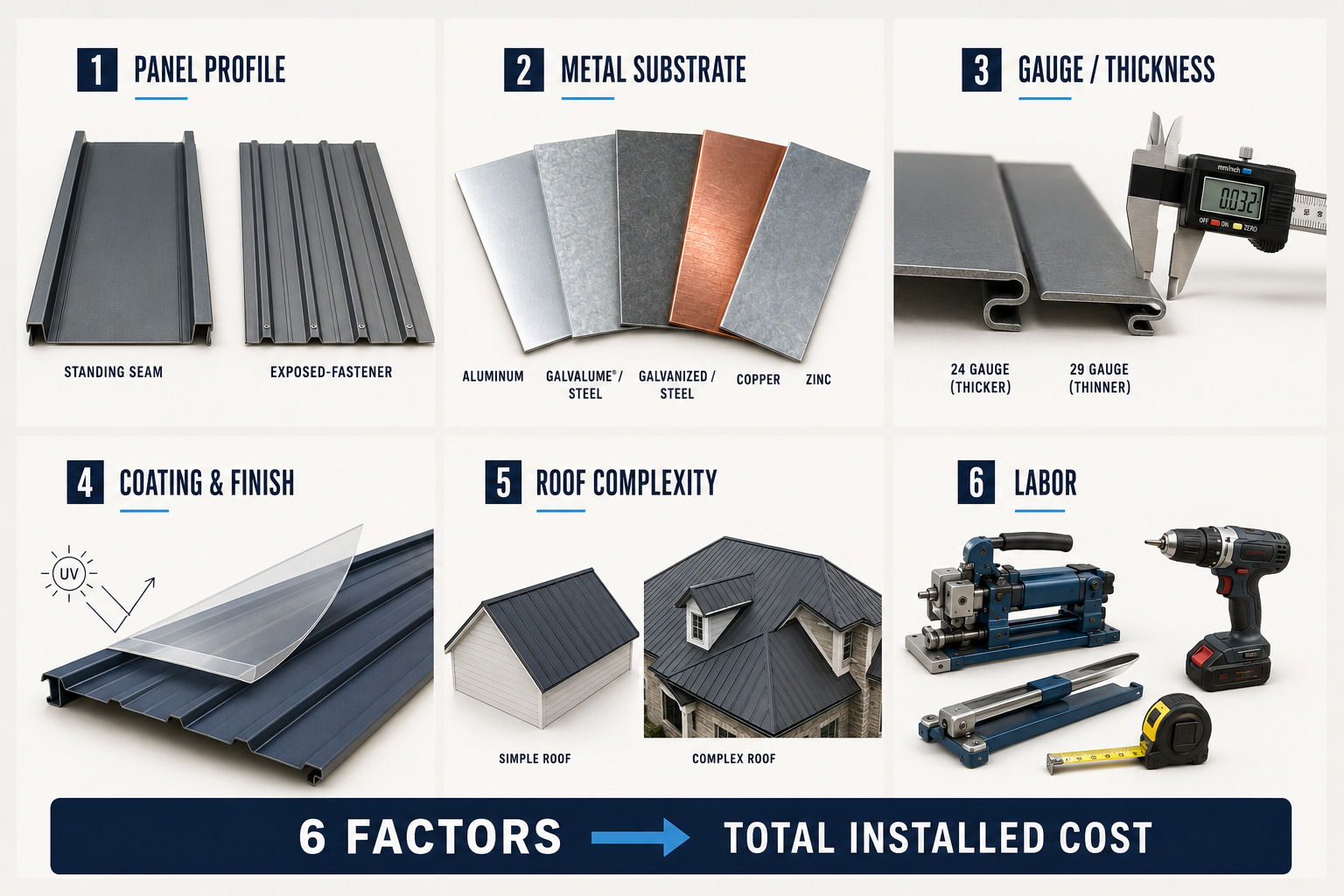
Six variables account for more than 90% of the installed price of metal sheets: panel profile, metal substrate, gauge (thickness), coating, roof complexity, and labor. Most homeowners are quoted on panel profile alone, which is why two bids for the same home can differ by $10,000 or more.
1. Panel Profile
The shape of the metal sheets determines how they are fastened, how they shed water, and how they handle thermal expansion. Standing seam metal sheets use concealed clips that allow the panels to float; exposed-fastener metal sheets are screwed through the face. The fastening method significantly affects long-term performance, maintenance frequency, and total ownership cost.
2. Metal Substrate
Aluminum, Galvalume-coated steel, galvanized steel, copper, and zinc are the five primary metal sheet substrates used in residential roofing. They differ in weight, hardness, corrosion resistance, and price per square foot. In Houston’s coastal-adjacent environment, substrate selection affects both the warranty and the realistic service life of the metal sheets.
3. Gauge (Sheet Thickness)
Thicker metal sheets (lower gauge numbers) generally resist denting better. However, gauge alone does not determine impact resistance — the alloy, panel profile, and support spacing all factor in. Houston homeowners in the hail corridor should request the product’s UL 2218 impact classification, not just a gauge specification.
4. Coating and Finish
PVDF (polyvinylidene fluoride) coatings outperform silicone-modified polyester (SMP) in color retention and UV resistance, but command a price premium on metal sheets. In Houston’s sun-intense climate, the coating is not a cosmetic choice; it is a weather barrier that extends the functional life of the panels beneath it.
5. Roof Complexity
A simple gable roof with metal sheets is priced very differently from a hip roof with dormers, skylights, multiple valleys, and a chimney. Complex geometry increases panel cutting, waste, flashing work, and labor time—all of which add directly to cost per installed square foot.
6. Labor
Standing seam metal sheets require specialized training, factory-specific tooling (portable seamers, clip jigs, brake equipment), and more installation time than exposed-fastener systems. Labor costs in the Houston metro run higher than the national average due to heat exposure, demand after storm events, and the skilled trades shortage affecting specialty roofing work. According to Western States Metal Roofing, labor (installation) typically represents 60–70% of the total installed cost of a metal roofing system—with materials accounting for the remaining 30–40%. In Houston, heat-related crew constraints and post-storm demand can push labor costs toward the higher end of that range.
Source: Western States Metal Roofing, Angi
Metal Sheets Cost by Panel Type—Houston Installed Prices (2026)
The table below reflects fully installed costs—metal sheets, underlayment, flashing, ventilation, labor, and permit—for a typical 28-square (2,800 sq ft) Houston residential roof. Material-only costs for metal sheets can be 40–60% lower, but material-only comparisons ignore the largest cost drivers.
| Metal Sheets Type | Cost per Sq Ft (Installed) | 28-Square Home Estimate | Best For | Key Trade-off |
|---|---|---|---|---|
| Exposed-Fastener Steel Metal Sheets (R-Panel / Corrugated) | $3.50 – $7.00 | $9,800 – $19,600 | Patio covers, garages, accessory structures | Periodic fastener/washer inspection required |
| Metal Shingles / Interlocking Tile Sheets | $7.00 – $14.00 | $19,600 – $39,200 | HOA-restricted neighborhoods, traditional appearance | System-specific replacement parts required |
| Standing Seam — Galvalume Steel Sheets | $8.00 – $15.00 | $22,400 – $42,000 | Long-term primary residence, inland Houston | Higher upfront cost vs. asphalt |
| Standing Seam — Aluminum Metal Sheets | $12.00 – $22.00 | $33,600 – $61,600 | Coastal-adjacent / salt-air properties | More susceptible to denting than steel sheets at same gauge |
| Copper Roofing Sheets | $20.00 – $40.00 | $56,000 – $112,000 | Custom homes, dormers, architectural accents | Premium pricing; galvanic risk with incompatible metals |
| Zinc Roofing Sheets | $18.00 – $35.00 | $50,400 – $98,000 | High-end architectural, curved forms | Limited Houston availability; long lead times |
Metal Sheets by Material: What You Actually Get at Each Price Point
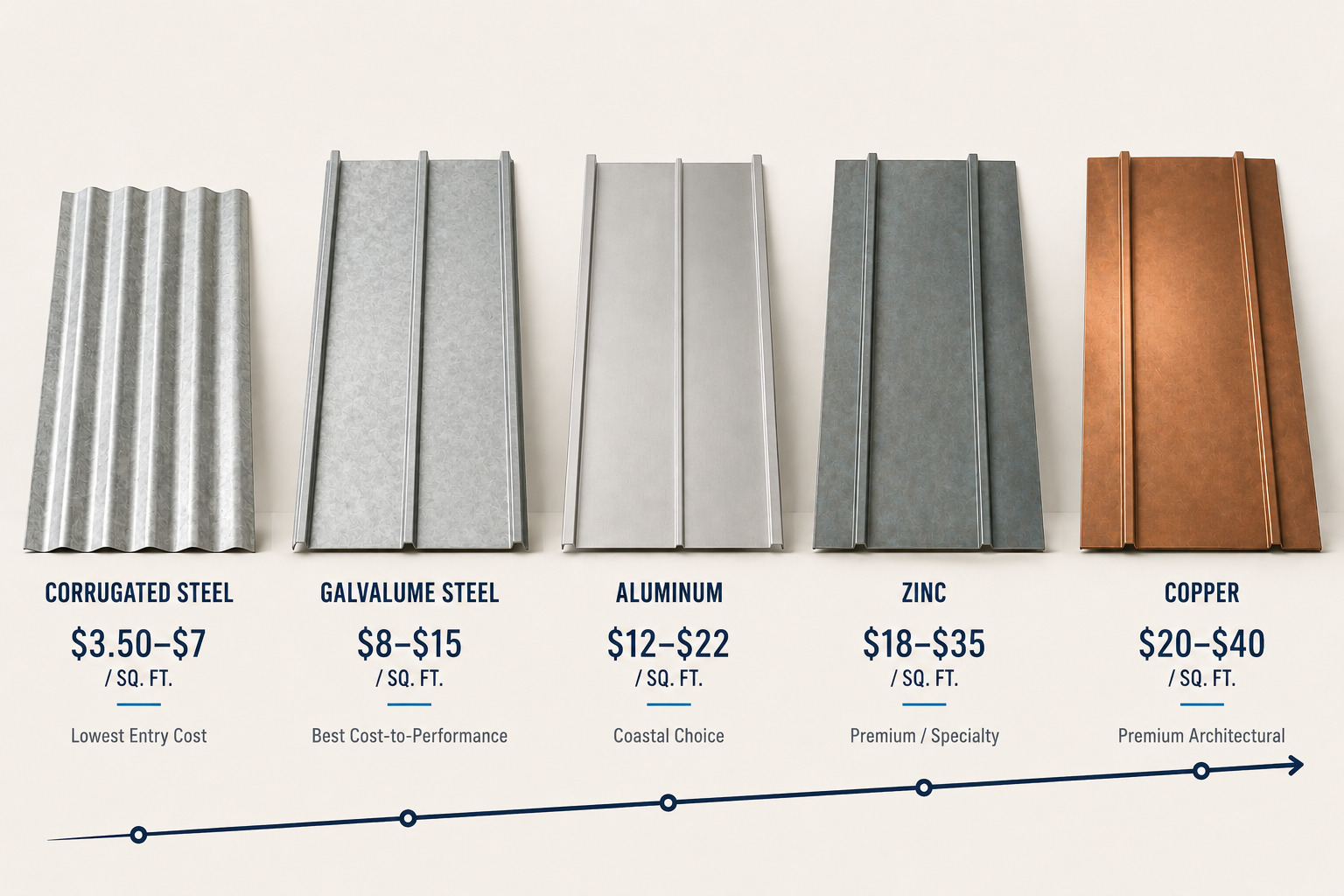
Galvalume Steel Sheets: The Volume Option
Galvalume steel sheets are the most commonly installed metal roofing substrate in Houston and for inland properties, they often deliver the strongest cost-to-performance ratio.
Galvalume metal sheets consist of carbon steel coated with a 55% aluminum / 43.4% zinc / 1.6% silicone alloy. According to Sheffield Metals International, the aluminum component provides barrier protection while the zinc provides galvanic (sacrificial) protection at cut edges—a meaningful advantage when metal sheets are cut and drilled during installation. Installed standing seam Galvalume steel sheets typically run $8.00–$15.00 per square foot in Houston.
Trim pieces, valley metal, and pipe boots should all be fabricated from compatible materials. Galvanic corrosion occurs where dissimilar metals contact Galvalume steel sheets—an installation detail that separates experienced contractors from generalists.
Source: Sheffield Metals International
Aluminum Metal Sheets: The Coastal Choice
Aluminum metal sheets’ natural oxide layer provides corrosion resistance that does not depend on a coating, making them the stronger choice for Houston properties near the Gulf, Galveston Bay, Clear Lake, or the Ship Channel corridor.
Unlike Galvalume steel sheets, aluminum metal sheets do not rust conventionally. When the surface is scratched, the oxide layer reforms. This property is especially valuable within 10–20 miles of salt-air exposure. The trade-off: aluminum metal sheets are softer. At the same gauge, they dent more visibly than steel sheets during hail. Homeowners in Harris County’s hail corridor, which has recorded hailstones up to 2.75 inches, should request UL 2218 impact test documentation and review whether the cosmetic damage exclusion (Texas Endorsement HO-145) will apply to their policy.
Installed aluminum metal sheets run $12.00–$22.00 per square foot in Houston.
Source: Sheffield Metals International, Texas Department of Insurance
Corrugated Metal Sheets: Agricultural to Architectural
Corrugated metal sheets carry the lowest entry price in the category, but the wide range of products under this label means quality varies dramatically—from basic agricultural panels to architectural-grade residential systems.
Installed corrugated metal sheets run $3.50–$7.00 per square foot. The difference between a $3.50 corrugated system and a $7.00 one often comes down to panel gauge, coating quality, and whether the installation uses solid roof decking and a high-temperature underlayment beneath the metal sheets. A corrugated system over solid decking with proper underlayment performs very differently from the same metal sheets over open purlins.
Copper Roofing Sheets: When Cost Is Not the Primary Filter
Copper roofing sheets are a premium architectural material—not a standard residential system. They develop a natural patina through exposure and require no paint coating throughout their service life. In Houston, copper sheets are most commonly used for bay roofs, dormers, cupolas, porch sections, and custom architectural details at $20.00–$40.00 per square foot installed. Copper runoff can stain masonry and painted surfaces, and copper sheets must never contact aluminum or galvanized steel directly.
Zinc Roofing Sheets: Rare in Houston, Right for Some Projects
Zinc sheets are more common in European architectural work than in Houston, but they are a legitimate premium option for residential projects that prioritize patina, longevity, and complex form. Zinc metal sheets self-heal minor surface scratches as patina develops, and they can be shaped into curved forms that few other metal sheets accommodate. Installed cost: $18.00–$35.00 per square foot. Local availability in Houston is limited, and lead times typically run 6–10 weeks.
Labor Costs for Metal Sheet Installation in Houston
Labor accounts for 60–70% of the total installed cost of a metal roofing system—with materials making up the remaining 30–40%, according to Western States Metal Roofing. On a $35,000 standing seam project, that is $21,000–$24,500 in installation labor—the largest single variable that separates a high-quality metal sheet installation from one that leaks within three years.
Factors that drive metal sheet labor costs higher in Houston:
- Heat exposure. Crews working on metal sheets in 100°F heat work shorter shifts and require additional safety measures. This increases labor hours per project.
- Specialized tooling. Standing seam metal sheets require manufacturer-specific seaming machines and clip jigs. Not every crew is equipped or trained for this work.
- Tear-off and disposal. Removing existing roofing before installing metal sheets adds $1.00–$2.50 per square foot before the first new panel goes on.
- Deck repairs. It is common to find deteriorated OSB or damaged decking once old roofing is stripped. Deck repairs add $1.50–$5.00 per square foot in affected areas before metal sheet installation can begin.
- Permitting. City of Houston and Harris County permit fees vary by project value. Budget $300–$700 for a standard residential metal sheet replacement permit.
Source: Western States Metal Roofing
Houston-Specific Factors That Affect Metal Sheets Cost
National cost guides for metal sheets are calibrated for the Mountain West or Southern California—not Houston. These are the local variables that change your installed price.
Underlayment Specification Under Metal Sheets
Standard 30-lb felt is not adequate beneath metal sheets in Houston’s climate. High-temperature synthetic underlayment—rated for 200°F or higher—is required under metal sheets in hot attic assemblies where surface temperatures can exceed 160°F on summer afternoons. The cost difference is $0.25–$0.75 per square foot, but the performance difference is significant. According to Green Builder Media, standard underlayments fail within 20–25 years in hot climates, often before the metal sheets above them show any sign of wear.
Source: Green Builder Media, NRCA
Windstorm Certification for Metal Sheet Projects
Residential properties in certain Houston-area TDI-designated zones require a WPI-8 windstorm certificate for roof work. This requires a third-party inspection during metal sheet installation—not after. If your contractor has not factored windstorm inspection into the project scope, you will pay for it separately or lose the certificate entirely. Always confirm whether your property requires this before signing a metal sheets contract.
Corrosion Environment and Metal Sheet Warranty Zones
A property in La Porte sits in a meaningfully different corrosive environment than one in Katy or Sugar Land. Most major manufacturers void standard paint warranties on metal sheets installed within 1,500 feet of the ocean—the most common exclusion threshold, according to Western States Metal Roofing. Sheffield Metals’ Coasteel product is specifically engineered for coastal environments and carries warranty coverage down to 300 feet from breaking surf, but explicitly excludes any project closer than that; at those distances, aluminum becomes the recommended substrate. For Houston properties near Galveston Bay, Clear Lake, or the Ship Channel, request the product’s coastal warranty documentation and confirm the exact distance thresholds before specifying Galvalume steel sheets.
Source: Western States Metal Roofing, Sheffield Metals International
Post-Storm Demand Surge on Metal Sheet Pricing
After a major storm, roofing material costs can surge dramatically. Following Hurricane Katrina, shingle prices more than doubled—from $35 to $75 per square—within the first months of recovery, as shortage of materials, contractor scarcity, and displaced labor all converged simultaneously, according to Roof Crafters. For typical Houston hail events (rather than catastrophic storms), the pricing effect is more modest, but contractor availability tightens and metal sheet lead times extend across the entire metro area within days of a significant storm. Homeowners who install metal sheets proactively secure better pricing and avoid the inspection backlog that follows a major weather event.
Source: Roof Crafters
40-Year Cost Comparison: Metal Sheets vs. Asphalt Shingles
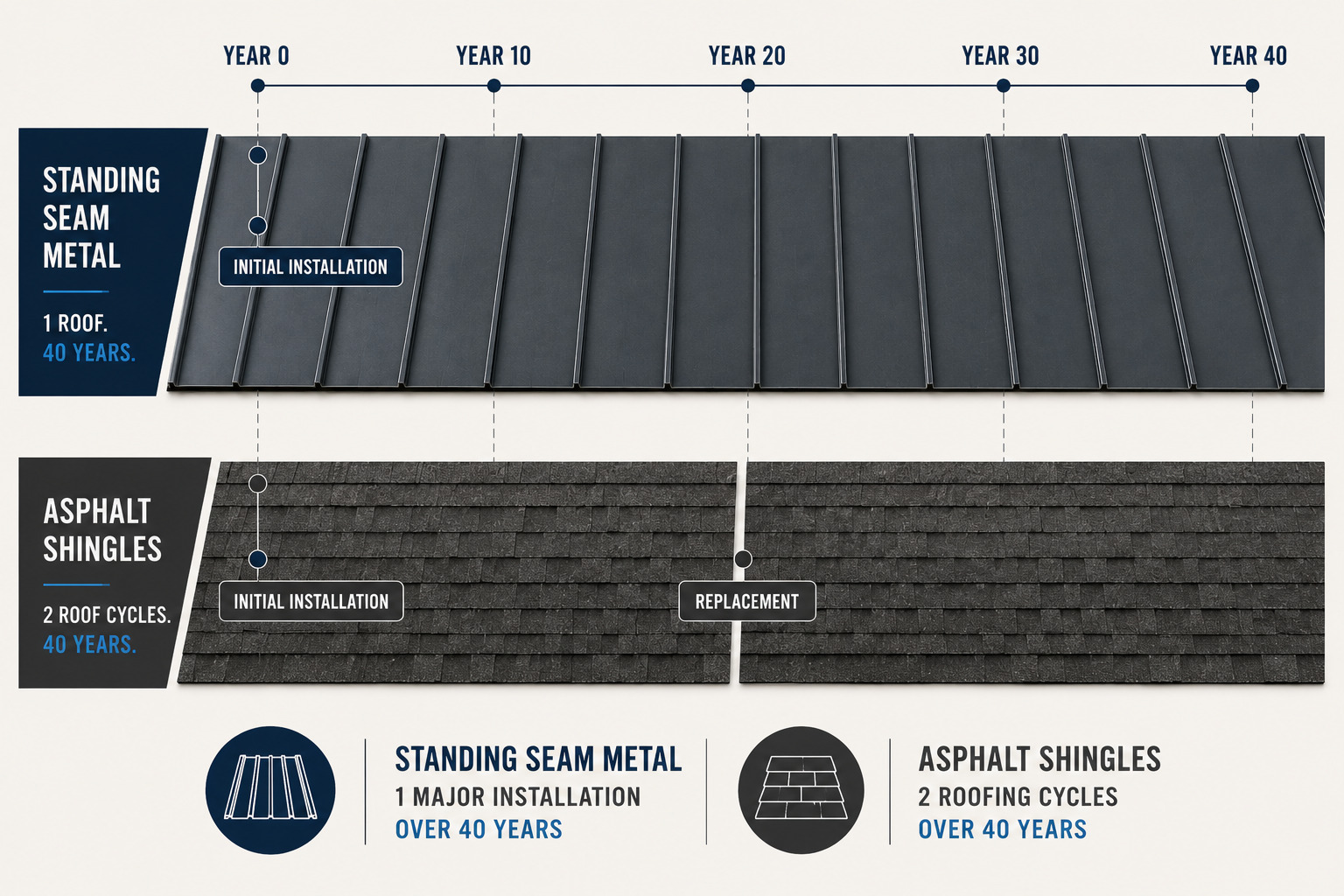
On a 40-year timeline, standing seam metal sheets often cost less than two cycles of asphalt replacement even before accounting for insurance credits. The math below reflects Houston conditions, where asphalt consistently underperforms its rated service life.
| Cost Category | Asphalt Shingles (40-Year Horizon) | Standing Seam Metal Sheets (40-Year Horizon) |
|---|---|---|
| Initial Installation | $12,000 – $18,000 | $28,000 – $55,000 |
| Replacement #1 (Year 17–22, with disposal) | $14,000 – $22,000 | $0 |
| Replacement #2 (Year 34–40, if applicable) | $17,000 – $26,000 (inflation-adjusted) | $0 |
| Hail deductibles (estimate: 2 claims × $3,000) | $6,000 | Reduced or avoided with Class 4 metal sheets |
| Maintenance / repairs over 40 years | $3,000 – $8,000 | $1,500 – $4,000 |
| Insurance premium savings (Class 4 metal sheets, ~25% credit) | $0 | ~$1,875/year = $75,000 over 40 years |
| Total 40-Year Outlay (before insurance credit) | $52,000 – $80,000 | $29,500 – $59,000 |
| Net Position After Insurance Credit (40 years) | No credit available | Metal sheets often reach cost parity or lower total cost |
Insurance savings estimate: The Texas Department of Insurance reports the average annual homeowners insurance premium in Texas reached approximately $3,291 in 2024, with many Houston-area homeowners paying $4,000 or more depending on location, coverage level, and claims history. A 25% Class 4 discount applied to a $4,000 annual premium equals $1,000/year in savings — $40,000 over 40 years. For homes insured at higher Coverage A limits, savings can reach $1,500–$1,875/year. Actual savings depend on your carrier, policy, property location, and the specific metal sheet product’s UL 2218 classification. Source: Richey Insurance, “Key Statistics on Homeowners Insurance in Texas (2026),” citing Texas Department of Insurance 2024 data. Asphalt replacement cost inflation-adjusted at 4% annual escalation. This 40-year analysis is Achilles Roofing’s original market assessment — not independently published or peer-reviewed.
Texas Insurance Credits for Impact-Resistant Metal Sheets
A qualifying Class 4 impact-rated metal sheet system may reduce your homeowner’s insurance premium by 15–35% on the Coverage A (dwelling) portion of your policy. For a $500,000-insured home, that can mean $1,875 or more saved per year—every year the metal sheets are on the house.
Key facts before selecting metal sheets for this purpose:
- The UL 2218 rating belongs to the tested assembly—not to metal sheets as a category. Request the product’s impact test documentation before signing.
- TDI Form PC068 is required. Your contractor must complete this form at project completion for the insurance credit to activate. Ask for it in your contract scope before metal sheet installation begins.
- Endorsement HO-145 is the trade-off. Most carriers require you to accept a cosmetic damage exclusion — meaning hail dents on your metal sheets that do not cause leaks will not be covered. Read this endorsement before agreeing to it.
- Confirm the credit amount before installation. The TDI mandates credits, but the percentage varies by insurer and policy. Your insurance agent is the only source of truth for your specific metal sheets project.
Source: Texas Department of Insurance, Texas Department of Insurance
What to Ask Before Signing a Metal Sheets Contract
The most expensive metal sheets mistake in Houston is not choosing the wrong panel—it is hiring a contractor who cannot install it correctly. Standing seam metal sheets in particular require factory training, dedicated tooling, and familiarity with the panel manufacturer’s installation manual. A general roofing contractor without that training should not be installing standing seam metal sheets.
Ask for the following in writing before any metal sheets contract is signed:
- The exact manufacturer name and product line for the metal sheets
- Panel profile, metal substrate, and gauge of the sheets
- Finish type (PVDF vs. SMP) and coating warranty term
- Underlayment specification—product name and temperature rating beneath the metal sheets
- Fastener and clip specifications
- Impact classification (UL 2218 Class 1–4) and the test report number for the metal sheet assembly
- Wind uplift rating for the tested assembly
- Whether a WPI-8 windstorm inspection is included in the metal sheets scope
- Who completes TDI Form PC068 after installation
- Workmanship warranty term and what it covers
- References for standing seam metal sheet projects of similar complexity
Note on deductible waivers: Under Texas law (Texas Insurance Code §707.005), a contractor who waives or absorbs a homeowner’s insurance deductible is committing insurance fraud—regardless of how the offer is framed. A contractor offering this on a metal sheets project is not protecting you. Source: Texas Department of Insurance
Frequently Asked Questions
How much do metal sheets cost per square foot in Houston?
Installed costs for metal sheets in Houston range from $3.50–$7.00 per square foot for exposed-fastener steel panels to $12.00–$22.00 per square foot for standing seam aluminum. The range reflects differences in metal sheet type, substrate, roof complexity, and labor. Material-only prices for metal sheets are substantially lower but are not a useful comparison because installation, underlayment, flashing, and ventilation account for 50–65% of total project cost.
What is the cheapest type of metal sheets for roofing?
Exposed-fastener corrugated metal sheets are the lowest-cost option, at $3.50–$7.00 per square foot installed. They are best suited for patio covers, garages, and accessory structures where periodic maintenance access is practical. For a primary residence, the lower upfront cost of corrugated metal sheets is partially offset by more frequent inspection requirements compared to concealed-fastener standing seam systems.
Are metal sheets better than asphalt shingles for Houston homes?
It depends on your timeline. The 2025 Cost vs. Value Report shows metal roofing nationally recovers approximately 50% of project cost at resale, compared to 68% for asphalt, meaning metal sheets carry a lower immediate resale premium. However, for homeowners staying 10+ years, the 40-year total ownership picture often favors metal sheets: asphalt fails at 15–22 years under Houston’s climate (requiring two full replacements), while metal sheets installed once—combined with insurance premium credits of $1,000–$1,875/year for Class 4 systems—frequently produce a lower total outlay. Metal sheets are the stronger choice for long-term owners; asphalt may still be practical for homeowners expecting to sell within 5–7 years. Source: The Roofing Brief / Remodeling Magazine
How long do metal sheets last on a Houston roof?
Properly specified and installed metal sheets in Houston are commonly associated with service lives of 40–70 years. Aluminum and premium Galvalume steel sheet systems are toward the higher end of that range. Actual performance depends on the metal substrate, coating quality, installation workmanship, and maintenance. The components around the metal sheets—underlayment, flashing, and sealants—may require attention before the sheets themselves wear out.
Do metal sheets qualify for Texas insurance discounts?
Metal sheets rated UL 2218 Class 4 may qualify for insurance premium credits of 15–35% on the Coverage A portion of a Texas homeowner’s policy. The contractor must complete TDI Form PC068 at project completion. Most carriers require Endorsement HO-145—a cosmetic damage exclusion—to receive the full discount. Confirm eligibility and the credit amount with your insurance agent before installation. Source: Texas Department of Insurance
What gauge metal sheets should I choose for hail resistance?
For residential standing seam, 24-gauge Galvalume steel sheets or 0.040-inch aluminum sheets are commonly specified. 22-gauge steel sheets or 0.050-inch aluminum sheets provide better dent resistance—relevant in Harris County’s hail corridor. However, gauge alone does not determine impact resistance for metal sheets. Always request the product’s UL 2218 Class test report and confirm how your insurance policy treats cosmetic denting.
Can metal sheets be installed over existing shingles?
Sometimes. Whether metal sheets can be overlaid depends on local building codes, the number of existing roofing layers, the roof deck condition, ventilation, and the metal sheet manufacturer’s installation instructions. A contractor should inspect the deck before recommending an overlay. In many Houston cases, a full tear-off is advisable to identify rot, water damage, or inadequate decking before metal sheets are installed.
What is oil canning on metal sheets?
Oil canning is visible waviness or rippling in the flat areas of metal sheets. It is an aesthetic characteristic, not a structural defect—the sheets are not failing or leaking. Wider panels, smoother finishes, and darker colors make oil canning more visible on metal sheets. Narrower panels, striated or ribbed textures, and matte coatings reduce the effect. Discuss panel width and finish options with your contractor before metal sheet selection is finalized.
How much does it cost to install metal sheets on an average Houston home?
For a typical Houston home with a 28-square (2,800 sq ft) roof, total installed costs for metal sheets range from $9,800–$19,600 for exposed-fastener steel panels, $22,400–$42,000 for standing seam Galvalume steel sheets, and $33,600–$61,600 for standing seam aluminum sheets. These figures include panels, underlayment, flashing, ventilation, labor, and permits. Copper sheets run $56,000–$112,000 for the same roof area.
Are standing seam metal sheets worth the extra cost?
For a primary residence in Houston, standing seam metal sheets are worth the premium for most homeowners planning to stay 10+ years. The concealed clip system eliminates the exposed fastener penetrations that require periodic maintenance on R-panel or corrugated sheets, provides stronger resistance to water entry, and qualifies for the same Class 4 insurance credits. The incremental cost over exposed-fastener metal sheets is typically $4.00–$8.00 per square foot—a difference that the insurance credit alone can recoup within 3–5 years.
Get a Metal Roof Assessment
Achilles Roofing & Exteriors provides roof inspections, metal sheet system recommendations, and written fixed-price estimates for homeowners across the Houston area, including Houston, Katy, Cypress, Sugar Land, The Woodlands, Pearland, and Spring.
Written fixed-price estimate · GAF Certified Plus · 800+ Houston projects · Financing from $199/mo
 Call (832) 346-8021
 About Achilles Roofing & Exterior
Houston’s specialist in full roof replacements, Spanish tile, clay tile, copper, and high-end exterior systems. Founded 2017. 800+ completed projects · 4.90-star Google · 5.0 Thumbtack · Founded by Ahmad Faiz.
Mailing: 1919 W Sam Houston Pkwy N, Unit #110, Houston, TX 77043 — (832) 346-8021
The Woodlands Office: 2002 Timberloch Pl, Suite 200, The Woodlands, TX 77380 — (281) 771-0303
Warehouse: 16310 Cypress Bend Drive, Cypress, TX 77429 — (832) 353-2383
Sources
- National Insurance Crime Bureau (NICB). Hail and Wind Claims Report. National Insurance Crime Bureau. (Documents Texas as the #1 state for hail insurance claims for eleven consecutive years; records 902 major hail events in Texas in 2025, establishing the state’s sustained exposure to severe weather relevant to metal sheet selection.)
- Cypress Roof Guide / National Weather Service Houston. How Bad Does Hail Get in Cypress and Harris County, and How Often? Cypress Roof Guide. (Documents Harris County’s 143 hail events from 2016–2025, averaging approximately 14 significant events per year; 119 events reached the NWS 1-inch severe-hail threshold; illustrates dramatic year-to-year volatility, from zero events in 2022 to 28 events in both 2023 and 2024.)
- Sheffield Metals International. Galvalume Steel vs. Aluminum: What Metal Roof Material Should I Pick? Sheffield Metals Learning Center. (Compares Galvalume steel and aluminum metal sheet performance; details Galvalume’s 55% aluminum/43.4% zinc/1.6% silicone alloy coating, self-healing edge corrosion properties, and cost efficiency versus aluminum’s superior salt-air corrosion resistance in coastal environments.)
- Sheffield Metals International. The Durable, Cost-Effective Option for Coastal Metal Roofing Projects: Coasteel. Sheffield Metals Learning Center. (Details Coasteel’s coastal warranty coverage zone of 300–1,500 feet from breaking surf; explicitly excludes projects within 300 feet of the ocean where aluminum is the recommended metal sheet substrate; extends coverage to the edge of brackish water as an alternative distance threshold.)
- Western States Metal Roofing. Metal Roof Cost and Price Guide 2026. Western States Metal Roofing. (Reports labor represents 60–70% of total installed metal roofing system cost, with materials accounting for the remaining 30–40%; provides installed cost benchmarks of $10–$16/sq ft for standing seam and $7–$12/sq ft for corrugated metal sheets nationally.)
- Western States Metal Roofing. Metal Roofing in Coastal Areas: Paint Warranties. Western States Metal Roofing. (Documents 1,500 feet from the ocean as the most common paint warranty exclusion threshold across major metal sheet manufacturers; explains proximity-to-ocean clauses that void standard coverage for coastal installations.)
- Texas Department of Insurance (TDI). Products Qualifying for Impact-Resistant Roofing Credits. Texas Department of Insurance. (Defines UL 2218 Class 1–4 eligibility criteria for impact-resistant metal sheet systems; mandates TDI Form PC068 completion at project installation as the required activation step for insurance premium credits.)
- Texas Department of Insurance (TDI). Commissioner’s Bulletin B-0030-98: Mandatory Premium Credits for Impact Resistant Roof Coverings & Endorsements HO-145 / TDP-022. Texas Department of Insurance. (Establishes mandatory insurance premium credit schedules for UL 2218 Class 1–4 impact-resistant roofs by territory; introduces the optional cosmetic damage exclusion for hail claims under Endorsement HO-145 and TDP-022.)
- Richey Insurance / Texas Department of Insurance. Key Statistics on Homeowners Insurance in Texas (2026). Richey Insurance. (Reports average Texas homeowners insurance premium of approximately $3,291 in 2024 per TDI data; notes premiums commonly exceed $4,000/year in the Houston area; documents a 55% premium increase since 2019, providing the baseline for Class 4 metal sheet insurance credit calculations.)
- Texas Legislature. Texas Insurance Code §707.005. Texas Legislature Online. (Prohibits contractors from waiving, absorbing, rebating, or crediting a homeowner’s insurance deductible on metal sheet or other roofing projects; violations are subject to criminal referral under Texas law.)
- Roof Crafters. Why Do Roofing Prices Increase After a Hurricane Hits? Roof Crafters. (Documents post-Hurricane Katrina roofing material price doubling — from $35 to $75 per square — within the first months of recovery; reports material costs can rise 2–3× in the months following a catastrophic storm due to simultaneous material shortage, labor scarcity, and displaced-worker cost burdens.)
- Green Builder Media. Underlayment Service Life in Hot Climates. Green Builder Media. (Documents standard roofing underlayment failure at 20–25 years in hot-climate installations — frequently before the metal sheets above them reach end of service life — supporting the specification of high-temperature synthetic underlayment in Houston assemblies.)
- U.S. Department of Energy (DOE). Energy Saver: Cool Roofs. U.S. Department of Energy. (Outlines solar reflectance and thermal emittance performance metrics for metal sheets with reflective finishes; documents potential energy use reduction in hot climates while noting that savings depend on assembly, insulation, and building-specific variables.)
- National Roofing Contractors Association (NRCA). Roofing Manual: Metal Panel and SPF Roof Systems. National Roofing Contractors Association. (Establishes installation standards, underlayment specifications, fastener and clip requirements, and workmanship benchmarks for metal sheet roofing systems.)
- Angi. Metal Roofing Cost Estimator 2025. Angi, Inc. (Provides national and regional installed cost benchmarks for metal roofing sheet systems by panel type, used to cross-reference the price ranges reported in this guide.)
- Modernize. Contractor Network Cost Data 2025. Modernize Home Services. (Aggregates contractor-reported installed cost data for metal sheets by panel profile across U.S. markets, providing a secondary cost validation source for the ranges in this guide.)
- The Roofing Brief / Remodeling Magazine. Roof Replacement ROI & Resale Value Report 2025. The Roofing Brief. (Reports asphalt shingle replacement nationally recovers approximately 68% of project cost at resale; metal roofing recovers approximately 50% — a lower immediate resale premium despite superior durability, reflecting buyer perception rather than 40-year total ownership value.)