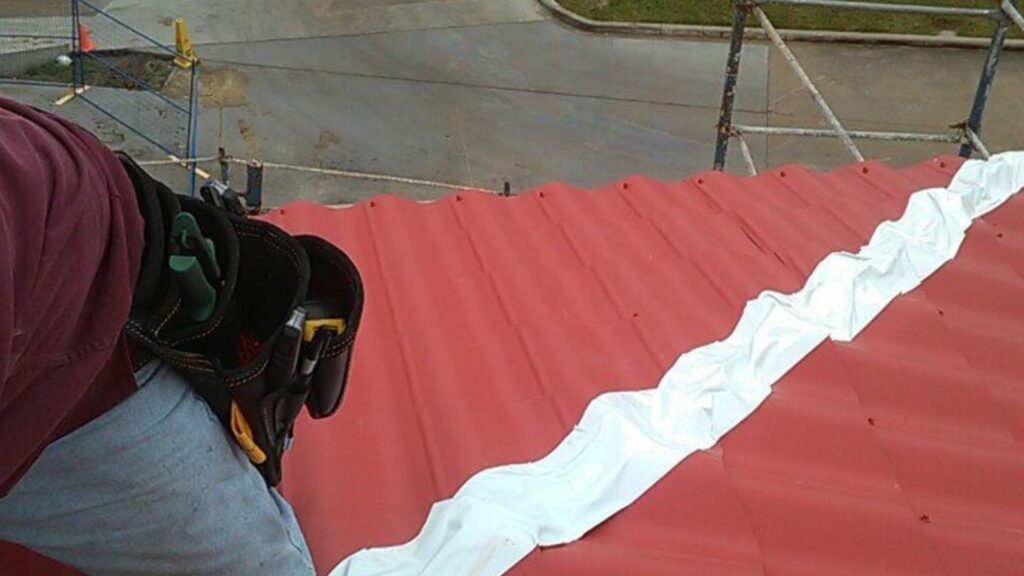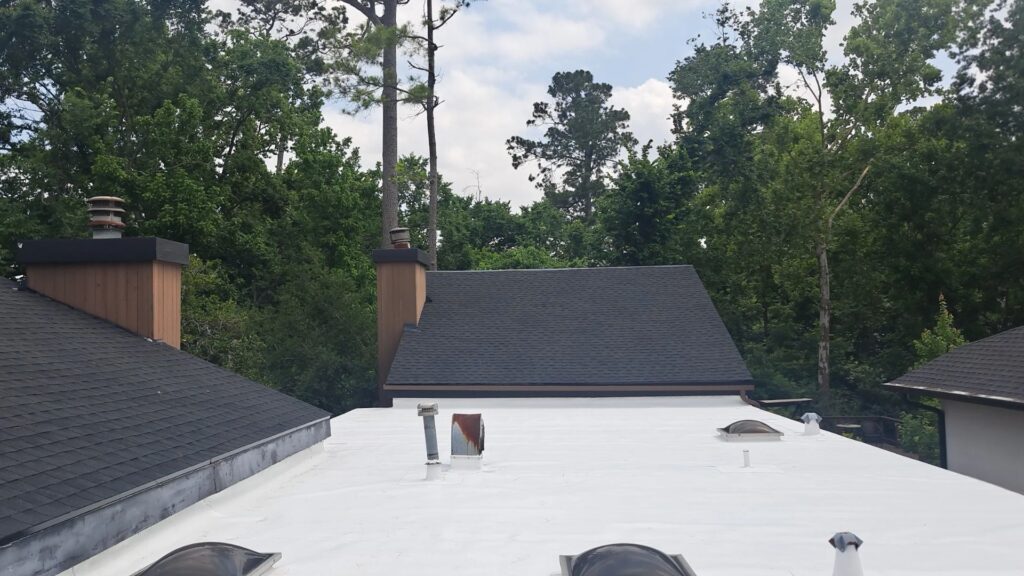

Bottom line upfront: Most hail dents on a standing seam roof are cosmetic. A dent in the flat of a panel, with the finish intact, doesn’t stop the roof from shedding water. Damage becomes functional when hail splits or punctures metal, opens or deforms a seam, or breaks a vent, boot, skylight, or flashing — anywhere it creates a path for water.
After a hailstorm, a dented metal roof can look far worse than a dented shingle roof. Every impact shows. But a standing seam roof keeps water out through its seams, its clips and the details around its edges and penetrations — not because the flat of each panel is perfectly smooth. A roof can be covered in dimples and still be completely watertight.
That does not mean every dent is harmless, and it does not mean you should ignore a storm. It means the real question is not “how dented is it?” but “did the hail reach anything that manages water?” This guide shows how to tell, what Texas insurance does with cosmetic hail damage, and why climbing up to look can do more harm than the storm.
What Is the Difference Between Cosmetic and Functional Hail Damage?
Cosmetic damage changes how the roof looks without changing how it works: dents in the panel face, with the coating unbroken and the seams closed. Functional damage reduces the roof’s ability to keep water out or shortens its life: split or punctured metal, seams that have opened, or broken flashings and penetrations.
| What the inspection finds | Type | Usual next step |
|---|---|---|
| Shallow dents in the flat of the panel, finish intact | Cosmetic | Document with dated photos; no repair needed for performance |
| Dents on the raised ribs or seams, seams still closed | Check closely | Inspect the seam along its length; usually cosmetic |
| Seam opened, separated or disengaged | Functional | Re-seam or replace the affected panels |
| Panel split, torn or punctured | Functional | Replace the panel; check the deck below |
| Vent caps, pipe boots, skylights or trim cracked or crushed | Functional | Repair or replace the component |
| Finish chipped or cracked at dent edges | Assess | Usually cosmetic on Galvalume — see the study below |
Notice where the functional damage sits. Almost none of it is in the flat of the panel. It is at the seams and at the parts that interrupt the panel — the same details that cause most metal roof leaks without any hail at all.
Do Hail Dents Rust? What a 2025 Texas Study Found
Generally, no. A 2025 study by Fort Worth roofing engineers found that hail dents in Galvalume-coated steel did not corrode faster than the rest of the panel, even where the coating had minor cracks. They concluded that dents from hail up to 2½ inches generally are not functional damage unless they open a path for moisture.
The worry with a dent is that it cracks the protective coating and lets rust start. To test that, the engineers dented Galvalume-coated steel panels to match hail from 1¼ to 2 inches, scored the coating deliberately, and put the panels through accelerated salt-spray testing. They also examined a real Fort Worth roof that had been hit by hail up to about 2½ inches in 1995.

The finding that surprised us: walking on it is worse
The same study also simulated someone stepping on a panel rib and buckling it. That foot-traffic buckle showed corrosion after 162 hours of salt spray — while the hail dents showed none after 336. In other words, a homeowner or an inexperienced inspector walking the roof to look at hail dents can create a more serious defect than the hail did.
⚠ Do not climb onto a metal roof to check for hail. Metal panels are slippery, especially after rain, and the fall risk is real. Stepping on the ribs can also buckle them, and the study above found buckles corrode where hail dents did not. Check from the ground, use binoculars, and let a professional document the roof — ideally with a drone inspection so nobody walks the panels.
Where Hail Actually Breaks a Standing Seam Roof
- Seams. A heavy impact directly on a seam can deform it or, on some snap-lock profiles, partially disengage it. Check that every seam in the impact area is still fully closed along its length.
- Vent caps and pipe boots. Plastic vent caps crack and rubber boots split. These are the most common functional hail damage on a metal roof, and they are cheap to replace.
- Skylights. Domes and glazing can crack even when the surrounding panels are fine.
- Ridge, hip and trim. Thinner trim pieces dent and deform more easily than the panels, and a bent trim edge can let wind-driven rain in.
- Gutters and downspouts. Often dented badly. Dented gutters can still drain — but crushed downspouts may not.
Hail size matters, but not in a straight line. Impact energy rises steeply as hailstones get bigger.

That is why a roof that shrugged off one storm can be damaged by the next. If you are not sure whether hail reached your area, the soft metals around your home — gutters, AC fins, mailbox, fence caps — are the quickest tell. We explain how to read them in signs of hail on the rest of your property.
Does a Class 4 Rating Mean My Roof Won’t Dent?
This catches a lot of homeowners out. They paid for an impact-rated roof, a storm comes through, and the roof is dented. The rating was about function, not appearance. For more on what impact ratings do and do not promise, see why Class 4 does not mean dent-proof.
Will Insurance Pay for Cosmetic Hail Dents in Texas?
It depends on your policy. Many Texas homeowners who received an insurance credit for an impact-resistant roof also signed Endorsement HO-145, which excludes cosmetic hail damage to the roof. With that endorsement, dents that do not let water in are typically not covered. Hail damage that affects the roof’s ability to keep out water still is.

So the first thing to find out after a storm is whether HO-145 is on your policy. If it is, a purely cosmetic claim is unlikely to succeed, and the inspection should focus on whether any functional damage exists. If it is not, cosmetic damage may be covered under your policy terms — your agent or adjuster is the only person who can tell you.
Two practical points. First, report storm damage promptly; most policies require it, and there are outer time limits too — see how long you have to file. Second, Achilles documents damage with photos and a written report your adjuster can use, and coordinates with the adjuster during the on-site inspection. We are not a public adjuster and do not negotiate claims on your behalf. If a claim goes wrong, here is what to do if a claim is denied.
Why This Matters More in Houston
Texas leads the country in hail damage year after year, and the Houston area sits in it. A roof here is likely to see several hailstorms over its life, so knowing what is cosmetic matters: it stops you replacing a sound roof after one storm, and it stops you ignoring a cracked boot that will leak in the next downpour.
Texas has led the nation in hail damage for 11 consecutive years, with 902 major hail events record in 2025. Locally, the largest hailstone on record in Harris County reached 2.75 inches near Tomball. Sources: National Insurance Crime Bureau; StormerSite, aggregating NOAA Storm Prediction Center reports — as cited on Achilles’s premium roof replacement guide
The bigger risk in Houston is not the dent — it is the next rain. A split pipe boot or a lifted trim edge may not leak in the storm that caused it. It leaks two weeks later in a heavy afternoon downpour, and by then nobody connects it to the hail. That is why the inspection should happen within days, and why the penetrations matter more than the panel faces.
What to Do After a Hailstorm
- Stay on the ground. Use binoculars or a phone zoom. Do not walk the panels.
- Take dated photos of gutters, downspouts, AC fins, vents you can see, and any debris or hailstones.
- Check inside — attic, ceilings near vents and skylights — after the next heavy rain.
- Check your policy for HO-145 before you file.
- Book an inspection within days and ask for a written report that labels each finding cosmetic or functional.
A good metal roof hail report includes
- Dated photos of dents and their locations across the roof
- Close-ups of every seam in the impact area, showing whether it is closed
- Each vent cap, pipe boot, skylight and flashing, inspected and photographed
- Any split, puncture or cracked finish identified specifically
- A clear label on each finding: cosmetic or functional
If the findings are functional, most are component repairs — a boot, a vent cap, a trim piece, a single panel — handled through hail damage roof repair.
Should You Replace a Dented Standing Seam Roof?
We would rather tell you a dented roof is sound than sell you one you do not need. If a few panels are punctured, those panels can often be replaced individually — and that is easier on some systems than others, which we explain in snap-lock vs. mechanical seam. For the broader question of when any standing seam roof has reached the end, see does your standing seam roof need replacement, or just repair?
If the damage is widespread and you are replacing a standing seam roof, check current standing seam pricing in Houston before you talk to anyone, and have the roof inspected after the storm so you know which situation you are in.
Related Services from Achilles Roofing & Exterior
Hail Damage Roof Repair
Photo documentation, a written report, and repair of functional damage.
Drone Roof Inspections
Documents the whole roof without anyone walking the panels.
Storm Damage Repair
For wind and storm damage beyond hail.
Standing Seam Replacement
When hail damage is functional and widespread.
Frequently Asked Questions
Most hail dents in the flat of a standing seam panel are cosmetic: they change appearance but not the roof’s ability to shed water. Damage is functional when hail splits or punctures the metal, opens or deforms a seam, or breaks a vent cap, pipe boot, skylight or flashing. A professional inspection should label each finding one way or the other in writing.
Generally not on Galvalume-coated steel. A 2025 study published in IIBEC Interface found that hail dents did not corrode faster than undamaged metal in 336 hours of salt-spray testing, and a Fort Worth roof hit by hail up to about 2.5 inches showed no corrosion at its dents 27 years later. The study tested R-panel, so seams on standing seam roofs still need checking separately.
It depends on the policy. If you signed Endorsement HO-145 to receive a premium credit for an impact-resistant roof, cosmetic hail damage to the roof is excluded, though damage that affects the roof’s ability to keep out water is still covered. Without HO-145, cosmetic damage may be covered under your policy terms. Check with your agent before filing.
No. Metal roofs are slippery, especially after rain, and falls are a real risk. Walking on panel ribs can also buckle them, and a 2025 study found a foot-traffic buckle corroded within 162 hours of salt-spray testing while hail dents did not. Check from the ground and have a professional inspect, ideally by drone.
Larger hail can dent metal panels, but denting is not the same as functional damage. A 2025 study concluded that dents from hail up to 2½ inches generally are not functional on Galvalume panels unless they create a moisture path. Impact energy rises steeply with size — 2-inch hail carries about sixteen times the energy of 1-inch hail — so very large hail is more likely to damage seams, trim and penetrations.
It can. A UL 2218 Class 4 rating means the product resisted cracking or penetration in a standardized impact test, not that it will not dent. A Class 4 metal roof with visible dents may have performed exactly as rated. Whether those dents are covered by insurance depends on whether your policy carries a cosmetic damage exclusion.
Often, yes. A punctured or split panel can usually be removed and replaced if a matching profile and color are available. Snap-lock panels are generally easier to replace individually than mechanically seamed panels, and double-lock seams are the hardest to open. Widespread functional damage across many panels is when full replacement makes more sense.
Stay off the roof, take dated photos of damage visible from the ground and of soft metals like gutters and AC fins, check your attic and ceilings after the next rain, look for an HO-145 endorsement on your policy, and book a professional inspection within days. Ask for a written report that labels each finding cosmetic or functional.
Sources & References
- Achilles Roofing & Exterior. (2026). Hail damage roof repair, storm restoration, and impact-resistant shingle replacement in Houston. Achilles Roofing Services.
- International Institute of Building Enclosure Consultants. (2025, August 12). Fall exclusive: A deep dive into hail-caused dents: A study of corrosion resistance within dents in Galvalume-coated steel roof panels. IIBEC Interface.
- Roof Industry Committee on Weather Issues. (2026). RICOWI field investigation report: Texas A&M hailstorm performance analysis and damage assessment. RICOWI Reports Library.
- Texas Department of Insurance. (1998). Windstorm inspection program standards and bulletin archive (Bulletin No. B-0030-8). TDI Engineering Services Division.
A Dented Roof Is Not Always a Damaged Roof
We document every seam, vent and flashing, label each finding cosmetic or functional, and tell you honestly whether anything needs fixing. Written quote before work begins.
Serving Houston, Cypress, The Woodlands, Sugar Land, Katy, Spring and surrounding areas.