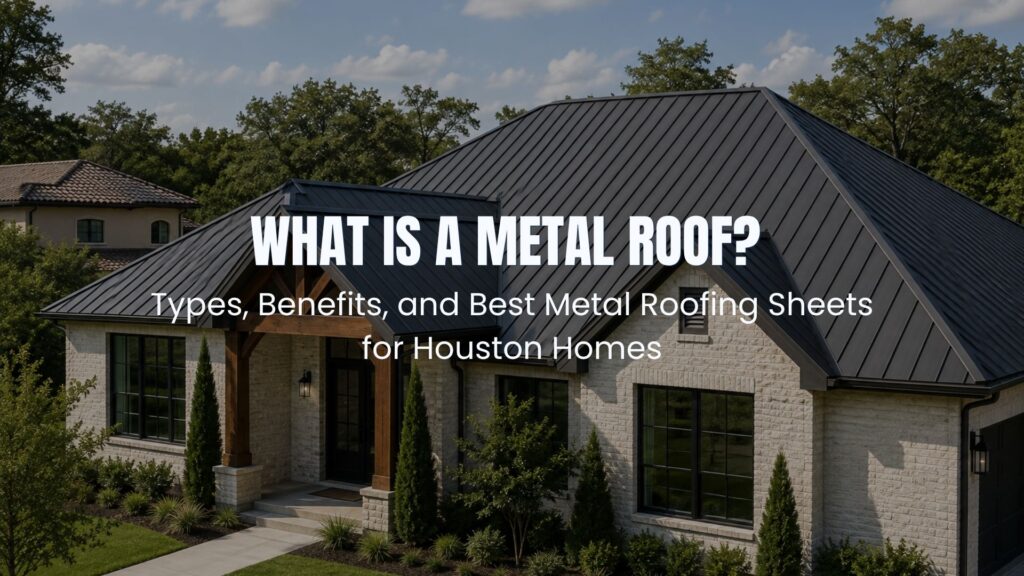
Quick Answer: What is a Metal Roof?
A metal roof is a roofing system made from metal panels, shingles, tiles, or sheets. The most common materials include aluminum, steel, copper, and zinc.
Unlike asphalt shingles, which use an organic or fiberglass mat covered with asphalt and mineral granules, metal roofing relies on formed metal panels or interlocking pieces to shed water and protect the home. Depending on the material, profile, coating, roof assembly, and installation quality, a metal roof can provide decades of service with relatively low routine maintenance.
Metal roofing generally costs more upfront than asphalt shingles. However, many homeowners choose it for its long service life, resistance to heat and moisture, design flexibility, and potential performance advantages during severe weather.
The most important point is that a metal roof is not simply a sheet of metal. It is a complete system that includes the panels, underlayment, fasteners or clips, flashing, ventilation, roof decking, and installation details.
Metal Roofing Basics
What is a metal roof?
A metal roof is a roofing system in which the primary weather barrier consists of formed metal panels, shingles, tiles, or sheets. These components are installed over a roof deck and underlayment, then connected with exposed fasteners, concealed clips, interlocking seams, or other approved attachment methods.
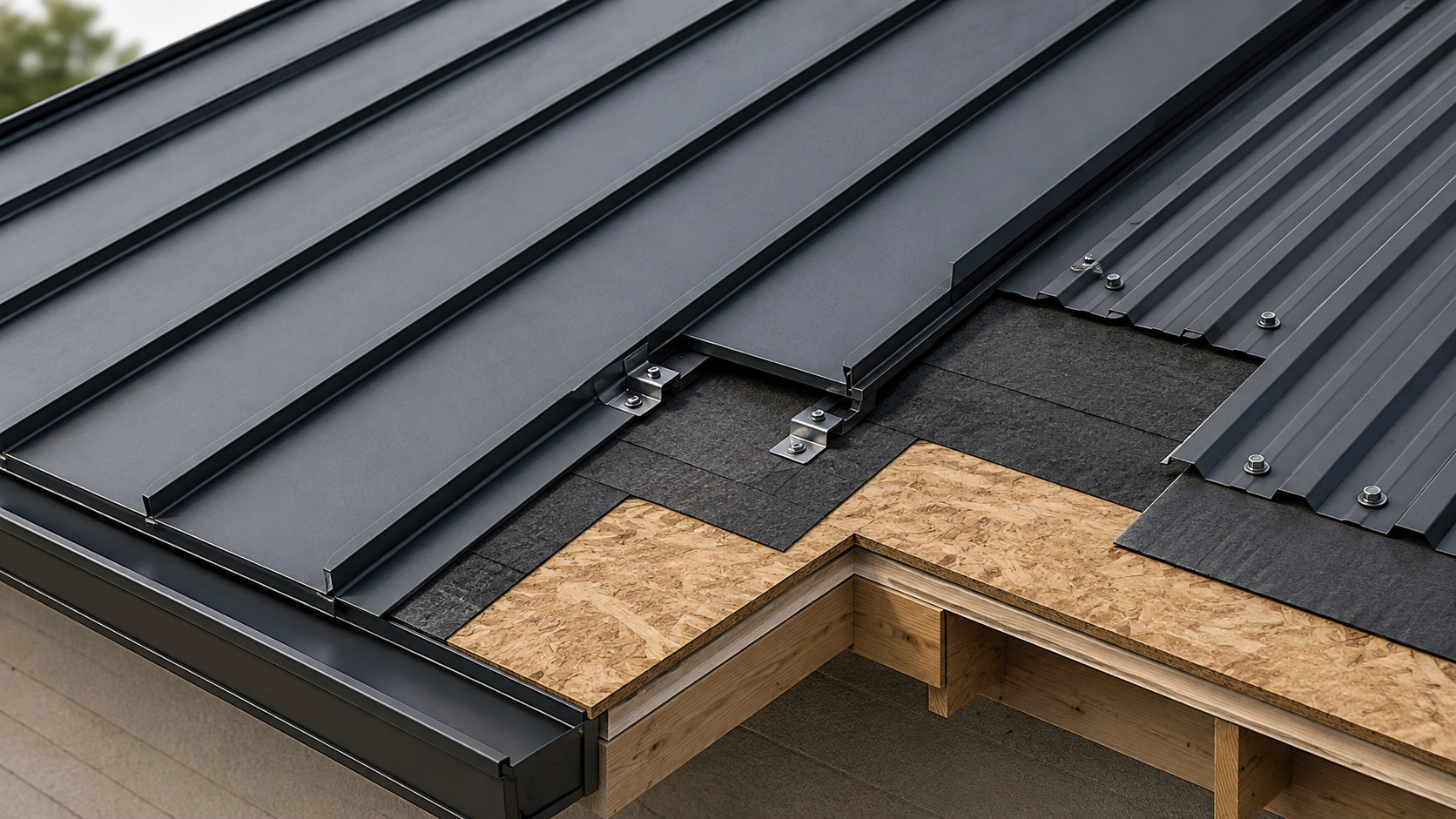
The panel profile and fastening system determine how the roof:
-
Sheds rainwater.
-
Handles wind uplift.
-
Accommodates thermal expansion and contraction.
-
Resists corrosion.
-
Performs around chimneys, skylights, valleys, and other penetrations.
-
Maintains its appearance over time.
Metal roofing is available in many designs. A basic exposed-fastener panel on a patio cover and a premium concealed-fastener standing seam system on a residence are both metal roofs, but they are not equivalent products.
Their expected performance can differ significantly based on:
-
The metal substrate.
-
Panel thickness or gauge.
-
Coating and finish.
-
Roof slope.
-
Underlayment.
-
Fasteners and clips.
-
Flashing details.
-
Ventilation.
-
Installation workmanship.
What are metal roofing sheets?
“Metal roofing sheets” generally refers to flat or formed pieces of metal used to cover a roof. In residential roofing, the more common terms are:
-
Metal roofing panels.
-
Metal roof sheets.
-
Standing seam panels.
-
R-panel roofing.
-
Corrugated metal panels.
-
Metal shingles.
-
Interlocking metal tiles.
These products can be manufactured from aluminum, Galvalume-coated steel, galvanized steel, copper, zinc, or other approved metals.
The term “sheet metal roof” is sometimes used conversationally, but “metal roofing sheets” and “metal roof panels” are more precise terms for homeowners researching roofing options.
How does a metal roof work?
Metal panels are shaped to direct water toward the roof edge, gutters, and downspouts. Seams, laps, fasteners, clips, and flashing are designed to limit water intrusion while allowing the roof to withstand movement and weather exposure.
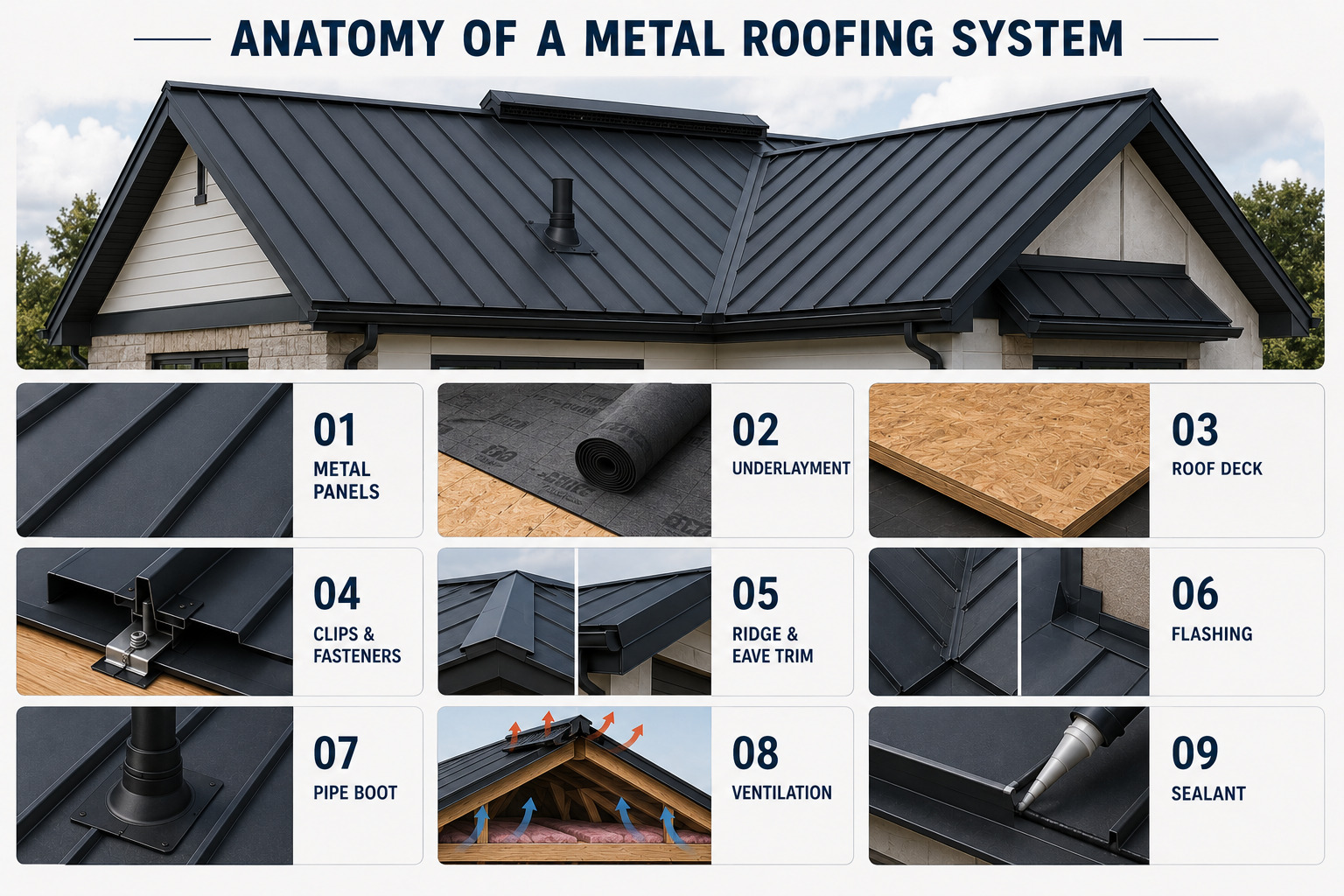
A complete metal roofing system typically includes:
-
Metal panels, shingles, or tiles.
-
Synthetic or high-temperature underlayment.
-
Roof decking, usually plywood or OSB.
-
Fasteners, clips, or concealed attachment systems.
-
Ridge caps and eave trim.
-
Valley and sidewall flashing.
-
Pipe boots and penetration flashing.
-
Intake and exhaust ventilation.
-
Sealants used where required by the system manufacturer.
At Achilles Roofing, we often emphasize the difference between the metal itself and the roofing system around it. A high-quality panel can still perform poorly if the roof has inadequate underlayment, improper flashing, incompatible fasteners, or no provision for thermal movement.
Metal Roofing Types
Metal roofing is not one product. The following profiles are among the most common options for residential and light-commercial applications.
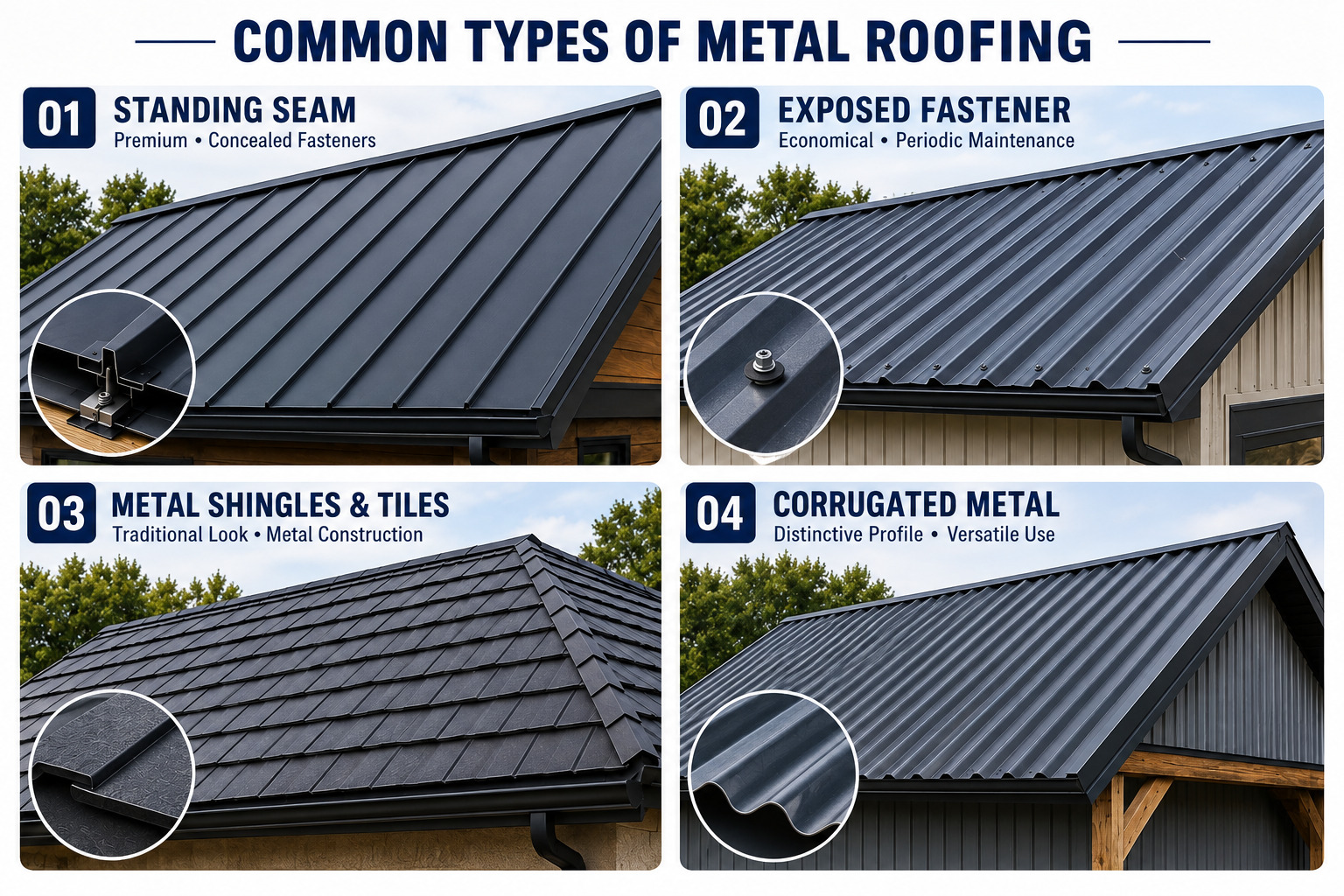
Standing seam metal roofing
Standing seam roofing uses long metal panels with raised vertical seams. The panels are usually attached with concealed clips rather than screws installed through the visible face of the panel.
A floating clip system can allow the panels to expand and contract as temperatures change. This makes the fastening design especially important in climates such as Houston, where roof surfaces experience intense summer heat and regular temperature changes.
Potential advantages include:
-
Clean, modern appearance.
-
Fewer exposed fastener penetrations.
-
Long panel lengths.
-
Strong resistance to water entry when properly designed.
-
Compatibility with aluminum and steel substrates.
-
Options for high-performance coatings.
-
Low routine maintenance compared with many exposed-fastener systems.
Standing seam is often selected for premium residential roofs, but it is not automatically the best choice for every property. The correct panel, seam type, clip spacing, substrate, and minimum roof slope must be confirmed using the manufacturer’s specifications.
Best for: Homeowners who want a premium appearance, long-term durability, and a concealed-fastener system.
Exposed-fastener panels
Exposed-fastener panels are attached with screws that pass through the face of the panel. The screws typically use washers designed to seal the penetration.
These systems are often less expensive than concealed-fastener standing seam systems and can be suitable for:
-
Patio covers.
-
Garages.
-
Workshops.
-
Agricultural buildings.
-
Barndominiums.
-
Accessory structures.
-
Some residential roof applications.
The primary maintenance concern is the exposed fastener system. Washers, screws, panel laps, and sealants should be inspected periodically because heat, ultraviolet exposure, weather, and movement can affect their performance.
The cost and service life of exposed-fastener panels vary considerably. Avoid comparing them with standing seam roofing solely by the type of metal. The panel thickness, coating, roof assembly, slope, and installation quality also matter.
Best for: Budget-conscious projects and secondary structures where periodic inspection and maintenance are acceptable.
Metal shingles and interlocking tiles
Metal shingles and tiles are stamped or formed to resemble traditional roofing materials such as:
-
Asphalt shingles.
-
Cedar shakes.
-
Slate.
-
Clay tile.
-
Concrete tile.
They allow homeowners to receive the appearance of a conventional roof while using a metal-based roofing system. Depending on the product, the pieces may interlock or attach using concealed fasteners.
Potential advantages include:
-
Greater design flexibility.
-
A more traditional appearance.
-
Compatibility with some HOA requirements.
-
Lower weight than concrete or clay tile.
-
Options for impact-rated products.
-
Use on complex roof sections and architectural features.
Not every metal shingle or tile has the same attachment method or impact classification. Homeowners should review the product’s installation manual and testing documentation before assuming that a particular system carries a specific rating.
Best for: Homeowners who want metal roofing performance without the appearance of broad vertical panels.
Corrugated metal panels
Corrugated panels have a repeating wave or rib pattern. They are commonly used on agricultural buildings, workshops, outbuildings, and architectural projects.
Corrugated roofing can also be used on residential structures when it is properly specified and installed. However, homeowners should distinguish between architectural-grade corrugated products and basic agricultural panels.
Important considerations include:
-
Whether the roof has solid decking.
-
The type of underlayment.
-
Panel thickness and finish.
-
Fastener quality.
-
Flashing details.
-
Rain noise.
-
Ventilation and insulation.
-
The manufacturer’s minimum slope requirements.
A corrugated roof installed over solid decking, insulation, and an appropriate underlayment can perform very differently from an agricultural panel installed over open framing.
Best for: Accessory structures, agricultural-style homes, modern architectural designs, and projects where the ribbed appearance is intentional.
Metal Materials and Benefits
Aluminum roofing
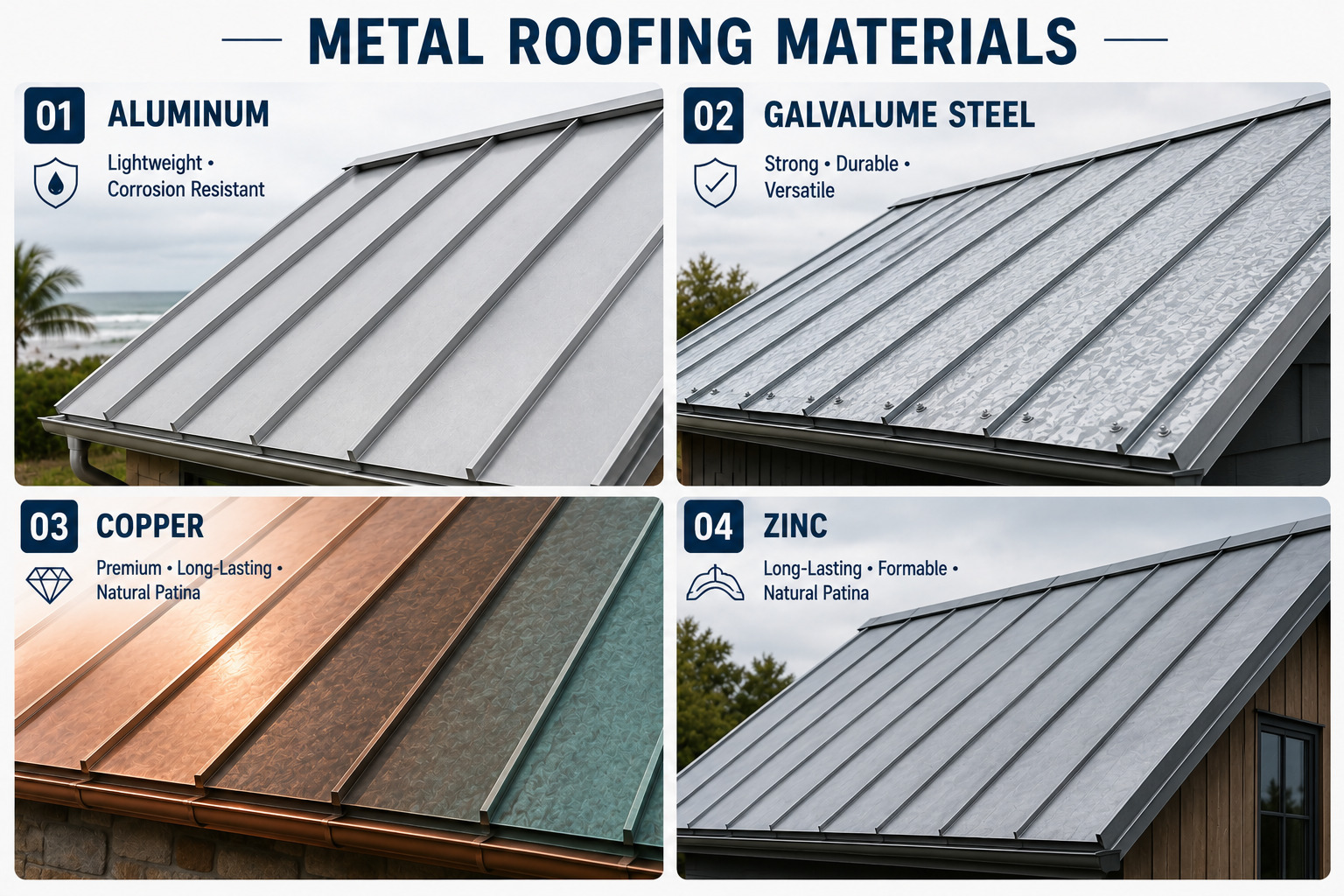
Aluminum is lightweight and naturally resistant to rust because it forms a protective oxide layer when exposed to air. This makes it a popular option for humid, coastal, and salt-air environments.
Aluminum may be especially worth considering for Houston properties with greater exposure to:
-
Gulf air.
-
Saltwater.
-
Brackish water.
-
Persistent humidity.
-
Heavy rainfall.
-
Corrosive environmental conditions.
Aluminum does not eliminate every roofing concern. The finish, fasteners, flashing, cuts, penetrations, and installation details still affect long-term performance. Homeowners should also understand that aluminum can be more susceptible to visible denting than harder steel products at comparable thicknesses.
Galvalume steel roofing
Galvalume is carbon steel coated with an aluminum-zinc alloy. It combines the strength of steel with added corrosion resistance from the coating.
Potential advantages include:
-
Greater hardness than aluminum.
-
Good resistance to denting at comparable thicknesses.
-
Broad product availability.
-
Many color and profile choices.
-
Lower material cost than some aluminum systems.
Coated steel is not equally suitable for every environment. Properties with substantial salt-air exposure should be evaluated using the exact product warranty and manufacturer recommendations. Aluminum generally provides a stronger corrosion-resistance advantage in harsh coastal environments, but the appropriate choice depends on the property and the specific product. Source: Sheffield Metals International
Copper roofing
Copper is a premium roofing material known for its appearance, workability, and long service potential. Over time, it develops a natural patina that changes its color and helps protect the surface.
Copper is commonly used for:
-
Custom homes.
-
Historic restorations.
-
Bay roofs.
-
Dormers.
-
Cupolas.
-
Porches.
-
Architectural accents.
It is substantially more expensive than standard aluminum or steel roofing and requires careful detailing around materials that could create galvanic corrosion. Copper runoff can also stain certain masonry and exterior surfaces.
Zinc roofing
Zinc develops a protective patina and can be formed into complex shapes. It is more common in high-end architectural projects than in standard residential construction.
Potential advantages include:
-
Long service life.
-
Natural patina.
-
No conventional paint coating required.
-
Suitability for curved or complex roof forms.
-
Distinctive architectural appearance.
Zinc requires experienced design and installation. Availability, lead times, material cost, and runoff management should all be considered before selecting it for a Houston home.
Houston Benefits
Houston’s heat, humidity, rainfall, ultraviolet exposure, and severe storms make roofing material selection especially important. Metal roofing is not automatically the right answer for every house, but the following benefits may make it attractive to local homeowners.
Long service life
A properly designed and installed metal roof can last for several decades. Many metal roofing systems are commonly associated with service lives of approximately 40–70 years, although the actual result depends on the material, coating, weather exposure, maintenance, and workmanship.
A roof’s service life is also affected by the components around the panels. Flashing, sealants, fasteners, roof penetrations, and underlayment may require attention before the metal panels themselves reach the end of their useful life.
For this reason, homeowners should evaluate the warranty and expected life of the entire roof system, not only the panel material.
Heat and energy performance
Metal roofing can help reduce heat absorption when it uses a reflective finish with suitable solar reflectance and thermal emittance.
A cool roof reflects more sunlight and releases more absorbed heat than a conventional dark roof. The Department of Energy notes that cool roofs can reduce annual air-conditioning energy use in some hot-climate applications, although the actual savings depend on the building and roofing assembly. Source: ENERGY
The result for a particular Houston home depends on:
-
Roof color.
-
Coating type.
-
Solar reflectance.
-
Thermal emittance.
-
Attic insulation.
-
Ventilation.
-
Roof orientation.
-
HVAC efficiency.
-
Home size and design.
-
Existing air leaks.
A metal roof does not automatically make a house cooler, and it does not guarantee a specific reduction in utility bills. Ask for the tested performance data for the exact roofing product being considered.
Resistance to rain and moisture
Metal panels do not absorb water in the same way that many organic roofing materials can. Properly formed panels also shed rain efficiently when the roof slope, seams, flashing, and drainage system are correctly designed.
However, metal roofing is not waterproof simply because it is metal. Leaks can occur at:
-
Panel seams.
-
Fasteners.
-
Valleys.
-
Skylights.
-
Chimneys.
-
Wall intersections.
-
Pipe penetrations.
-
Improperly installed flashing.
-
Damaged or deteriorated sealants.
In Houston, installation quality and drainage details are just as important as the panel material.
Wind and impact performance
Some metal roofing systems are tested for high wind uplift and impact resistance. However, ratings belong to the specific tested assembly—not to all metal roofs as a category.
Performance can depend on:
-
Panel profile.
-
Metal thickness.
-
Seam design.
-
Clip spacing.
-
Fastener type.
-
Roof deck.
-
Underlayment.
-
Edge details.
-
Installation method.
-
Product testing.
UL 2218 Class 4 is an impact-resistance classification that applies to qualifying tested products. Not every metal panel carries this classification, and Class 4 does not mean that the roof cannot sustain cosmetic damage during a severe hailstorm.
Similarly, wind ratings such as 130 mph or higher must be tied to the exact roofing assembly and installation requirements. Homeowners should request the product’s testing and installation documentation rather than relying on a general marketing statement.
Corrosion resistance
Aluminum, copper, and zinc do not rust in the same way that unprotected steel does. Galvalume and galvanized steel use protective coatings to slow corrosion.
For a Houston property, material selection should consider:
-
Distance from the Gulf or saltwater.
-
Exposure to prevailing winds.
-
Nearby bays, marshes, or industrial pollutants.
-
Panel cuts and penetrations.
-
Fastener compatibility.
-
Coating type.
-
Manufacturer warranty limitations.
-
Maintenance access.
A simple “within 50 miles of the coast” rule may be too broad. Corrosive exposure can vary significantly between properties, and manufacturers may use different warranty limitations. Aluminum is often favored in harsher coastal environments, while coated steel may remain a practical option farther inland or in less corrosive settings. Source: Sheffield Metals International
Lower routine maintenance
Metal roofing typically requires less routine maintenance than many asphalt roofing systems, but “maintenance-free” is not accurate.
A metal roof should still be inspected periodically for:
-
Loose or damaged fasteners.
-
Failed sealants.
-
Corrosion.
-
Scratched finishes.
-
Damaged flashing.
-
Blocked valleys.
-
Debris accumulation.
-
Tree branches.
-
Storm damage.
-
Deterioration around penetrations.
Standing seam systems reduce the number of exposed fasteners, which can simplify maintenance. Exposed-fastener systems require closer attention to screws, washers, laps, and sealants.
Lightweight construction
Metal roofing is generally lighter than concrete tile, clay tile, and natural slate. In some replacement projects, its lower weight can reduce structural concerns compared with heavier roofing materials.
That does not mean structural review is never necessary. The existing roof deck, framing, previous roofing layers, water damage, additions, and local building requirements should be evaluated before installation.
Recyclability and design flexibility
Steel and aluminum roofing products can be recycled at the end of their useful life. Metal roofing also provides a wide range of colors, textures, profiles, and finishes.
Homeowners can choose a system that looks:
-
Traditional.
-
Modern.
-
Industrial.
-
Architectural.
-
Similar to slate or tile.
-
Similar to asphalt shingles.
-
Appropriate for a specific HOA or neighborhood.
Finish performance varies by product. Ask whether the panel uses a PVDF, SMP, or other coating system, and review the actual color, chalk, fade, and substrate warranties.
Potential insurance credits
Some impact-resistant roofing products may qualify for an insurance credit in Texas. The amount is not universal and depends on the homeowner’s insurance company, policy, product documentation, roof classification, and other requirements.
The Texas Department of Insurance explains that qualifying roofing materials may be eligible for premium discounts and that contractors must complete Form PC068 after installation for applicable policies. Homeowners should confirm the requirements and potential savings with their insurance agent before signing a roofing contract. Source: Texas Department of Insurance
An impact-resistant roof may also be subject to a cosmetic-damage exclusion. Texas recognizes Endorsement HO-145, which can exclude hail damage that affects the appearance of a roof but does not affect its ability to keep out water. Source: Texas Department of Insurance
A lower premium does not necessarily mean that all hail damage will be covered. Review the policy carefully.
Choosing a System
Aluminum or steel?
Aluminum may be a strong choice for properties with greater coastal or salt-air exposure because of its corrosion resistance. Galvalume steel may be attractive where strength, availability, and initial material cost are priorities.
The best choice depends on:
-
Property location.
-
Exposure conditions.
-
Roof design.
-
Desired appearance.
-
Budget.
-
Hail risk.
-
Product warranty.
-
Contractor experience.
-
Availability of compatible accessories.
The material should be selected together with the panel profile, coating, fasteners, flashing, and underlayment.
What gauge should homeowners choose?
A thicker panel may improve dent resistance, but gauge alone does not determine the performance of a metal roof. The material type, alloy, panel design, support spacing, impact testing, and installation also matter.
Homeowners should ask:
-
What is the exact panel thickness?
-
What metal is being used?
-
Is the product impact-rated?
-
What does the manufacturer recommend for hail-prone areas?
-
Does the warranty cover cosmetic damage?
-
Are the trim and flashing made from compatible materials?
-
Will thicker material affect the project cost?
Avoid treating one thickness as the correct choice for every Houston property.
Which finish is best?
Metal roofing is commonly available with finishes such as PVDF or silicone-modified polyester. PVDF finishes are often selected for premium color retention and ultraviolet performance, while SMP finishes may provide a more budget-friendly option.
The correct finish depends on:
-
Color.
-
Roof exposure.
-
Budget.
-
Warranty requirements.
-
Desired resistance to chalking and fading.
-
Visibility of oil canning.
Darker, glossier, and wider panels may make oil canning more noticeable. Matte finishes, textured coatings, striated panels, and narrower pan widths may reduce its appearance, but oil canning cannot always be eliminated completely.
What is oil canning?
Oil canning is visible waviness or rippling in the flat areas of metal panels. It can result from manufacturing stress, handling, thermal movement, panel width, installation conditions, or irregularities in the roof substrate.
Oil canning is generally considered an aesthetic characteristic rather than a structural failure. It does not automatically indicate that a roof is leaking or unsafe.
Homeowners concerned about oil canning should discuss the following before installation:
-
Panel width.
-
Color and finish.
-
Metal thickness.
-
Striated or ribbed options.
-
Substrate condition.
-
Clip and fastening layout.
-
Manufacturer tolerances.
Is metal roofing noisy?
A metal roof can sound louder than asphalt when installed over open framing without solid decking, insulation, or underlayment.
On a typical residential assembly with a solid roof deck, underlayment, attic insulation, and finished interior ceilings, rain noise is usually substantially reduced. The roof assembly—not just the metal panel—determines the acoustic result.
What should a homeowner ask a contractor?
Before hiring a metal roofing contractor, ask for:
-
The exact manufacturer and product line.
-
The panel profile and material.
-
The panel thickness.
-
The finish type and warranty.
-
The required roof slope.
-
Wind and impact testing documentation.
-
Underlayment specifications.
-
Flashing and ventilation details.
-
Fastener or clip specifications.
-
A written scope of work.
-
Workmanship warranty terms.
-
References for similar projects.
-
Documentation needed for insurance or windstorm certification.
A contractor should be able to explain why a particular system fits the property rather than recommending a generic sheet of metal.
Metal vs. Asphalt
Metal roofing is often worth considering for homeowners who plan to stay in their homes for many years and value durability, appearance, and lower routine maintenance. Asphalt shingles may remain a practical choice for homeowners prioritizing a lower initial investment or expecting to sell soon.
The right decision depends on the roof’s condition, the homeowner’s ownership plans, the property’s exposure, and the available budget.
Frequently Asked Questions
How long does a metal roof last in Houston?
Many properly specified and installed metal roofing systems are designed to last for several decades. Aluminum and premium steel systems may have expected service lives of approximately 40–70 years, but actual performance depends on material, coating, roof assembly, weather exposure, maintenance, and installation quality.
A manufacturer’s warranty is not the same as a guaranteed service life. Review both the material warranty and the contractor’s workmanship warranty.
What is the best metal roofing material for Houston?
There is no single material that is best for every Houston property.
Aluminum is often considered for homes with stronger coastal or salt-air exposure because it is highly resistant to corrosion. Galvalume steel may be a practical choice farther inland or when strength and initial material cost are priorities. Copper and zinc are premium options for custom designs and architectural details.
The final recommendation should be based on the property’s exposure, roof design, budget, and the manufacturer’s warranty requirements.
Does a metal roof make a house hotter?
Not necessarily. A metal roof with a suitable reflective finish can reduce solar heat absorption. However, indoor comfort and energy savings also depend on attic insulation, ventilation, roof color, HVAC efficiency, home orientation, and air sealing.
A metal roof should not be marketed as an automatic guarantee of lower energy bills.
Do metal roofs rust in Houston?
Aluminum, copper, and zinc do not rust in the same way as unprotected steel. Galvalume and galvanized steel use protective coatings to resist corrosion.
Coated steel can still be affected by harsh salt-air exposure, damaged coatings, incompatible fasteners, poor flashing, and unprotected cuts. Homeowners should review the product’s environmental limitations and warranty before selecting a steel system.
Can hail damage a metal roof?
Yes. Metal roofing can sustain visible dents from large hail, particularly when lighter-gauge aluminum is used. A dent may be cosmetic, but hail can also damage seams, coatings, flashing, vents, and other components.
Impact-resistant products may reduce the risk of functional damage, but no roofing material is completely hail-proof. Ask the contractor for the product’s impact classification and confirm how the insurance policy treats cosmetic damage.
Are metal roofs loud when it rains?
They can be loud when installed over open framing without a solid roof deck, insulation, or underlayment. A properly assembled residential metal roof generally provides substantially better sound control than an exposed agricultural-style installation.
The contractor should explain the complete roof assembly, not just the panel material.
Can metal roofing be installed over shingles?
Sometimes, but the answer depends on local requirements, the existing roof condition, the number of roofing layers, the panel system, ventilation, and the manufacturer’s installation instructions.
A contractor should inspect the roof deck and existing shingles before recommending an overlay. In some cases, a tear-off is necessary to identify rot, water damage, inadequate decking, or improper prior repairs.
Can a metal roof qualify for a Texas insurance discount?
Some qualifying impact-resistant roofing products may be eligible for an insurance credit. The amount and requirements vary by insurer and policy. TDI Form PC068 may be required for applicable policies, but homeowners should confirm the process with their insurance agent. Texas Department of Insurance
Do not assume that every metal roof automatically qualifies for a discount.
Does a Houston metal roof need windstorm certification?
Properties in designated Texas windstorm areas may require documentation showing that certain construction or repair work meets applicable windstorm requirements. A WPI-8 certificate relates to compliance with those requirements; it is not automatically granted simply because the roof is made from metal.
Ask the contractor whether the project requires windstorm documentation and who will coordinate the inspection or certification.
How much does a metal roof cost in Houston?
The price depends on:
-
Roof size and pitch.
-
Panel profile.
-
Aluminum versus steel.
-
Panel thickness.
-
Coating.
-
Tear-off and disposal.
-
Roof decking repairs.
-
Flashing and ventilation.
-
Roof penetrations.
-
Labor and project complexity.
-
Required permits and documentation.
Standing seam aluminum roofing generally costs more than basic exposed-fastener panels or asphalt shingles. For a project-specific estimate, a contractor should inspect the roof and provide a written scope of work.
Get a Metal Roof Assessment
Achilles Roofing & Exteriors provides roof inspections, replacement services, and metal roofing guidance for homeowners across the Houston area, including Houston, Katy, Cypress, Sugar Land, The Woodlands, Pearland, and Spring.
Written fixed-price estimate · GAF Certified Plus · 610+ Reviews · Financing from $199/mo
 Call (832) 346-8021
 About Achilles Roofing & Exterior
Houston’s specialist in full roof replacements, Spanish tile, clay tile, copper, and high-end exterior systems. Founded 2017. 610+ Reviews · 4.90-star Google · 5.0 Thumbtack · Founded by Ahmad Faiz.
Mailing: 1919 W Sam Houston Pkwy N, Unit #110, Houston, TX 77043 — (832) 346-8021
The Woodlands Office: 2002 Timberloch Pl, Suite 200, The Woodlands, TX 77380 — (281) 771-0303
Warehouse: 16310 Cypress Bend Drive, Cypress, TX 77429 — (832) 353-2383
Sources
- U.S. Department of Energy (DOE). Energy Saver: Cool Roofs. U.S. Department of Energy. (Outlines cool roof technology performance metrics; details how high solar reflectance and thermal emittance lower roof surface temperatures, reduce peak cooling demand, and lower energy costs in warm climates.)
- Sheffield Metals. Galvalume® Steel vs. Aluminum: What Metal Roof Material Should I Pick? Sheffield Metals Learning Center. (Compares performance parameters of Galvalume steel versus aluminum standing seam systems; details Galvalume’s 55% Al-Zn coating, self-healing edge corrosion resistance, and cost efficiency versus aluminum’s superior salt-air corrosion resistance in coastal environments.)
- Texas Department of Insurance (TDI). Products Qualifying for Impact-Resistant Roofing Credits. Texas Department of Insurance. (Defines eligibility criteria and testing guidelines for residential impact-resistant roof coverings tested under UL 2218; mandates TDI Form PC068 installation certification and product labeling requirements to qualify for insurance premium credits.)
- Texas Department of Insurance (TDI). Commissioner’s Bulletin # B-0030-98: Mandatory Premium Credits for Impact Resistant Roof Coverings & Endorsements HO-145 / TDP-022. Texas Department of Insurance. (Establishes mandatory insurance premium credit schedules by territory for UL 2218 Class 1–4 impact-resistant roofs; introduces optional cosmetic damage exclusions for hail claims under Endorsement HO-145 and TDP-022.)