Quick Answer: Is Aluminum Metal Roofing or Steel Roofing Better for Houston Homes?
In the aluminum vs. steel roofing comparison for Houston homes, the decisive difference is corrosion resistance: aluminum’s self-healing oxide layer regenerates automatically when scratched or struck, while Galvalume’s zinc-aluminum coating degrades over time at cut edges, fastener holes, and hail-strike locations in salt-air environments.
Aluminum also runs lighter at 1.0–1.5 lbs/sq ft versus steel’s 1.5–2.5 lbs/sq ft, reflects more solar heat (50–95% vs. 25–70%), and requires near-zero maintenance over its 50–70 year service life. Galvalume steel’s advantages are physical dent resistance — it is a harder metal and resists cosmetic hail denting better at equivalent gauge — and a lower upfront installed cost, typically $1–$3 per square foot less than aluminum. Both materials achieve UL 2218 Class 4 and FM 4473 ratings and qualify for Texas Department of Insurance wind and hail premium discounts of 20–35%.
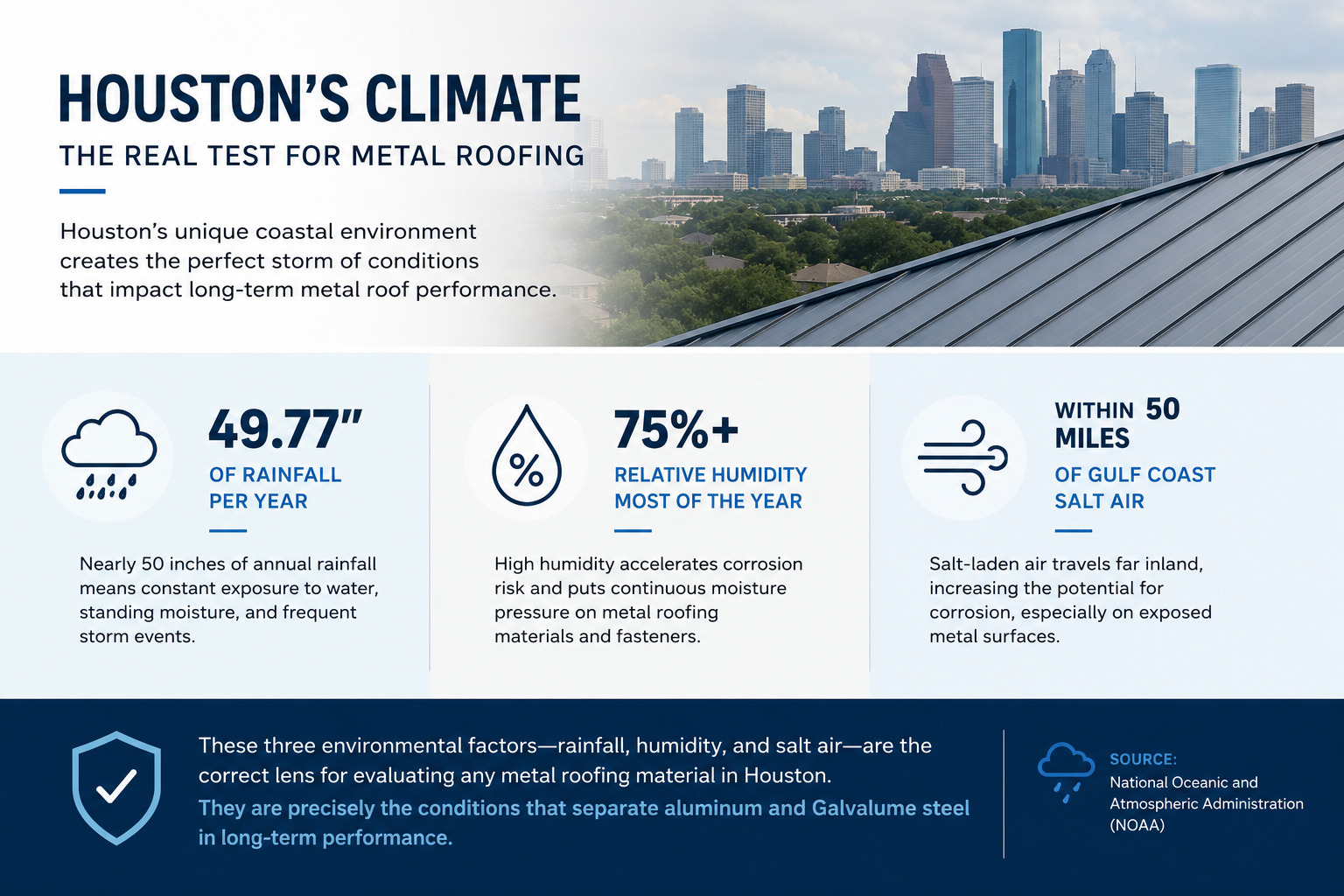
For most Houston homeowners within 50 miles of the Gulf Coast — which covers the majority of the metro — aluminum wins the aluminum vs. steel debate on a 40–70 year horizon because of its corrosion advantage. Steel is the stronger value choice further inland, where coastal salt exposure is lower and hail dent resistance is the primary concern.
The Core Difference: How Each Metal Protects Itself From Corrosion
Aluminum’s corrosion protection is intrinsic to the metal. Galvalume steel’s is a coating applied over it. In dry climates, that distinction is largely academic. In Houston’s coastal environment, it is the single most important variable in a metal roofing comparison.
Aluminum forms a thin aluminum oxide layer on contact with air. That layer is the metal’s natural corrosion barrier — and unlike a surface coating, it regenerates automatically when scratched, abraded, cut, or struck by hail. There is no primer to fail. No edge cut to rust. No coating to be consumed by salt air over time.
Galvalume steel is carbon steel coated with a zinc-aluminum alloy (typically 55% aluminum, 43.5% zinc, 1.5% silicon). That coating is highly effective and dramatically outperforms standard galvanized steel in most climates. But it is a coating — and coatings degrade. In near-coastal, high-humidity environments, zinc consumption at cut edges, fastener holes, and hail-strike locations accelerates over time. SINTEF’s long-term marine atmospheric research documents this degradation and identifies aluminum as the preferred metal for coastal construction specifically because it eliminates the coating-degradation failure mode entirely.
In the worst coastal environments, galvanized steel can develop red rust in under three years. Metal Construction News identifies aluminum, stainless steel, and copper as the three metals preferred for coastal construction — with aluminum’s self-regenerating oxide layer cited as the defining property that separates it from coated steel products in high-humidity environments.
Sources: SINTEF (2021); Metal Construction News (2024)
What “Galvalume” Actually Means — and Why It Matters
Galvalume is not raw steel. It is a zinc-aluminum alloy-coated steel product that outperforms galvanized steel but still relies on a surface coating for corrosion protection. Most standing seam and exposed-fastener steel panels sold for residential roofing in Houston in 2026 are Galvalume — not raw galvanized — and the comparison is more nuanced than the common framing of “steel rusts, aluminum doesn’t.”
Standard galvanized steel uses a pure zinc coating that sacrifices itself through galvanic protection when exposed to corrosion. Galvalume’s zinc-aluminum blend combines galvanic protection (from zinc) with barrier protection (from the aluminum content), which is why it outperforms galvanized steel in most published corrosion tests. The limitation is that both mechanisms rely on the coating remaining intact — and Houston’s environment works against that over time at cut edges, fastener penetrations, and hail-strike locations.
Aluminum Metal Roofing vs. Steel Roofing — Houston Performance Comparison
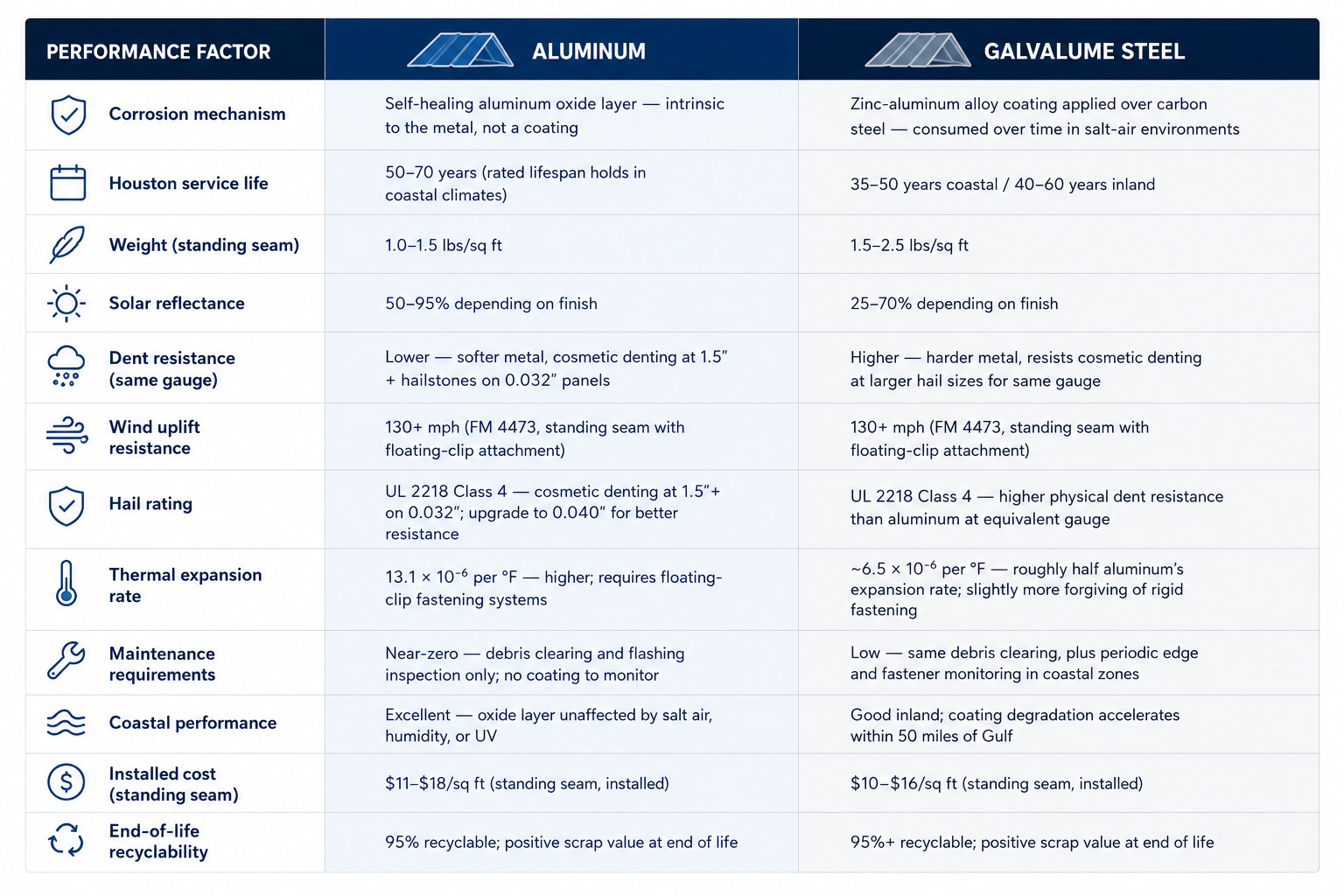
The table below compares aluminum and Galvalume steel standing seam across the seven performance factors that matter most in Houston’s climate. Each factor is evaluated through Houston’s lens — not a national average — because this market’s coastal exposure, hail frequency, and UV intensity sit at the high end of the U.S. range.
Where Aluminum Outperforms Steel in Houston
1. Corrosion Resistance Within 50 Miles of the Gulf Coast
Aluminum is the superior material for corrosion resistance in Houston’s coastal environment because its oxide layer regenerates automatically — Galvalume steel’s coating does not. For any property within approximately 50 miles of Galveston Bay — which covers Harris, Fort Bend, Brazoria, Galveston, and most of Montgomery County — this difference is the decisive long-term performance factor.
The Aluminum Association confirms that aluminum’s oxide layer reforms within minutes of air exposure, providing continuous corrosion protection without degradation. Galvalume’s zinc-aluminum coating, while excellent by coated-steel standards, begins degrading at cut edges and fastener holes in sustained high-humidity environments — precisely the failure mode SINTEF’s marine atmospheric corrosion research documents. Over a 50-year service window, the practical consequence is a roof that maintains full weather resistance without intervention versus one that requires increasing monitoring of edge and fastener conditions.
The Aluminum Association confirms that aluminum’s oxide layer reforms within minutes of air exposure, providing continuous corrosion protection without degradation — a property that directly supports the material’s 40-to-70-year residential service life in high-humidity coastal markets like Houston.
Source: The Aluminum Association
2. Thermal Performance — Reflects More Heat Out of Your Home
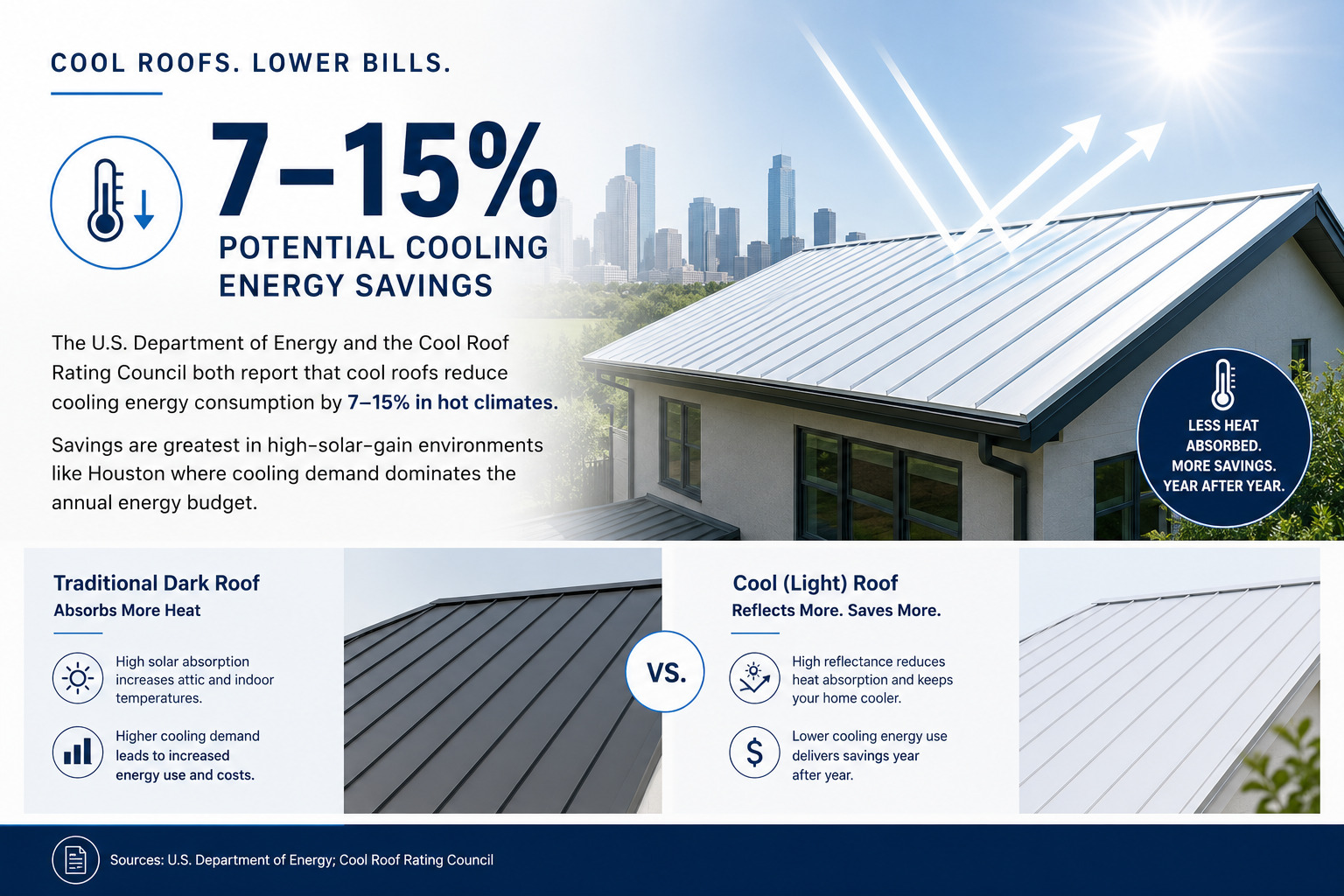
Aluminum reflects 50–95% of incoming solar radiation depending on finish; Galvalume steel reflects 25–70%. In Houston, where air conditioning runs eight to nine months per year, that gap translates to a measurable difference in cooling load and energy cost.
The mechanism is solar reflectance (SR) and thermal emittance (TE). High SR means the surface reflects incoming energy; high TE means it releases absorbed heat rather than storing it. Aluminum performs well on both measures, and its higher natural reflectance gives it an edge over steel even with identical paint systems — because aluminum’s substrate reflects more energy that reaches the metal behind the paint layer.
ENERGY STAR-designated cool roof products meeting minimum SR and TE thresholds are eligible for utility rebates through CenterPoint Energy and Entergy Texas in some service areas. Aluminum standing seam products qualify more readily than steel at equivalent finish grades due to the substrate’s higher inherent reflectance.
3. Weight — Structural Advantage on Older Houston Homes
Aluminum standing seam weighs 1.0–1.5 lbs per square foot. Galvalume steel weighs 1.5–2.5 lbs per square foot. On most replacement projects, the difference is academic. On Houston homes built in the 1960s–1980s with original rafter framing, it can eliminate the need for structural engineering review.
The majority of residential roofing work in Houston is replacement, not new construction — and existing structures have rated load limits. Installing a heavier material over original framing may require a structural assessment and potentially additional rafter support, adding cost and timeline. Aluminum installs over most existing Houston decks without either. For homeowners on older properties in neighborhoods like Meyerland, Garden Oaks, or Westbury, this distinction is practically relevant.
4. Long-Term Maintenance — What You Simply Won’t Have to Do
Aluminum’s near-zero maintenance profile means no coating to monitor, no edges to inspect for rust initiation, and no periodic sealant reapplication at fastener locations. In Houston’s coastal zones, Galvalume steel — while low-maintenance by most standards — requires periodic inspection of cut edges, fastener penetrations, and any hail-strike locations where the coating may be compromised.
That maintenance difference is not a minor convenience gap. It is a compounding performance advantage. A roof that maintains its weather resistance without active intervention over 50 years outperforms one that requires monitoring to catch coating degradation before it reaches the steel substrate. We see the consequences of deferred maintenance on Galvalume roofs in our tear-offs — early edge rust on 15–20-year-old steel installations in coastal zip codes that would not have appeared on aluminum at the same age.
Where Galvalume Steel Outperforms Aluminum in Houston
1. Dent Resistance — The Hail Advantage
Galvalume steel is harder than aluminum at the same gauge, making it physically more resistant to cosmetic denting from hailstones. Standard 24-gauge steel resists cosmetic denting at hail sizes that would dent standard 0.032-inch aluminum panels. In Houston zip codes with documented 2-inch or larger hail events, this is a legitimate specification advantage.
The critical distinction: neither material suffers structural failure from hail at its UL 2218 Class 4 rating. A dented aluminum or steel roof continues to perform its weather-resistance function correctly. The dents are cosmetic. But cosmetic denting affects insurance claims, resale perception, and some homeowners’ satisfaction with the installation.
Aluminum’s dent-resistance gap can be closed by upgrading gauge — from standard 0.032 inch to 0.040 inch — at an additional cost of approximately $1.30–$1.70 per square foot. Specifying 0.040-inch aluminum in Houston’s active hail corridors (particularly north and northwest of the city center) is the correct response to this limitation. For homeowners unwilling to absorb that gauge-upgrade cost, steel’s inherent hardness makes it the simpler path to dent resistance.
Doppler radar has detected hail at or near Houston on 272 occasions in recorded history, including 28 occasions in the past year. Harris County has recorded 248 hail reports since 2004 per StormerSite and NOAA Storm Prediction Center data, with the largest confirmed hailstone measuring 2.75 inches near Tomball. Texas has ranked first for hail damage claims for 11 consecutive years per the National Insurance Crime Bureau.
Sources: Interactive Hail Maps; National Weather Service Houston/Galveston; StormerSite / NOAA SPC; National Insurance Crime Bureau (NICB)
2. Upfront Cost — The Real Price Gap
Galvalume steel standing seam typically installs at $10–$16 per square foot; aluminum typically installs at $11–$18 per square foot — a gap of roughly $1–$2 per square foot across comparable panel profiles and gauge specifications. (Source: Angi, 2026)
On a 2,000-square-foot roof, that gap represents $2,000–$6,000 in installed cost. For homeowners with a defined budget ceiling, a short ownership horizon, or a property where the long-term corrosion advantage of aluminum is less decisive (further inland, lower humidity), steel’s lower upfront cost is a legitimate reason to choose it. The cost gap does not disappear when you look at lifetime cost — aluminum’s longer service life and lower maintenance cost close most of the gap over 40 years — but for cash-flow-constrained decisions, it is real.
3. Thermal Expansion — Slightly More Forgiving Installation
Aluminum expands and contracts at approximately 13.1 × 10⁻⁶ per °F — roughly twice steel’s expansion rate of ~6.5 × 10⁻⁶ per °F. In Houston, where roof surface temperatures swing from below 40°F in winter to over 150°F in direct summer sun, aluminum panels move significantly across each seasonal cycle. That movement must be accommodated by floating-clip attachment systems; rigid fastening causes panel buckling and fastener fatigue.
Galvalume steel’s lower expansion rate is slightly more forgiving of installer variation. It does not eliminate the need for floating-clip systems on standing seam — those are required for any metal panel in Houston’s temperature range — but it provides a narrower window of error during installation. This is an installer-quality argument more than a material argument. With an experienced aluminum installer, it is a non-issue.
The Houston Hail Problem: Aluminum vs. Steel, Side by Side
Both aluminum and Galvalume steel achieve UL 2218 Class 4 impact ratings — the highest classification for residential hail resistance — but they respond differently to hail at the physical level. Steel dents less visibly from large hailstones; aluminum recovers its corrosion barrier automatically even at dent locations.
- Standard aluminum (0.032 inch): Cosmetic dents from hailstones 1.5 inches or larger. Waterproofing unaffected. Oxide layer regenerates at impact sites — no corrosion initiation at dent locations.
- Upgraded aluminum (0.040 inch): Cosmetic dents from hailstones approximately 2 inches or larger. $1.30–$1.70/sq ft additional cost. Recommended in north/northwest Houston hail corridors.
- Standard Galvalume steel (24 gauge): Higher physical dent resistance than 0.032-inch aluminum. Dents from 2-inch or larger hailstones possible. Zinc-aluminum coating may be disrupted at impact sites — monitoring recommended in coastal zones.
- Heavy Galvalume steel (22 gauge): Highest dent resistance of the four options. Higher weight than aluminum equivalents. Marginally higher installed cost than standard steel.
The important framing: hail damage to either metal panel is a cosmetic issue. Hail damage to asphalt shingles is a structural performance issue — granule loss, weather barrier breach, and accelerated aging. A dented metal roof continues functioning. A hail-struck asphalt roof is degrading faster from the day of impact. That distinction matters when comparing metal roofing (either aluminum or steel) to asphalt, even if it does not resolve the aluminum-vs.-steel question.
UL 2218 Class 4 roofing systems qualify for 20–35% wind and hail premium discounts under Texas Department of Insurance guidelines — with annual savings of $500–$1,500 for most Houston homeowners depending on home value and coverage. Both aluminum and Galvalume steel standing seam systems regularly achieve Class 4 ratings.
Source: Texas Department of Insurance (TDI); Metal Roofing Alliance, 2025
Aluminum vs. Steel Roofing: Cost Comparison in Houston (2026)
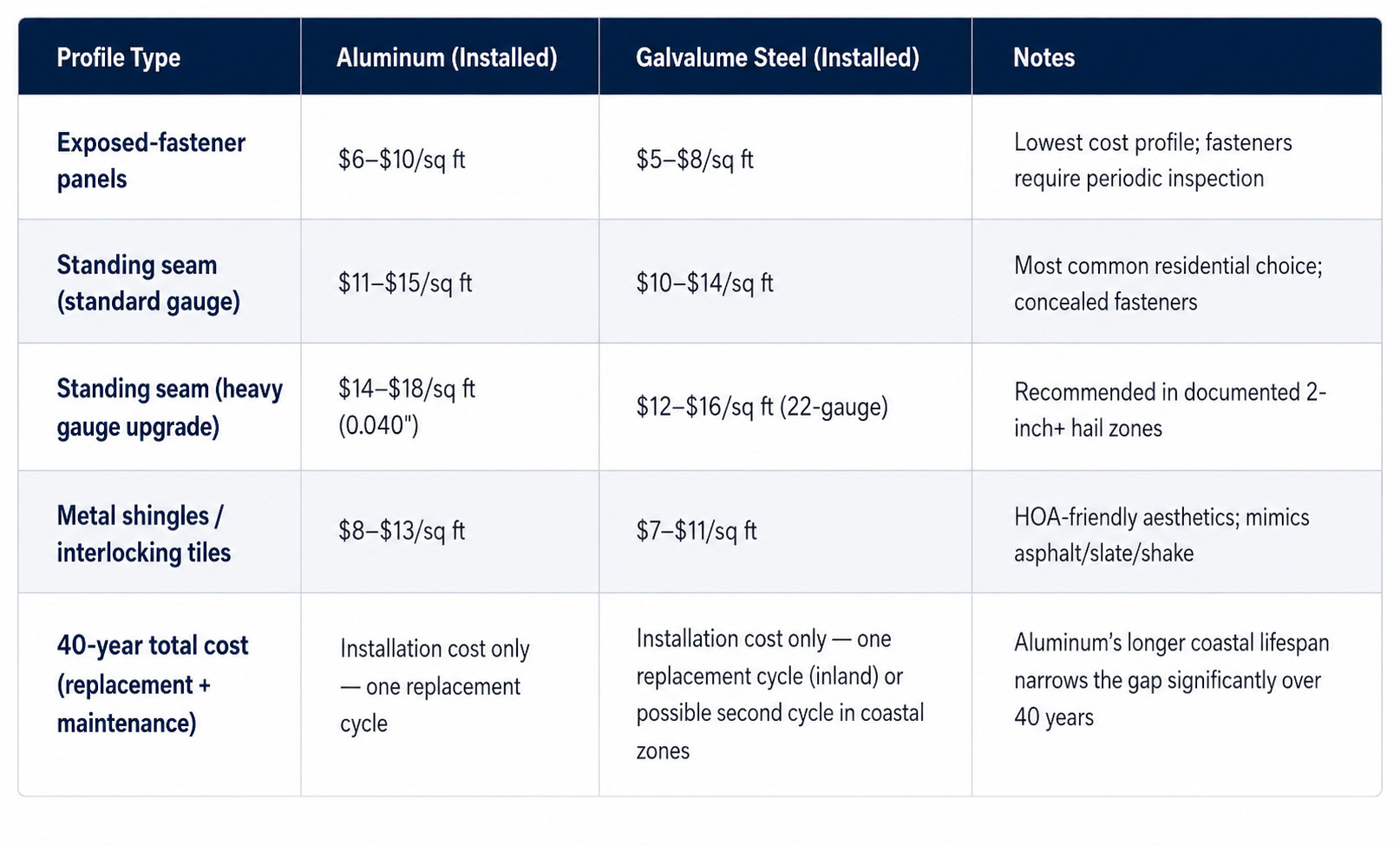
Installed cost varies by profile type, gauge, and panel width — not just material. The table below shows installed price ranges for each profile category based on current market data. All figures are for professional installation including underlayment, trim, and flashing. (Source: Angi, 2026)
Insurance Impact: Class 4 Ratings and TDI Discounts
Both aluminum and Galvalume steel standing seam systems regularly achieve UL 2218 Class 4 and FM 4473 ratings, qualifying Houston homeowners for 20–35% wind and hail premium discounts under Texas Department of Insurance guidelines. The discount applies regardless of which metal you choose — the rating is determined by the system’s tested performance, not the material.
The practical insurance considerations between the two metals are:
- Cosmetic damage claims: Aluminum’s softer surface may produce larger cosmetic dent claims after significant hail events. Most carriers offer Endorsement HO-145 (cosmetic damage exclusion) — a standard condition for receiving the full Class 4 discount. If your policy includes HO-145, cosmetic aluminum denting is excluded from claims. Understand your endorsements before choosing material based on dent concerns.
- TDI Form PC068: The contractor completes this form at project completion to activate the Class 4 discount with your carrier. Applies to both aluminum and steel installations. Ensure your contractor is familiar with this process — not all are.
- Annual savings: For a $500K Coverage A policy, a 25% Class 4 discount saves approximately $1,875 per year at a 1.5% base rate — over $75,000 across a 40-year service life. The insurance savings argument applies equally to both metals.
Most aluminum and steel standing seam systems are pre-approved for Texas WPI-8 windstorm certification in coastal counties, meaning installation in Harris, Galveston, and surrounding counties can proceed without individual engineering review — a significant timeline advantage over non-pre-approved roofing systems.
Source: Texas Department of Insurance (TDI)
The 5 Factors That Determine Which Metal Is Right for Your Houston Home
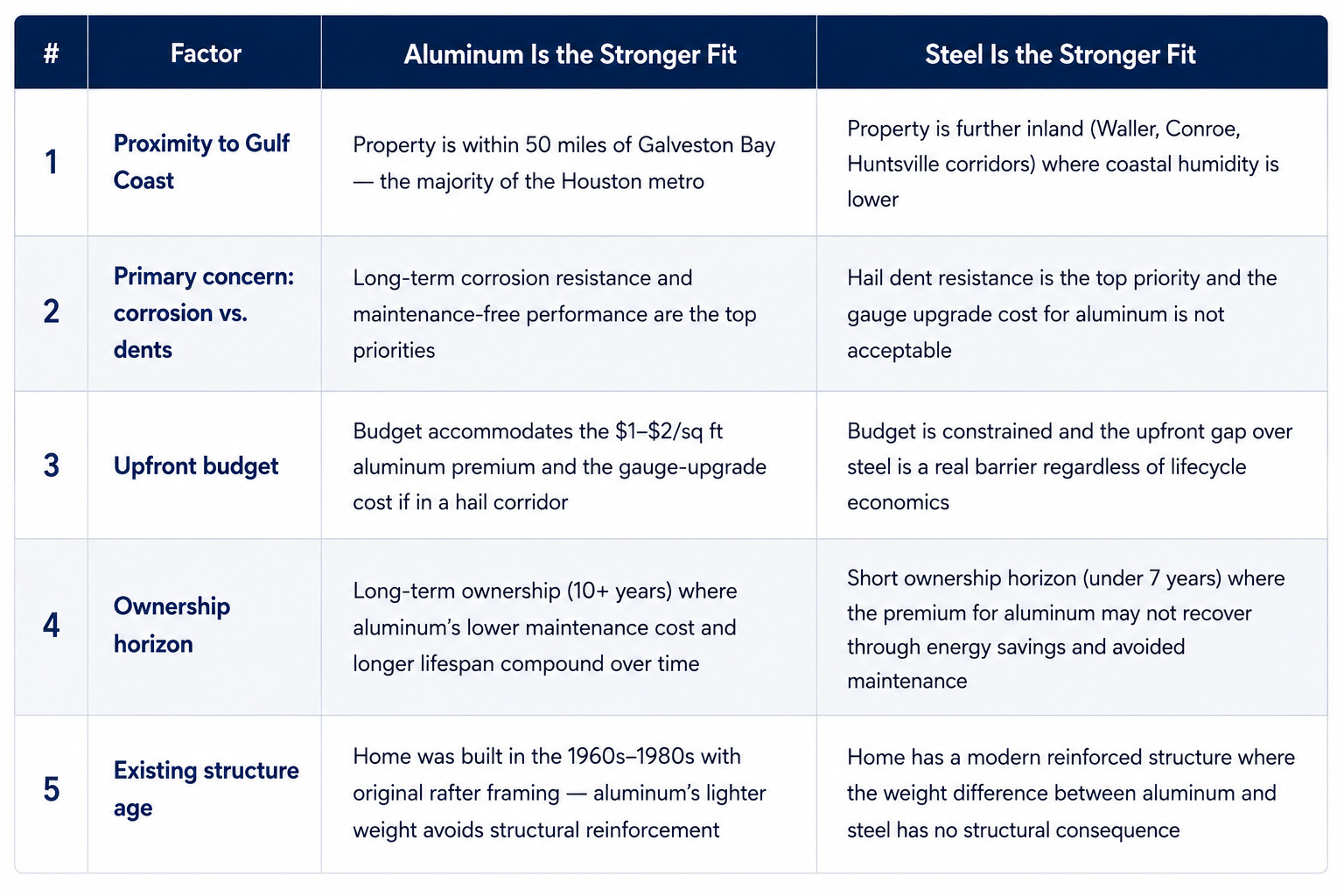
The aluminum vs. steel decision is not universal — it is property-specific. Five variables determine which material’s performance profile is the better match for a given Houston home and homeowner.
Our Position: Which We Recommend More Often and Why
In coastal Harris County and in properties within 30 miles of Galveston Bay, we recommend aluminum over Galvalume steel in the majority of cases — not because steel is a poor material, but because Houston’s combination of sustained humidity, salt air, and hail exposure is precisely the environment where aluminum’s self-healing oxide layer provides a performance advantage that compounds over decades.
A Galvalume roof installed on a coastal Houston property in 2026 will, in most cases, require more active monitoring in years 20–30 than an aluminum installation under the same conditions.
That said, we install Galvalume steel regularly — particularly on properties further inland, on projects where the gauge upgrade cost for aluminum’s hail resistance is the deciding factor, and on commercial applications where steel’s structural span capability is relevant. The right answer is property-specific, not material-universal. What we push back on is the framing that aluminum and steel are interchangeable in Houston’s climate. They are not.
Achilles Roofing’s own field assessment based on 610+ completed projects in the Houston metro and surrounding areas — not an independently published industry figure.
Frequently Asked Questions
Is aluminum or steel roofing better for Houston?
For most Houston homes within 50 miles of the Gulf Coast — which covers most of the metro — aluminum is the stronger long-term choice because its self-healing oxide layer provides corrosion resistance that Galvalume steel’s zinc-aluminum coating cannot match in sustained high-humidity, salt-air conditions. Galvalume steel is the better fit when hail dent resistance is the top priority, the budget cannot absorb aluminum’s upfront premium, or the property is located further inland where coastal corrosion exposure is lower.
How long does aluminum roofing last in Houston?
Aluminum roofing lasts 50–70 years in Houston’s climate. Unlike asphalt, which is rated at 20–30 years but realistically performs for 12–18 years in Houston’s heat and humidity, aluminum’s rated lifespan holds in coastal conditions because its oxide layer is unaffected by UV radiation, humidity cycling, and salt air.
How long does Galvalume steel roofing last in Houston?
Galvalume steel lasts 40–60 years in Houston’s inland areas and 35–50 years in coastal zones within 50 miles of the Gulf. Lifespan degradation in coastal zones is driven by accelerated zinc consumption at cut edges, fastener holes, and hail-strike locations — the three points where the protective coating is most vulnerable to Houston’s sustained humidity and salt air.
Does Galvalume steel rust in Houston’s humidity?
Standard Galvalume steel does not rust immediately — its zinc-aluminum coating provides significant corrosion resistance. But in Houston’s near-coastal environment, that coating degrades faster than it does in drier climates, particularly at cut edges and fastener penetrations. Over a 30–50-year service life, coastal Galvalume installations require more monitoring of edge and fastener conditions than aluminum, which regenerates its corrosion barrier automatically.
Which metal roof is more resistant to hail — aluminum or steel?
Galvalume steel is more physically dent-resistant than aluminum at the same gauge because it is a harder metal. Standard 24-gauge steel resists cosmetic denting at hail sizes that would dent standard 0.032-inch aluminum panels. However, upgrading aluminum to 0.040-inch gauge significantly narrows this gap. Both materials achieve UL 2218 Class 4 impact ratings, and neither suffers structural failure from hail — the difference is cosmetic denting only.
What is the price difference between aluminum and steel roofing in Houston?
Galvalume steel standing seam typically installs at $10–$16 per square foot; aluminum typically installs at $11–$18 per square foot — a gap of roughly $1–$2 per square foot at comparable profile and gauge specifications. On a 2,000-square-foot roof, that represents $2,000–$4,000. (Source: Angi, 2026) Aluminum’s longer coastal service life narrows the gap significantly when evaluated over a 40-year horizon.
Do both aluminum and steel qualify for Texas insurance discounts?
Yes. Both aluminum and Galvalume steel standing seam systems regularly achieve UL 2218 Class 4 and FM 4473 ratings, qualifying Houston homeowners for 20–35% wind and hail premium discounts under Texas Department of Insurance guidelines. The discount is determined by the system’s tested performance rating, not the metal type. The contractor completes TDI Form PC068 at project completion to activate the discount.
Is aluminum roofing louder than steel in rain?
No — the noise profile of a properly installed residential metal roof depends on the assembly (decking, underlayment, attic insulation), not the metal type. Research from the Acoustic Group at the University of Luleå, Sweden measured rain on a properly assembled metal roof at 52 dBA versus 46 dBA on asphalt shingles — a 6-decibel difference that falls below the 8-decibel threshold at which most humans detect a perceptible change. That measurement applies to both aluminum and steel assemblies built to residential code. The noise stereotype originates from agricultural metal buildings over open framing, which is a different construction method entirely.
Does aluminum expand more than steel and is that a problem?
Yes — aluminum expands and contracts at approximately 13.1 × 10⁻⁶ per °F, roughly twice steel’s expansion rate of ~6.5 × 10⁻⁶ per °F. In Houston’s temperature range, aluminum panels move more across seasonal cycles. This is managed through floating-clip attachment systems that allow panels to slide freely along their length as they expand and contract. With an experienced aluminum installer using the correct clip system, thermal expansion is not a performance problem — it is an installation requirement that must be met.
Can I install aluminum or steel roofing over my existing roof deck?
In most cases, yes — both aluminum and steel standing seam can be installed over existing OSB or plywood decking in good condition. Aluminum’s lighter weight (1.0–1.5 lbs/sq ft vs. steel’s 1.5–2.5 lbs/sq ft) makes it the lower-risk choice on older Houston homes with original 1960s–1980s rafter framing, where the additional weight of steel may require a structural review. Your contractor should assess existing deck condition and framing before specifying either material.
Get a Material-Specific Estimate for Your Houston Home
Ranges are useful; your roof isn’t a range. Achilles Roofing installs both aluminum and Galvalume steel standing seam systems across Houston — with written fixed-price estimates and a material recommendation based on your property’s location, existing structure, and hail exposure history. No pressure. No deductible waivers. No spec-sheet sales pitches.
Written fixed-price estimate · GAF Certified Plus · 800+ Houston projects · Financing from $199/mo
 Call (832) 346-8021
 About Achilles Roofing & Exterior
Houston’s specialist in full roof replacements, Spanish tile, clay tile, copper, and high-end exterior systems. Founded 2017. 610+ reviews· 4.90-star Google · 5.0 Thumbtack · Founded by Ahmad Faiz.
Sources
- ASTM International. ASTM A792/A792M — Standard Specification for Steel Sheet, 55% Aluminum-Zinc Alloy-Coated by the Hot-Dip Process. ASTM International.
- BIEC International. (2022). Product information — GALVALUME® 55% Al-Zn coated steel. BIEC International Inc. (wholly owned subsidiary of BlueScope Steel Ltd.).
- Cool Roof Rating Council. (2020, November 12). Determining the energy savings of a cool roof [PDF]. Cool Roof Rating Council Documents.
- DuPont / U.S. Steel. (2023, October 16). U.S. Steel and DuPont launch COASTALUME™ product — North America’s first GALVALUME® solution engineered and warrantied for coastal environments. DuPont Newsroom.
- Englert Inc. Steel and aluminum, two great metal roofing materials. Englert Metal Roofing Articles. (Confirms: aluminum 20–35% higher cost than steel; coastal finish warranty not available for steel panels; steel 1.5–2.0 lbs/sq ft vs. aluminum 0.5–0.75 lbs/sq ft.)
- Interactive Hail Maps. (2026). Houston, TX local hail map and storm tracker. Interactive Hail Maps Portal.
- McElroy Metal. Is Galvalume® as effective as aluminum in coastal applications?. McElroy Metal Blog.
- Metal Construction News. (2024, May 14). Using metal in coastal environments. Metal Construction News Architecture Insights.
- Metal Roofing Alliance. (2026). Metal Roofing Alliance home page. MRA.
- Metal Sales USA. Learn about thermal expansion and contraction with metal panels. Metal Sales Blog. (Documents: 100-ft aluminum panel moves 1.56 inches per 100°F change; steel moves 0.78 inches — exactly half.)
- National Insurance Crime Bureau (NICB). (2026, May 18). 11th straight year: Texas is the hail damage capital of the U.S.. NICB Regional News. (Reports 902 major hail events in Texas in 2025, per Insurance Information Institute data cited within; Texas ranked #1 for hail damage eleven consecutive years.)
- National Weather Service Houston/Galveston. (2026). Houston/Galveston local quick storm data and preliminary reports. NOAA.
- SINTEF. (2021). Corrosion of aluminum in marine environments (SINTEF Report No. 2021-00342) [PDF]. SINTEF Industry Material Physics.
- StormerSite / NOAA Storm Prediction Center. (2026, August 11). Harris County, Texas hail reports — all reports since 2004. StormerSite (aggregating NOAA/SPC ground-truth hail reports). (Documents 248 hail reports since 2004; largest recorded hail 2.75 inches near Tomball; Harris County rated “Very High” hail risk.)
- Texas Department of Insurance. (2026). Texas Department of Insurance home page. TDI.
- U.S. National Oceanic and Atmospheric Administration. (2026). National Oceanic and Atmospheric Administration home page. U.S. Department of Commerce.
- U.S. Steel. (2020). Hail damage on coated sheet steel roofing [PDF]. U.S. Steel Technical Documents.
- Angi. (2026). How much does it cost to install a standing seam metal roof?. Angi Home Services Research. (Reports national installed cost data: steel standing seam $10–$16/sq ft; aluminum standing seam $11–$18/sq ft.)