✅ Last Updated: May 2026
Quick Answer: Why Is Copper Roofing the Best Premium Roof?
Looking for complete installation services? Visit our main page for premium copper roofing in Houston
When exploring the top copper roofing benefits, its incredible copper roof lifespan immediately stands out. While most roofs are replaced at least once during a homeowner’s lifetime, a properly installed copper roof can last over 100 years — making it one of the few roofing materials that may never need replacement again. Copper carries a Class A fire rating fire rating, reflects radiant heat to lower cooling expenses, requires virtually zero maintenance once its protective patina develops, and is 100% recyclable at end of life. The initial investment is premium. The long-term case is unmatched.
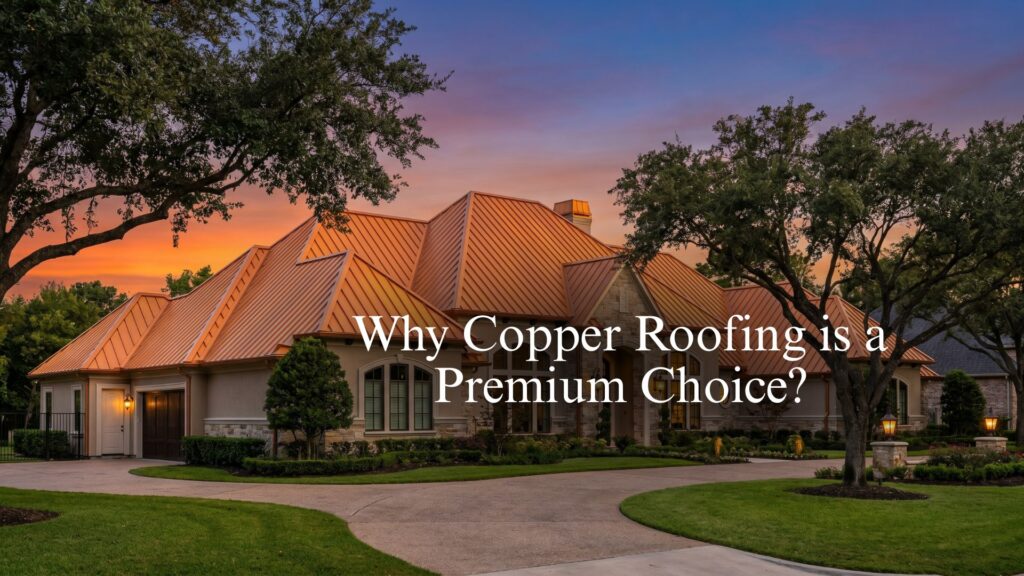
To ensure you receive all these copper roofing benefits, Achilles Roofing & Exterior provides expert copper metal roofing installation Houston homeowners can rely on, including full replacements, custom dome turrets, and premium architectural accent integrations.
What Is Copper Roofing?
Architectural copper is a premium metal roofing system known for its 70–100+ year lifespan, exceptional durability, and distinctive patina that protects the metal over time. Installation pricing depends on your roof’s complexity. Learn more about our pricing in our dedicated copper roofing investment guide.
| 100+ | 3–4× |
Class A |
|
Years — documented lifespan of properly installed copper roofing |
Asphalt shingle roofs replaced during the life of one copper roof |
Fire resistance rating — highest available, achieved naturally |
|
100% |
25% |
20–30 yrs |
|
Copper is fully recyclable at end of life — zero landfill waste |
Less pollution than asphalt across its full lifecycle |
Time for copper’s full protective patina to develop |
Sources: Copper Development Association, MBCI (2026), Earth911 (2026), The Environmental Blog (2025), NOAA (2024)
Unmatched Copper Roof Lifespan: 100+ Years of Protection
The Roof That Outlasts Everything Else
One of the most significant copper roofing benefits is that it lasts 2–5 times longer than any other standard residential roofing material. While asphalt shingles need replacement every 15–30 years and standard metal roofing lasts 40–70 years, the average copper roof lifespan routinely exceeds 100 years — with documented examples on historic buildings worldwide performing correctly for well over a century.
| Material | Typical Lifespan | Replacements Over 100 Years | Total Replacement Cost (est.) |
|---|---|---|---|
| 3-Tab Asphalt Shingles | 15–20 years | 5–6 replacements | $47,500–$88,200 |
| Architectural Asphalt Shingles | 20–25 years | 3–4 replacements | $28,500–$58,800 |
| Standard Metal Roofing | 40–70 years | 1–2 replacements | $18,900–$63,000 |
| Copper Roofing | 100+ years | 0 replacements | $0 additional |
Sources: Angi Houston (2026), RISE Roofing Houston (2026), Copper Development Association
When considering long-term copper roofing benefits, for a Houston homeowner, this means: install a copper roof once and it may outlast your ownership of the property— or your children’s ownership of it. Further proving these copper roofing benefits, insurance companies have been documented to depreciate copper roofing assets over 150 years — longer than any other residential roofing material.
Weather and Corrosion Resistance: The Roof That Cannot Rust
Self-Renewing Protection vs. Coating-Dependent Systems
When evaluating copper roofing benefits, remember that copper does not rust. Unlike painted steel or galvanized metal roofing systems where the protection is a coating applied over metal, copper’s protection is the metal itself — transformed by natural oxidation into a patina that is chemically stable and self-renewing. In Houston’s high-humidity, Gulf Coast environment, this distinction is the difference between a roof that requires monitoring and one that requires none.
Another one of the major copper roofing benefits is how well it handles every weather condition Houston delivers:
- Extreme heat and UV — copper reflects radiant heat and does not degrade under sustained UV exposure
- Heavy rainfall — welded or soldered seams are impervious to water infiltration at the joint
- High winds — mechanically fastened copper systems are engineered for Houston’s wind uplift requirements
- Hail — heavier gauge copper (20 oz or 24 oz) resists denting under all but the most severe events
- Humidity and salt air — the patina actively resists corrosion that Houston’s Gulf Coast environment accelerates on other metals
Low Maintenance — The Roof That Takes Care of Itself
Set It and Forget It — Seriously
To fully enjoy these copper roofing benefits, the maintenance requirement after the patina is established is essentially this: don’t damage the patina, keep the gutters clear, and schedule an occasional visual inspection. There is no repainting. No recoating. No rust treatment. No granule loss to monitor. No sealant to reapply. Repairs and replacements for Copper Metal roofing are the exception for copper roofing are the exception rather than the rule across its 100+ year lifespan.(Source: Modernize, 2026)
When weighing the best copper roofing benefits, contrast its maintenance requirement with asphalt shingles:
➡ Annual inspections for granule loss and lifting shingles
➡ Sealant reapplication around flashing and penetrations every 3–5 years
➡ Moss and algae treatment in Houston’s humid environment
➡ Replacement of individual damaged shingles after storm events
➡ Full replacement every 20–25 years regardless of visible condition
Highlighting the financial copper roofing benefits, industry data shows ongoing repair and maintenance costs for asphalt shingles average $300–$600 per year for a typical Houston home. Over 25 years, that’s $7,500–$15,000 in maintenance costs before the replacement itself. (Source: Angi, 2026)
Energy Efficiency — Lower Your Houston Cooling Bills
Reflecting Houston’s Heat Back Where It Belongs
Houston’s summer heat is demanding, which is why energy efficiency is one of the most critical copper roofing benefits in the United States. Cooling costs for a typical Houston home can exceed $200–$400 per month from June through September. Copper reflects radiant heat rather than absorbing it — unlike dark asphalt shingles that absorb solar radiation and transfer it into the attic and living space.
One of the most overlooked copper roofing benefits is how its energy efficiency mechanism works in both directions:
➡ Summer — copper reflects solar radiation, keeping the attic and living spaces cooler and reducing HVAC load
➡ Winter — copper’s thermal properties help retain interior warmth during Houston’s winter cold fronts
➡ Year-round — reduced thermal expansion and contraction extends the lifespan of seams and fasteners by reducing mechanical stress on connections
Translating these copper roofing benefits into real savings, energy data shows cool roof materials — including copper — can reduce annual cooling bills by 10–15% for Houston homes. On a $3,600 annual cooling cost, that’s $360–$540 per year — or $7,200–$10,800 over 20 years. (Source: Madd Roofing 2026 Regional Analysis)
Timeless Style That Boosts Curb Appeal and Property Value
The Only Roof That Gets More Beautiful Over Time
While most roofing materials degrade visually as they age, unique copper roofing benefits mean copper follows the opposite trajectory. The visual transformation from bright orange through deep bronze to blue-green patina is one of the most distinctive aging processes in architecture — and homeowners who choose copper typically consider the patina to be the most attractive stage of the roof’s life, not a sign of deterioration.
Beyond aesthetics, one of the most tangible copper roofing benefits is how this visual distinction translates into measurable property value. Copper roofing is consistently cited as one of the strongest resale value contributors among premium roofing materials. A documented copper installation is a verifiable architectural asset in a real estate transaction — and copper’s documented longevity and architectural status typically outperforms the average 60% return on premium roof replacements cited by Zillow.
To visually maximize these copper roofing benefits, architecturally, copper works best with:
➡ Spanish and Mediterranean-style homes — copper alongside clay tile is a classic premium pairing
➡ Historic and classical homes — copper has been the material of choice for premium architectural features since antiquity
➡ Modern luxury homes — the contrast between copper and contemporary cladding creates a distinctive statement
➡ Complex rooflines — dome turrets, curved dormers, and transition sections that other materials cannot cleanly execute
Eco-Friendly and Sustainable — The Smallest Footprint
The Premium Roofing Material With the Most Sustainable Lifecycle
For environmentally conscious homeowners, one of the top copper roofing benefits is that it’s the most sustainable premium roofing material available — not as a marketing claim, but as a measurable lifecycle reality. Adding to the list of copper roofing benefits, it is 100% recyclable, retaining approximately 95% of its market value at end of life. Unlike asphalt shingles — which contribute millions of tons of waste to U.S. landfills annually — copper generates zero landfill waste at end of life. (Source: Earth911, 2026)
♻️ 100% RecyclableZero Landfill |
🌿 25% Lower EmissionsThan Asphalt |
🔁 One Installation,One Carbon Event |
|
Copper retains ~95% of its market value at end of life and can be fully recycled into new copper products. Asphalt shingles contribute millions of tons to U.S. landfills annually with limited recycling options. (Source: Earth911, 2026) |
Metal roofing produces approximately 25% less pollution than asphalt shingles across its full lifecycle. Copper and zinc require less energy to process than steel or aluminum, further reducing manufacturing carbon footprint. (Source: The Environmental Blog, 2025) |
Copper’s 100+ year lifespan means its carbon cost is a single lifecycle event. Asphalt shingles require 3–5 manufacturing and installation cycles over the same period — multiplying the carbon impact by the number of replacements. |
Class A Fire Resistance — The Highest Rating, Naturally
Non-Combustible by Nature — No Chemical Treatments Required
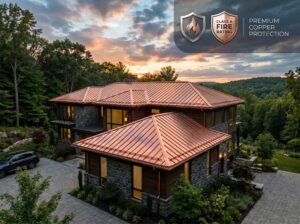
Copper achieves Class A fire resistance — the highest fire rating available for roofing materials — naturally, without chemical fire retardants, special coatings, or modified underlayment. Class A roofs can withstand severe fire exposure, limit flame spread, and provide critical protection against external fire hazards including airborne embers. Copper is non-combustible: it cannot burn.
(Source: copper.org ASTM E108.07a, MBCI 2026)
Per the Copper Development Association’s ASTM E108.07a testing: a typical copper standing seam roof system met all Class A requirements. Per MBCI building code documentation: 16 oz/sq ft copper or thicker can be installed over combustible decks and be considered Class A without additional testing.
For Houston homeowners, these fire-related copper roofing benefits provide:
➡ Maximum protection against external fire exposure and airborne embers
➡ Compliance with building codes in fire-sensitive zones without additional treatment
➡ Potential insurance premium advantages — Class A roofing is associated with lower fire risk
➡ A documented safety standard that adds to the home’s insurance and resale documentation
Is Copper Roofing Worth the Investment? The Honest Answer
The Real Calculation
Copper Metal roofing costs $15–$30 per square foot installed in Houston — or $37,800–$63,000 for a typical home. That is 3–4 times higher than architectural asphalt shingles at initial installation. Whether the long-term copper roofing benefits are worth the initial cost depends on three factors.
-
How long you plan to stay. Copper’s value compounds over time. If you’re staying 20+ years, the total cost of ownership — zero replacements, very low maintenance, energy savings — makes copper competitive with or cheaper than repeated asphalt replacements.
-
Whether your home’s architecture benefits from it. On homes where copper fits — Spanish tile homes, historic properties, luxury builds, complex architectural features — it adds measurable property value. On mismatched architecture, the premium is harder to justify.
-
Whether the upfront cost is manageable. Achilles Roofing offers GreenSky financing starting at $199/month for qualified applicants making copper accessible without full upfront payment.
Comparing Copper Roofing Benefits vs. Other Roofing Materials
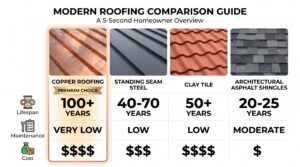
| Feature | Copper | Standing Seam Steel | Clay Tile | Arch. Asphalt |
|---|---|---|---|---|
| Lifespan | 100+ years | 40–70 years | 50+ years | 20–25 years |
| Maintenance | Very Low | Low | Low-Moderate | Moderate |
| Fire Rating | Class A (natural) | Class A | Class A | Class A (fiberglass) |
| Corrosion Resistance | Self-renewing patina | Coating-dependent | N/A | N/A |
| Recyclability | 100% | 100% | Partial | Limited |
| Energy Efficiency | High | High | Moderate | Low |
| Curb Appeal Over Time | Increases with patina | Stable | Stable | Decreases |
| Installed Cost (Houston) | $15–$30/sq ft | $9–$15/sq ft | $14–$28/sq ft | $4.50–$7/sq ft |
Sources: Angi Houston (2026), RISE Roofing Houston (2026), CostCheckUSA (2026), Roof Observations (2026), Earth911 (2026)
Frequently Asked Questions About Copper Roofing Benefits
Is copper roofing worth the cost?
For homeowners planning to stay 20+ years, the long-term copper roofing benefits make it the most financially rational premium choice when total cost of ownership is the metric. A $40,000–$63,000 copper installation on a typical Houston home requires zero replacements over 100 years. Three to four asphalt replacements over the same period cost $28,500–$88,200 — before accounting for maintenance costs, inflation, or labor cost escalation at the time of future replacements. On the right home and the right architecture, copper is not just a style choice. It is the most durable long-term investment in residential roofing.
What is the average copper roof lifespan?
A properly installed copper roof lasts 100 years or more. The Copper Development Association documents copper roof installations from the 1800s that remain structurally sound today. In Houston, the high-humidity environment accelerates patina development — the natural protective barrier that makes copper more durable the longer it is in place. Insurance companies have been documented to depreciate copper roofing assets over 150 years — longer than any other residential roofing material.
(Source: Copper Development Association)
Does copper roofing rust?
No. Copper does not rust. Rusting is an oxidation process specific to iron-based metals (steel). When copper oxidizes, it forms a patina — a chemically stable, self-renewing protective layer that cannot be further corroded by the oxidation process that formed it. The blue-green patina on a copper roof is not damage. In fact, providing a fully developed protective barrier is one of its main copper roofing benefits. Unlike painted steel roofing where corrosion begins if the protective coating is breached, copper’s protection comes from the material itself — and it gets stronger, not weaker, as it develops.
Why does copper roofing turn green?
A key contributor to copper roofing benefits, the blue-green color on copper roofs is called patina — a natural oxidation process that occurs as copper reacts with air, moisture, and environmental compounds over time. It typically begins developing within the first year of installation and reaches its characteristic blue-green color over 20–30 years, though Houston’s high humidity can accelerate this timeline. The patina is not corrosion. It is a stable mineral layer (primarily copper carbonate and copper sulfate) that actively protects the copper beneath it from further chemical change.
Is copper roofing good for Houston weather?
Yes — the many copper roofing benefits make it well-suited to Houston’s specific climate challenges. It reflects radiant heat rather than absorbing it, reducing cooling costs in extreme summers. Its self-renewing patina resists the corrosion that Houston’s high humidity and Gulf-area salt air accelerate on painted metal systems. It carries a Class A fire rating naturally. The primary Houston-specific consideration is hail: Texas ranked #1 for hail events nationally in 2023. Achilles Roofing specifies heavier gauge copper (20 oz or 24 oz) for Houston installations to reduce dent risk from large hail. (Source: Cotality 2026, NOAA 2024)
What are the disadvantages of copper roofing?
While the copper roofing benefits usually outweigh the drawbacks for premium homes, the primary disadvantages are: (1) High upfront cost — $15–$30 per sq ft installed, or $37,800–$63,000 for a typical Houston home. (2) Hail denting — copper can dent under large hail impacts; heavier gauge specification mitigates this risk. (3) Specialized installation required — it is absolutely crucial to hire copper roofing experts because copper fabrication, seam welding, and expansion joint design require specific expertise that not all roofing contractors have.
(4) Noise without proper insulation — without adequate attic insulation and correct underlayment, copper can transmit rain noise; proper specification eliminates this. (5) Patina appearance — the blue-green transformation is not to every homeowner’s taste; if you want to maintain the bright copper color, periodic maintenance is required.
Does a copper roof increase home value?
Yes — consistently across multiple sources. Copper roofing is one of the strongest documented resale value contributors among premium roofing materials. A documented copper roof installation is a verifiable architectural asset in a real estate transaction. According to a Zillow estimate cited by HHH Roofing, a premium roof replacement returns approximately 60% of its value in a real estate transaction — and copper’s documented longevity and architectural status typically outperforms that average. On architecturally compatible homes — Spanish tile, historic, luxury, or complex-roofline properties — these copper roofing benefits ensure the value contribution is most significant.
Does Achilles Roofing install copper roofing in Houston?
Yes. When it comes to premium copper metal roofing installation Houston residents trust, Achilles Roofing & Exterior leads the way across the city and surrounding areas including Katy, Cypress, Spring, and Pearland. Our copper work includes full roof replacements, custom dome turret installations, architectural accent integrations alongside clay tile and shingle systems, and premium exterior copper features. For a copper roofing assessment and written fixed-price estimate, call (832) 888-1666 or book online at achillesroofinghouston.com. GreenSky financing available from $199/month.
Ready to Install a Roof You’ll Never Replace Again?
Ready to experience these copper roofing benefits for yourself? It’s important to hire copper roofing experts to protect your investment. Achilles Roofing installs premium copper systems across Houston — full replacements, dome turrets, and architectural integrations. Written fixed-price estimate · GAF Certified Plus · 800+ Houston projects · Financing from $199/mo
About Achilles Roofing & Exterior
Houston’s specialist in full roof replacements, Spanish tile, clay tile, copper, and high-end exterior systems. Founded 2017. 800+ completed projects · 4.90-star Google · 5.0 Thumbtack · Founded by Ahmad Faiz.
Sources & References
- Copper Development Association. Architectural copper roofing — fire testing & lifespan documentation. copper.org
- MBCI. (2026). Fire resistance of metal panel roof systems. mbci.com
- Earth911. (2026, March 14). Sustainable roofing buyer’s guide: 2026 update. earth911.com
- The Environmental Blog. (2025). Which roofing materials are best for the environment? theenvironmentalblog.org
- Mountaintop Metal Roofing. (2026). Are asphalt shingles bad for the environment? mountaintopmetalroofing.com
- Modernize. (2026). Copper roofing costs, styles, benefits, and longevity. modernize.com
- Angi. (2026). How much does copper roofing cost? angi.com
- Roof Observations. (2026). Copper roof cost guide. roofobservations.com
- Cotality. (2026). Hail shifts from secondary peril to major catastrophe loss driver. artemis.bm
- NOAA NCEI. (2024). National climate report: Annual 2024. noaa.gov