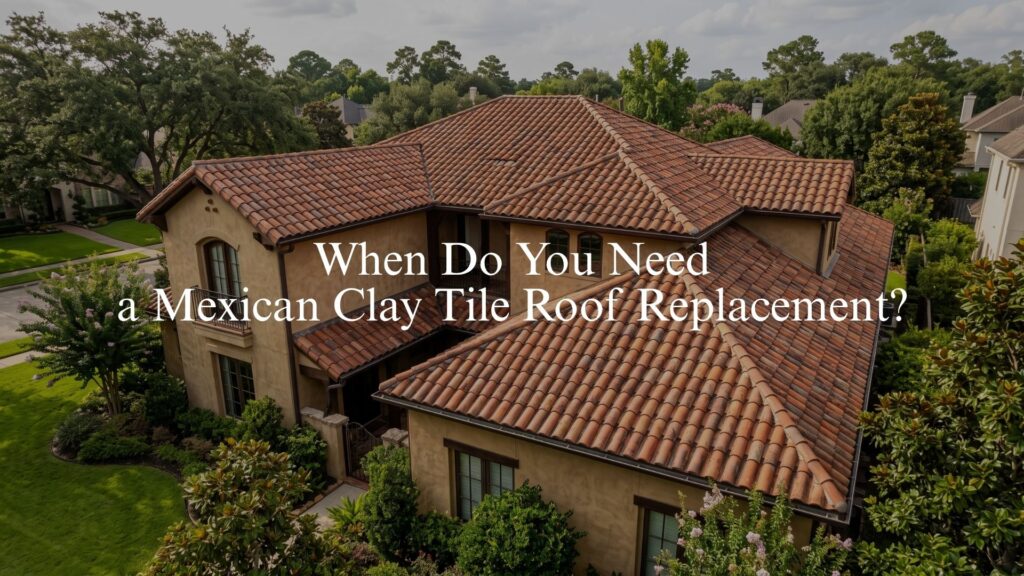
Quick Answer: When Should You Replace a Mexican Clay Tile Roof in Houston?
Replace a Mexican clay tile roof only when the tile body itself has failed — mass spalling, widespread fracturing, or deterioration that makes tiles impossible to re-set — or when the roof deck underneath has rotted. Everything short of that (worn underlayment, cracked ridge mortar, failed flashing) is a repair or restoration, not a replacement. In Houston, full replacement typically costs $30,000–$95,000+ and is genuinely necessary less often than homeowners are told.
How Long Does a Mexican Clay Tile Roof Last Before Replacement Is Actually Necessary?
A Mexican clay tile roof in Houston has two separate lifespans running in parallel, and confusing them is what leads to replacing a roof that didn’t need replacing.
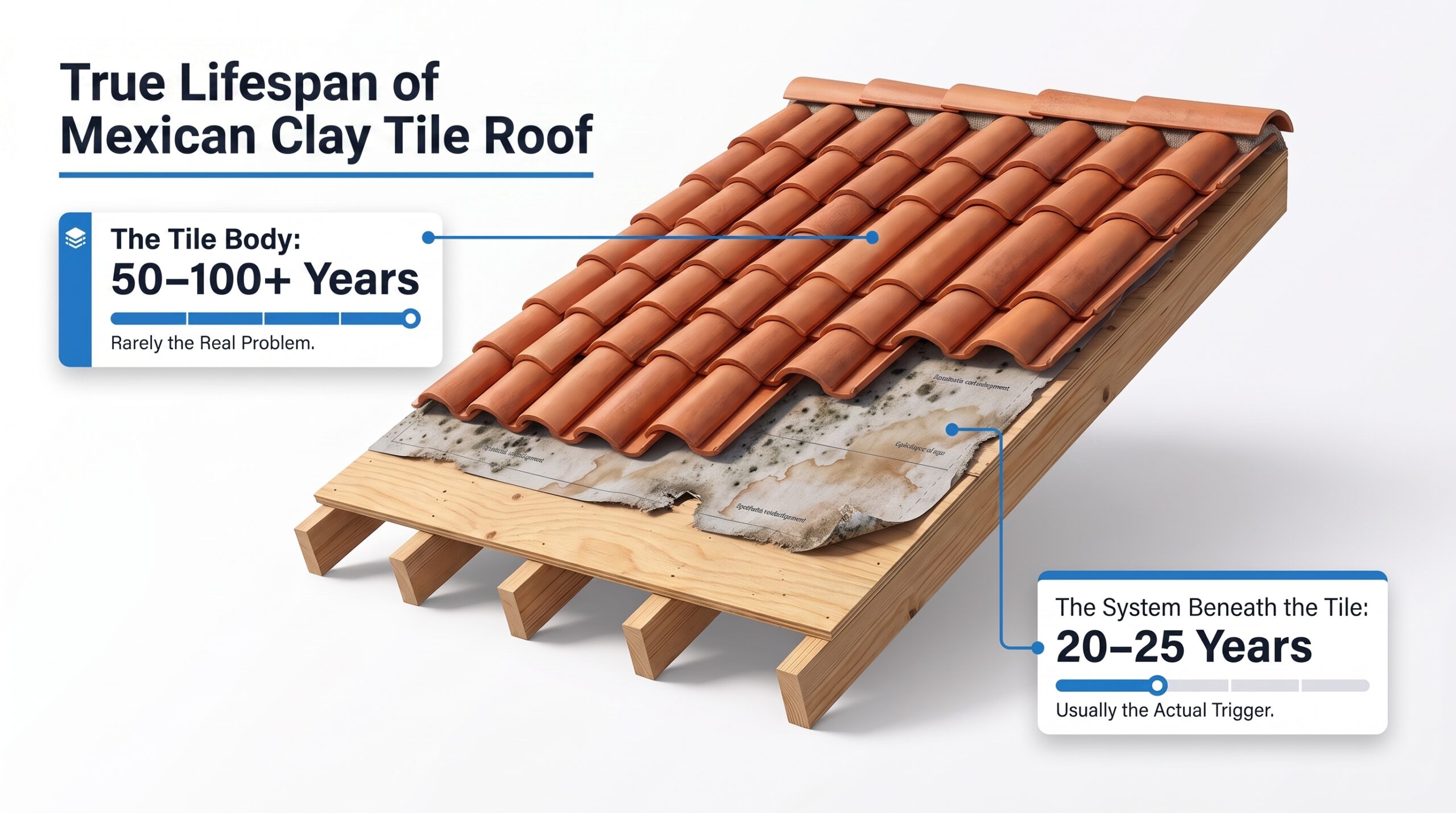
The Tile Body: 50–100+ Years (Rarely the Real Problem)
Fired clay does not rot, corrode, or degrade from UV exposure. According to the National Association of Home Builders’ component life-expectancy research, clay and concrete tile roofing carries the longest expected service life of any residential roofing category — 50–100+ years. When a tile roof gets replaced at year 20 or 30, the tile body is almost never the reason.
The System Beneath the Tile: 20–25 Years (Usually the Actual Trigger)
Underlayment, flashing, and ridge mortar are the components that actually wear out. Green Builder Media’s building-science reporting on heat-driven degradation puts tile roof underlayment service life at roughly 20–25 years in hot climates before a restoration is needed — well short of its rated maximum, because Houston attics regularly reach 130–150°F in summer.
The Real Cost of Confusing System Failure with Tile Failure: Houston homeowners frequently pay $30,000–$95,000+ for a full clay tile roof replacement when the actual problem was a $4,000–$28,000 underlayment refresh, flashing reseal, and mortar repoint — performed on a tile body that had another 50+ years of service life remaining. The tile didn’t fail. The system did.
Texas has been the National Insurance Crime Bureau’s hail damage capital of the U.S. for 11 consecutive years running, logging 902 major hail events in 2025 alone — more than double the second-place state. On an unmaintained clay tile system, that hail exposure is what turns a repairable system failure into a genuine replacement decision.
Source: National Insurance Crime Bureau
What Actually Forces a Full Clay Tile Roof Replacement in Houston?
Most clay tile “replacements” in Houston are actually triggered by one of four specific failure conditions — and Houston’s climate makes some of them uniquely severe here compared to drier tile markets like Arizona or Southern California.
Trigger 1: Tile-Body Failure — Mass Spalling and Fracturing
Spalling — surface flaking caused by trapped moisture expanding inside porous fired clay — is a replacement trigger only when it’s distributed across multiple tile courses, not isolated tiles. Professional inspectors quantify this the same way insurance adjusters quantify hail damage: with a sample “test square,” a marked 10 ft × 10 ft area used to count affected tiles and extrapolate density across the slope, rather than eyeballing the whole roof. Haag Engineering’s test-square protocol — the methodology most U.S. insurance carriers use to authorize roof replacement — treats 6–10 confirmed damage points per 100 sq ft as the threshold for functional (not merely cosmetic) damage. A handful of spalled tiles in one test square is a spot repair; spalling appearing in most sampled squares across a slope means the batch is failing together.
Source: Haag Global
Trigger 2: Structural Roof Deck Failure
Soft, spongy, or discolored decking (plywood or OSB sheathing) visible from inside the attic means water has been reaching the structural layer, not just the underlayment. Deck replacement requires full tile removal — the same labor scope as a full re-roof — so once the deck is compromised, replacement is usually the economical choice over a restoration.
Trigger 3: Storm Damage That Triggers a Legal “Matching” Requirement
When enough tiles are cracked from hail or wind that the original tile’s color or profile is discontinued or weathered beyond match, patch repair leaves a visibly inconsistent roof — and that’s not just a cosmetic complaint. The NAIC’s Unfair Claims Settlement Practices Model Regulation (Section 9.A(2)) requires insurers to replace enough of a damaged roof to achieve a “reasonably uniform appearance,” and at least 13 states have codified equivalent matching statutes or regulations. In practice, adjusters in those states routinely authorize full-slope or full-roof replacement once tile mismatch becomes clearly visible.
Sources: NAIC Model Regulation MDL-902; MWL Law; PropertyCasualty360
Trigger 4: A System Restoration Window That’s Already Closed
A roof that has skipped two full restoration cycles — 40–50 years without an underlayment refresh or flashing reseal — has run its system components at roughly double their rated life. At that point, removing tile for a restoration is far more likely to destroy tiles than preserve them, tipping the cost-benefit toward full replacement. (This 40–50-year threshold is Achilles’ own interpretation, derived from the underlayment life-cycle data above — it is not an independently published industry figure.) Separately, if a professional restoration was already performed and leaks recur at new locations within the workmanship-warranty window — commonly 2 years under NRCA guidance for residential roofing — that points to the tile body itself, not the restoration workmanship, as the ongoing point of failure.
Sources: Green Builder Media; National Roofing Contractors Association guidance (via NRCIA, National Roofing Authority)
9 Warning Signs Your Clay Tile Roof Needs Full Replacement, Not Repair
Most of these signs also show up before a repairable system failure — the difference is scale and recurrence. Here they are, ranked from most urgent to monitor closely.
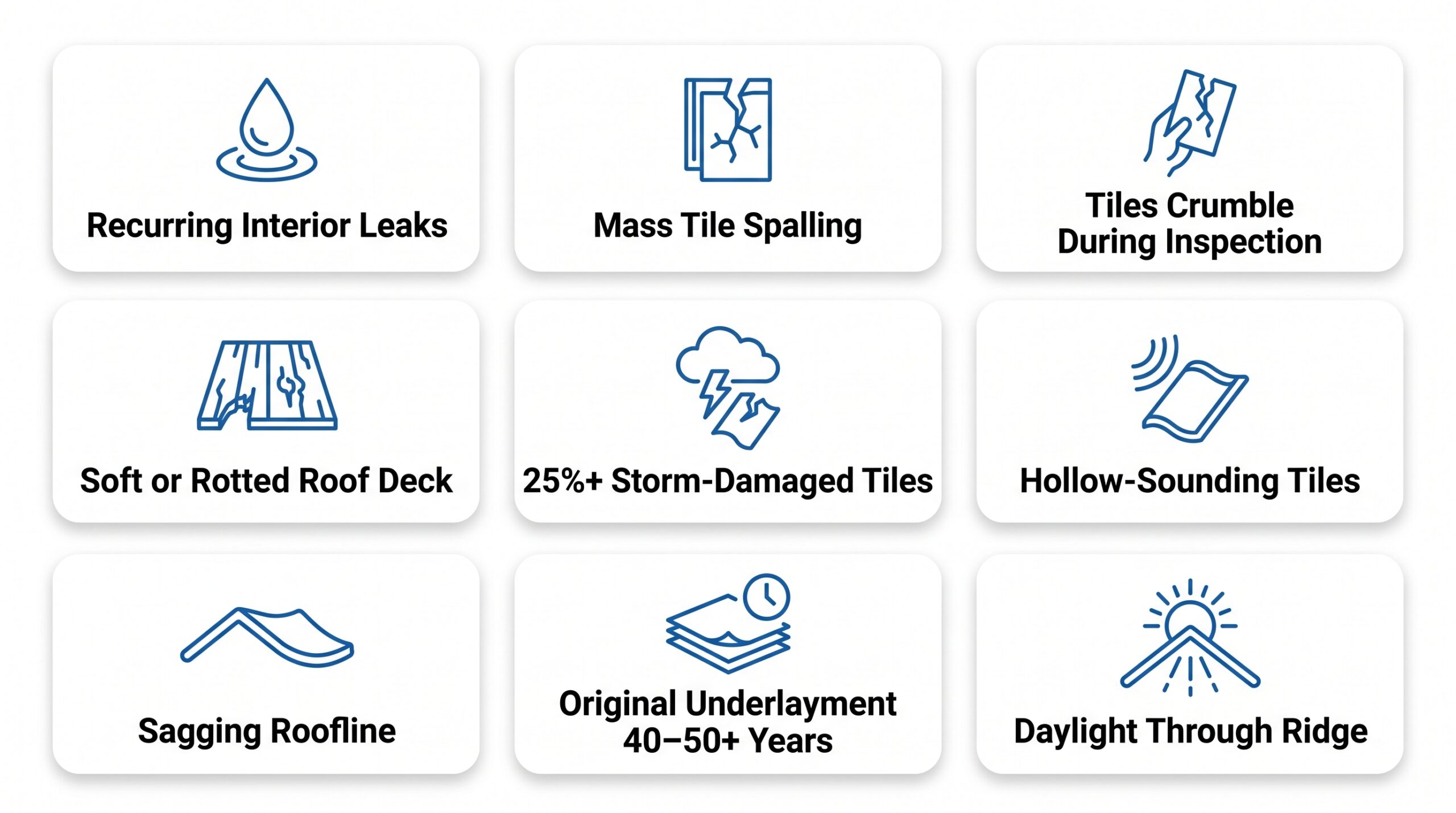
- Water stains or active leaks that recur after a professional restoration. This means the tile body — not the system — is now the point of failure. Call a licensed roofer within 48 hours.
- Mass spalling across multiple tile courses, confirmed by a test-square assessment, not just a few isolated tiles.
- Tiles that crack or crumble under light hand pressure during inspection — the firing integrity has broken down and the tile can’t be safely re-set.
- Soft, spongy, or discolored roof decking visible from inside the attic — evidence of structural, not just surface, water damage.
- 25%+ of tiles cracked from a single storm event, with the original tile profile discontinued or unavailable for color match.
- Tiles that sound hollow when tapped across multiple ridgelines or valleys — mass delamination of the fastening system, not a one-off.
- A roofline that visibly sags or waves when viewed from the street — a structural, not cosmetic, red flag.
- A roof over 40–50 years old that has never had an underlayment or flashing restoration — the system has likely run past the point where restoration is still viable.
- Daylight visible through the ridge from inside the attic, combined with crumbling mortar across most of the ridge run (not just one section) — a sign the ridge system has failed broadly, not locally.
The Insurance Institute for Business & Home Safety (IBHS) notes that roof failures account for approximately 25–40% of residential hurricane insurance claims, with flashing and penetration failures — not tile damage — the leading cause. That’s exactly why signs 1, 4, and 6 above are frequently system failures masquerading as reasons to replace, while signs 2, 3, 5, 7, and 9 are genuine tile-body failures that justify it.
Source: IBHS
Homeowner Checklist: Confirming You Actually Need Replacement Before You Call Anyone
Run this ground-level check before accepting any contractor’s replacement recommendation — it takes 20 minutes and rules out the most common false alarms.
Exterior Inspection (Ground Level / Binoculars or Drone)
- Scan all tile courses for spalling, cracking, or displacement — use binoculars or a drone; do not walk the roof without a professional present
- Check whether the roofline is straight or shows visible sagging/waving
- Inspect the ridge cap and mortar bed for gaps, cracks, or missing sections across multiple sections (not just one spot)
- Look for color or profile mismatch between original tile and any prior patch repairs
Attic Inspection (Interior)
- Inspect decking and rafters for soft spots, discoloration, or active moisture — this is the single most important indicator of deck-level (replacement-tier) damage
- Confirm no daylight is visible through the ridge
- Note whether staining is isolated to one or two spots (system issue) or widespread across multiple rafter bays (tile-body or deck issue)
When to Call a Professional Immediately
- Any active interior water intrusion
- Visible roofline sag or wave
- Spalling or cracking visible from the ground across more than one section of roof
- The roof has never had a documented underlayment or flashing restoration and is 40+ years old
Professional Assessment Checklist: What a Qualified Contractor Should Check Before Recommending Replacement
A legitimate clay tile replacement recommendation should be backed by documented, section-by-section evidence — not a walk-around and a verbal opinion.
Tile-by-Tile / Test-Square Assessment
- Test-square sampling (per Haag Engineering methodology) across each roof slope, with a documented damage-point count per 100 sq ft
- Tap-test results for hollow/delaminated tiles, logged by location, not just estimated
- Photo documentation of any spalling, cracking, or fracture patterns cited as justification for replacement
Deck and Structural Assessment
- Attic-side inspection of decking condition at every valley, penetration, and eave
- Moisture-meter readings on decking, not just a visual check
- Written confirmation of whether deck damage is isolated or roof-wide
Documentation You Should Receive Before Signing
- A written scope naming the specific underlayment, flashing, and mortar products to be used — “standard materials” is not acceptable
- Photo or drone evidence tied to each cited failure point
- A clear statement of whether the recommendation is a restoration or full replacement, and why restoration was ruled out
Houston Mexican Clay Tile Roof Replacement Costs (2026)
A full Mexican clay tile roof replacement in the Houston metro runs $30,000–$95,000+ installed as of 2026, driven primarily by roof complexity, tile sourcing, and tear-off labor.
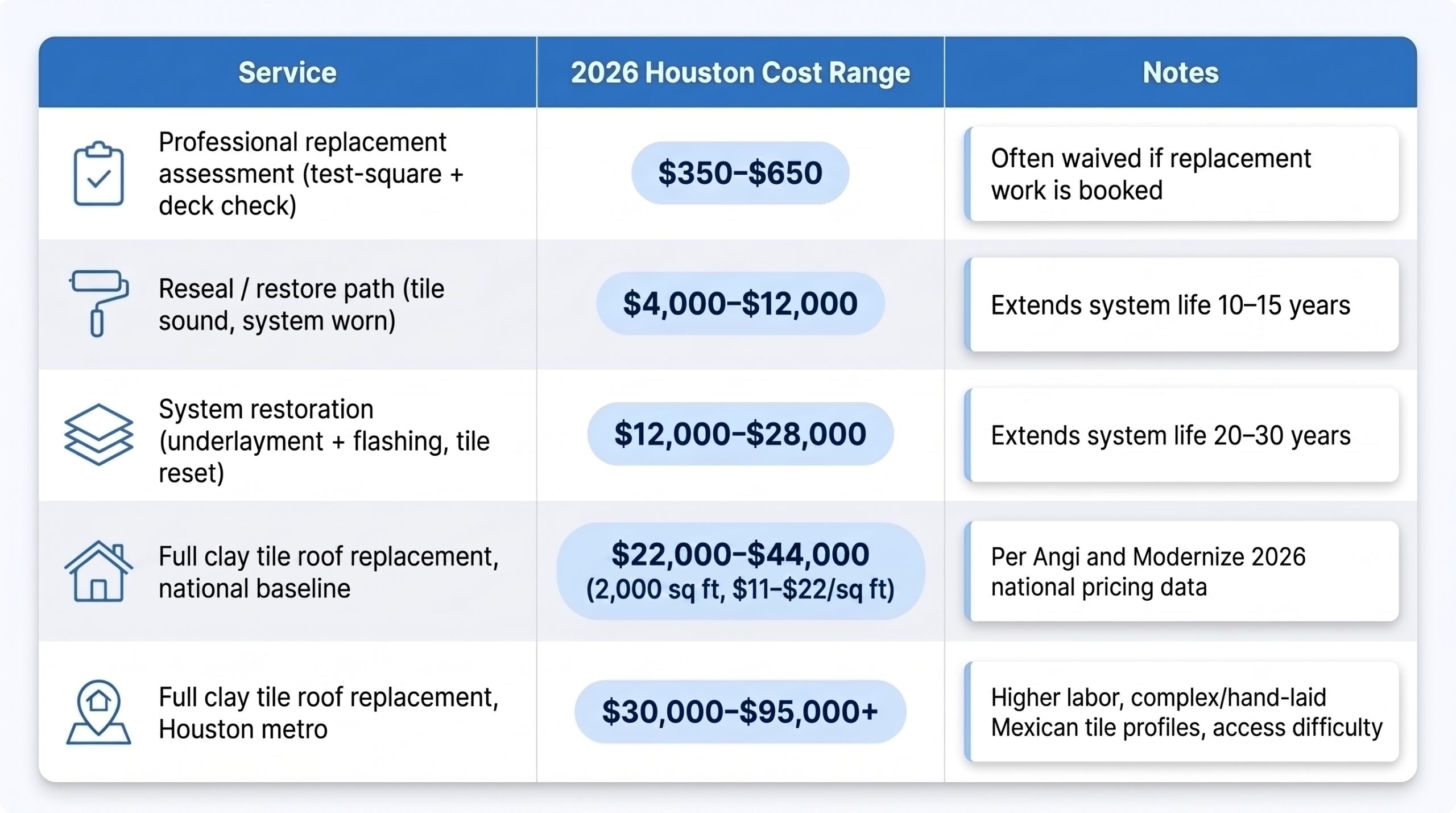
Sources: Angi 2026 clay tile roof cost data; Modernize 2026 clay roof pricing guide.
The replacement math: A homeowner who gets a proper tile-body assessment before committing to full replacement spends $4,000–$28,000 on a reseal or restoration in the majority of cases where the tile itself is still sound. A homeowner who accepts a replacement recommendation without that assessment can end up spending $30,000–$95,000+ replacing a tile body that had 50+ years of service life left.
Reseal vs. Restore vs. Replace: How to Decide
The three-path decision framework for a Mexican clay tile roof in Houston is defined by what has actually failed — the surface protection, the system beneath the tile, or the tile body itself. Matching the intervention to the failure prevents overspending in either direction.
Path 1: Reseal and Maintain
When it applies: Tiles are structurally sound. Flashing and underlayment are intact or have minor localized issues. Sealant is degraded or biological growth is present.
- Spot-replace cracked or missing tiles
- Reseal flashing at all penetrations
- Recoat tile surface with appropriate penetrating sealer
- Repoint ridge mortar if cracking exceeds cosmetic
Typical cost: $4,000–$12,000 | Extends system life: 10–15 additional years
Path 2: System Restoration (Underlayment and Flashing Refresh)
When it applies: Active leaking from flashing or underlayment failure. Roof is 18–25 years old. Tile body is intact and color-matchable.
- Professionally remove all tiles, catalog and store them
- Replace underlayment membrane (upgrade to two-layer modified bitumen for Houston’s climate)
- Replace all flashing at valleys, penetrations, ridges, and eaves
- Reset original tiles; replace any that cracked during removal
Typical cost: $12,000–$28,000 | Extends system life: 20–30 additional years
Path 3: Full Roof Replacement
When it applies: Tile body has widespread structural failure (mass spalling, fracturing from large hail, tiles too deteriorated to reset or color-match). Or: deck-level damage requires structural rebuild.
A full replacement is genuinely necessary far less often than the industry’s average sales process suggests. If a contractor recommends full replacement on a Mexican clay tile roof under 40 years old without showing you specific tile-body failure evidence, get a second opinion.
Typical cost: $30,000–$95,000+ | Lifespan: New 50–100-year system
The National Association of Home Builders (NAHB) estimates that clay and concrete tile roofing materials have the longest expected lifespan of any residential roofing category, at 50+ years, compared to 20–30 years for asphalt shingles. Proper diagnosis — not just proper maintenance — is what determines whether a homeowner captures that full lifespan or pays to replace it early.
Source: NAHB
Why a Clay Tile Roof Replacement Decision in Houston Is Different From the Rest of the Country
Most national guidance on clay tile roof replacement is written for climates like Southern California or Arizona — low humidity, low hail exposure, and no percentage-based insurance deductibles. Houston invalidates several of those assumptions.
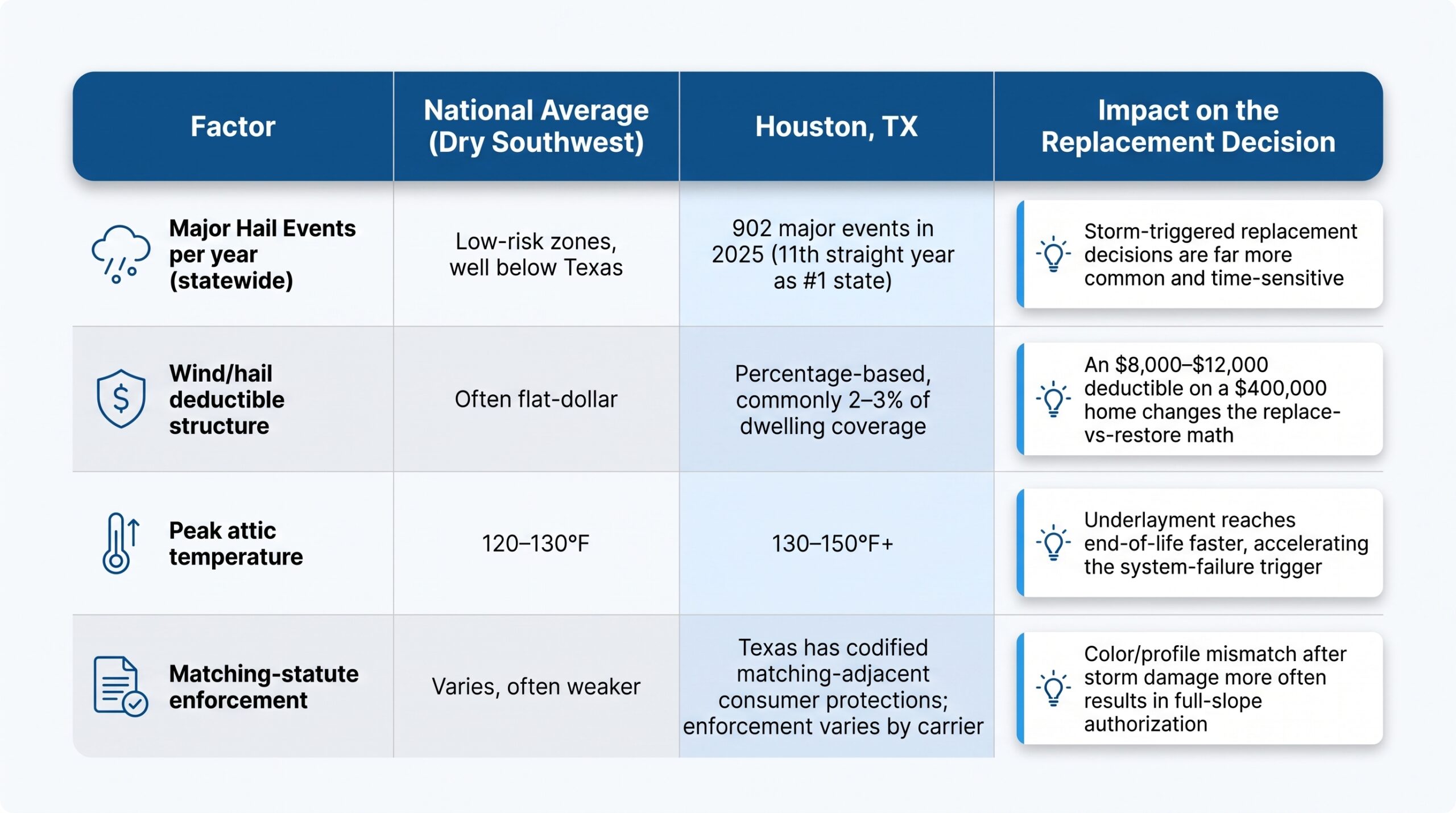
This is why Achilles Roofing Houston uses Houston-specific assessment protocols for every clay tile roof replacement evaluation — not national templates. The failure thresholds, insurance dynamics, and cost drivers are genuinely different here.
How to Find a Qualified Mexican Clay Tile Roof Replacement Contractor in Houston
Mexican clay tile roofing is a specialty trade. Not every licensed Houston roofer has the tile-handling experience required to avoid unnecessary tile loss during removal, assessment, or reset. Selecting the wrong contractor can turn a restorable roof into an unnecessary full replacement.
What to verify before hiring:
- Texas Department of Insurance (TDI) registration and insurance — Texas does not license roofing contractors at the state level, but contractors working in the Houston metro must carry a minimum of $500,000 general liability and workers’ comp. Verify certificates directly with the insurer; do not accept photocopies.
- Clay tile-specific experience — ask for references and photos from clay tile replacement projects specifically, not just shingle or metal work.
- Manufacturer training — major clay tile manufacturers (Ludowici, MCA, Entegra) offer contractor training programs covering tile-specific installation specs and approved underlayments.
- Test-square and drone inspection capability — a qualified contractor should offer documented, sampled damage assessment as a baseline service, not a verbal “it needs replacing.”
- No deductible-waiver offers — it is illegal in Texas for a contractor to offer to waive or absorb your insurance deductible; treat this as a hard disqualifier, not a selling point.
- Written scope and material specification — get a written quote naming the specific underlayment, sealant, and mortar mix being used, and a clear written justification for replacement over restoration.
Frequently Asked Questions
How do I know if my clay tile roof needs to be replaced or just repaired?
Replacement is justified only when the tile body has failed — mass spalling, widespread fracturing, or tiles too deteriorated to re-set — or when the roof deck has rotted. If the tiles are intact and only the underlayment, flashing, or ridge mortar has worn out, a restoration (not a full replacement) is the correct and far less expensive fix.
What is the average cost to replace a Mexican clay tile roof in Houston?
Full replacement in the Houston metro runs $30,000–$95,000+ as of 2026, depending on roof complexity, tile sourcing, and access. A national cost baseline from Angi and Modernize puts clay tile installation at $11–$22 per square foot before Houston-specific labor and complexity premiums.
How long does a Mexican clay tile roof last before it needs replacing?
The tile body itself can last 50–100+ years per NAHB component-life research. The system beneath it — underlayment, flashing, ridge mortar — typically needs restoration every 20–25 years, which is often mistaken for a signal that the whole roof needs replacing when it doesn’t.
Will my homeowners insurance pay for a clay tile roof replacement?
Only if the damage is storm-caused (hail, wind) rather than gradual wear. Texas has led the nation in major hail events for 11 straight years, and claims are typically paid out minus a percentage-based wind/hail deductible (commonly 2–3% of dwelling coverage in Texas).
Is it ever a scam if a contractor tells me I need a full roof replacement?
Not always, but be cautious if a contractor recommends full replacement on a tile roof under 40 years old without showing specific evidence of tile-body failure — and be very cautious of any contractor who offers to waive your deductible, which is illegal in Texas and a common storm-chaser tactic.
Does replacing a clay tile roof increase home value in Houston?
Yes, though most published resale data (like the JLC Cost vs. Value Report) benchmarks asphalt roofs, which recoup roughly 60–70% of cost at sale. Tile roofs aren’t tracked separately, but appraisers generally treat a fresh tile roof as resetting a 50–100-year asset, which realtors in Houston typically position as a selling point.
Can I replace just the damaged sections of a clay tile roof instead of the whole thing?
Yes, if the tile body elsewhere is sound — this is a restoration, not a replacement, and costs $4,000–$28,000 depending on scope. Full replacement is only necessary when damage or deterioration is widespread, or when color/profile matching for the original tile is no longer possible.
What’s the difference between a system restoration and a full replacement?
A restoration removes the tile, replaces the underlayment/flashing/mortar, and resets the original (or color-matched) tile — the tile body is preserved. A full replacement removes and discards the tile body itself because it has failed structurally. Restoration costs $12,000–$28,000; full replacement costs $30,000–$95,000+ in Houston.
Get a Clay Tile Roof Replacement Assessment in Houston
Achilles Roofing evaluates your tile body, deck, flashing, and underlayment condition using a documented test-square assessment, then gives you a written, fixed-price recommendation — reseal, restore, or clay tile roof replacement — with no default push toward the most expensive option.
Written fixed-price estimate · GAF Certified Plus · 610+ reviews · 4.9 star-rated on Google · Financing from $199/mo
 Call (832) 346-8021
 About Achilles Roofing & Exterior
Houston’s specialist in full roof replacements, Spanish tile, clay tile, copper, and high-end exterior systems. Founded 2017. 610+ reviews · 4.90-star Google · 5.0 Thumbtack · Founded by Ahmad Faiz.
Sources
- National Association of Home Builders. (2026). NAHB home page — component life-expectancy research on clay/concrete tile roofing (50–100+ year category).
- Green Builder Media. (2025, May 22). Roof underlayments: Can they take the heat?
- Angi. (2026). How Much Does a Clay Tile Roof Cost?
- Modernize. (2026). Clay Tile Roof Costs in 2026.
- National Insurance Crime Bureau. (2026). For the 11th straight year, Texas is the hail damage capital of the US.
- JLC (Journal of Light Construction). (2025). 2025 Cost vs. Value Report.
- Texas Department of Insurance. (2026). Storm fraud resources and state law cracks down on roof scams.
- National Oceanic and Atmospheric Administration. (2026). Storm Events Database.
- Haag Global (Haag Engineering). (2024). Haag’s Test Square Method; Protocol for Assessment of Hail-Damaged Roofing.
- National Association of Insurance Commissioners. Unfair Claims Settlement Practices Model Regulation (MDL-902), Section 9.A(2) — “reasonably uniform appearance” matching standard; state-by-state summary via MWL Law and PropertyCasualty360.
- National Roofing Contractors Association guidance on workmanship warranties, summarized via NRCIA and National Roofing Authority.
- Insurance Institute for Business & Home Safety. (2026). IBHS home page.