
Quick Answer: How Do You Maintain a Concrete Tile Roof in Texas?
Inspect your concrete tile roof twice a year — April–May and September–October — and after every hail or high-wind event. This is the foundation of effective concrete tile roof maintenance. Key tasks: check for cracked or displaced tiles, clear debris from valleys and gutters, inspect flashing sealant at every penetration, and evaluate your underlayment age. A properly maintained concrete tile roof lasts 50+ years in Texas. The tiles are nearly indestructible. The system underneath them is not.
How Long Does a Concrete Tile Roof Actually Last in Texas Before It Needs Maintenance?
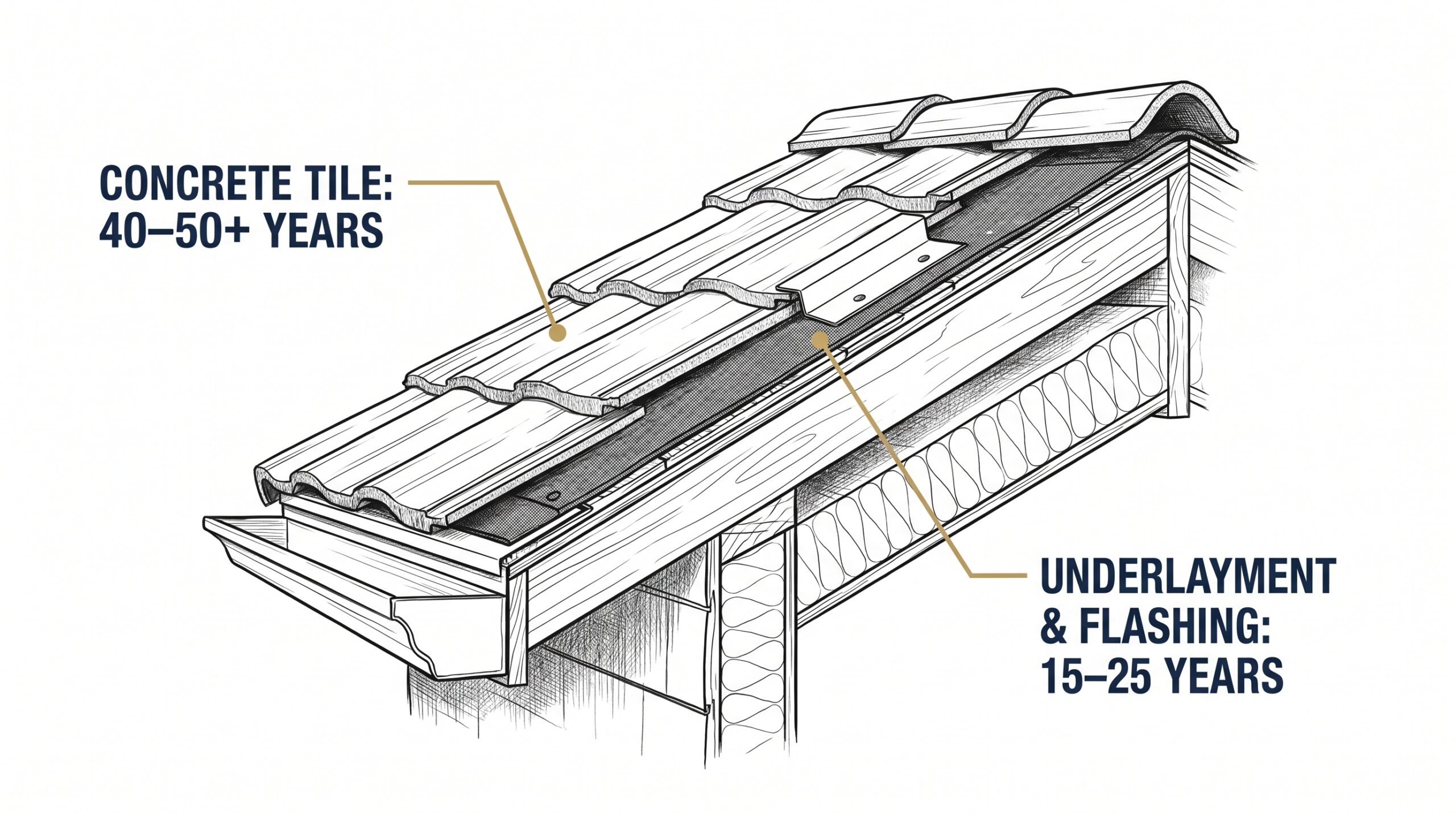
The most important thing Texas homeowners misunderstand about concrete tile maintenance is that two distinct timelines are running simultaneously:
- Tile lifespan: 40–50+ years. The cementitious body of a concrete tile is UV-stable, rot-proof, and does not degrade from moisture or heat cycling the way asphalt does. Concrete tiles fail primarily from mechanical damage — hail impact, improper foot traffic, or, less commonly, freeze-thaw cracking.
- System lifespan: 15–25 years before the underlayment, flashing, and ridge mortar require significant attention. This is what creates leaks. The water infiltration you see at year 20 is rarely a tile failure — it’s an underlayment or flashing failure beneath perfectly intact tile. In Texas, peak attic temperatures above 160°F accelerate underlayment aging faster than in any other region of the country.
This distinction has a real financial implication: many Houston homeowners pay $24,000–$75,000 for a full concrete tile roof replacement at year 22 when the actual fix was a $6,000–$14,000 underlayment and flashing refresh — performed on a tile body that had another 25–30 years of life remaining.
Industry ContextThe National Roofing Contractors Association (NRCA) documents concrete tile as one of the longest-lived residential roofing materials, with an expected service life of 40–50+ years. That lifespan assumes the system components beneath the tile — underlayment, flashing, and mortar — receive proactive maintenance. Without it, system failure at year 15–20 can force a full replacement despite a tile body with decades of life remaining.
Source: National Roofing Contractors Association (NRCA)
What Actually Wears Out on a Concrete Tile Roof in Texas?
Texas imposes four specific stressors on concrete tile roof systems that accelerate wear beyond what most national maintenance guides account for. Understanding what each stressor targets tells you exactly what to inspect and when.
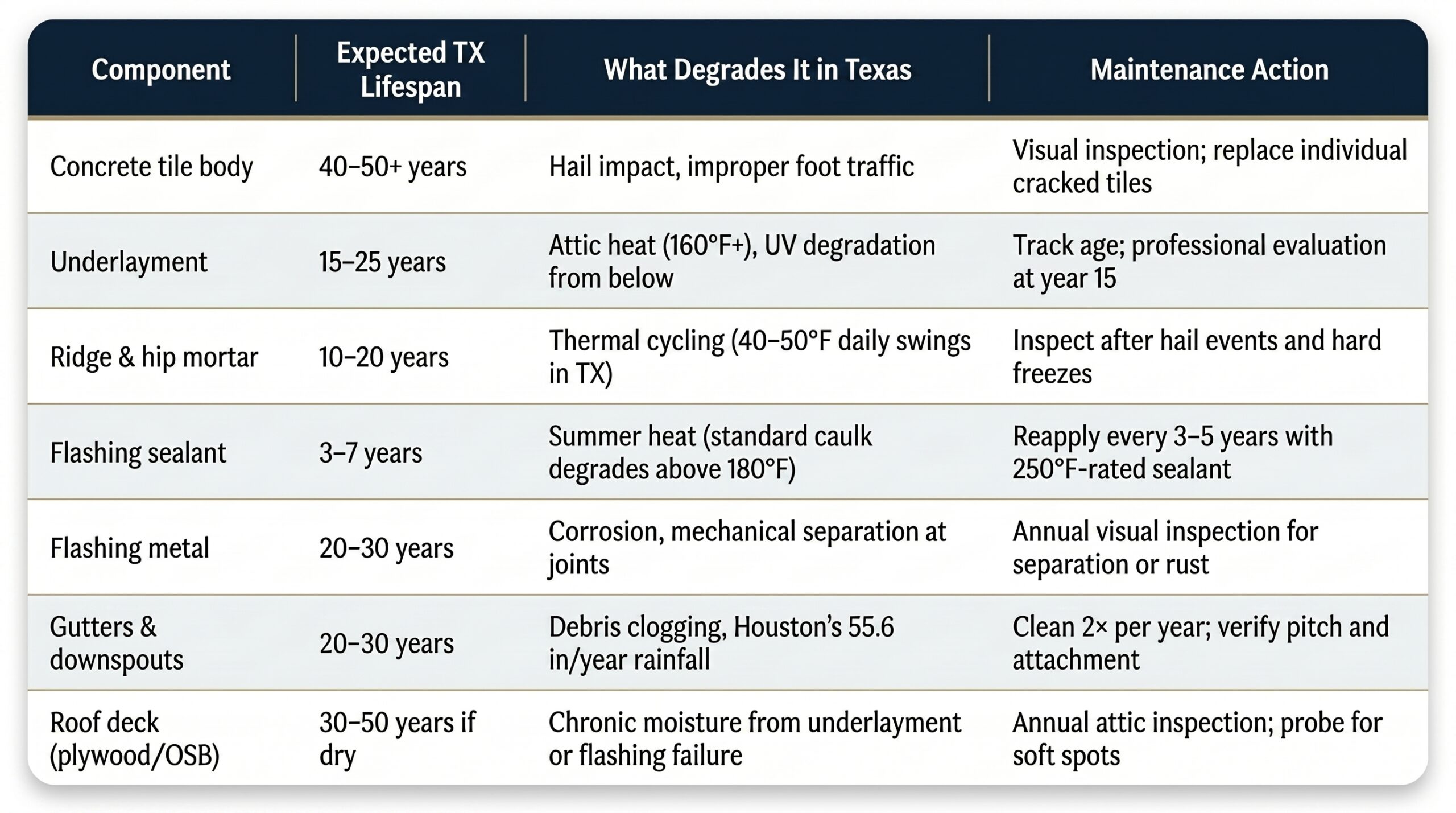
160°F+Peak attic temperature in Texas residential homes during summer — among the highest in the country. This radiant heat degrades underlayment from below, routinely reducing a rated 25-year underlayment to an effective 15–20 year lifespan in South Texas.Source: Texas A&M AgriLife Extension
The 8 Warning Signs Your Concrete Tile Roof Needs Maintenance Right Now
Concrete tile roofs announce their maintenance needs before they fail — if you know what signals to read. These eight indicators mean your roof needs attention now, not at the next scheduled window.
1. Cracked, broken, or missing tiles
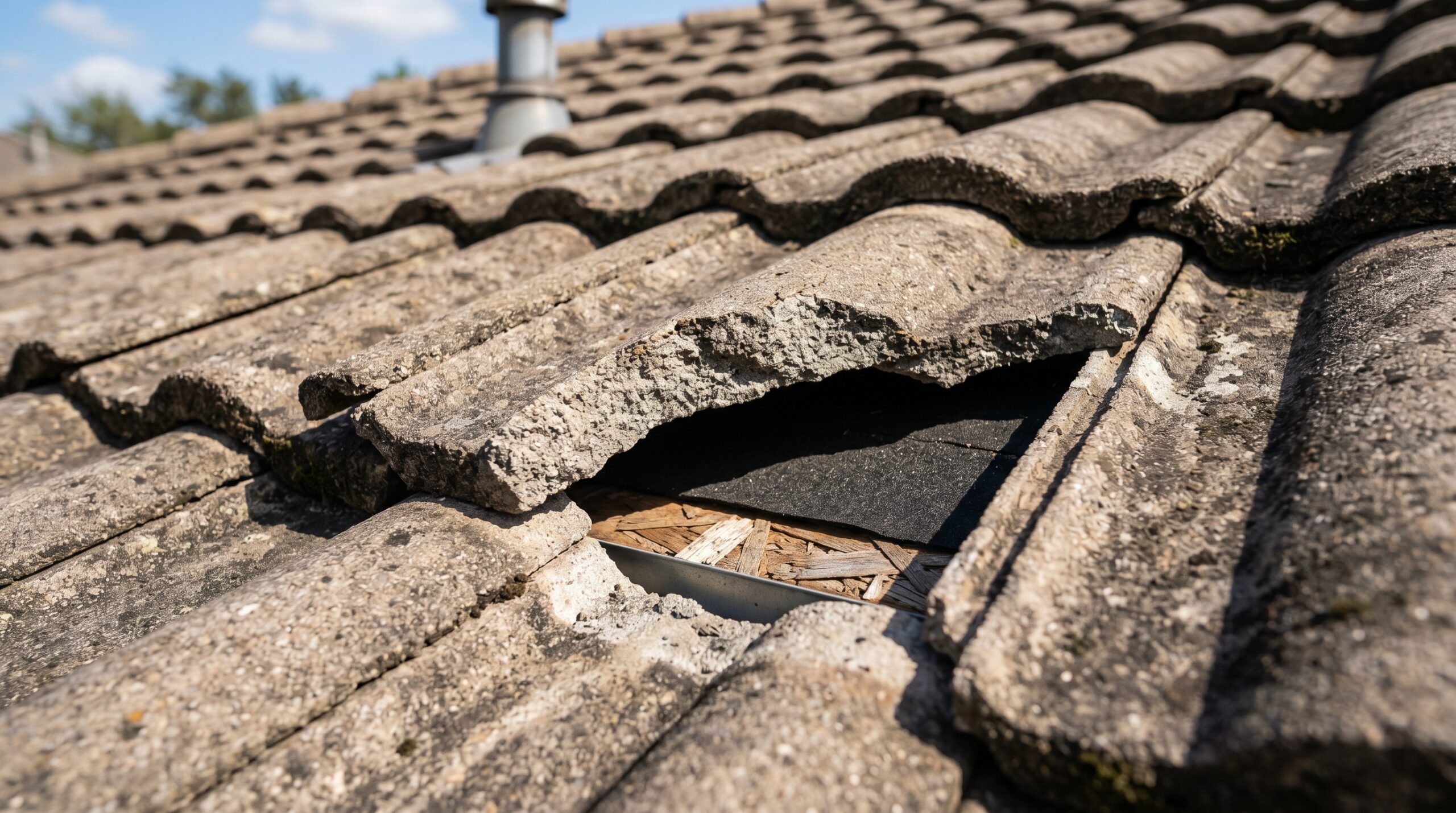
Any visible tile damage is an immediate maintenance item. A single cracked tile exposes the underlayment below to direct weather cycling. In Houston’s annual rainfall of 55.6 inches, an exposed underlayment section can saturate and rot the deck beneath it within one rainy season.
2. Displaced or raised ridge and hip tiles
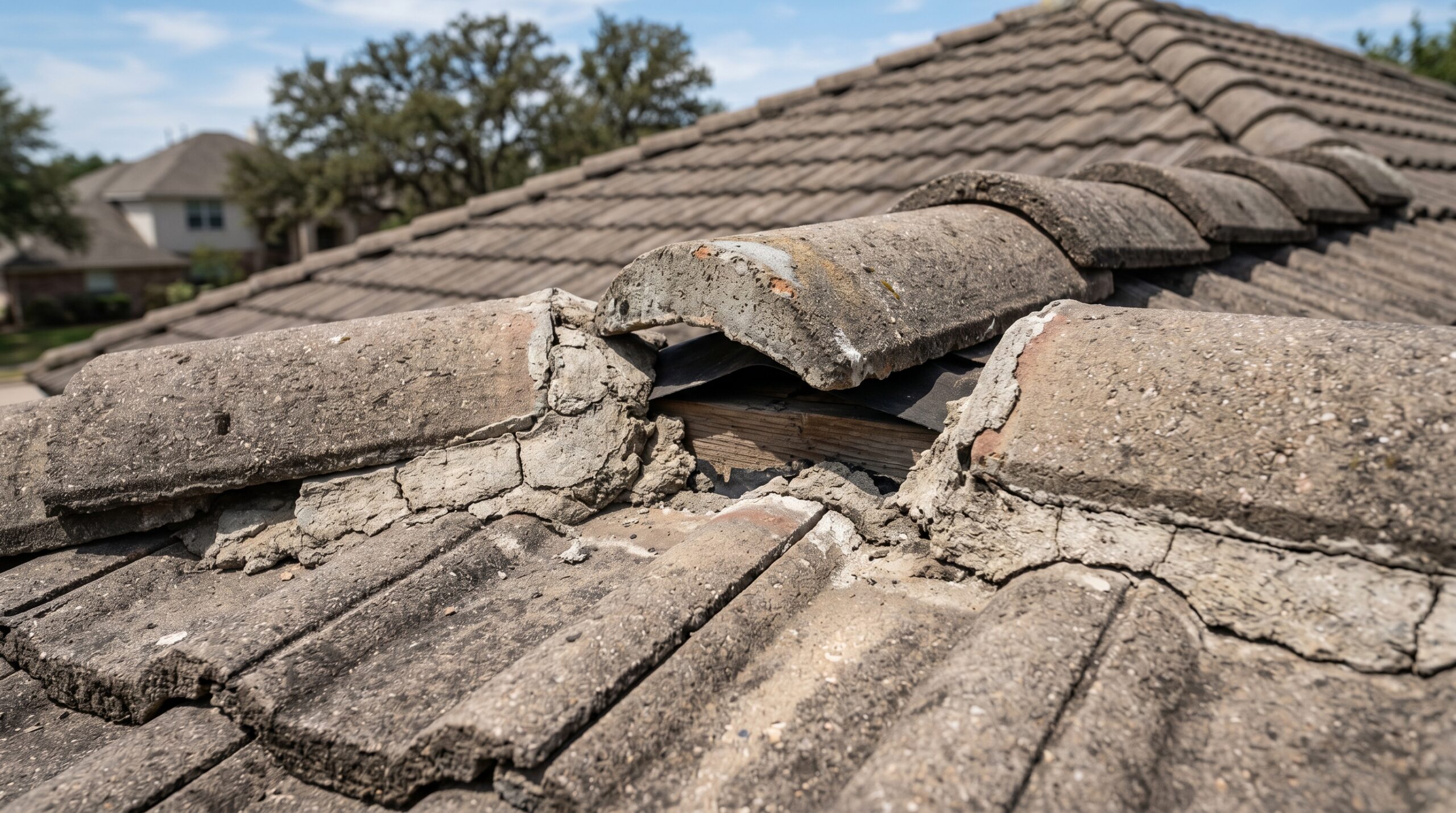
Ridge and hip tiles are held in place by mortar. When mortar fails — which it does earlier in Texas due to daily thermal cycling — ridge tiles lift or shift. A displaced ridge tile is a direct water entry point at the highest part of your roof, where runoff from every slope converges.
3. New ceiling stains after rain
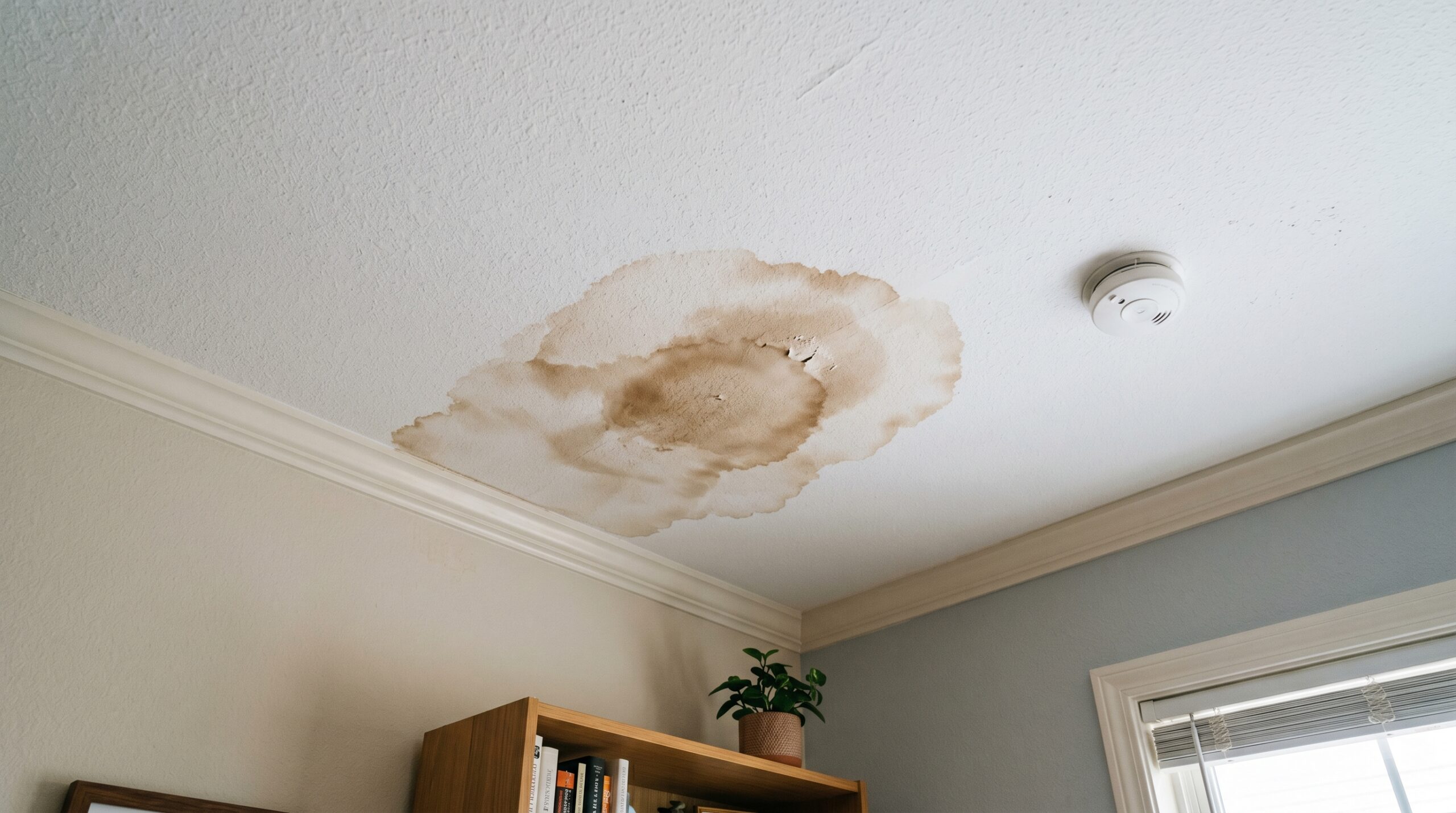
A water stain that appeared after a rain event is an active leak. The stain location inside the house is rarely directly below the entry point — water travels along rafters. Do not wait for the next maintenance window. An active leak can saturate and rot a deck section in 60–90 days in Houston’s climate.
4. Black streaking on tile surfaces
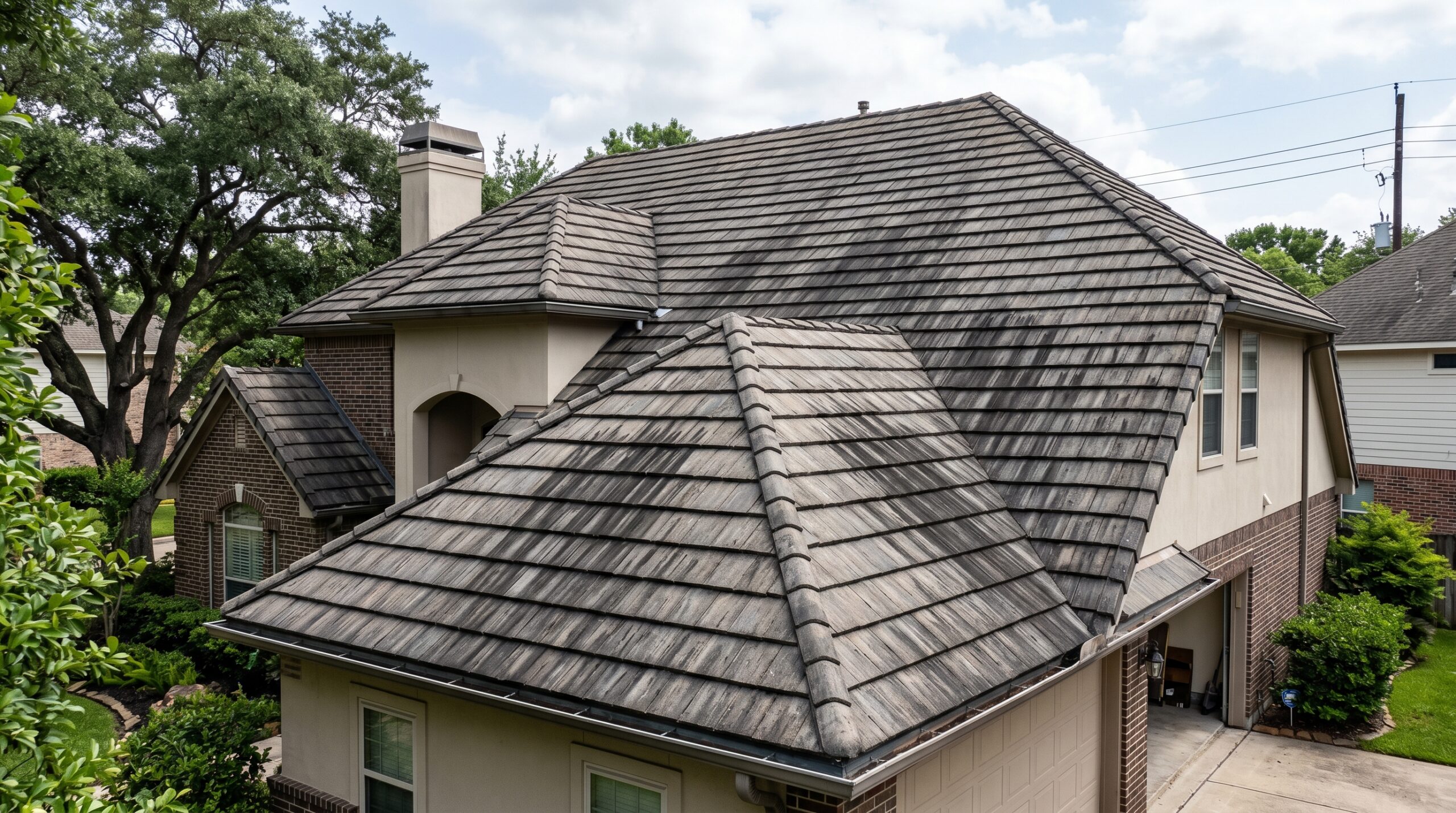
The dark streaks common on Houston-area roofs are Gloeocapsa magma — a cyanobacterium that feeds on the limestone in concrete tile and thrives in Houston’s 75% average annual humidity. It isn’t immediately structural, but it retains moisture against tile surfaces and accelerates surface erosion over time. It also signals ideal conditions for moss growth, which is more aggressive.
5. Cracked or missing mortar at ridge and hip joints
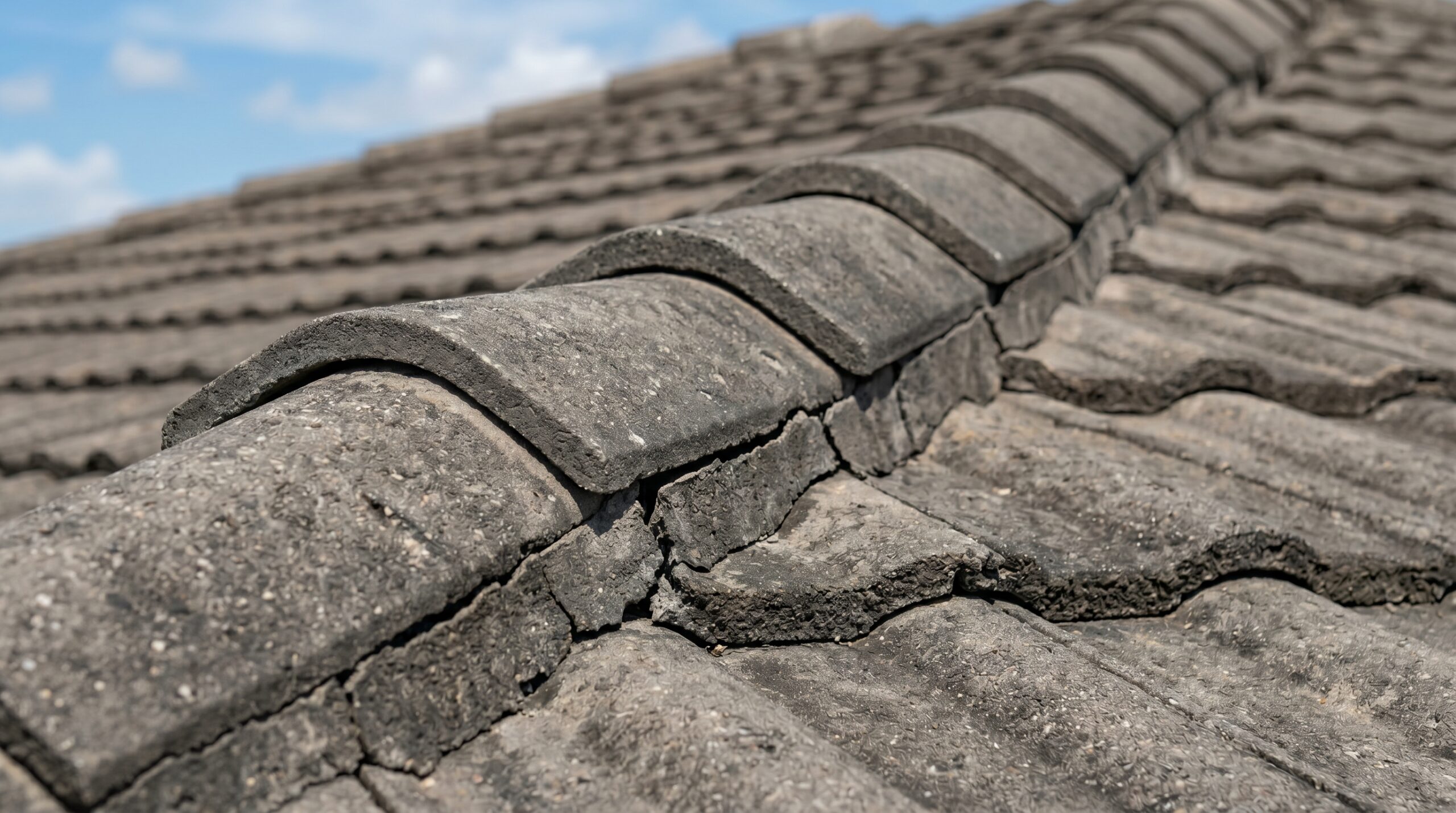
Visible mortar cracks or voids at ridge cap joints — even without tile displacement — mean the mortar bond is compromised. In a wind event, this is the difference between a ridge tile that stays put and one that lifts and breaks. Mortar repair is a low-cost fix; a wind-lifted ridge tile that cracks on impact requires matching and tile replacement.
6. Caulk separation at flashing points
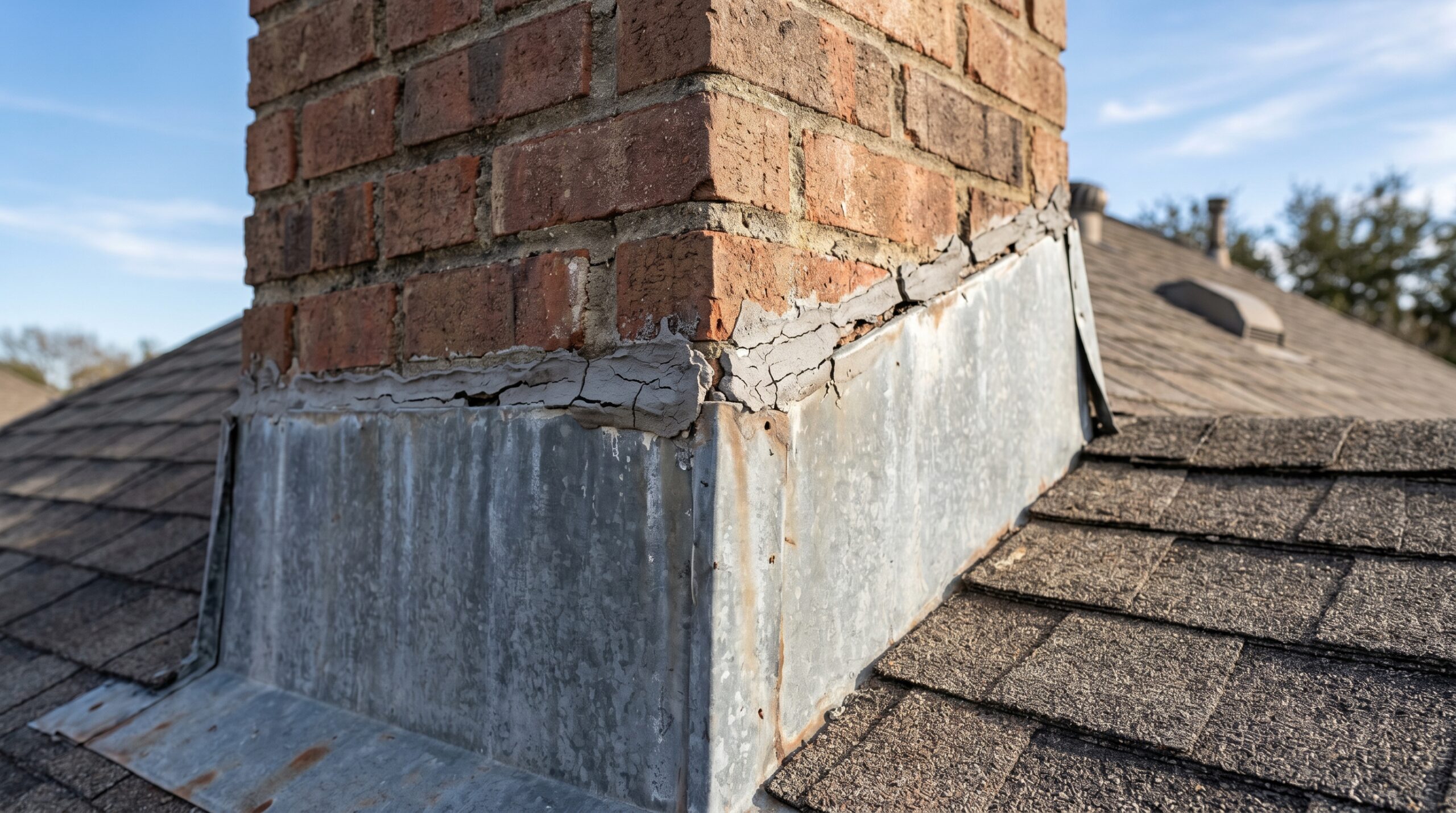
Sealant at chimney, skylight, pipe, and wall flashings is the shortest-lived component on the roof — typically 3–7 years under Texas summer heat. Separated or cracked sealant at a flashing joint is a maintenance item that costs $300–$700 to correct. Left unaddressed, it becomes a flashing replacement plus deck repair costing several thousand dollars.
7. Debris accumulation in valleys and gutters
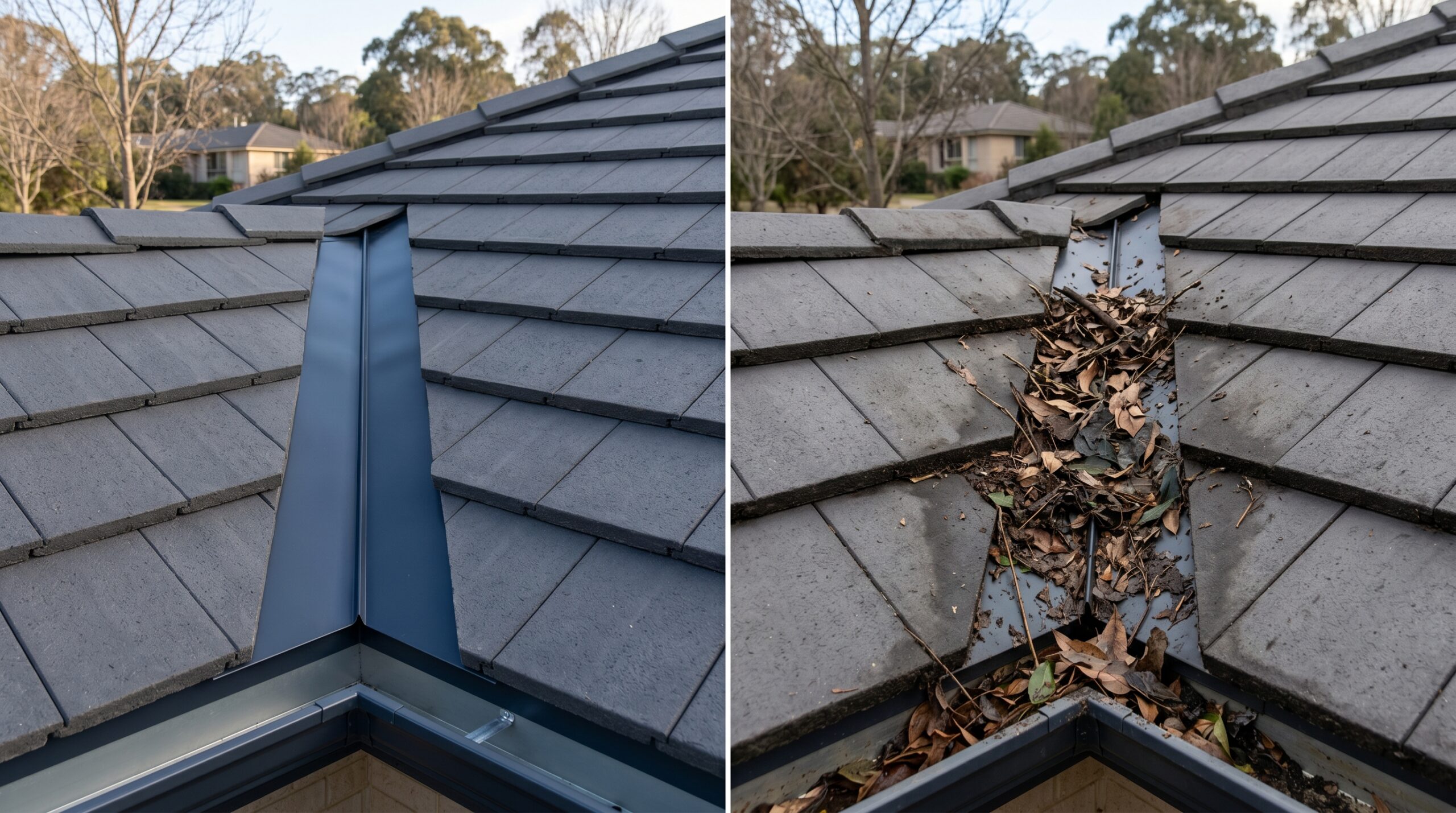
Packed debris in roof valleys creates a moisture reservoir directly over the underlayment. In Houston’s humidity, that sustained moisture accelerates underlayment degradation at the exact points — valleys — where two roof slopes channel concentrated runoff. Clogged gutters allow water to back up under the fascia and wick into the roof deck edge.
8. Roof system age approaching 15–20 years
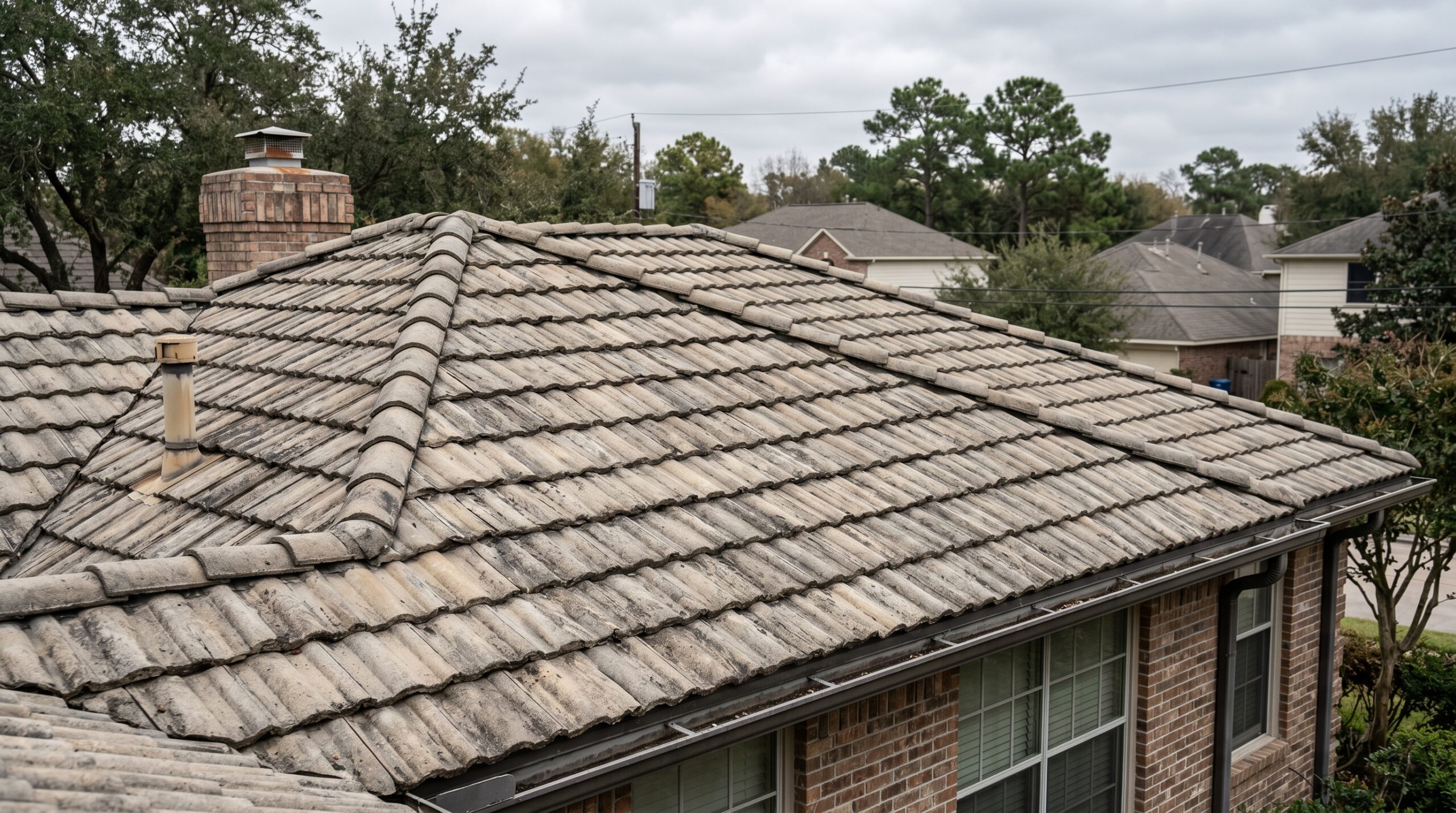
This is not a visible warning sign — it’s a calendar flag. If your concrete tile roof system is 15–20 years old and has never had a professional underlayment evaluation, the underlayment may be approaching or past its effective service life in Texas conditions. Schedule an evaluation before a storm event forces the issue.
#1 in the U.S.Texas leads the nation in reported hail events annually. Concrete tiles absorb significant impact before cracking, but 1.5″+ hailstones will crack tiles and displace mortar — making post-storm inspection critical after any significant hail event.Source: NOAA Storm Prediction Center
The Complete Yearly Concrete Tile Roof Maintenance Checklist for Texas Homeowners
“To ensure your tile roof survives the harsh Texas weather, proper upkeep is crucial. Make sure to follow our Concrete Tile Roof Maintenance Checklist to protect your investment.”
Two scheduled maintenance windows per year — one in spring, one in fall — plus responsive checks after storm events. Here is exactly what each window covers and why each task matters in the Texas context.
Spring Window — April to May (Most Critical)
Spring closes out winter and opens severe storm season. Any damage from freeze events must be identified and repaired before June. This is the most important maintenance window of the year for Texas homeowners.
- Full tile inspection from ground level with binoculars. Walk the full perimeter. Look for cracked, broken, displaced, or lifted tiles. Note any tiles that appear bleached or significantly lighter — this indicates surface coating loss and increased porosity.
- Ridge and hip mortar inspection. Scan all ridge caps for cracking, voids, or delamination. Texas thermal cycling stresses mortar earlier than any other climate. Check especially at the transition between ridge tiles and field tiles.
- Clear all valleys, gutters, and downspouts of debris. Use a leaf blower — not a pressure washer. Work from the ridge down to avoid driving debris under tile laps. Confirm downspouts are clear by running a garden hose.
- Inspect and reseal all flashing points. Check sealant at every chimney, pipe penetration, skylight, and wall junction. Any cracking or separation gets resealed before storm season with roofing-grade sealant rated for 250°F minimum.
- Inspect soffit and fascia for moisture staining or soft wood. Dark staining or spongy fascia boards indicate drainage backup or drip-edge failure. Both are inexpensive to fix now; they become deck repair jobs if left through another rainy season.
- Attic inspection for daylight, staining, and soft deck sections. On a bright afternoon, enter the attic and look for pinpoints of light (gaps in the deck), dark staining on rafters (past moisture), and any soft or springy areas when you walk on ceiling joists.
- Confirm attic ventilation is unobstructed. Ridge vents, soffit vents, and attic fans all need a clear path. Blocked ventilation allows attic temperatures to climb higher, accelerating underlayment degradation from below. The FHA recommends 1 sq ft of net free ventilation per 150 sq ft of attic floor area.
- Photograph and document everything with date-stamped photos. This is your pre-storm-season baseline for insurance purposes. More on this below.
Summer Spot Checks — June to August
Summer in Texas is not a scheduled maintenance window — it’s a reactive one. Roof work during peak summer heat (roof surface temperatures reach 150–180°F) carries serious heat safety risks. Schedule any needed repairs for early morning before 9am or defer non-urgent items to fall.
- Inspect within 48 hours after any hail event. Walk the gutters and check for dented downspouts and gutters — a proxy indicator for hail size. Dimpled aluminum means 1″+ stones likely hit the roof. File your insurance inspection request within your policy window (typically 30–90 days from the event date).
- Check for displaced ridge tiles after wind events exceeding 50 mph. A ridge tile lifted by wind is a direct water entry point. If visible from ground level, this is a same-week repair — not a fall item.
- Monitor interior ceilings after heavy rain. A new stain after rain means an active leak. Locate which roof feature it’s beneath and call for emergency repair. Do not defer an active leak.
- Observe gutter flow during rain from ground level. No water from a downspout during heavy rain means a blockage. Water overflowing the front of a gutter means a pitch problem, a full clog, or a separated downspout joint.
Fall Window — September to October
The fall window closes out hurricane and tropical storm season and prepares the roof for winter rains. Treat this as a full repeat of the spring inspection — not a quick visual pass.
- Repeat the full spring inspection sequence. Five months of Texas summer advances marginal conditions. Mortar that was cracked in spring may have delaminated fully by October. Flashing sealant applied in April may have failed in August heat.
- Clean gutters again. Even in Houston’s partial deciduous canopy, fall debris accumulates. Clean gutters are essential before winter rains increase in frequency.
- Treat algae and moss growth. Houston’s summer humidity produces peak algae and moss growth on north-facing slopes and shaded valleys. Apply a diluted sodium hypochlorite solution (1 part bleach to 3 parts water) from the ridge down with a low-pressure pump sprayer. Let dwell 15 minutes, rinse lightly. Do not pressure wash — this strips the surface coating from concrete tile permanently.
- Reapply flashing sealant at any points showing degradation. Any sealant that survived spring but cracked through summer needs reapplication before winter rain season.
- Schedule a professional underlayment evaluation if the system is 15+ years old. This is the highest-leverage fall task for any concrete tile roof approaching mid-life. A 15-year-old underlayment in Texas conditions may have 5–10 years remaining, or it may be failing now. Only a physical inspection — which requires tile removal — can determine this. Schedule before demand peaks.
- Check attic insulation for moisture damage. Any summer leak, however minor, may have wetted insulation. Wet insulation loses R-value and promotes mold. Verify radiant barrier integrity while in the attic.
Winter Considerations — November to March
Most of Houston doesn’t experience sustained freeze, but freeze events occur — and when they do, concrete tile mortar is the first thing affected. North Texas homeowners face more consistent freeze-thaw exposure.
- Inspect ridge and hip mortar after any hard freeze event. Water that has infiltrated cracked mortar expands approximately 9% when it freezes, widening the crack. Even a mild Houston freeze can advance marginal mortar failure into active displacement.
- Watch for ice dams in North Texas homes. Ice dams form when heat escaping through inadequately insulated roofs melts snow that refreezes at the cold eave edge, backing water under tiles. The solution is an insulation and ventilation fix — but the water damage presents at the tile layer.
- Do not defer active leak repairs. Winter rain in Texas is sustained and heavy. An active leak in December can rot a deck section by February. Emergency repair in cold weather costs far less than deck replacement in spring.
What Does Concrete Tile Roof Maintenance Cost in Houston? (2026 Data)
Here is what Texas homeowners should expect to pay for each maintenance service in the Houston metro area in 2026. These ranges reflect actual contractor pricing — not national averages that bear no relationship to local labor and material costs.
| Service | Houston Cost Range (2026) | Recommended Frequency |
|---|---|---|
| Professional roof inspection | $200–$500 | 2× per year (spring + fall) |
| Gutter cleaning (professional) | $150–$350 | 2× per year |
| Flashing sealant reapplication | $300–$700 | Every 3–5 years |
| Individual tile replacement | $150–$400 per tile | As needed (post-hail/impact) |
| Algae/moss treatment | $400–$900 | Every 3–5 years (Houston humidity) |
| Ridge and hip mortar repair | $800–$2,500 | Every 10–15 years (TX thermal stress) |
| Professional underlayment evaluation | $400–$800 | At year 15, then every 5 years |
| Full underlayment + flashing replacement | $6,000–$14,000 | Every 15–25 years |
| Full concrete tile roof replacement | $24,000–$75,000 | Every 40–50 years (if well maintained) |
The maintenance math is straightforward: a homeowner who spends approximately $700/year on inspections and minor repairs invests roughly $10,500 over 15 years. A homeowner who defers all maintenance and replaces the roof at year 20 due to underlayment failure pays $24,000–$75,000 for a replacement that proper maintenance would have deferred by another 20–30 years.
Industry ContextTile roof installation in Houston ranges from $10–$14/sq ft installed for concrete tile and $14–$20+/sq ft for clay tile, with full project costs ranging from $24,000 to $75,000 depending on roof size, pitch, and complexity. These figures reflect 2026 Houston metro market pricing, where roofing labor costs run higher than the national average due to demand driven by frequent storm cycles.
What You Can Do Yourself vs. What Requires a Professional
Walking on a concrete tile roof is not like walking on asphalt shingles. Correct foot placement is over the tile batten — the horizontal nailer strip beneath each tile course — not on the tile body itself. Untrained walking on tile bodies cracks tiles, voids manufacturer warranties, and causes the exact damage homeowners are trying to prevent. This is the most important restriction to understand before any DIY maintenance attempt.
| Task | DIY-Safe? | Notes |
|---|---|---|
| Ground-level visual inspection (binoculars) | Yes | Most productive non-professional inspection method available |
| Attic inspection (daylight, staining, moisture) | Yes | Flashlight + dated photos; look for light penetration, dark staining, soft deck |
| Gutter cleaning (single-story, stable ladder) | Yes | Do not lean ladder against gutter fascia — use a standoff |
| Debris blowing from eave level | Yes | Blower from the ladder at roofline — do not step onto the roof surface |
| Algae treatment (diluted bleach, low pressure) | Careful | Protect landscaping below; work from ridge down; never pressure wash |
| Flashing sealant reapplication | Careful | Only if reachable from ladder without stepping onto tile surface |
| Walking on tile roof | No | Requires trained batten-step technique; untrained walking cracks tiles and voids warranties |
| Individual tile replacement | No | Requires tile matching, correct batten-step placement, and re-nailing sequence |
| Ridge and hip mortar repair | No | Requires mortar type matching and mechanical fastening before re-mortaring |
| Underlayment evaluation | No | Requires tile removal at multiple locations — professional only |
Texas Summer Safety NoteRoof surface temperatures in Texas peak between 11am and 4pm, reaching 150–180°F on tile surfaces in summer. Any task involving ladder use at roofline height should be performed before 9am or after 6pm between June and September. Heat exhaustion on a roof is fast-acting and serious. Schedule professional summer repairs for early morning windows only.
What Contractors Won’t Tell You About Concrete Tile Roof Maintenance
Most roofing contractors are in the business of replacing roofs, not maintaining them. That creates a structural incentive to recommend replacement when maintenance is the correct answer. Here are the things a contractor with your interests in mind will tell you — and that many won’t.
Pressure washing voids your tile warranty and accelerates system failure
A significant number of Houston homeowners have their concrete tile roofs pressure washed for algae removal. This strips the surface coating that protects the tile’s cement body, drives pressurized water directly under tile laps onto the underlayment, and accelerates the exact degradation they’re trying to stop. Any contractor who recommends pressure washing for a concrete tile roof is giving you bad advice. The correct treatment is a low-pressure diluted bleach application or zinc strip installation at the ridge.
Underlayment failure is not a reason to replace the tile
When an underlayment fails and leaks appear, many homeowners are quoted full roof replacements because it’s easier to sell and more profitable to perform. In the majority of cases where the concrete tile body is intact, underlayment and flashing replacement is the correct scope. This preserves the original tile, which — if it’s a quality concrete product — still has 20–30 years of life remaining.
Documenting maintenance protects you in hail claims
Insurance carriers in Texas can deny or reduce hail damage claims by attributing damage to “pre-existing deterioration.” Homeowners with dated photographic inspection records and written contractor maintenance reports have a documented baseline that eliminates this argument. A maintenance record showing a clean bill of health six months before a storm is difficult for an adjuster to dispute.
The Texas Department of Insurance provides guidance on the hail claims process and your rights as a policyholder at tdi.texas.gov.
75%Houston’s average annual relative humidity — confirmed by U.S. National Centers for Environmental Information (NCEI) climate normals. Daily humidity ranges from 90% at 6am to 55% at 3pm, creating sustained moisture conditions that accelerate algae growth and mortar degradation on north-facing and shaded roof surfaces.Source: Current Results / U.S. NCEI Climate Normals
When Does Maintenance Stop Being Enough? The Replacement Threshold
Maintenance is the right answer for a concrete tile roof until one or more of these conditions is met. At that point, the math shifts and replacement becomes the financially rational decision.
- More than 25–30% of tiles are structurally compromised. At this threshold, systematic failure is occurring. The tile body itself may be at end-of-life, or impact damage from a severe hail event may have compromised too large an area for individual tile replacement to be economical.
- Roof deck shows rot or structural compromise. Deck repair always requires full tile removal. If the deck needs replacement, a combined deck-underlayment-retiling project is the logical scope.
- Multiple leaks appearing across different roof sections despite repeated professional repair. One repaired leak is a maintenance issue. Multiple new leaks across different areas after professional repair indicates systemic underlayment failure — not isolated point failures.
- Underlayment age exceeds 25 years in Texas conditions. A 25-year-old underlayment in Texas has been subjected to conditions that a 30–35-year-old underlayment experiences in northern states. After year 25 without evaluation, assume replacement is needed.
- Repair costs projected over the next 5 years exceed 50–60% of replacement cost. This is the standard replacement threshold across roofing systems. When deferred maintenance has accumulated to this point, replacement delivers better value and a new system warranty.
Industry ContextAge alone — if under 40 years — is rarely a sufficient reason to replace a concrete tile roof. The correct question is not “how old is the roof?” but “how old is the system beneath the tile, and what condition is it in?” A 30-year-old concrete tile roof with a recently refreshed underlayment and intact tile may have 20+ years of service life remaining. A 15-year-old roof with a failed underlayment may need immediate intervention.
Source: NRCA
Frequently Asked Questions
How often should a concrete tile roof be inspected in Texas?
Twice a year — April–May (spring) and September–October (fall) — plus a visual check within 48–72 hours after any hail event or wind event exceeding 50 mph. Houston’s annual rainfall of 55.6 inches and active hail exposure justify more frequent inspection than the national recommendation of once every three years. The twice-yearly schedule is calibrated to Texas storm season timing: spring inspection closes out winter before storm season opens; fall inspection closes out hurricane season before winter rains increase.
Can I walk on my concrete tile roof to inspect it?
No. Untrained walking on a concrete tile roof cracks tiles and can void manufacturer warranties. Concrete tile requires foot placement directly over the tile batten — the horizontal nailer strip beneath each tile course — not on the tile body itself. Professional roofers trained in concrete tile systems use specific body weight distribution and step placement to prevent breakage. For homeowners, the most effective inspection method is ground-level viewing with binoculars, a ladder at the roofline (without stepping onto the roof surface), or a drone camera pass.
What causes black streaks on concrete tile roofs in Houston?
The black streaking common on Houston-area concrete tile roofs is Gloeocapsa magma — a cyanobacterium (often misidentified as mold or mildew) that feeds on the limestone content in concrete tile and thrives in humid conditions. At 75% average annual humidity, Houston is ideal territory for it. It spreads via airborne spores and is cosmetic rather than immediately structural, but it retains moisture against tile surfaces and accelerates surface erosion over time. Treatment: diluted bleach solution (1:3 bleach to water) applied low-pressure from the ridge down. Long-term prevention: zinc or copper strip installation at the ridge, which provides continuous biological growth inhibition as rainwater carries metal ions down the slope.
How long does a concrete tile roof last in Texas?
The tile body lasts 40–50+ years in Texas conditions. The system beneath the tile — underlayment, flashing, and mortar — lasts 15–25 years before requiring significant maintenance or replacement. Most concrete tile “failures” in Texas are underlayment failures, not tile failures. A well-maintained concrete tile roof with a proactively refreshed underlayment at year 15–20 can realistically serve a home for 50–60+ years from original installation.
How do I know if my concrete tile roof underlayment needs to be replaced?
The underlayment cannot be directly inspected without removing tiles. Signs it may already be compromised: recurring leaks at flashing points despite flashing repair, ceiling stains that don’t correspond to any identifiable tile or flashing failure, and finding dried or crumbling black felt material when a tile is removed for any repair. If the roof system is 15+ years old, schedule a professional underlayment evaluation, which involves removing tiles at several locations to physically inspect the material. In Texas, this should happen at year 15, not year 25.
What is the best time of year to do concrete tile roof maintenance in Houston?
April–May is the optimal primary window. This closes out the mild winter, catches any freeze damage before the storm season, and gives repair contractors clear scheduling before summer heat restricts work hours. September–October is the optimal fall window, after the bulk of hurricane and tropical storm season, before winter rains increase. Avoid scheduling non-emergency roof work in July and August; roof surface temperatures exceed 150°F, posing heat exhaustion risks to workers and reducing workmanship quality.
Does homeowners insurance cover concrete tile roof maintenance in Texas?
No. Routine maintenance is not a covered peril under any standard Texas homeowners policy. Policies cover sudden and accidental damage — hail, wind, fire — not wear and scheduled upkeep. However, maintaining dated inspection records and receipts directly strengthens your position in a hail claim. Insurance carriers can and do deny claims by attributing damage to deferred maintenance rather than storm impact. A documented maintenance history eliminates that argument. The Texas Department of Insurance provides policyholder guidance on storm damage claims at tdi.texas.gov.
Is it worth maintaining a concrete tile roof or should I just replace it?
For any concrete tile roof under 40 years old with an intact tile body, proactive maintenance is almost always the financially correct decision compared to full replacement. The key variable is not age — it is underlayment condition. A 22-year-old roof with intact tile and a degraded underlayment needs a $6,000–$14,000 underlayment refresh, not a $24,000–$75,000 full replacement. The only cases where replacement beats maintenance: more than 25–30% of tiles are structurally compromised, the deck has rotted, or the projected repair cost over the next five years exceeds 50–60% of full replacement cost.
Get a Concrete Tile Roof Maintenance Assessment in Houston
Achilles Roofing inspects tiles, mortar, flashing, and underlayment age—and give you a written, fixed-price plan to keep your roof going 50+ years.
Written fixed-price estimate · GAF Certified Plus · 610+ Reviews · 4.9 Star-rated on Google · Financing from $199/mo
 Call (832) 346-8021
 Sources & References
- Current Results. (2026). Houston weather averages: Temperature and precipitation climate data. Current Results Weather and Science.
- International Code Council. (2026). International Code Council home page. ICC.
- National Roofing Contractors Association. (2026). National Roofing Contractors Association home page. NRCA.
- Texas A&M AgriLife Extension Service. (2026). Texas A&M AgriLife Extension Service home page. Texas A&M University System.
- Texas Department of Insurance. (2026). Texas Department of Insurance home page. TDI.
- U.S. Environmental Protection Agency. (2026). UV index scale. Sun Safety.
- U.S. National Oceanic and Atmospheric Administration. (2026). Storm Prediction Center home page. National Weather Service.