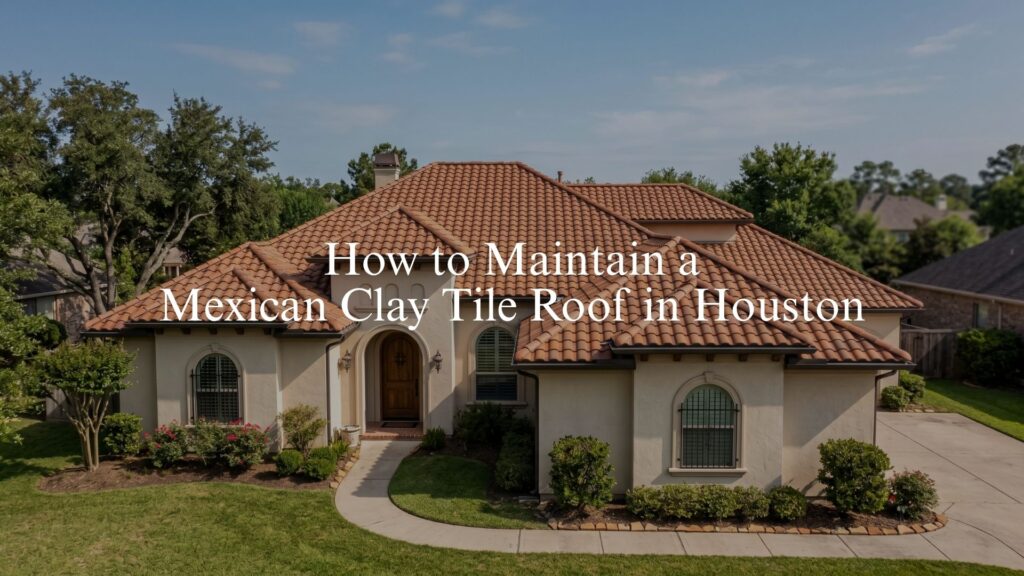
Quick Answer: How Do You Maintain a Mexican Clay Tile Roof in Houston?
Inspect your Mexican clay tile roof twice a year — March–April and September–October — and within 72 hours after any hail or tropical-storm event. Core tasks: check for cracked, slipped, or spalling tiles; clear debris from valleys and gutters; reseal flashing at every roof penetration; and assess underlayment age. A well-maintained Mexican clay tile roof lasts 80–100 years in Houston. The tiles are nearly indestructible. The system beneath them is not.
How Long Does a Mexican Clay Tile Roof Last in Houston?
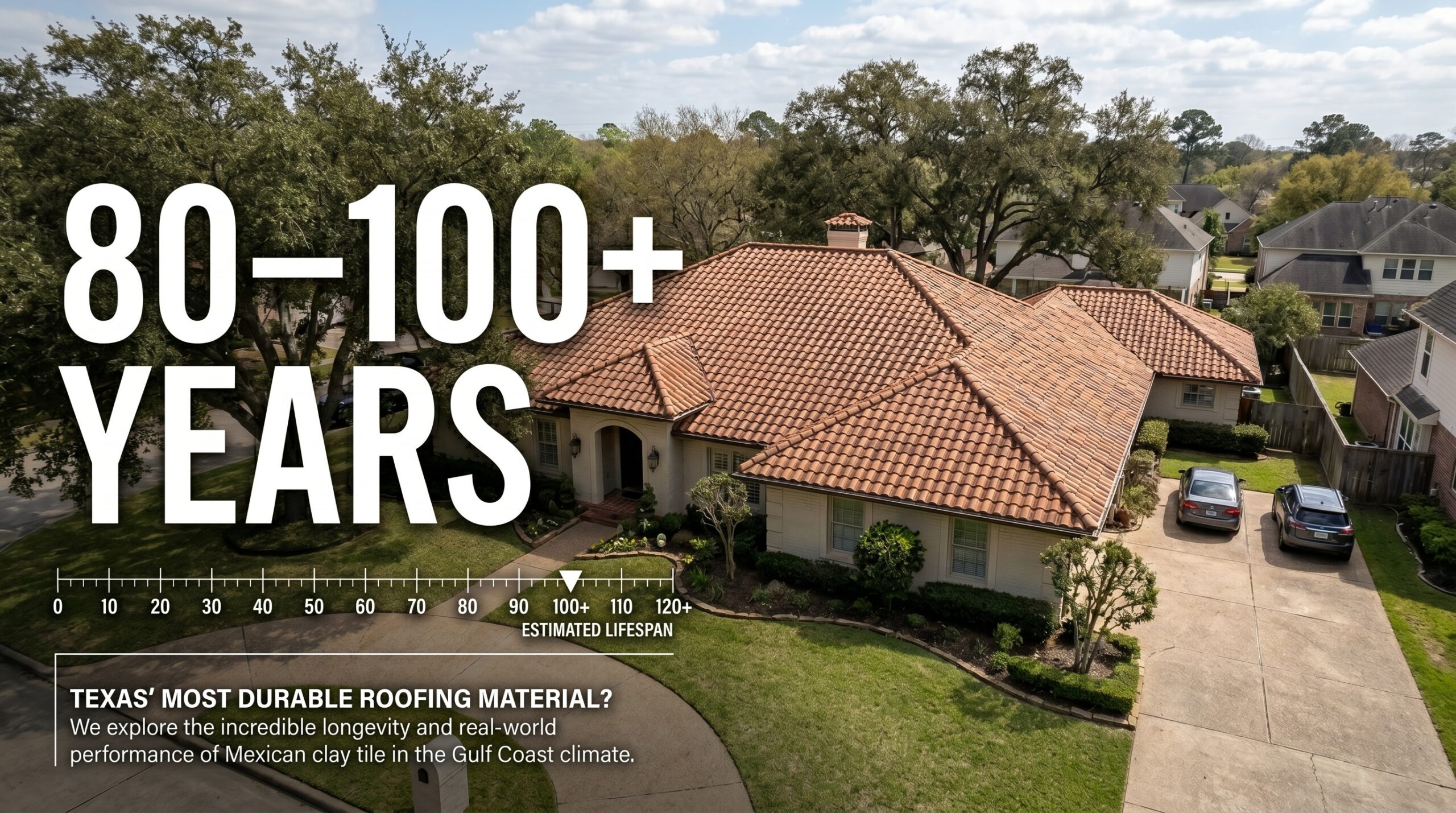
A Mexican clay tile roof in Houston has two separate lifespans running in parallel, and confusing them is the most expensive mistake Houston homeowners make.
The Tile Body: 80–100+ Years
Fired clay is one of the most durable roofing materials on earth. The tile body itself — the terracotta form — does not rot, does not corrode, and does not degrade from UV exposure. When maintained correctly, individual tiles outlast the houses beneath them. The oldest intact clay tile roofs in the American Southwest exceed 100 years of service life.
According to the National Roofing Contractors Association (NRCA), clay tile carries an expected service life of 50–100+ years, making it one of the longest-lived residential roofing materials available.
Source: NRCA
The System Beneath the Tile: 15–25 Years Without Maintenance
Here is where Houston homeowners consistently lose money. The tile is fine. What fails is everything the tile is sitting on:
- Underlayment: The waterproof membrane beneath the tile degrades with heat cycling. Houston attics regularly reach 130–150°F during summer peak — temperatures at which traditional asphalt-saturated felt underlayment begins to soften and lose structural integrity. According to Green Builder Media’s building science reporting, felt (“tar paper”) starts to degrade above sustained high heat, shortening its effective service life well below its rated 20-year maximum in hot climates like Houston’s. Sources: Green Builder Media; Energy Attic
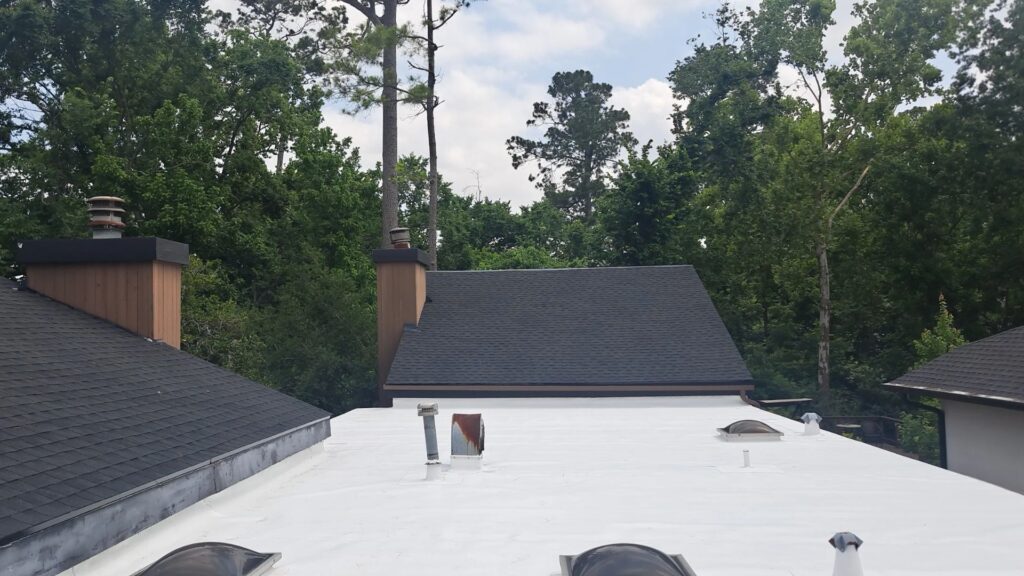
- Flashing: Metal or rubberized flashings at valleys, penetrations, skylights, and chimneys oxidize, separate, and crack. This is the #1 entry point for water in Houston clay tile homes.
- Ridge mortar: The mortar bedding that caps the ridge tiles is a portland cement mix. Houston’s thermal expansion cycles — cold fronts dropping temps 40°F in hours — crack ridge mortar within 15–20 years.
- Clay tile sealant (surface coating): Unlike concrete tile, Mexican clay tile is porous. The protective sealant coat applied at installation or after restoration absorbs UV and moisture and requires reapplication every 5–10 years in Houston’s climate.
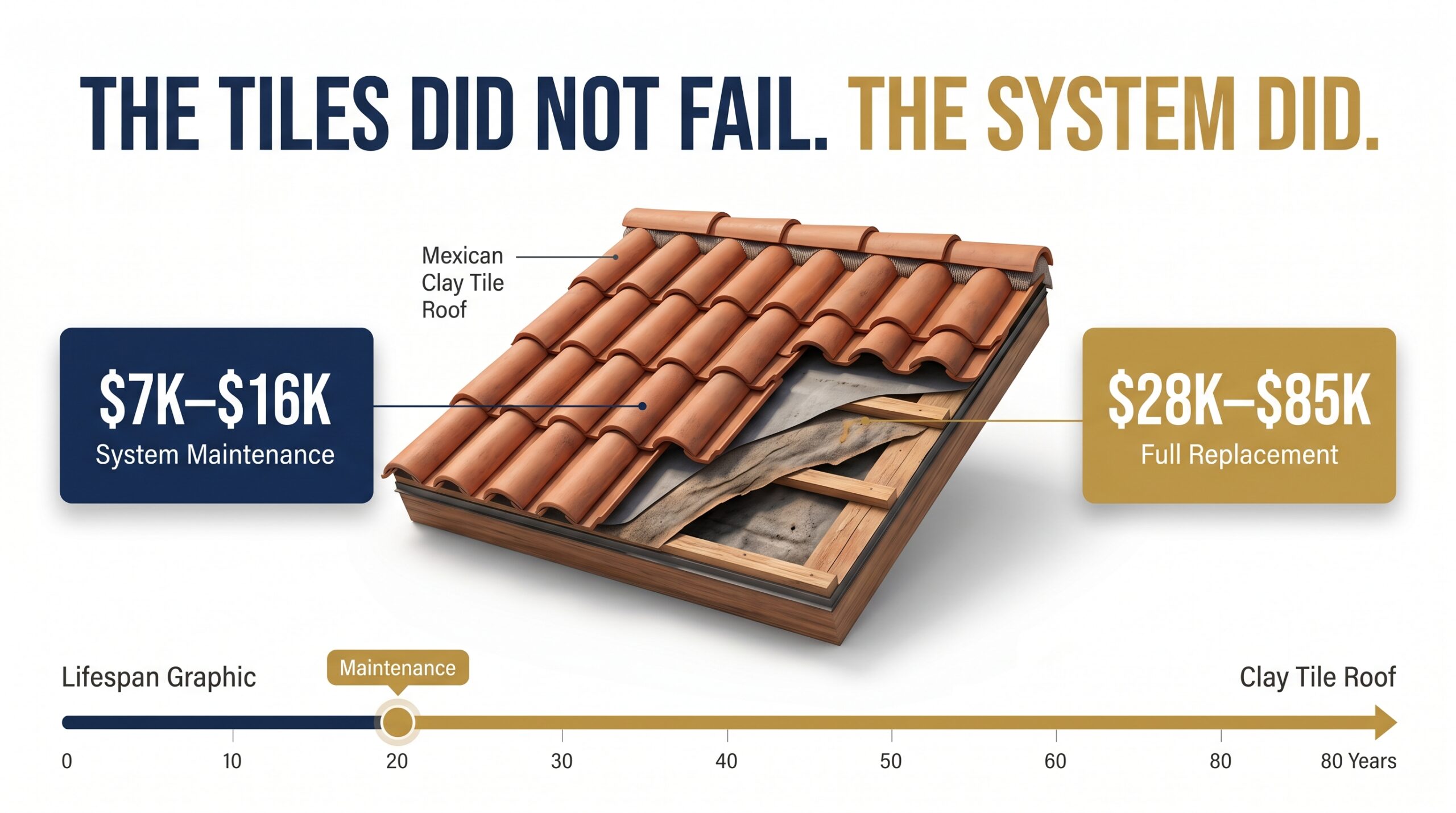
The Real Cost of Ignoring System Maintenance: Houston homeowners frequently pay $28,000–$85,000 for a full clay tile roof replacement at year 20–22 when the actual problem was a $7,000–$16,000 underlayment refresh, flashing reseal, and mortar repoint — performed on a tile body that had another 60+ years of service life remaining. The tiles did not fail. The system did.
Houston receives an average of 49.77 inches of rainfall per year — nearly 10 inches more than the U.S. national average of 38 inches. That moisture load on an unsealed clay tile system accelerates underlayment degradation significantly.
Source: NOAA / National Weather Service Houston
What Actually Wears Out on a Mexican Clay Tile Roof in Houston?
Mexican clay tile fails differently than concrete tile, asphalt shingle, or metal roofing — and Houston’s specific climate stressors make some failure modes uniquely severe here. Understanding what each stressor targets tells you exactly what to inspect and when.
Stressor 1: Thermal Cycling (Temperature Swings)
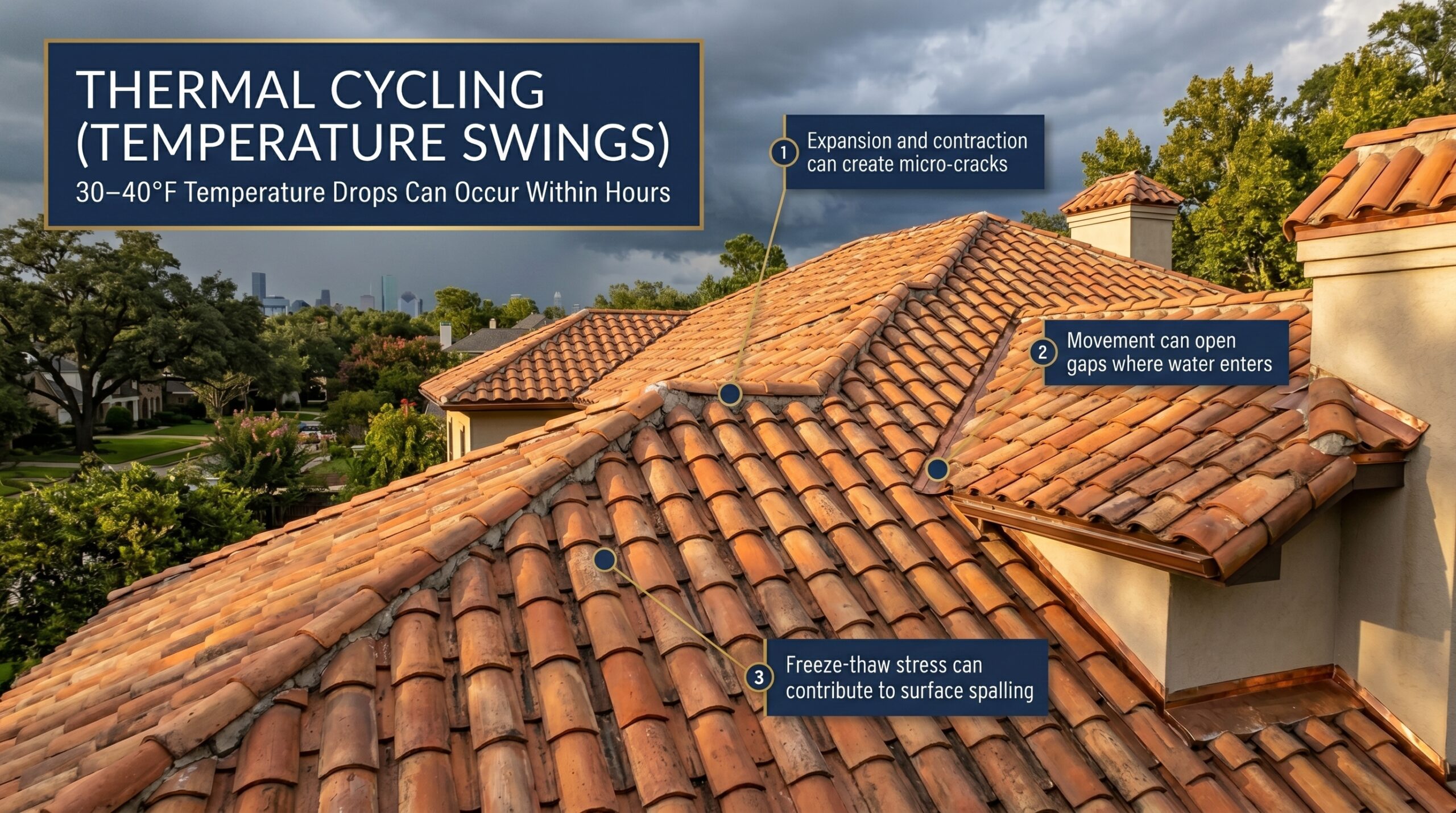
Houston does not experience mild, gradual seasons. Blue northers can drop temperatures 30–40°F within hours. This rapid thermal cycling causes clay tile, mortar, and underlayment to expand and contract at different rates. Over time, the differential movement opens micro-cracks in mortar beds, loosens tile fasteners, and creates gaps at flashing edges where water enters.
Clay tile is more brittle than concrete tile and more sensitive to freeze-thaw cycling. While Houston rarely freezes deeply, the occasional hard freeze — combined with clay tile’s natural porosity — can cause surface spalling when moisture trapped inside the tile expands.
Stressor 2: Houston Humidity and Biological Growth
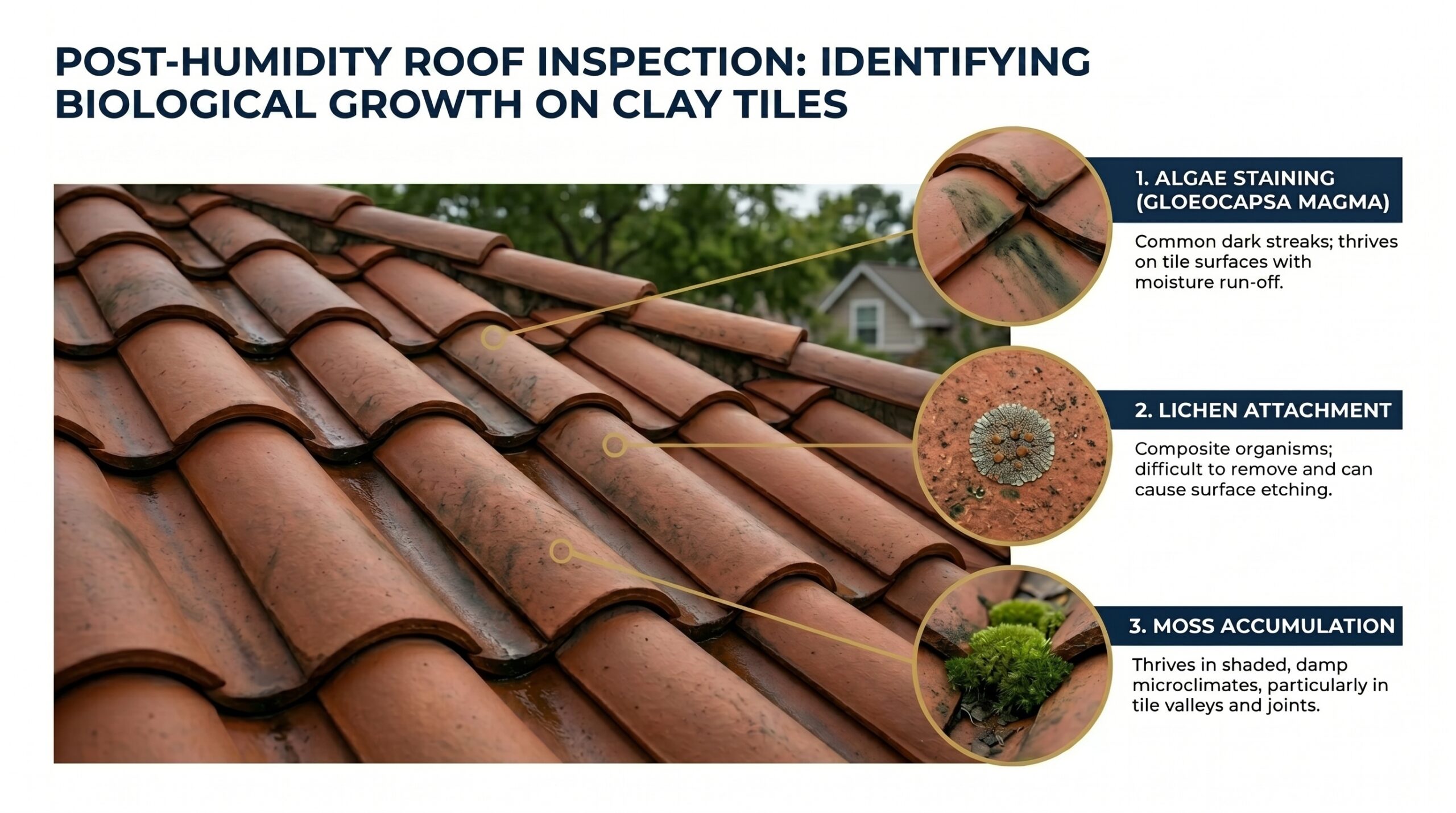
Houston averages relative humidity above 70% year-round. This creates ideal conditions for algae, lichen, and moss to colonize unsealed clay tile surfaces within 3–5 years of installation or the last sealant application.
- Algae (Gloeocapsa magma): The black streaking seen on Houston clay tile roofs. Cosmetic at first, but the root structure penetrates micro-pores in the clay and accelerates surface spalling over time.
- Lichen: More aggressive than algae. Lichen physically bonds to the clay surface and, once established, requires professional chemical treatment and mechanical removal. DIY pressure washing at incorrect PSI shatters tile.
- Moss: Retains moisture against the tile surface, compounding the spalling and moisture-infiltration risk under the tile course.
Source: NOAA National Centers for Environmental Information
Stressor 3: Hail and Wind Events
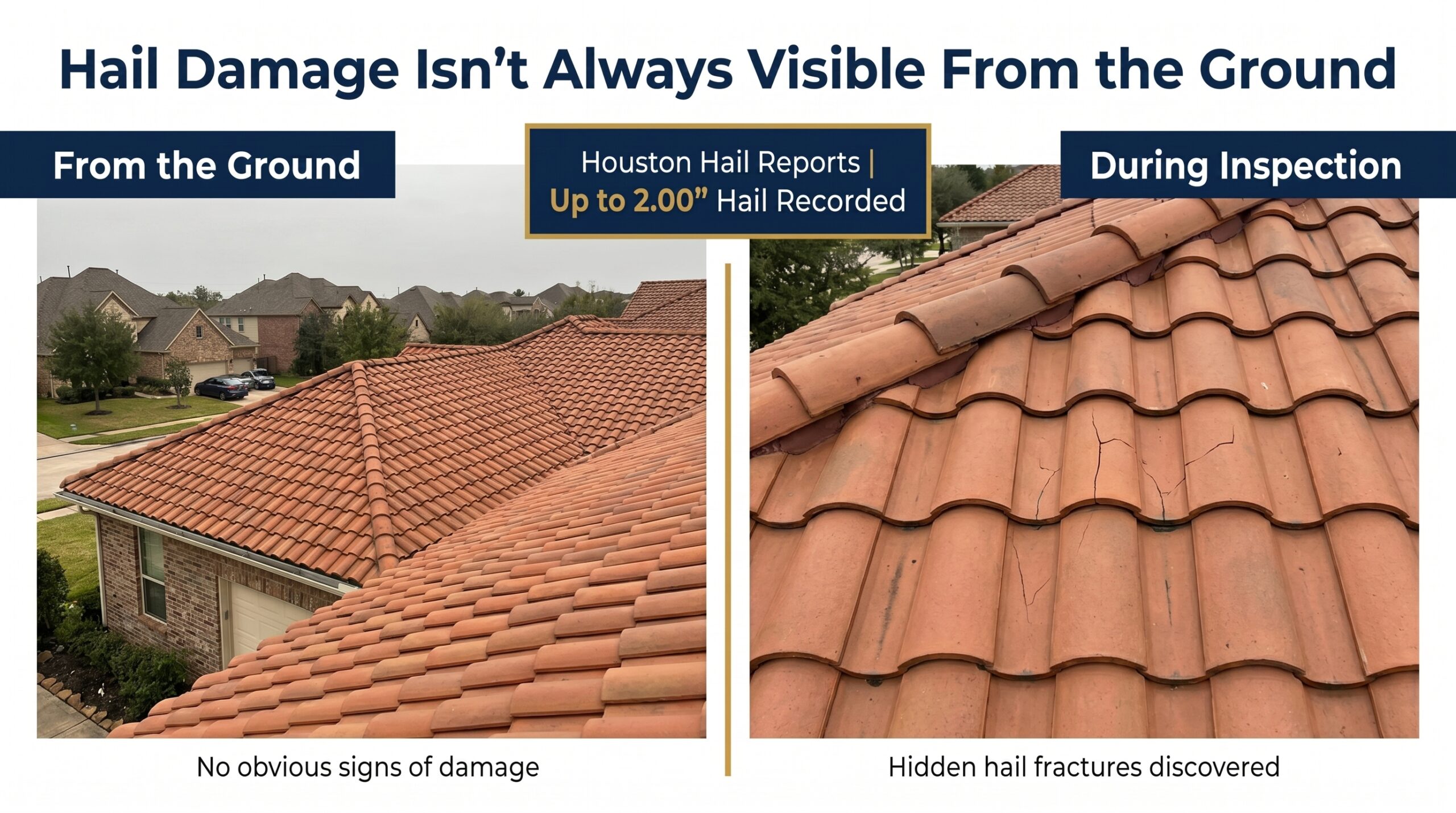
Harris County is among the most hail-prone urban counties in the United States. Storm spotter reports aggregated for the Houston metro show multiple hail events per year with stones exceeding 1 inch in 2023 alone; the largest recorded hail report near Houston’s city center measured 2.00 inches. Verified hail event records for Harris County are searchable by year through NOAA’s National Centers for Environmental Information Storm Events Database. Clay tile has excellent impact resistance against small hail, but 1.5-inch-plus stones — common in Houston supercell storms — cause tile fractures that are often invisible from the ground. These hairline fractures allow water infiltration for years before interior damage becomes apparent.
Source: NOAA NCEI Storm Events Database
Hurricane-force winds (Tropical Storm / Category 1 events affecting Houston) create negative pressure that lifts tiles off fasteners rather than shattering them. Post-storm inspection is not optional.
Stressor 4: UV Load and Sealant Degradation
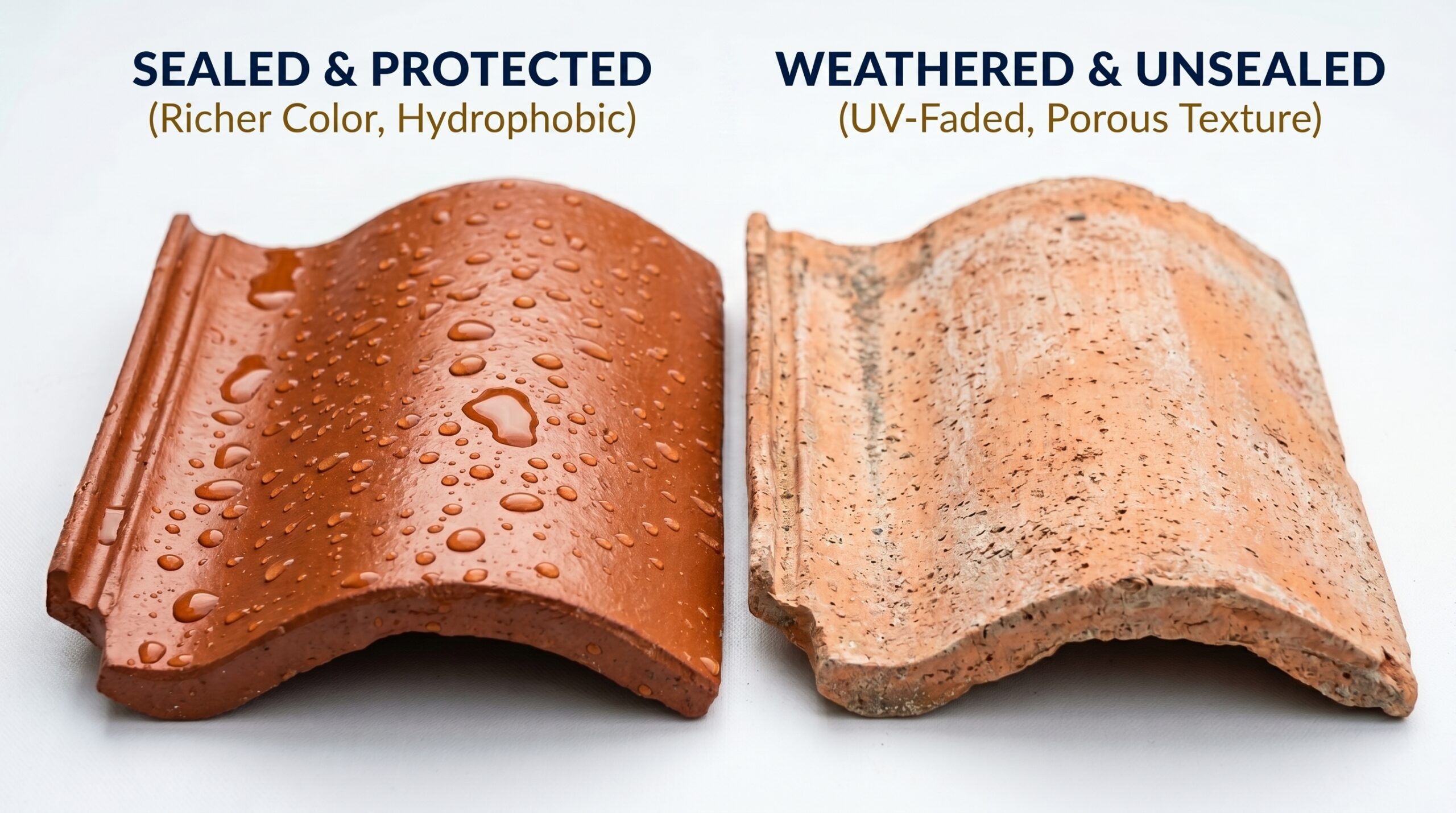
Houston receives approximately 204 sunny days per year, with peak UV index readings of 10–11 during summer months. Mexican clay tile that was sealed at installation will see measurable sealant degradation within 5–7 years under Houston’s UV load. An unsealed clay tile becomes increasingly porous, absorbing more moisture during rain events and losing its color richness as the natural clay oxidizes. Source: EPA
Unsealed Mexican clay roof tile is significantly more porous than premium kiln-fired clay tile. Under ASTM C1167 — the governing standard for clay roof tiles — Grade 1 tiles must achieve less than 6% water absorption. Handmade Mexican clay tile (Saltillo-style), which is lower-fired and more porous than high-grade commercial tile, readily absorbs moisture when unsealed. As Clay Imports — a Texas-based Mexican tile manufacturer — states: unsealed Saltillo tile “must be sealed to prevent water absorption and ensure long-term durability.” Repeated moisture absorption cycles stress the tile fastening system and accelerate wear on the underlayment below. Sources: ASTM; Clay Imports
9 Warning Signs Your Mexican Clay Tile Roof Needs Attention Now
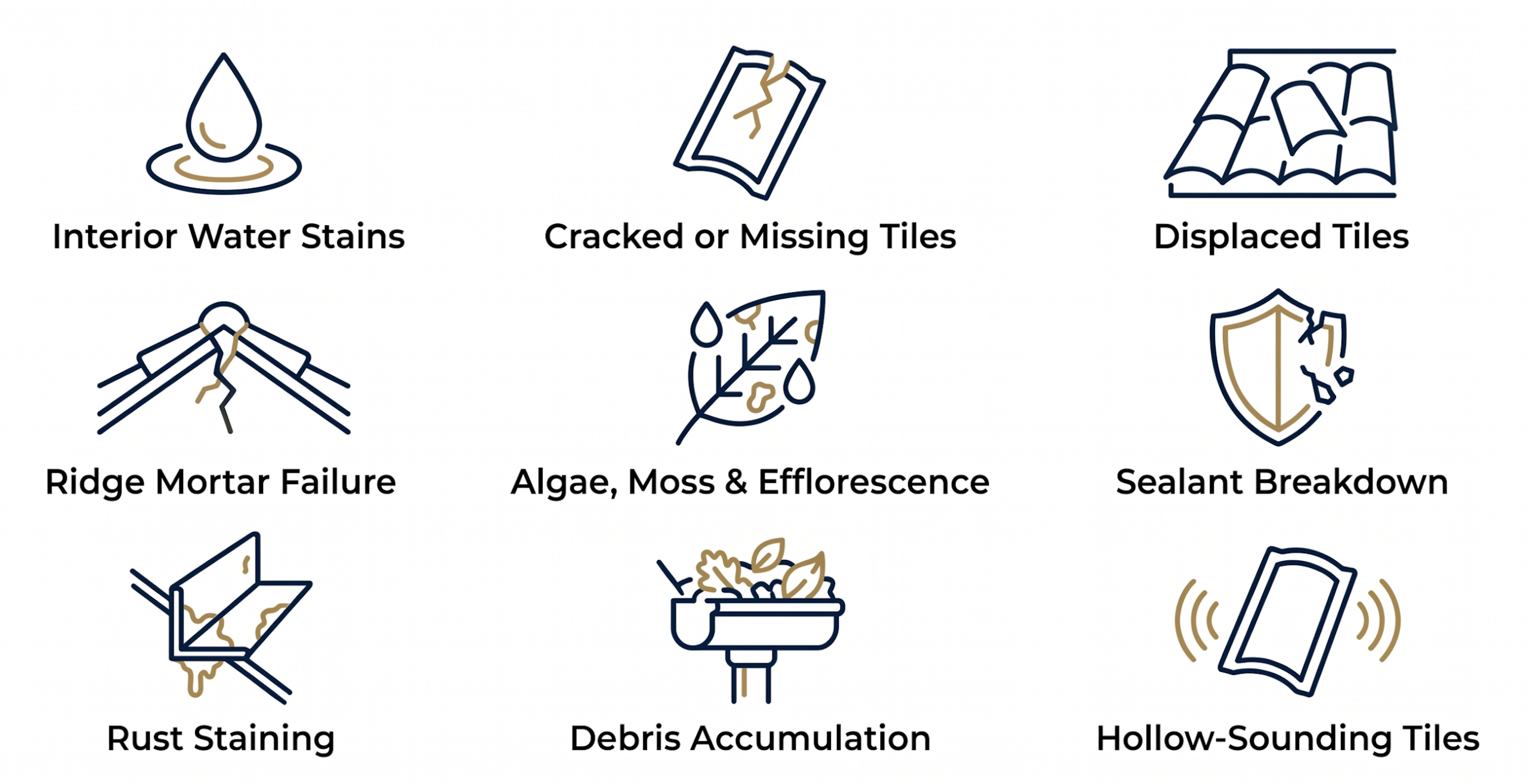
Most Mexican clay tile roof failures announce themselves months — sometimes years — before catastrophic damage occurs. Here are the nine signs Houston homeowners should never ignore, ranked from most urgent to monitor closely.
- Water stains on interior ceilings or attic decking. Any interior moisture is an active system failure. Do not wait for the next rainy season. Call a licensed roofer within 48 hours.
- Visibly cracked, chipped, or missing tiles. Each broken tile is an unprotected opening in your underlayment. Hail fractures often appear as clean hairline cracks barely visible from the ground — binoculars or a drone inspection is the only reliable ground-level check.
- Displaced or slipped tiles (tiles that have shifted out of course alignment). Wind events loosen fasteners. A slipped tile exposes the tile below it to direct rain impact and creates a water-channeling gap.
- Crumbling or missing ridge mortar. Ridge mortar failure is the most common entry point for water in Houston clay tile homes over 15 years old. If you can see daylight through the ridge cap tiles from your attic, the mortar bed has failed.
- Black streaks, green growth, or white efflorescence on tile surfaces. Black = algae. Green = moss or lichen. White = efflorescence (mineral deposits from water migrating through the tile — a sign moisture is infiltrating the tile body, not just running off it).
- Granular sealant flaking or powdery residue on tiles or in gutters. This is the protective sealant coat breaking down. When you see this, the tile surface is approaching unprotected status.
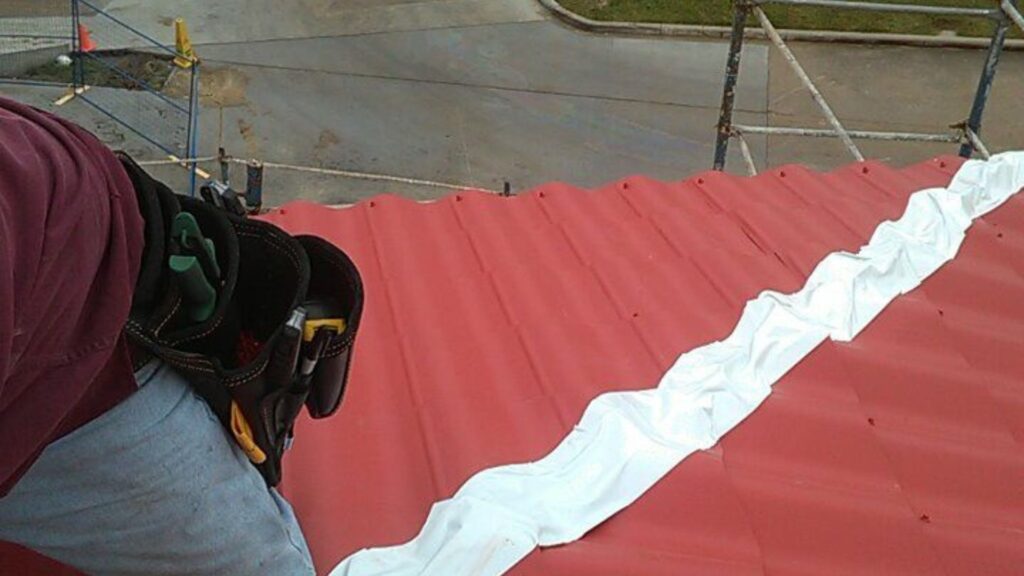
- Rust staining running from flashing points. Rust streaks from valleys, pipe boots, or chimney flashings signal flashing corrosion. This is weeks, not years, from active leaking.
- Debris accumulation in valleys, gutters, and behind dormers. Organic debris (leaves, seeds, pine needles) retains moisture against the tile surface and flashing — the biological growth and corrosion cycle begins here.
- Tiles that sound hollow when tapped (delamination). A clay tile that sounds hollow when gently tapped with a rubber mallet has separated from its mortar bed or fastener. It is mechanically unsupported and will fail under the next wind event.
The Insurance Institute for Business & Home Safety (IBHS) notes that roof failures account for approximately 25–40% of residential hurricane insurance claims, with flashing and penetration failures being the leading cause — not tile damage itself.
Source: IBHS
Mexican Clay Tile Roof Maintenance: Spring Inspection Checklist
Conduct your spring inspection between March 15 and April 30 — after winter’s thermal cycling stress but before peak hurricane season begins June 1. This is your opportunity to catch freeze-thaw damage and prepare the system for summer’s UV and rain load.
Exterior Inspection (Ground Level / Binoculars or Drone)
- Scan all tile courses for cracked, chipped, displaced, or missing tiles — use binoculars or a drone; do not walk the roof without a professional present
- Inspect ridge cap tiles and mortar bed for visible gaps, cracks, or missing sections
- Check for black streaking (algae) or green biological growth on tile surfaces
- Look for rust staining originating from any flashing point (valleys, pipes, chimney, skylights)
- Inspect visible flashing edges for lifting, separation, or cracking
- Confirm all gutters are secured and sloped correctly; check for granular sealant residue in gutters
- Clear all debris from valleys, behind dormers, and around any roof penetrations
Attic Inspection (Interior)
- Inspect attic decking and rafters for water staining, soft spots, or active moisture
- Check that soffit and ridge vents are unobstructed (proper ventilation is critical to underlayment longevity in Houston heat)
- Confirm no daylight is visible through the ridge from the attic interior
- Look for signs of pest intrusion at eave gaps — displaced clay tiles create entry points for rodents and wasps
Professional Tasks to Schedule in Spring
- Flashing reseal at all penetrations (every 3–5 years)
- Ridge mortar inspection and repointing if cracks exceed 1/4 inch width
- Biological growth treatment with a low-pressure biocide application if algae or lichen is present
- Sealant condition assessment — if last application was 7+ years ago, schedule recoating before summer
- Post-freeze tile tap test for hollow (delaminated) tiles — common after Houston’s occasional hard freezes
Mexican Clay Tile Roof Maintenance: Fall Inspection Checklist (Houston)
Conduct your fall inspection between September 15 and October 31 — after hurricane season peaks in September, before the first cold fronts arrive. This is your damage-assessment window and your system-hardening opportunity before winter.
Exterior Inspection
- Full tile-by-tile scan for hail damage from the summer storm season (use drone imagery for highest accuracy)
- Inspect all valleys for debris, deteriorated flashing, or displaced tiles
- Check ridge mortar for any new cracking from summer thermal cycling
- Inspect tile surface for UV-driven sealant breakdown (chalky or powdery residue)
- Clear gutters of summer debris accumulation before winter rains
- Inspect pipe boots and skylights for cracked or dried rubber gaskets
Attic Inspection
- Repeat moisture and staining inspection post-hurricane season
- Verify attic insulation is not wet or displaced — compressed or wet insulation dramatically reduces R-value and accelerates roof deck moisture buildup
- Confirm attic ventilation is functioning before winter closes up the home
Professional Tasks to Schedule in Fall
- Hail damage assessment if any 1-inch+ hail events occurred since last inspection — file insurance claim before the policy year rolls over
- Flashing reseal at any penetration showing rust staining or edge separation
- Tile replacement for any cracked or missing tiles before winter rain season
- Sealant recoat if spring assessment flagged significant UV degradation
The Federal Emergency Management Agency (FEMA) recommends roof inspections within 72 hours after any wind event exceeding 58 mph (EF-0 tornado-equivalent force) to identify concealed fastener pull-out before subsequent rain events cause water infiltration.
Source: FEMA Building Science — High Wind
Houston Mexican Clay Tile Roof Maintenance Costs (2026)
These are real Houston-market cost ranges based on 2026 contractor pricing in the greater Houston metro (Harris, Fort Bend, Montgomery, Brazoria counties). Costs vary by roof pitch, access complexity, tile color-match availability, and contractor.
| Service | Frequency | 2026 Houston Cost Range | Notes |
|---|---|---|---|
| Professional roof inspection (clay tile) | 2x per year | $350–$650 | Includes drone imaging; some roofers waive if repair work is booked |
| Individual tile replacement (1–10 tiles) | As needed | $85–$200 per tile installed | Color-match on aged Mexican clay can be difficult — budget for slight variance |
| Ridge mortar repointing (full ridge) | Every 15–20 years | $1,800–$5,500 | Higher cost for complex hip-and-valley rooflines |
| Flashing reseal (all penetrations) | Every 3–5 years | $600–$2,200 | Critical maintenance; prevents 80%+ of clay tile water intrusion claims |
| Clay tile sealant recoat (full roof) | Every 5–10 years | $1.50–$3.00/sq ft | 2,000 sq ft roof = $3,000–$6,000 installed; extends tile life and restores color |
| Biological growth treatment (algae/lichen) | Every 3–5 years | $800–$2,500 | Low-pressure biocide application; do NOT pressure wash Mexican clay tile |
| Full underlayment replacement (existing tile re-set) | Every 20–25 years | $8,000–$22,000 | Tile body is preserved; only membrane replaced — NOT a full re-roof |
| Full clay tile roof replacement | Only if tile body has failed | $30,000–$95,000+ | Justified only when tile body (not just system) has failed; rare before 50 years |
The maintenance math: A homeowner who performs proactive maintenance (inspections, sealant recoats, flashing reseals, mortar repointing) over a 25-year period spends roughly $15,000–$30,000 total. A homeowner who defers all maintenance and faces a full underlayment or roof replacement at year 22 spends $30,000–$95,000 — for a system failure, not a tile failure.
Reseal vs. Restore vs. Replace: How to Decide
The three-path decision framework for a Mexican clay tile roof in Houston is defined by what has actually failed — the surface protection, the system beneath the tile, or the tile body itself. Matching the intervention to the failure prevents overspending.
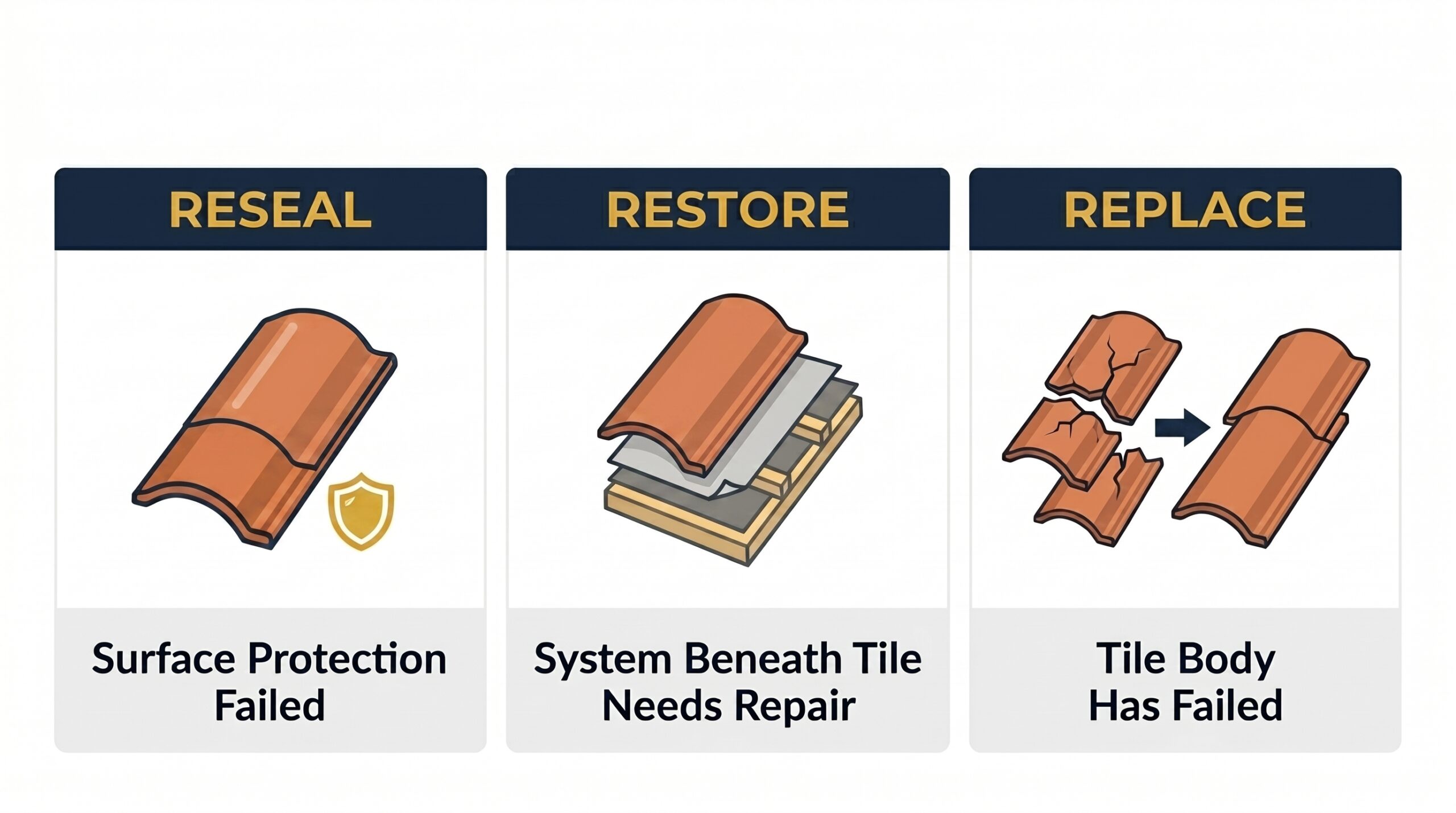
Path 1: Reseal and Maintain (Right Choice in Most Cases)
When it applies: Tiles are structurally sound. Flashing and underlayment are intact or have minor localized issues. Sealant is degraded or biological growth is present.
- Spot-replace cracked or missing tiles
- Treat biological growth with professional biocide application
- Reseal flashing at all penetrations
- Recoat tile surface with appropriate penetrating sealer
- Repoint ridge mortar if cracking exceeds cosmetic
Typical cost: $4,000–$12,000 | Extends system life: 10–15 additional years
Path 2: System Restoration (Underlayment and Flashing Refresh)
When it applies: Active leaking from flashing or underlayment failure. Interior staining confirmed. Roof is 18–25 years old. Tile body is intact and color-matchable.
- Professionally remove all tiles, catalog and store them
- Replace underlayment membrane (upgrade to two-layer modified bitumen for Houston climate)
- Replace all flashing at valleys, penetrations, ridges, and eaves
- Reset original tiles; replace any that cracked during removal
- Repoint ridge mortar; reseal tile surface
Typical cost: $12,000–$28,000 | Extends system life: 20–30 additional years
Path 3: Full Roof Replacement
When it applies: Tile body has widespread structural failure (severe spalling, mass fracturing from large hail, tiles deteriorated to the point where color match is impossible or tile integrity is compromised). OR: The home is being re-roofed as part of a structural renovation that requires deck-level work.
A full replacement is genuinely necessary far less often than the industry’s average sales process suggests. If a contractor recommends full replacement on a Mexican clay tile roof under 40 years old without showing you specific tile-body failure evidence, get a second opinion.
Typical cost: $30,000–$95,000+ | Lifespan: New 50–100-year system
The National Association of Home Builders (NAHB) estimates that clay and concrete tile roofing materials have the longest expected lifespan of any residential roofing category, at 50+ years, compared to 20–30 years for asphalt shingles. Proper system maintenance is listed as the primary factor determining whether the tile body reaches its rated lifespan.
Source: NAHB
Why Mexican Clay Tile Roof Maintenance in Houston Is Different From the Rest of the Country
Most national maintenance guides for clay tile roofing were written for climates like Southern California or Arizona — low humidity, low rainfall, and minimal biological growth. Houston invalidates nearly every assumption those guides make.
Here is what makes Houston categorically different:
| Factor | National Average (Dry Southwest) | Houston, TX | Impact on Clay Tile System |
|---|---|---|---|
| Annual rainfall | ~15–20 inches (Phoenix, LA) | ~49.8 inches | 3–4x higher moisture load on underlayment and flashing |
| Average humidity | 30–40% | 70–75% | Algae/lichen colonize unsealed clay within 3–5 years |
| Peak attic temperature | 120–130°F (dry Southwest) | 130–150°F+ | Accelerates underlayment degradation; felt underlayment begins to soften above sustained high heat, shortening effective service life in hot climates. Source: Green Builder Media / NRCA |
| Hail events per year | 2–4 (low-risk zones) | 10–20 significant events | Cumulative micro-fracture risk; post-storm inspections are mandatory |
| Sealant recoat interval | Every 10–12 years | Every 5–7 years | UV load + humidity = faster breakdown |
This is why Achilles Roofing Houston uses Houston-specific maintenance protocols for every Mexican Clay Tile Roof inspection — not national templates. The maintenance interval, material specs, and failure modes are genuinely different here.
How to Find a Qualified Mexican Clay Tile Roof Contractor in Houston
Mexican clay tile roofing is a specialty trade. Not every licensed Houston roofer has the tile-handling experience required to avoid tile cracking during inspection, removal, or re-setting. Selecting the wrong contractor can create more damage than the original problem.
What to verify before hiring:
- Texas Department of Insurance (TDI) registration — Texas does not license roofing contractors at the state level, but contractors working in the Houston metro must carry a minimum of $500,000 general liability and workers’ comp. Verify certificates of insurance directly; do not accept photocopies. Source: Texas Department of Insurance
- Clay tile-specific experience — Ask for references from clay tile jobs specifically. Request photos of completed clay tile restoration projects. Roofers experienced only in shingle or metal work will walk tile incorrectly and generate cracking.
- Manufacturer training — Major clay tile manufacturers (Ludowici, MCA, Entegra) offer contractor training programs. Trained contractors understand tile-specific installation specs, approved underlayments, and sealant compatibility.
- Drone or aerial inspection capability — Any qualified clay tile contractor should offer drone inspection as a baseline service. A contractor who wants to physically walk your tile roof as a first step without documented reason is likely to cause damage.
- Written scope and material specification — Get a written quote that names the specific underlayment product, sealant product, and mortar mix being used. “Standard materials” is not acceptable for a clay tile system.
Frequently Asked Questions
How often should I inspect my Mexican clay tile roof in Houston?
Twice per year: once in spring (March–April) and once in fall (September–October). Additionally, inspect within 72 hours of any hail event with stones 1 inch or larger, or any tropical storm / hurricane-force wind event. Houston’s storm frequency makes event-triggered inspections as important as scheduled ones.
Can I pressure wash my Mexican clay tile roof in Houston?
No. Do not pressure wash Mexican clay tile at standard residential PSI settings (1,500–3,000 PSI). Clay tile is porous and more fragile than concrete tile. High-pressure washing fractures the tile surface, strips the protective sealant, and forces water under the tile course into the underlayment. The correct method is a low-pressure (500–800 PSI) biocide application by a licensed contractor experienced with clay tile.
How long does a Mexican clay tile roof last in Houston?
The tile body: 80–100+ years with proper maintenance. The system beneath the tile (underlayment, flashing, ridge mortar): 15–25 years before significant maintenance or restoration is required. The single biggest factor determining total system lifespan is whether the underlayment and flashing receive proactive maintenance before failure, not after.
Does homeowner’s insurance cover Mexican clay tile roof repairs in Houston?
It depends on the cause. Hail damage, wind damage, and storm-related tile fracturing are typically covered under standard Texas homeowner’s policies, subject to your deductible. Gradual deterioration, lack of maintenance, and biological growth damage are typically excluded. Document all storm events with NOAA data and file claims within your policy’s reporting window — most Texas policies require notice within 1–2 years of the event. Consult your specific policy and a licensed Texas public adjuster for coverage questions. Source: Texas Department of Insurance
What is the difference between Mexican clay tile and Spanish clay tile?
The terms are often used interchangeably in the Houston market. “Mexican clay tile” typically refers to handmade or semi-handmade terracotta barrel tiles, often with slight dimensional variation and a more rustic, earthy appearance. “Spanish clay tile” or “mission tile” typically refers to machine-manufactured clay barrel tiles with more consistent dimensions. Both are fired clay and share the same maintenance requirements — though handmade Mexican clay tile is often more porous and may require more frequent sealant reapplication.
How much does it cost to reseal a Mexican clay tile roof in Houston?
A full-roof sealant recoat on a Mexican clay tile roof in Houston runs $1.50–$3.00 per square foot installed (2026 pricing). For a 2,000 sq ft roof surface, expect $3,000–$6,000. This does not include biological growth treatment (add $800–$2,500 if needed) or individual tile replacement. Resealing every 5–7 years is the highest-leverage maintenance investment for Houston clay tile systems.
When should I replace rather than repair my Mexican clay tile roof in Houston?
Replace when: (1) the tile body itself has widespread structural failure — mass spalling, pervasive fracturing, tiles too deteriorated to be re-set; (2) the underlayment has failed in multiple locations and tile removal/reset for a full underlayment replacement would damage too many tiles to be cost-effective; or (3) the roof deck (plywood or OSB sheathing) has sustained rot or structural damage requiring replacement. If only the underlayment and flashing have failed, a system restoration — not a full replacement — is almost always the right answer.
Is Mexican clay tile a good choice for Houston’s climate?
Yes — with proper maintenance. Clay tile’s thermal mass moderates attic temperature swings better than any other common residential roofing material, reducing HVAC load during Houston summers. Its fire resistance (Class A when installed per code) and wind resistance make it well-suited to Houston’s storm environment. The requirement for proactive sealant maintenance and regular flashing inspection is the trade-off for its 80–100-year tile lifespan.
Can I walk on my Mexican clay tile roof for inspection?
Only if you know exactly where to step and are wearing soft-soled shoes — and even then, it is not recommended for homeowners. Mexican clay tile has specific walk paths (on the tile overlap zone near the butt, never on the barrel crown). An amateur stepping on the barrel crown shatters the tile instantly. Use binoculars, a drone, or hire a contractor experienced in clay tile for any roof-level inspection.
Get a Mexican Clay Tile Roof Maintenance Assessment in Houston
Achilles Roofing evaluates your tiles, flashing, ridge mortar, sealant, and underlayment age — then provides a written, fixed-price plan to help extend the life of your roof.
Written fixed-price estimate · GAF Certified Plus · 610+ Reviews · 4.9 star-rated on Google · Financing from $199/mo
 Call (832) 346-8021
 About Achilles Roofing & Exterior
Houston’s specialist in full roof replacements, Spanish tile, clay tile, copper, and high-end exterior systems. Founded 2017. 610+ reviews · 4.90-star Google · 5.0 Thumbtack · Founded by Ahmad Faiz.
Sources & References
- ASTM International. (2022). Standard specification for clay roof tiles (ASTM C1167-22). ASTM International Store. https://store.astm.org/c1167-22.html
- Clay Imports. (2026). Tile 101: Sealed vs. unsealed Saltillo tiles. Clay Imports Insights Blog. https://clayimports.com/blogs/all-about-natural-terracotta/tile-101-sealed-vs-unsealed-saltillo-tiles
- Energy Attic. (2026). Outside the attic blog. Energy Attic Systems. https://energyattic.com/outsidetheattic/
- Federal Emergency Management Agency. (2026). High-wind hazard-specific building science guidance. U.S. Department of Homeland Security. https://www.fema.gov/emergency-managers/risk-management/building-science/hazard-specific/high-winds
- Green Builder Media. (2025, May 22). Roof underlayments: Can they take the heat? Green Builder Media. https://www.greenbuildermedia.com/blog/roof-underlayments-can-they-take-the-heat
- Insurance Institute for Business & Home Safety. (2026). Insurance Institute for Business & Home Safety home page. IBHS. https://ibhs.org/
- National Association of Home Builders. (2026). National Association of Home Builders home page. NAHB. https://www.nahb.org/
- National Oceanic and Atmospheric Administration. (2026a). Storm events database. National Centers for Environmental Information. https://www.ncei.noaa.gov/stormevents/
- National Oceanic and Atmospheric Administration. (2026b). National Centers for Environmental Information home page. NCEI. https://www.ncei.noaa.gov/
- Texas Department of Insurance. (2026). Homeowners insurance coverages. Texas Department of Insurance Consumer Portal. https://www.tdlr.texas.gov/consumer/homecoverage.html
- U.S. Environmental Protection Agency. (2026). UV index scale. Sun Safety. https://www.epa.gov/sunsafety/uv-index-scale-0
- U.S. National Weather Service. (2026). Houston/Galveston, TX Weather Forecast Office home page. National Oceanic and Atmospheric Administration. https://www.weather.gov/hgx/