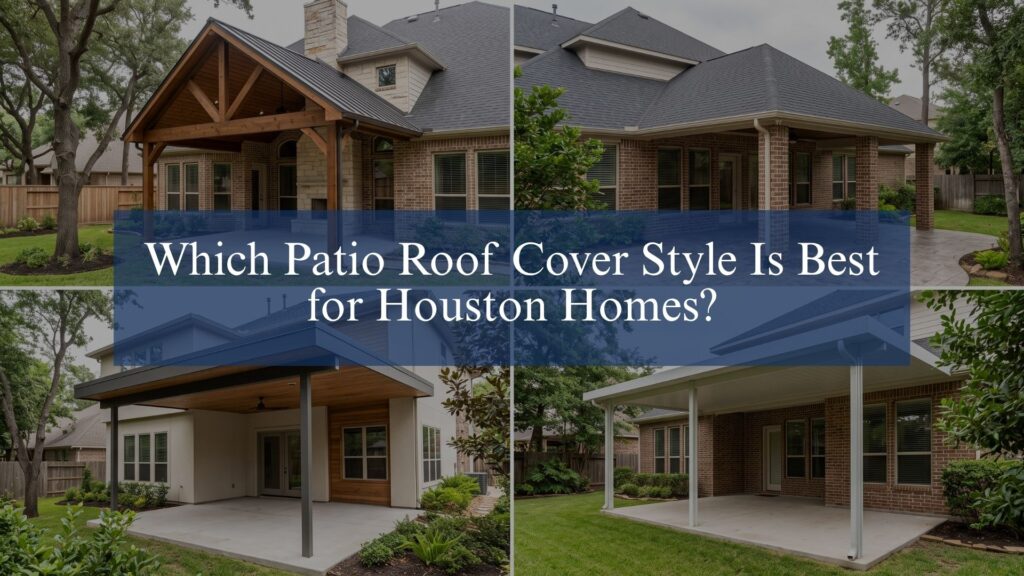
Quick Answer: Which Patio Roof Cover Style Is Best for Houston?
For most Houston homes, a hip-style patio roof cover is the best overall choice because its four-sided slope sheds wind up to 50% more effectively than a gable design in Houston’s 140-160 mph design wind zone, while an insulated solid panel (aluminum or polycarbonate) outperforms open lattice by 10-15 degrees during peak summer heat. Flat/lean-to covers cost the least ($20-$50 per sq ft) and suit tight side-yard spaces but require the most disciplined drainage detailing. The right style depends on your wind exposure, budget, and whether the structure ties into your existing roofline.
This guide covers the main patio roof styles, the six factors that determine how each performs in Houston, the mistakes homeowners make when choosing among them, and the most common material and permit questions.
Why Roof Style Matters More in Houston Than in Most U.S. Markets
Roof style matters more in Houston because the city sits in one of the highest wind design zones in the continental U.S. (140-160 mph, ASCE 7 Exposure C), gets a 30-year normal of 51.84 inches of rain annually, and receives sunshine averaging nearly 60% of the possible amount for the year — with July and August averaging highs of 94.5-94.9°F. A style that performs fine in a low-wind, low-heat market can underperform badly here.
These three variables — wind, water, and heat — are the filter every style decision should pass through before cost or looks. A patio cover that is a plywood-and-shingle box in Ohio needs to survive a different physical environment in Harris County.
The Main Patio Roof Cover Styles and What Each One Demands
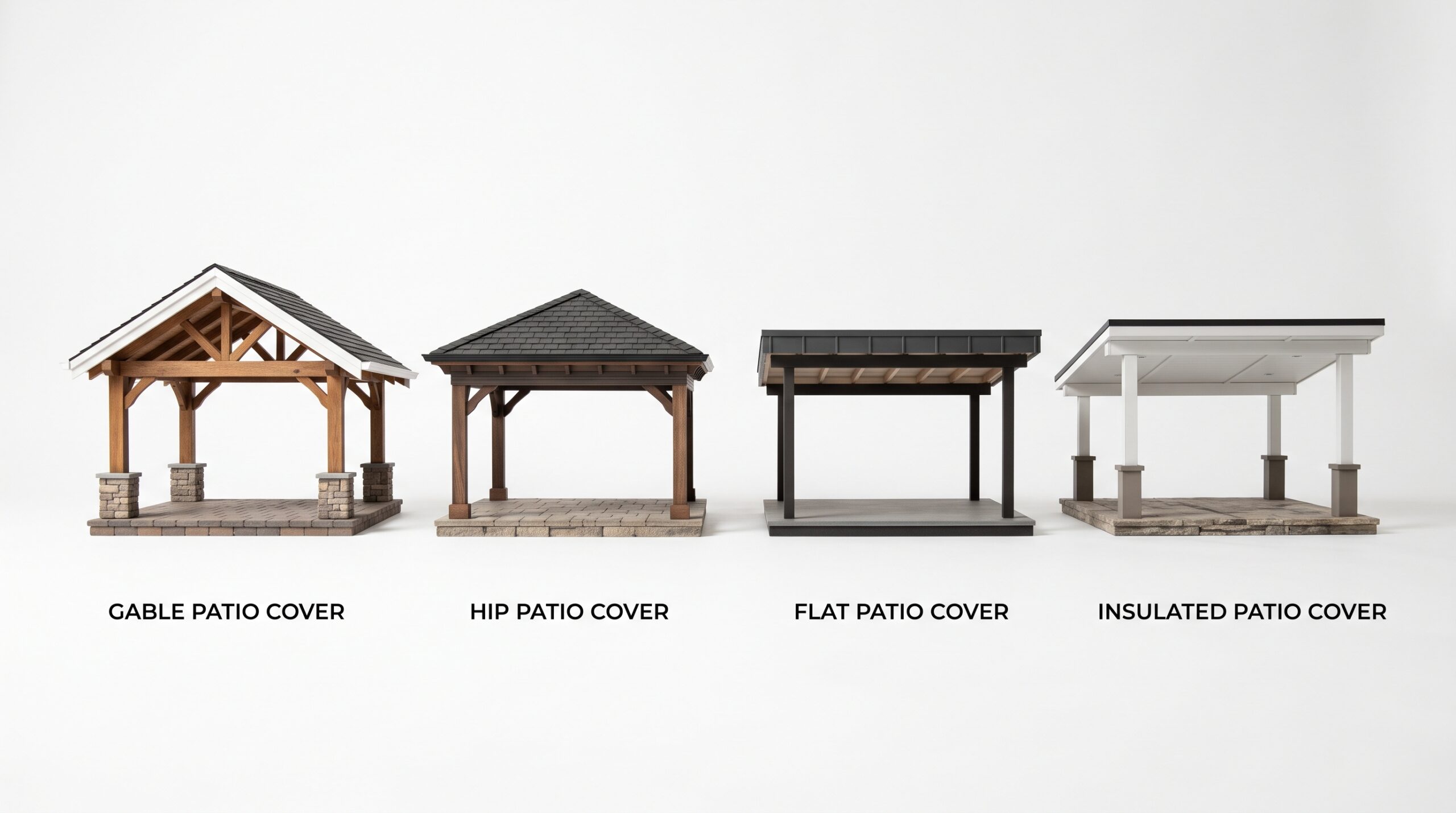
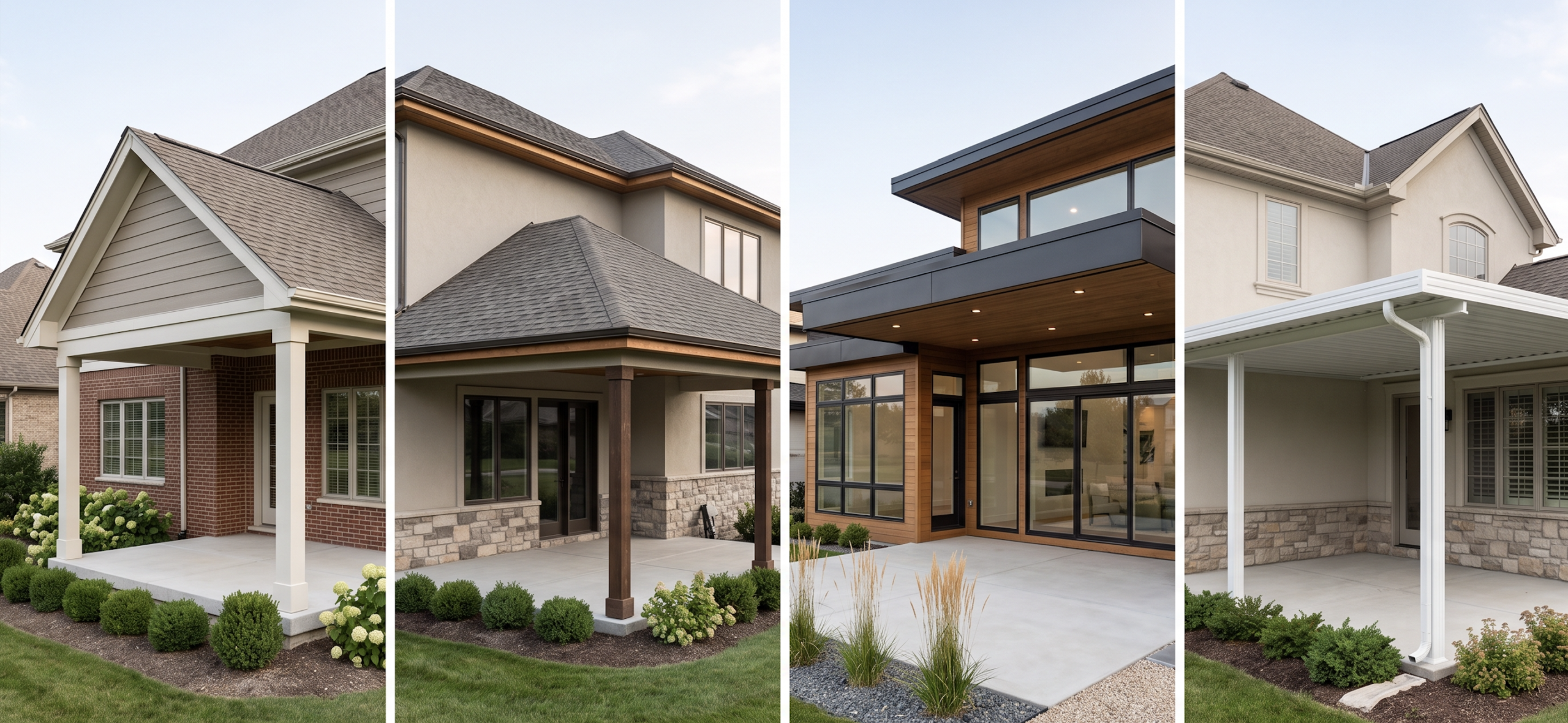
Not all patio roof cover styles handle Houston’s wind, rain, and heat the same way. The style you choose determines your wind exposure, your drainage plan, and how much heat actually reaches the seating area below:
- Gable: Two angled planes meeting at a center ridge, matching most rooflines but carrying the highest wind risk without engineered bracing.
- Hip: Slopes on all four sides, removing the flat end wall that catches wind on a gable design — the strongest standard style for Houston’s wind zone.
- Flat / lean-to: A single pitched plane, the most affordable and space-efficient option, but the least forgiving on drainage detailing.
- Insulated solid panel vs. open lattice: Not a roof shape but a covering choice that determines whether the space underneath is 3-5°F or 10-15°F cooler than direct sun.
What You Must Get Right Before Choosing a Patio Roof Style — 2026
Six decisions determine whether a patio roof cover style performs well on a Houston home. Each one trades off against the others — cost, roofline match, wind resistance, heat performance, material durability, and code compliance rarely all point to the same style at once.
Point 1: Gable Roofs Match Your Roofline But Carry the Highest Wind Risk
A gable patio roof cover features two angled roof planes that meet at a central ridge, matching the classic peaked-roof look of most Houston homes. It is the most visually matched style to traditional rooflines but is also the style FEMA post-storm data flags as the highest-risk in high wind because of its exposed triangular end wall.
- Cost: $70-$155 per sq ft installed; a typical 18×20 gable structure runs $14,000-$31,000
- Best for: Homes where roofline matching is a higher priority than maximum wind resistance, provided the contractor adds engineered gable-end bracing
If you choose gable, insist on hurricane straps at every roof-to-wall connection and engineered gable-end bracing — this is the single upgrade that closes most of the performance gap with a hip roof.
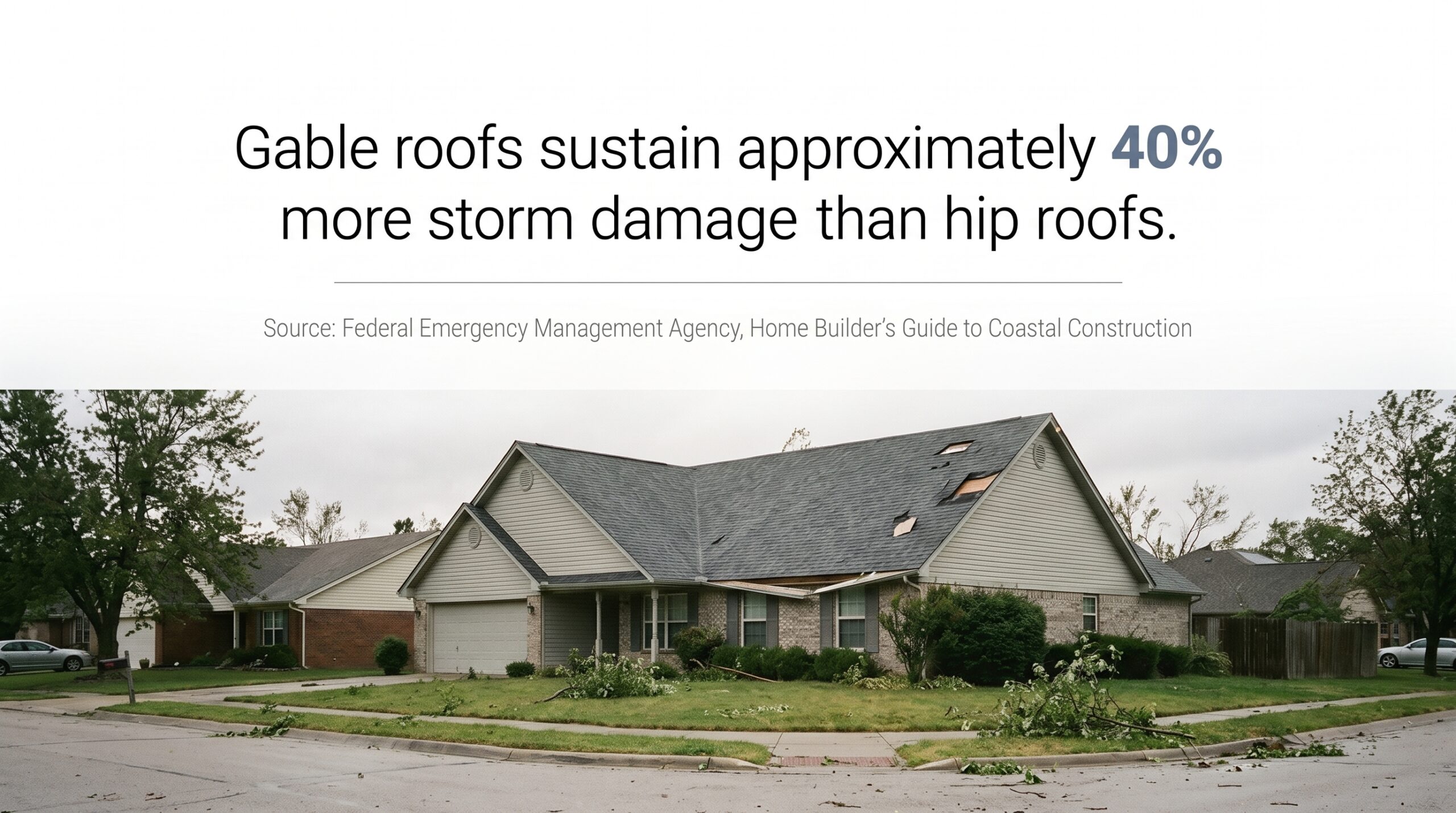
FEMA post-storm assessments found gable roofs sustain roughly 40% more damage than hip roofs in comparable storm events — largely due to unbraced gable-end walls that catch wind like a sail.
Source: Federal Emergency Management Agency, Home Builder’s Guide to Coastal Construction
Point 2: Hip Roofs Are the Strongest Standard Style for Houston’s Wind Zone
A hip patio roof cover slopes on all four sides instead of two, eliminating the flat vertical end wall that catches wind on a gable design. Wind flows over and around a hip roof rather than pushing directly against it, which is why it is the structurally strongest common patio roof style available for Houston’s wind zone.
- Cost: Typically 10-20% more than an equivalent gable structure due to more complex framing and additional hip rafters
- Best for: Open backyards, coastal-influenced wind exposure, and homeowners prioritizing structural longevity over exact roofline matching
Because Houston’s design wind speed (140-160 mph) sits well above the national median, the FEMA-documented damage gap between hip and gable roofs is more consequential here than in lower-wind markets — a hip roof’s advantage compounds rather than stays flat as regional wind speed rises. This is a Houston-specific way to read the data that most national patio-cover guides don’t connect for readers.
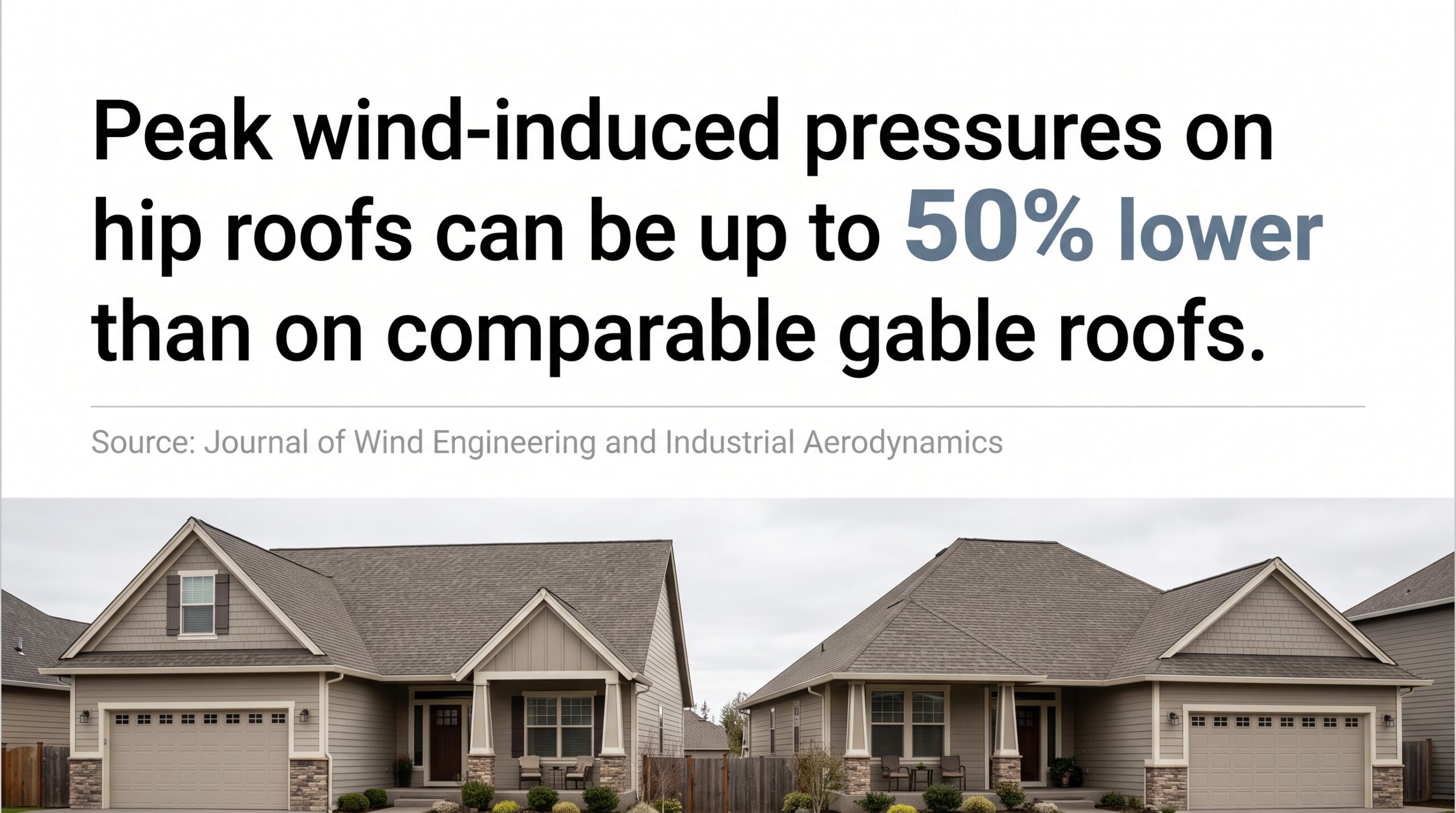
Peer-reviewed wind-tunnel testing found peak wind-induced pressures on hip roofs can run as much as 50% lower than on gable roofs of comparable pitch.
Source: Journal of Wind Engineering and Industrial Aerodynamics
Point 3: Flat and Lean-To Roofs Are Cheapest But Demand Precise Drainage
A flat or lean-to patio roof cover is a single-plane structure that pitches away from the house at a slight angle, typically the most affordable and space-efficient style for narrow yards or covered walkways. It is not literally flat — code requires a minimum ¼ inch per foot slope for drainage — but it reads as a single clean plane rather than a peaked roof.
- Cost: $20-$50 per sq ft installed; a 10×20 lean-to typically runs $4,000-$10,000
- Best for: Side-yard installations, budget-conscious projects, and homes where the cover attaches below the roofline rather than into it
This style requires the most careful gutter and downspout sizing of any option, since all runoff concentrates at one low edge instead of being split across multiple roof planes.
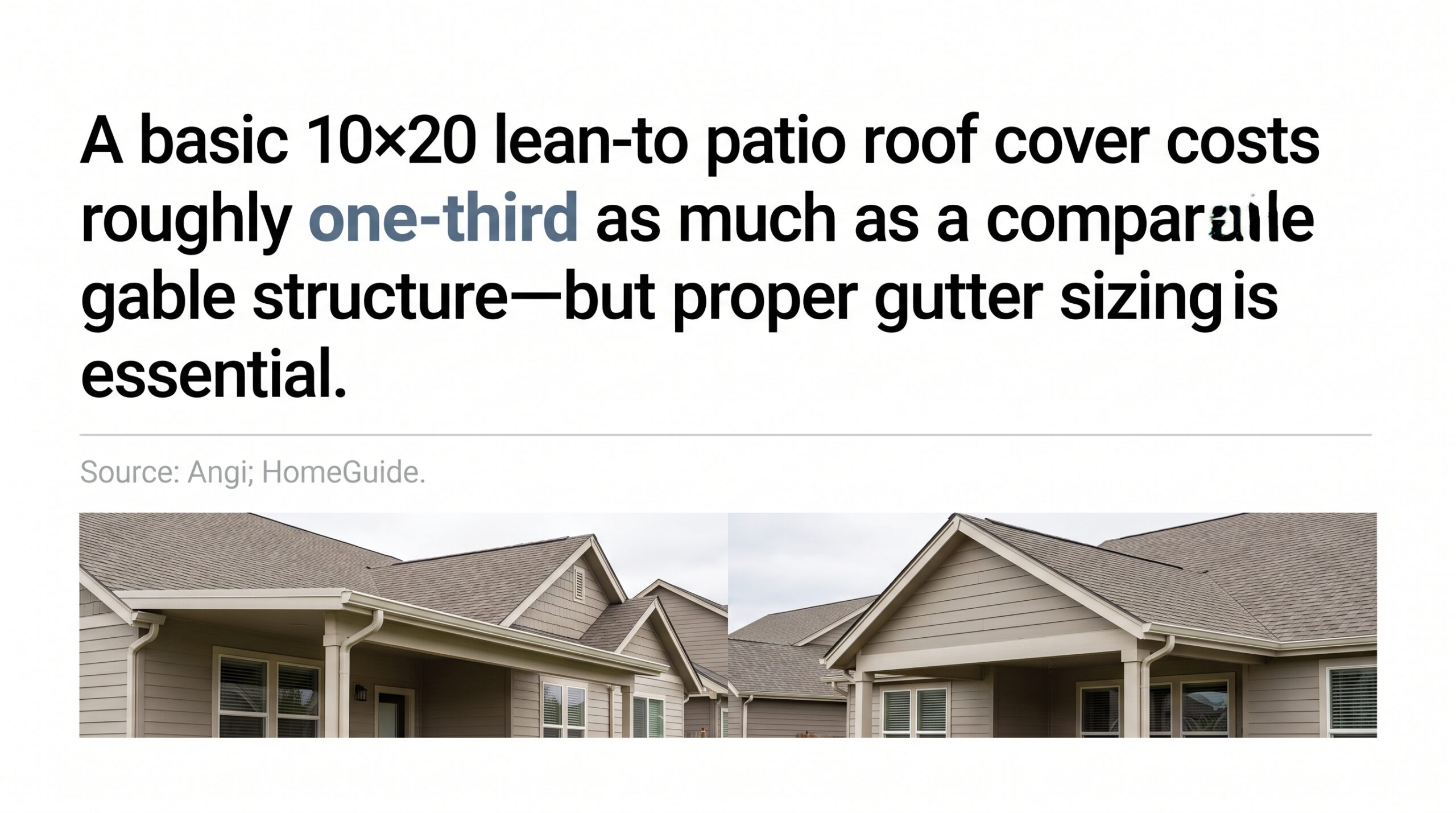
A basic 10×20 lean-to patio roof cover costs roughly a third of what a comparable gable structure runs installed — but every dollar saved on framing has to be reinvested in gutter and downspout sizing, since a single-plane roof concentrates all of its runoff at one edge.
Source: Angi; HomeGuide
Point 4: Insulated Panels Beat Lattice on Heat, Not on Airflow
An insulated solid panel cover uses a foam- or fiberglass-cored roof panel that blocks radiant heat, while an open lattice cover uses spaced slats that let sun and air pass through. The performance gap between them is the largest heat-comfort variable in patio design, larger than the choice between gable, hip, or flat framing.
| Cover Type | Typical Under-Cover Temperature vs. Direct Sun* | Airflow | Rain Protection |
|---|---|---|---|
| Open lattice | 3-5°F cooler | High | None to minimal |
| Insulated solid panel | 10-15°F cooler | None (unless vented) | Full |
*This is a field-observed range reported by patio cover installers, not a controlled lab study of open-air structures — no independent thermal study of patio-specific lattice vs. solid roofing was found. The closest independent physical evidence comes from enclosed-space research:
Florida Solar Energy Center field monitoring across 21 occupied Florida homes found that adding a radiant barrier — the same heat-blocking principle used in solid insulated panels — reduced the attic-to-ambient temperature differential by 16°F at a monitored test site, and that reflective, light-colored roofing reduced peak attic temperatures by more than 20°F compared to dark, absorptive roofing (Parker & Sherwin, 1998, ASHRAE Annual Meeting). Open-air patio structures should see a smaller effect than sealed attics, since ambient air continuously exchanges underneath them — consistent with the narrower gap reported in the field for lattice vs. insulated patio covers.
Given that the U.S. Department of Energy attributes up to a 25% cooling-cost reduction to exterior shading generally, an insulated solid-panel cover placed against a west- or south-facing wall is doing double duty: shading the patio itself and reducing solar load on the adjacent exterior wall and windows.
Exterior shading can cut cooling costs by up to 25%, and enclosed-space field research shows that adding a radiant barrier — the same principle behind an insulated solid panel — cuts the attic-to-ambient temperature gap by 16°F at a monitored test site.
Source: U.S. Department of Energy, Energy Saver, Florida Solar Energy Center
Point 5: Material Choice Determines Whether the Style Survives Houston Humidity
The roof style only performs as well as the material it’s built from, and Houston’s humidity is unforgiving of the wrong choice. Aluminum, wood, steel, and polycarbonate all behave differently once they’ve been through a few Houston summers.
| Material | Avg. Cost/sq ft (installed) | Lifespan | Houston Climate Fit |
|---|---|---|---|
| Aluminum | $20-$50 | 20-30+ years | Excellent — resists rot, rust, and termites in high-humidity conditions |
| Wood | Standalone units $2,500-$4,000 | 10-15 years without heavy maintenance | Fair — requires regular sealing against Houston humidity and termite pressure |
| Polycarbonate panel | Comparable to aluminum framing plus panel cost | 10-25 years depending on UV-rated grade | Good for light-transmitting sections; degrades faster than aluminum under intense UV |
| Steel | Similar to aluminum, heavier structurally | 20-25 years with proper coating | Good, but requires a corrosion-resistant coating in coastal-humidity zones |
Aluminum patio structures typically carry 20-30+ year service lives with minimal maintenance, while comparable wood structures require resealing every 1-3 years to resist rot and termite pressure in Houston’s humidity.
Source: Angi, HomeGuide
Point 6: Permits and Gutter Resizing Are Not Optional Add-Ons
Any patio cover attached to a Houston home requires a building permit, and adding a new roof plane changes how much water your existing gutters have to handle. Skipping either step is the fastest way to turn a style choice into a code or water-damage problem.
- Permit: Required by the Houston Permitting Center for any structure attached to the home, with IRC Appendix H governing height, wall-opening, and structural requirements
- Drainage: A new roof plane adds catchment area to the same gutter system your home already has — it must be recalculated, not assumed adequate
How to Choose the Right Style: A 4-Step Framework
- Check your wind exposure first. Open, unshielded backyards and properties near the coast should weigh hip roofs more heavily regardless of budget.
- Decide whether the cover ties into your roofline or attaches below it. Roofline-integrated covers demand the closer roofline match a gable or integrated-slope hip provides; wall-attached shed and lean-to covers have more design flexibility.
- Weigh heat against airflow. If the patio is used mainly in the evening, lattice may be enough. If it’s used at midday in July, insulated solid panels are the only style that meaningfully changes the experience.
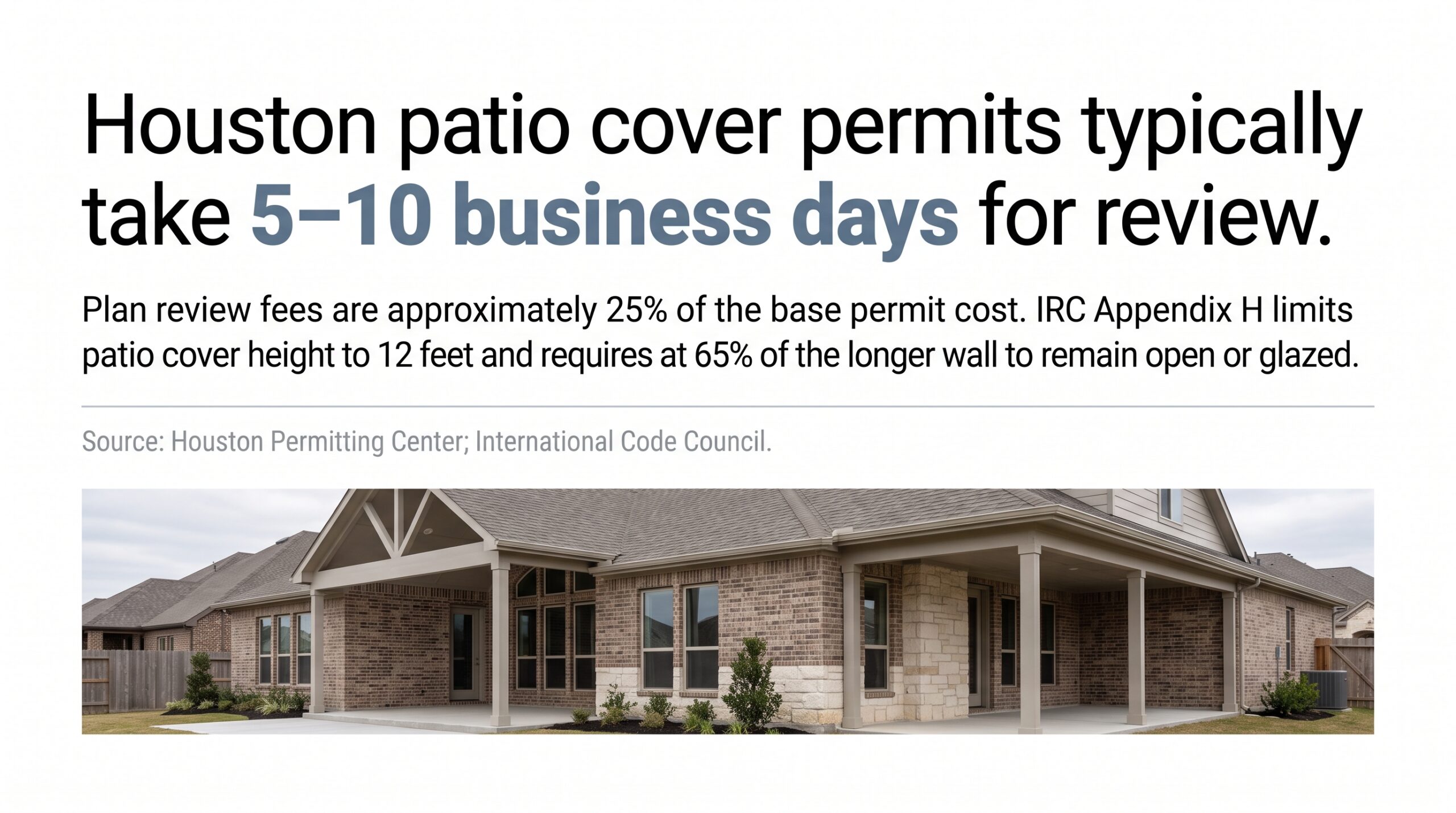
- Confirm the permit and drainage plan before committing to a style. The City of Houston requires a building permit for any patio cover attached to the home, with plan review fees around 25% of the base permit cost and a typical 5-10 business day turnaround for straightforward projects.
The Angle Most Patio Cover Guides Miss
Most patio cover content ranks styles by looks or price alone. The framing we use with Houston homeowners is different: treat style selection as a wind-and-heat engineering decision first, and an aesthetic decision second. A hip roof that doesn’t match your home’s gable roofline is a better long-term investment in this wind zone than a perfectly matched gable that needs bracing upgrades to be safe. Homeowners rarely hear this from patio-only contractors, because framing carpenters — as opposed to roofing-trained crews — are not always thinking about the same wind-uplift and flashing failure points a roofer is trained to evaluate at the roofline connection.
The Mistakes Homeowners Make Choosing a Patio Roof Style
Every patio contractor selling a style has a financial incentive to make their preferred option sound like the obvious choice. The mistakes below are the ones that generate the most callbacks after the fact.
Mistake 1: Choosing a Style by Looks Alone
Matching the patio roof to the home’s existing gable roofline feels like the safe, obvious choice, but looks alone ignore wind exposure entirely. A gable-style patio cover in an open, unshielded backyard is taking on measurably more wind risk than a hip roof would in the same spot, and that risk doesn’t show up until a storm tests it.
Mistake 2: Treating Gable-End Bracing as Optional
Some contractors price a gable patio roof cover without engineered gable-end bracing to keep the bid competitive. The Insurance Institute for Business & Home Safety specifically flags unbraced gable ends as a common high-wind failure point, and its FORTIFIED Roof standard requires this bracing for exactly that reason. Skipping it doesn’t save the homeowner money — it defers the cost to the next major wind event.
Mistake 3: Assuming Any Shade Structure Delivers the Same Heat Relief
Homeowners often assume that any roof over the patio solves the heat problem. Open lattice and insulated solid panels are not interchangeable on this point: lattice trades heat blocking for airflow, while insulated panels block far more radiant heat but need mechanical ventilation to avoid trapping warm air underneath. Choosing between them without weighing how the space is actually used at midday leads to a patio nobody wants to sit on in July.
Mistake 4: Not Resizing Gutters for the New Roof Style’s Catchment Area
Whatever style is chosen, the new roof plane adds real catchment area to a gutter system that was sized for the home’s original roof alone. Flat and lean-to styles concentrate this problem at a single edge, but every style adds load. Skipping this recalculation is one of the most common reasons a technically well-built patio roof still causes water damage at the foundation or fascia within the first year or two.
Frequently Asked Questions
What is the most durable patio roof style for Houston’s climate?
A hip-style, insulated aluminum patio roof cover is the most durable combination for Houston. The hip framing sheds wind more effectively than gable framing, and aluminum resists the rot, rust, and termite pressure that city’s humidity creates for wood structures.
Is a gable or hip roof better for a patio cover in high-wind areas?
A hip roof is generally better in high-wind areas. FEMA post-storm data shows hip roofs sustain roughly 40% less damage than gable roofs in comparable storms, because the four-sided slope removes the flat, wind-catching end wall that gable designs have.
How much does a patio roof cover cost in Houston?
Costs range from about $20-$50 per sq ft for a basic flat or lean-to cover up to $70-$155 per sq ft for a fully built gable or hip structure, with most Houston projects landing between $4,500 and $31,000 depending on size, material, and roofline complexity.
Do I need a permit for a patio roof cover in Houston?
Yes. Any patio cover attached to the home requires a permit through the Houston Permitting Center, and most jurisdictions apply IRC Appendix H, which caps patio cover height at 12 feet and requires at least 65% of the longer wall to remain open or glazed.
What’s the difference between an insulated and a lattice patio cover?
An insulated cover uses a solid foam- or fiberglass-cored panel that blocks radiant heat and rain, while a lattice cover uses open slats that let sun, air, and rain pass through. Insulated covers run notably cooler underneath during peak heat; lattice covers trade that cooling for better natural airflow and a lower price point.
Which patio roof material lasts longest in Houston humidity?
Aluminum typically lasts longest in Houston’s humidity, with a 20-30+ year service life and resistance to rot, rust, and termite damage that wood and lower-grade steel do not share.
Get a Roofline-Integrated Patio Roof Cover Assessment
Choosing between gable, hip, flat, insulated, and material options is easier with a contractor who evaluates wind, drainage, and roofline connection together — not just carpentry. If you’re planning a patio roof cover for your Houston home, we’ll walk you through the right style for your wind exposure, budget, and roofline before a single board is cut. No high-pressure pitch. No scope inflation. Just an honest assessment of what your specific project requires. Written fixed-price estimate · GAF Certified Plus · 4.9 star-rated on Google · 610+ reviews · Houston projects · Financing from $199/mo
 Call (832) 346-8021
 About Achilles Roofing & Exterior
Houston’s specialist in full roof replacements, Spanish tile, clay tile, copper, and high-end exterior systems. Founded 2017. 610+ reviews · 4.90-star Google · 5.0 Thumbtack · Founded by Ahmad Faiz.
Sources
- Angi. (2026). How much does it cost to build a covered patio? Angi Project Cost Guides. https://www.angi.com/articles/patio-cover-installation-cost.htm
-
American Society of Civil Engineers. (2026). ASCE hazard tool: Wind, seismic, ice, and flood data portal. ASCE. https://ascehazardtool.org/
-
City of Houston. (2021). Houston residential code based on the 2021 International Residential Code (IRC). UpCodes Municipal Viewer. https://up.codes/viewer/houston/irc-2021
-
City of Houston. (2026). Houston Permitting Center home page. Department of Public Works & Engineering. https://www.houstonpermittingcenter.org/
-
Florida Solar Energy Center. (1998). Monitored summer peak attic air temperatures in Florida residences (Report No. FSEC-PF-336-98) [PDF file]. University of Central Florida Energy Research Publications. https://publications.energyresearch.ucf.edu/wp-content/uploads/2018/06/FSEC-PF-336-98.pdf
-
HomeGuide. (2026). How much does a covered patio cost? HomeGuide Pricing Index. https://homeguide.com/costs/covered-patio-cost
-
Insurance Institute for Business & Home Safety. (2026). Insurance Institute for Business & Home Safety home page. IBHS Fortified. https://ibhs.org/
-
ScienceDirect. (1991). Wind engineering in retrospect and prospect. Journal of Wind Engineering and Industrial Aerodynamics, 38(2-3), 115-124. https://www.sciencedirect.com/science/article/abs/pii/016761059190046Y
-
U.S. Federal Emergency Management Agency. (2026). Federal Emergency Management Agency home page. U.S. Department of Homeland Security. https://www.fema.gov/
-
U.S. National Oceanic and Atmospheric Administration. (2023). Annual local climatological data: Houston George Bush Intercontinental Airport (Station ID 01202313IAH) [PDF file]. National Centers for Environmental Information. https://www.ncei.noaa.gov/pub/access/cebrequests/2023lcdannual/01202313IAH.pdf