TPO dominates commercial flat roofing in Houston, but not every TPO installation is the same, and not every flat roof that is leaking needs to be replaced. In 2026, commercial property owners and mixed-use homeowners facing a failing flat roof confront a question the market rarely answers clearly: what thickness, what fastening method, and what does a defensible replacement actually cost in Houston’s specific climate? This guide answers all three, with real project data, a material comparison framework, and a repair-versus-replace decision matrix.
QUICK ANSWER
2026 Cost: Houston TPO replacements run $6.00 to $12.00/sq. ft. ($9,000–$18,000 for 1,500 sq. ft.), driven by strict local wind codes.
Houston Spec: Thinner options fail under local heat and tropical storms; thick 90MM TPO with hot-air welded seams is the required standard for a 20–30 year lifespan.
TPO Advantage: Outperforms rubber and asphalt by reflecting intense heat to cut cooling bills and providing superior wind uplift resistance.
Compliance: Systems must be FM-approved/UL-listed to maintain standard commercial insurance and TWIA windstorm coverage.
Repair vs. Replace: Patch young, isolated leaks; replace systems over 15 years old or under-spec’d to avoid compounding deferred maintenance costs.
Achilles Model: Fixed-price contracts based on a full tear-off deck inspection, utilizing standard 90MM TPO and entirely new flashing.
What Does a Commercial TPO Roof Replacement Cost in Houston in 2026?
A commercial TPO roof replacement in Houston runs $6.00 to $12.00 per square foot installed in 2026, putting a 1,500 sq ft flat roof between $9,000 and $18,000, and a 3,500 sq ft multi-section commercial property between $21,000 and $42,000. The single largest cost variable is not the TPO membrane itself—it is the thickness specification, fastening method, and deck condition discovered during tear-off.
According to cost data aggregated by HomeAdvisor, commercial flat roof replacement in the U.S. averages $4 to $14 per square foot nationally for TPO systems. Houston pricing trends 10–20% above national averages due to Harris County permit requirements, Wind Zone IV fastening schedules mandated by the International Building Code, and a licensed commercial roofing labor pool that commands a market premium over residential crews.
Houston Commercial TPO Replacement Cost by Scope
| Scope of Work | Typical Houston Cost |
|---|---|
| Localized membrane patch (roof-to-wall junction, isolated seam failure) | $800 – $2,500 |
| Partial section replacement (<500 sq ft) | $4,000 – $7,500 |
| Full 45MM TPO replacement (1,500 sq ft flat roof) | $7,500 – $11,000 |
| Full 60MM TPO replacement (1,500 sq ft flat roof) | $8,500 – $12,500 |
| Full 90MM TPO replacement (1,500 sq ft flat roof) — recommended Houston spec | $10,000 – $13,000 |
| Full 90MM TPO + pitched roof combination (3,000–3,500 sq ft total) | $15,000 – $20,000+ |
| Deck repair (rotted OSB or damaged sheathing, per sheet) | +$75 – $150 per sheet |
| Penetration flashing (HVAC curbs, pipes, drains — per unit) | +$200 – $500 per penetration |
Figures reflect Achilles Roofing pre-job estimates issued across Houston, Katy, Cypress, and Spring between Q3 2024 and Q2 2025, including Estimate #4870 and #4915 from an April–May 2025 three-roof replacement project in Houston 77055.
Why Commercial Flat Roofs Fail in Houston (Despite Looking Fine From the Ground)
Commercial flat roofs in Houston rarely fail because the membrane punches through or wears down uniformly. They fail because flashings, seams, and penetration details degrade at Gulf Coast humidity and UV levels that are two to three times higher than in drier markets like Dallas or Phoenix. The membrane surface may look intact. The seams and terminations beneath the surface are where water wins.
Houston metro averages 49.77 inches of annual rainfall—roughly 1.6 times the U.S. national average—along with summer rooftop temperatures that regularly exceed 160°F on dark-surface membranes and sustained tropical-storm wind loads that test every seam termination on the roof. That heat-plus-moisture cycle drives the failure modes that cause the majority of commercial flat roof leak calls in this market.
The Three Hidden Failure Modes on Houston Commercial Flat Roofs
Based on Achilles Roofing’s inspections of commercial and mixed-use flat roofs across Houston, Katy, Cypress, and Spring since 2007, three failure patterns account for the overwhelming majority of flat roof leak calls in this market:
- Roof-to-wall and parapet flashing failure. The junction between the flat membrane and any vertical surface, an exterior wall, parapet, mechanical curb, or HVAC unit, is the single most common water entry point on a Houston flat roof. Houston’s thermal expansion cycle (40°F winter lows to 95°F+ summer highs) stresses these terminations every day. On a project completed in May 2025 at Pine Creek Lane, Houston 77055, a localized roof-to-wall leak was the visible symptom of a membrane that had failed systemically across its full 1,533 sqft. The flashing was simply the first point to give.
- Seam delamination on under-spec membranes. A 45MM or 60MM membrane with adhesive-bonded seams is undersized for Houston’s wind uplift exposure. The seams, not the field membrane, peel first. Hot-air-welded seams on a properly spec’d 90MM TPO system create a bond stronger than the membrane itself. Adhesive seams on a thin membrane in a tropical storm event do not.
- Ponding water accelerating membrane breakdown. Houston’s flat terrain and heavy rainfall events create ponding water conditions on any flat roof with inadequate drainage or deflected decking. Ponding accelerates UV degradation, stresses seams, and eventually saturates the underlying decking, turning a membrane replacement into a deck replacement if left unaddressed.
None of these failure modes is visible from ground level. All three are why a commercial flat roof in Houston can pass a visual inspection and still be one tropical storm from an interior damage event.
TPO vs. Modified Bitumen vs. EPDM: Which Flat Roof System Is Right for Houston?
For Houston’s combination of extreme UV exposure, high heat, year-round humidity, and tropical storm wind loading, the flat roofing material decision comes down to three factors in this order: seam strength, heat reflectivity, and wind uplift resistance. Cost ranks fourth. TPO with hot-air welded seams leads on all three criteria for this climate. The alternatives have trade-offs that matter specifically in Southeast Texas.
According to the NRCA’s 2015–16 Market Survey, TPO holds a 40% share of the new low-slope commercial construction market and 30% of the reroofing market, making it the single-ply category leader by a significant margin over EPDM (22% new construction) and modified bitumen (12.4% new construction). Over 1.8 billion sq ft of TPO are installed annually, accounting for more than 50% of all single-ply roofs installed in the U.S.
Source: NRCA 2015–16 Market Survey, as reported by Roofing Magazine and IIBEC
Flat Roofing Material Comparison for Houston Properties
| Property | 90MM TPO (recommended) |
Modified Bitumen | EPDM (Rubber) |
|---|---|---|---|
| Heat reflectivity | High (white surface standard) | Low–Medium (dark surface) | Low (black standard) |
| Seam strength | Hot-air welded — strongest option | Torched or cold-applied adhesive | Adhesive — can delaminate in heat |
| Wind uplift resistance | Excellent (mechanical fastening + welded seams) | Good | Moderate |
| UV resistance in Texas | Excellent | Moderate | Degrades faster than TPO in sustained UV |
| Typical Houston lifespan | 20–30 years | 12–20 years | 15–25 years |
| Installed cost / sq ft (Houston) | $6.50–$12.00 | $4.50–$8.00 | $5.00–$9.00 |
| Energy savings vs. dark roof | Yes — reflective surface reduces cooling load | Minimal (unless white-coated) | Minimal (black surface) |
Cost ranges reflect Houston market conditions as of 2025–2026. Lifespan estimates assume proper installation to spec; an undersized membrane or improper seaming reduces service life significantly in Gulf Coast conditions.
The thickness question matters. Not all TPO is the same product. A 45MM TPO membrane installed in Houston is being underbuilt for this climate—it is the minimum thickness available, not the correct specification for a market with tropical storm wind loading and 95°F+ ambient temperatures. Achilles Roofing specifies 90MM TPO as the standard on every Houston flat roof project because the membrane’s long-term resistance to thermal cycling, puncture, and seam stress is directly proportional to its thickness.
The Houston Heat Problem: Why Reflectivity Belongs at the Top of Your Flat Roof Spec
Houston ranks among the hottest urban markets in the continental United States for rooftop surface temperatures. Dark-surface flat roofing membranes—modified bitumen and standard EPDM—routinely reach 150°F–175°F on Houston rooftops during summer months. That surface temperature differential accelerates membrane degradation, increases interior cooling loads, and stresses HVAC systems serving the space below.
Research published by Oak Ridge National Laboratory (ORNL) confirms that cool roofs decrease solar gain, directly lowering cooling energy demand, with savings highest in hot-climate zones like Houston. ORNL’s Simplified Transient Analysis of Roofs (STAR) model, used across multiple peer-reviewed studies, consistently shows that white-surface reflective membranes significantly reduce peak cooling loads versus dark-surface alternatives at equivalent insulation levels. ORNL also maintains a free Cool Roof Calculator that lets property owners estimate location-specific energy savings before committing to a material spec.
One detail that rarely appears in commercial roofing quotes: for properties in TWIA-designated Texas windstorm counties (Galveston, Jefferson, Matagorda, and 11 other Gulf Coast counties), TPO installations must carry FM Approval or UL listing and pass a TDI windstorm inspection to receive a WPI-8 certificate—a mandatory prerequisite for windstorm and hail coverage through the Texas Windstorm Insurance Association. Non-compliant installations are ineligible for TWIA coverage regardless of membrane thickness. For Harris County (Houston) properties outside the TWIA zone, most commercial insurers similarly require FM-approved or UL-listed roofing assemblies to maintain full commercial policy coverage. Confirm your assembly’s listing status before signing any flat roof replacement contract.
Repair vs. Full Replacement: How Houston Property Owners Should Decide
A localized repair preserves the existing membrane and addresses a specific failure point—roof-to-wall flashing, a seam separation, or a single penetration boot. It is the right move when the membrane is relatively young, and the failure is genuinely isolated. Full replacement is the right move when the membrane has reached end-of-life, deterioration is systemic, or when the existing spec (thickness, fastening method) is inadequate for the building’s actual weather exposure. The expensive mistake is applying a repair to a membrane that is already a full replacement candidate.
The Repair-or-Replace Decision Framework
| Condition | Recommended Path | Rationale |
|---|---|---|
| Membrane <10 years old, single isolated leak at a flashing or seam | Localized repair | Failure is genuinely isolated; the membrane still has a serviceable life |
| Membrane 10–15 years old, one or two leak points | Full inspection first; repair if the deck and field membrane are sound | Age alone does not dictate replacement, but deck condition and UV degradation must be assessed before repair is quoted |
| Membrane 15+ years old, with any number of leak points | Full replacement | End-of-life membrane; repair buys 6–18 months at best and defers the replacement cost while interior damage risk accumulates |
| Membrane undersized for the building (45MM or 60MM in Wind Zone IV) | Full replacement to correct the spec | An undersized membrane is an ongoing liability; repair does not correct the specification deficiency |
| Active interior leaks at multiple locations | Full inspection; likely full replacement | Multiple leak points indicate systemic membrane or flashing failure, not isolated incidents |
| Post-storm event with documented wind or hail damage | Insurance inspection; likely full replacement | Wind uplift damage at seams or flashings is typically systemic; insurers often total flat roofs above a per-square damage threshold |
The economic case for full replacement over repair of an end-of-life membrane is straightforward: a localized repair on a 15-year-old Houston flat roof costs $1,500–$2,500 and delivers at best 6–18 months of additional service. A full 90MM TPO replacement on the same 1,500 sq ft roof costs $10,000–$13,000 and delivers 20–30 years of warranted service. The repair path costs the same or more over a five-year horizon once interior damage remediation and second mobilization expenses are included.
How Achilles Roofing Approaches Commercial-Grade TPO Replacement in Houston
At Achilles Roofing & Exterior, we approach low-slope and flat roofing with an inspection-first, fixed-contract model: every project begins with a full membrane, deck, and flashing assessment before a price is quoted, and every quoted price is the exact amount the property owner pays. This meticulous pre-job inspection is what identifies deck rot, undersized flashing, and drainage deficiencies—the hidden issues that typically trigger expensive change orders on lower-bid contracts after the tear-off has already started.
Case Study in Focus: The Pine Creek Lane Overhaul
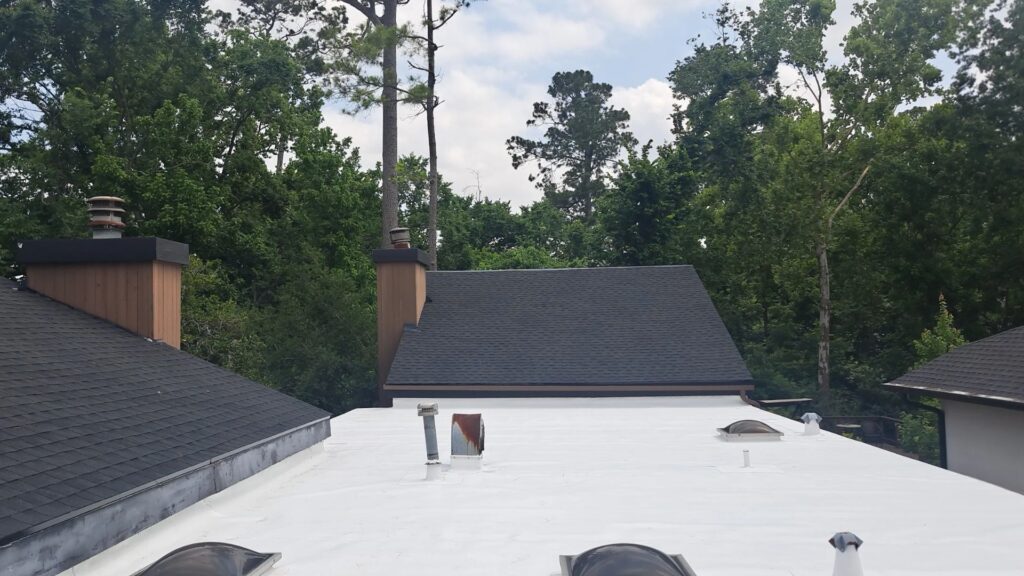
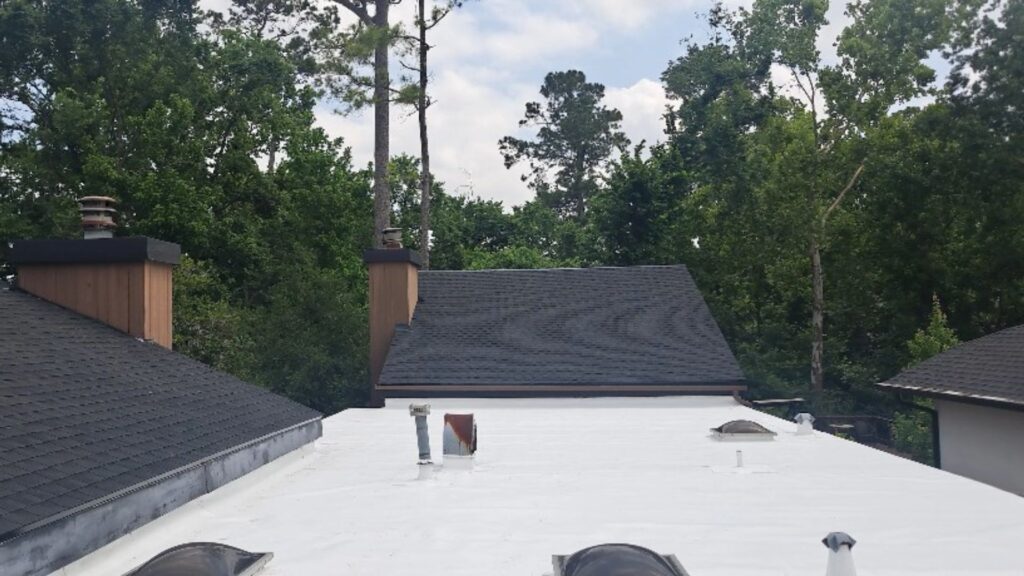
The real-world value of this comprehensive approach is demonstrated in the Achilles case study at Pine Creek Lane in Houston (Zip 77055). What began as a routine service call for a single roof-to-wall leak revealed systemic deterioration across a complex 3,482 sq. ft. residential-commercial hybrid system.
Instead of offering a temporary patch, Achilles executed a complete, single-mobilization overhaul. This included replacing 1,925 sq. ft. of pitched areas with upgraded 6-nail GAF Timberline NS® architectural shingles, alongside a full commercial-spec tear-off and replacement of the 1,533 sq. ft. flat roof section using our standard 90MM TPO membrane. The entire multi-roof project was brought under a unified GAF System Plus™ Limited Warranty, proving that commercial-grade reliability belongs on any flat surface, regardless of the property type.
 |
 |
|
Before |
After |
Standard Practices on Every Achilles TPO Project
-
90MM TPO Membrane, Mechanically Fastened: This heavy-duty, ultra-thick commercial membrane is the standard spec on every Achilles flat roof project—not a premium upgrade. It represents the minimum correct specification required to withstand Houston’s intense UV exposure and extreme heat.
-
Hot-Air Welded Seams Throughout: All field seams and perimeter terminations are physically fused using hot-air welders rather than adhesive bonding. Welded seams form a monolithic bond that is structurally stronger than the membrane itself, completely eliminating the adhesive failures common to local low-slope roofs.
-
Full Tear-Off Before Inspection Is Finalized: Substrate and deck conditions are thoroughly assessed only after the old materials are entirely stripped away, never estimated from the surface. True deck repair needs and pricing are disclosed upfront so there are no surprises during installation.
-
New Flashing and Counterflashing at All Perimeters: Achilles replaces all flashings at walls, curbs, and penetrations. Reusing old flashing on a brand-new membrane is the single leading cause of “new roof, same leak” scenarios in Houston’s wind-driven rain climate.
-
Upstream Drainage Assessment: Scuppers, drains, and slope variables are verified and corrected before the new TPO membrane goes down. Existing ponding water is diagnosed and resolved as part of the initial scope of work, never hidden away as a post-completion warranty exclusion.
-
Comprehensive Workmanship Warranty: Achilles backs its flat roof installations with a dedicated workmanship warranty. This provides independent security alongside the manufacturer’s material coverage and remains fully transferable if the property is later sold or leased.
“In Houston, the most common flat roof scenario we see is a 15-to-20-year-old membrane where someone patched the visible leak two or three times and never addressed what the rest of the surface was doing. By the time we do the full tear-off, the deck tells the real story. That’s why we don’t price a flat roof replacement until we can see the deck.” — Senior Inspector, Achilles Roofing & Exterior
Get a Fixed-Price Commercial Roof Assessment — No Surprises
Achilles Roofing’s pre-job inspection identifies membrane condition, deck integrity, flashing failure points, and drainage issues before any contract is signed. What you are quoted is what you pay.
Schedule Your Fixed-Price Inspection.
Visit achillesroofinghouston.com
Or call (832) 346-8021 to get started.
Frequently Asked Questions
What is the best flat roof material for a commercial property in Houston?
For Houston’s climate, defined by intense UV exposure, summer heat exceeding 95°F, year-round humidity, and tropical storm wind loading, 90MM TPO (Thermoplastic Polyolefin) with mechanical fastening and hot-air welded seams is the recommended flat roofing material for commercial and mixed-use properties. TPO’s white reflective surface reduces rooftop temperatures and cooling loads, its welded seams outperform adhesive alternatives in wind uplift, and its UV resistance exceeds that of EPDM rubber under sustained Texas sun. Achilles Roofing installed a 90MM TPO mechanically fastened system on a 1,533 sq ft Houston flat roof in May 2025 as part of a complete three-roof property overhaul. Explore TPO shingles and flat roof options available for Houston commercial properties.
How much does a commercial TPO roof replacement cost in Houston?
A commercial TPO roof replacement in Houston costs approximately $6.00–$12.00 per square foot installed in 2026, depending on membrane thickness, roof complexity, deck condition, and the number of penetrations. For a 1,500 sq ft flat roof, the most common residential-commercial size in Houston, that translates to roughly $9,000–$18,000. A 90MM TPO replacement on a 1,533 sq ft roof, as completed by Achilles Roofing in May 2025, came in at approximately $10,000–$13,000, including full tear-off, deck repairs, new flashings, and all penetration work.
Should I repair or replace my commercial flat roof in Houston?
If the membrane is under 10 years old and the failure is genuinely isolated to a single flashing or seam, a localized repair is appropriate. If the membrane is 15 or more years old, or if you have had multiple leak points repaired previously, full replacement is almost always the more cost-effective path. A patch on an end-of-life TPO membrane in Houston delivers 6–18 months of additional service at best, after which you face the same replacement cost plus any interior damage remediation from moisture intrusion during the delay. Achilles Roofing’s general rule: if the membrane is over 15 years old, get a full inspection before agreeing to any repair quote.
What is the difference between 45MM, 60MM, and 90MM TPO?
TPO thickness refers to the gauge of the membrane itself, measured in thousandths of an inch (millimeters in trade parlance). 45MM is the thinnest commercially available TPO and represents minimum-spec installation—adequate for low-exposure, interior-climate markets and inappropriate for Houston’s wind and UV conditions. 60MM is mid-spec. 90MM is the correct specification for Houston: thicker membrane, greater puncture resistance, greater thermal stability under repeated heat cycling, and longer service life under Gulf Coast conditions. Achilles Roofing specifies 90MM as the standard on all Houston flat roof projects, not as an upgrade, but as the baseline correct spec for this market.
How long does a TPO flat roof last in Houston?
A properly installed 90MM TPO mechanically fastened system in Houston carries an expected service life of 20–30 years when installed to Wind Zone IV specifications with hot-air welded seams and new flashing at all terminations. Under-spec systems (45MM or 60MM with adhesive seams) will typically perform for 10–18 years in this climate before flashing and seam failures begin compounding. The Achilles Roofing 90MM TPO installation completed in May 2025 at a Houston residential-commercial property was installed to the full 20–30-year service life specification.
Can a contractor replace both a flat TPO roof and pitched shingle roofs at the same property?
Yes, and completing both in a single mobilization is significantly more cost-efficient than scheduling separate projects. A single mobilization eliminates duplicate setup, crew deployment, and haul-off costs. Achilles Roofing & Exterior completed a full three-roof replacement at a Houston residential property in May 2025: one 1,533 sq ft flat roof using a 90MM TPO mechanically fastened system, plus two pitched roof sections totaling 1,925 sq ft using GAF Timberline NS® architectural shingles—all under one contract with one GAF System Plus™ warranty registration, completed in five working days.
How long does a commercial roof replacement take in Houston?
A standalone commercial flat roof replacement on a 1,500 sq ft section typically takes two to three working days for a standard Achilles Roofing crew, including tear-off, deck assessment and repair, new membrane installation, flashing, and final inspection. For a larger combined scope covering flat and pitched roofing sections simultaneously, Achilles completed a 3,482 sq ft three-roof replacement (flat TPO plus two pitched shingle sections) in five working days in May 2025. From the initial inspection call to the completed, paid project, the total elapsed time, including estimating and contracting, was 20 calendar days.
Does Achilles Roofing handle commercial roofing in Houston, Katy, and Cypress?
Yes. Achilles Roofing & Exterior handles commercial and mixed-use flat roofing across Houston, Katy, Cypress (77429, 77433, 77410), Spring, Sugar Land, and Pearland. The company is GAF Factory Certified, RCAT Certified, GHBA Certified, A+ BBB Accredited, and carries both general liability and workers’ compensation insurance. Ahmad Faiz leads all commercial inspections and project management, with 18 years of hands-on roofing experience in the Houston market.
Sources & References:
-
Bianchi, M. V. A., Desjarlais, A. O., Miller, W. A., & Petrie, T. W. (2011). Cool roofs and thermal insulation: Energy savings and peak demand reduction (Report No. ORNL/TM-2011/4). Oak Ridge National Laboratory. https://www.coolrooftoolkit.org/wp-content/uploads/2012/05/Cool-Roofs-and-Thermal-Insulation.pdf Cited by: 13
-
HomeAdvisor. (2024). How much does it cost to install or replace a flat roof? https://www.homeadvisor.com/cost/roofing/flat-roof/
-
National Roofing Contractors Association. (2016). NRCA releases 2015-2016 market survey results. Roofing Magazine. https://roofingmagazine.com/nrca-releases-2015-16-market-survey/
-
Smith, R. K. (2015). Changing rainfall and humidity within Southeast Texas. SpringerPlus, 4, Article 445. https://doi.org/10.1186/s40064-015-1245-7 (Note: This is the peer-reviewed publication for PMC4547975). Cited by: 5
-
Texas Department of Insurance. (n.d.). Windstorm building code requirements. Texas Windstorm Insurance Association. https://www.tdi.texas.gov/wind/twia-building-code.html
-
U.S. Energy Information Administration. (2024). Average revenue per kilowatthour to ultimate customers by end-use sector: Commercial and industrial (Table 5.B) [PDF]. https://www.eia.gov/electricity/sales_revenue_price/pdf/table_5B.pdf
-
U.S. General Services Administration. (n.d.). Facilities management and commercial real estate policies. Public Buildings Service. https://www.gsa.gov/sandbox/offline-pages/pbs/facilities-management