QUICK ANSWER
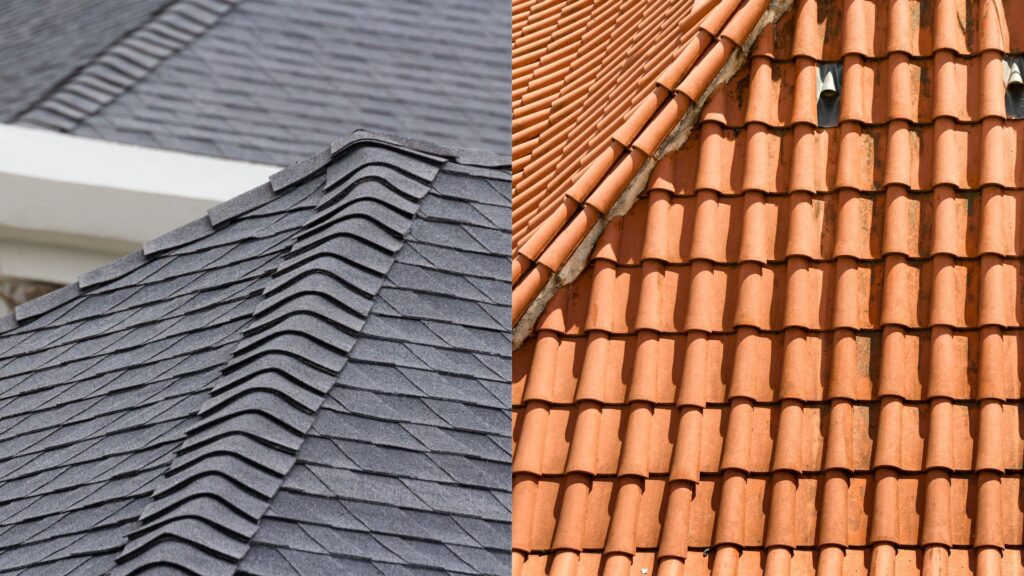
For most Houston homeowners, asphalt shingles offer the best balance of heat resistance, storm performance, and cost. Clay tile roofing outperforms in longevity and thermal mass but carries a higher upfront cost and requires structural reinforcement. Neither is universally better. The right choice depends on your budget, home structure, and neighborhood aesthetic.
We’ve inspected hundreds of roofs across Houston’s diverse neighborhoods, from Montrose bungalows to Sugar Land new-builds, and the damage patterns after extreme heat or storm events tell a clear story. Both materials have real strengths in the Houston climate. But they fail in very different ways, and those failure modes matter when you’re deciding what to put over your family’s head.
150°F+
Conventional dark asphalt roofs can reach 150°F or more on a sunny summer afternoon, while a reflective cool roof under the same conditions stays more than 50°F cooler, according to the U.S. Department of Energy. In Houston, where ambient temperatures regularly exceed 95–100°F in July and August, dark shingles can sustain peak surface temperatures for up to five hours of direct sun exposure.
Source: U.S. Department of Energy — Energy Saver: Cool Roofs
Head-to-Head: At-a-Glance Comparison
The table below summarizes how asphalt shingles and clay tile compare across every factor relevant to Houston homeowners. No single material wins every category. Understanding the tradeoffs is the key to making the right choice.
| Factor | Asphalt Shingles | Clay Tile | Winner |
|---|---|---|---|
| Upfront Cost (per sq. ft.) | $4 – $9 installed | $12 – $25 installed | Asphalt |
| Lifespan (Houston climate) | 15 – 25 years | 40 – 60+ years | Clay Tile |
| Heat Resistance | Good (Class A rated) | Excellent (natural thermal mass) | Clay Tile |
| Hurricane Wind Rating | Up to 130 mph (Impact-rated) | Up to 150 mph (properly installed) | Tie (varies) |
| Hail Resistance | Excellent (Class 4 IR available) | Poor — clay cracks under impact | Asphalt |
| Weight / Structural Load | ~2–3 lbs per sq. ft. | ~9–12 lbs per sq. ft. | Asphalt |
| Energy Efficiency (cool roof) | Good (reflective options) | Excellent (natural airflow under tile) | Clay Tile |
| Maintenance in Houston | Low-moderate (watch for algae) | Low (but cracked tiles must be replaced) | Tie |
| Insurance Premium Impact | Neutral to favorable (Class 4) | Favorable (longevity discount) | Tie |
| Availability / Contractors | Very wide availability | Specialized — fewer qualified contractors | Asphalt |
Heat Performance: How Each Material Handles 150°F Roof Surfaces
Clay tile handles Houston heat better at the material level, thanks to its natural thermal mass and the air gap created beneath tiles. However, modern reflective asphalt shingles (“cool roof” shingles) have significantly closed this gap, qualifying for ENERGY STAR ratings and reducing attic temperatures by up to 30°F.
How Clay Tile Handles Houston Heat
Clay is a naturally dense material. It absorbs heat slowly, retains it during the day, and releases it after sunset—a thermal buffering effect that prevents rapid temperature swings in your attic and living spaces. The barrel or S-curve shape of most clay tiles also creates an air channel underneath each tile, allowing natural ventilation that dissipates heat before it penetrates the roof deck.
In Houston’s humid subtropical climate, this passive cooling mechanism is genuinely valuable. Homes with clay tile roofs in Houston’s River Oaks and West University neighborhoods consistently report lower summer cooling costs compared to comparable homes with standard asphalt. Though we note that many of those homes also have superior attic insulation and older tree canopies.
27%
Potential reduction in peak cooling demand for air-conditioned residential buildings by using cool roofing products, which reflect more sunlight and absorb less heat than conventional roofs.
How Asphalt Shingles Handle Houston Heat
Traditional dark asphalt shingles absorb more heat than almost any other roofing material. This is the historically valid knock against asphalt in hot climates. However, the roofing industry has responded. Today’s Class A fire-rated architectural shingles, and especially “cool roof” products from manufacturers like GAF (Timberline Cool Series) and Owens Corning (Duration Cool), incorporate infrared-reflective granules that meaningfully reduce heat absorption.
- Cool roof asphalt shingles reflect 25–40% of solar radiation vs. 5–15% for standard dark shingles
- Light-colored asphalt shingles (tan, gray, weathered wood) perform significantly better than charcoal or black ones
- Proper attic ventilation (1:150 ratio per building code) is more impactful than shingle color in most Houston homes
Our field experience: the biggest differentiator in cooling costs is attic ventilation and insulation, not roofing material. We’ve seen clay tile homes with poor ventilation perform worse than asphalt homes with properly installed ridge vents and blown insulation.
Storm Survival: Hail, Wind, and Hurricane Season
Houston averages 5–7 named tropical systems per season affecting the Gulf Coast. For hail, Houston’s most common insurance claim trigger, asphalt wins clearly. For sustained hurricane-force wind, properly installed clay tile can match or exceed asphalt, but a single hailstone can crack a clay tile, requiring individual tile replacement that is costly and difficult to color-match.
#1
Texas continues to lead the nation in severe weather risk, recording 902 major hail events in 2025—the highest of any U.S. state, according to NOAA’s Storm Prediction Center. This frequency drives immense financial loss; for instance, the state saw nearly 193,000 hail claims in a single year (2019). State Farm, the largest home insurer in the U.S., recently reported that Texas remains one of its top states for hail losses. Nationally, the company’s hail-related payouts reached a staggering $5 billion in 2024 ($3.8 billion for property and $1.2 billion for vehicles), a significant increase from the $3.5 billion reported just two years prior.
Sources: Insurance Information Institute — Facts & Statistics: Hail · NOAA Storm Prediction Center Annual Severe Weather Report · State Farm Newsroom, March 2023
Hail Resistance: Asphalt Wins Clearly
This is arguably the most important category for Houston homeowners, and asphalt wins it decisively. Impact-resistant (IR) asphalt shingles, rated Class 3 or Class 4 under UL 2218 testing, are designed to withstand hailstones up to 2 inches in diameter without cracking or granule loss. Many Houston insurance carriers offer premium discounts of 20–30% for Class 4-rated roofs.
Clay tile, by contrast, is brittle under impact. A 1.5-inch hailstone that a Class 4 asphalt shingle absorbs can crack or shatter a clay tile. Individual tile replacement is possible, but:
- Color and texture matching after years of weathering is nearly impossible
- Walking on clay tile for repairs risks cracking adjacent tiles
- Widespread hail events (like the April 2016 Houston storm) can necessitate full roof replacement
Wind Resistance: Clay Tile Can Excel—With the Right Installation
Clay tile’s weight (9–12 lbs per square foot) gives it natural wind resistance when properly installed. In Florida, the closest analog to Houston’s hurricane exposure, clay tile is a dominant roofing material precisely because of this. The keyword is properly installed. Clay tile must be mechanically fastened (not just mortared) in Hurricane exposure zones, with every tile attached to the battens per the manufacturer specs.
Asphalt shingles in the 130 mph wind-rated range are more than adequate for most Houston events. After Hurricane Harvey (2017) and Hurricane Beryl (2024), our inspection teams found that shingle failures were more often related to improper installation—too few nails, nails too high on the shingle, or inadequate starter courses—than to material limitations.
Cost & Long-Term ROI: The Numbers Houston Homeowners Need
Asphalt shingles cost $8,000–$18,000 for a typical Houston home (installed). Clay tile runs $22,000–$50,000+ for the same footprint. But a clay tile’s 50+ year lifespan means you may only replace it once in a lifetime. Asphalt may need replacement every 20–25 years in Houston’s climate. The 30-year total cost of ownership can favor clay tile on larger, structurally appropriate homes.
56.9%
National average resale ROI for asphalt shingle roof replacement, according to the JLC 2024 Cost vs. Value Report. While the West South Central regional average is currently 48.5%, homeowners in high-demand markets like Houston can often recoup more value by installing Class 4 impact-resistant shingles. These upgrades are specifically designed to withstand severe hail and are recognized by many Texas insurers for premium discounts, typically ranging from 15% to 25%.
Sources: JLC Cost vs. Value Report 2024 (National) · JLC Cost vs. Value Report 2024 (Regional) · Texas Department of Insurance — Home Insurance Discounts
The Structural Cost Caveat for Clay Tile
Most Houston homes built after 1980 are not engineered for clay tile’s weight. A structural engineer assessment ($400–$800) is required before installation, and if the roof deck and/or framing need reinforcement, add $3,000–$10,000 to your project cost. This is rarely discussed upfront by contractors eager to close a sale. We believe in telling you before you fall in love with a material.
Insurance Premium Considerations
Houston homeowners’ insurance is increasingly expensive. The roofing material you choose materially impacts your premium:
- Class 4 Impact Resistant Asphalt: Discounts of 20–30% from many Texas carriers (Allstate, State Farm, USAA)
- Clay Tile: Favorable ratings for fire and wind, but hail endorsements are more expensive
- Any Roof Under 15 Years Old: Many carriers require a roof age certification—a new roof resets this clock regardless of material
We always recommend calling your insurance agent before choosing a material. The premium savings from a Class 4 asphalt roof can offset thousands of dollars over a decade.
Our Recommendation: Who Should Choose Which Material
Choose asphalt if you want proven hurricane-zone performance, excellent hail resistance, insurance savings, and a lower initial investment. Choose clay tile if your home is structurally rated for it, you’re in a higher-end neighborhood where aesthetics matter for resale, you plan to stay long-term, and you live in a lower-hail-frequency zone within Greater Houston.
Choose Asphalt Shingles If:
- Your home is a standard wood-frame build (the vast majority in Houston)
- You want Class 4 hail protection and insurance savings
- Budget is a priority—you need a quality roof without a $40,000+ investment
- Your roof has complex geometry (multiple valleys, dormers)—asphalt is far easier to work with
- You want a 10–25 year solution while building equity before a luxury upgrade
Choose Clay Tile If:
- Your home is a stucco, masonry, or concrete build engineered for heavy materials
- You’re in a higher-end neighborhood (River Oaks, Bellaire, West University Place) where curb appeal commands a premium
- You plan to own the home for 25+ years and want a true lifetime roof
- You have a simpler roof pitch (4:12 to 8:12 works best for tile installation)
- Aesthetics align with Mediterranean, Spanish Colonial, or Tuscan architecture
◆ Achilles Roofing VerdictFor Most Houston Homeowners: Asphalt—But Make It Class 4
After 14 years of installing and inspecting roofs across greater Houston, our honest recommendation for most homeowners is a premium architectural asphalt shingle with a Class 4 impact-resistance rating and a cool-roof granule package. You get documented hail protection, meaningful insurance savings, proven storm performance, and a 25-year product warranty, without the structural and financial complexity of tile. For the right home, clay tile is extraordinary. But for most Houston builds, excellent asphalt beats average tile every time.
Frequently Asked Questions
Clay tile has better innate heat resistance due to its thermal mass and natural ventilation channel beneath each tile. However, modern ENERGY STAR-certified asphalt shingles have significantly narrowed this gap. For most Houston homes, proper attic ventilation matters more than material choice when it comes to summer cooling costs.
Expect 15–25 years for standard 3-tab asphalt shingles in Houston. Premium architectural shingles with algae-resistant granules last 20–30 years. Houston’s UV exposure, humidity, and hail events reduce lifespan compared to drier climates. Annual inspections and proper ventilation are the biggest factors in maximizing longevity.
Most wood-frame homes built in Houston after 1980 are not engineered for clay tile’s weight of 9–12 lbs per square foot. A structural engineer assessment is required before installation. If reinforcement is needed, expect to add $3,000–$10,000 to the project cost. Concrete block, masonry, or older craftsman homes are more likely to be eligible.
Both materials can perform well in hurricanes when properly installed. Clay tile’s weight provides natural wind resistance, but it is vulnerable to hail. Impact-resistant (Class 4) asphalt shingles offer excellent hurricane wind ratings and superior hail protection. For Houston’s combined wind-and-hail risk, Class 4 asphalt is the most comprehensive single-material solution.
Clay tile can earn favorable ratings for fire and wind resistance, which may reduce premiums with some carriers. However, because clay is prone to hail damage—a leading claim driver in Texas—some insurers charge higher hail endorsement premiums. Class 4 impact-resistant asphalt shingles typically deliver more reliable insurance savings in the Houston market. Always consult your agent before choosing a material.
A mid-grade architectural asphalt shingle (e.g., GAF Timberline HDZ or Owens Corning Duration) installed by a certified contractor is the most cost-effective durable option for Houston. Expect $9,000–$16,000 for an average 2,000 sq. ft. home, with a 30-year manufacturer warranty and Class 4 options available at a modest premium. This represents the best balance of cost, durability, and insurance performance in the Houston market.
In Houston’s climate, asphalt shingle roofs typically need replacement every 20–25 years under normal conditions. However, a significant hail event (1.5″ or larger) can warrant earlier replacement regardless of age. Clay tile roofs can last 40–60+ years with proper maintenance. Annual professional inspections, especially after storm seasons, help identify damage early and prevent costly interior water damage.
Not Sure Which Roof Is Right for Your Home?
Achilles Roofing offers free, no-pressure roof inspections across Greater Houston. We’ll assess your structure and existing roof condition and give you an honest material recommendation, not just the one with the highest margin.
Sources & References
-
Insurance Information Institute. (n.d.). Facts + statistics: Hail.
-
JLC Online. (2024b). 2024 Cost vs. value report: West south central.
-
State Farm. (2024a, April 11). Hail damage increases in 2023: 5 tips to reduce it.
-
State Farm. (2024b, April 11). State Farm reports increase in hail claim costs.
-
https://www.tdi.texas.gov/tips/home-insurance-discounts.html
-
U.S. Department of Energy. (n.d.). Cool roofs. Energy Saver.
-
U.S. Environmental Protection Agency. (n.d.). Using cool roofs to reduce heat islands.