
Quick Answer: When Should You Replace a Concrete Tile Roof?
Replace a concrete tile roof when more than 25–30% of tiles are cracked, broken, or missing; when the underlayment has exceeded 20–25 years; when you have recurring leak patterns despite repeated repairs; or when the roof deck shows rot or structural compromise. Age alone — if under 40 years — is rarely sufficient reason to replace.
How Long Does a Concrete Tile Roof Last Before It Needs Replacing?
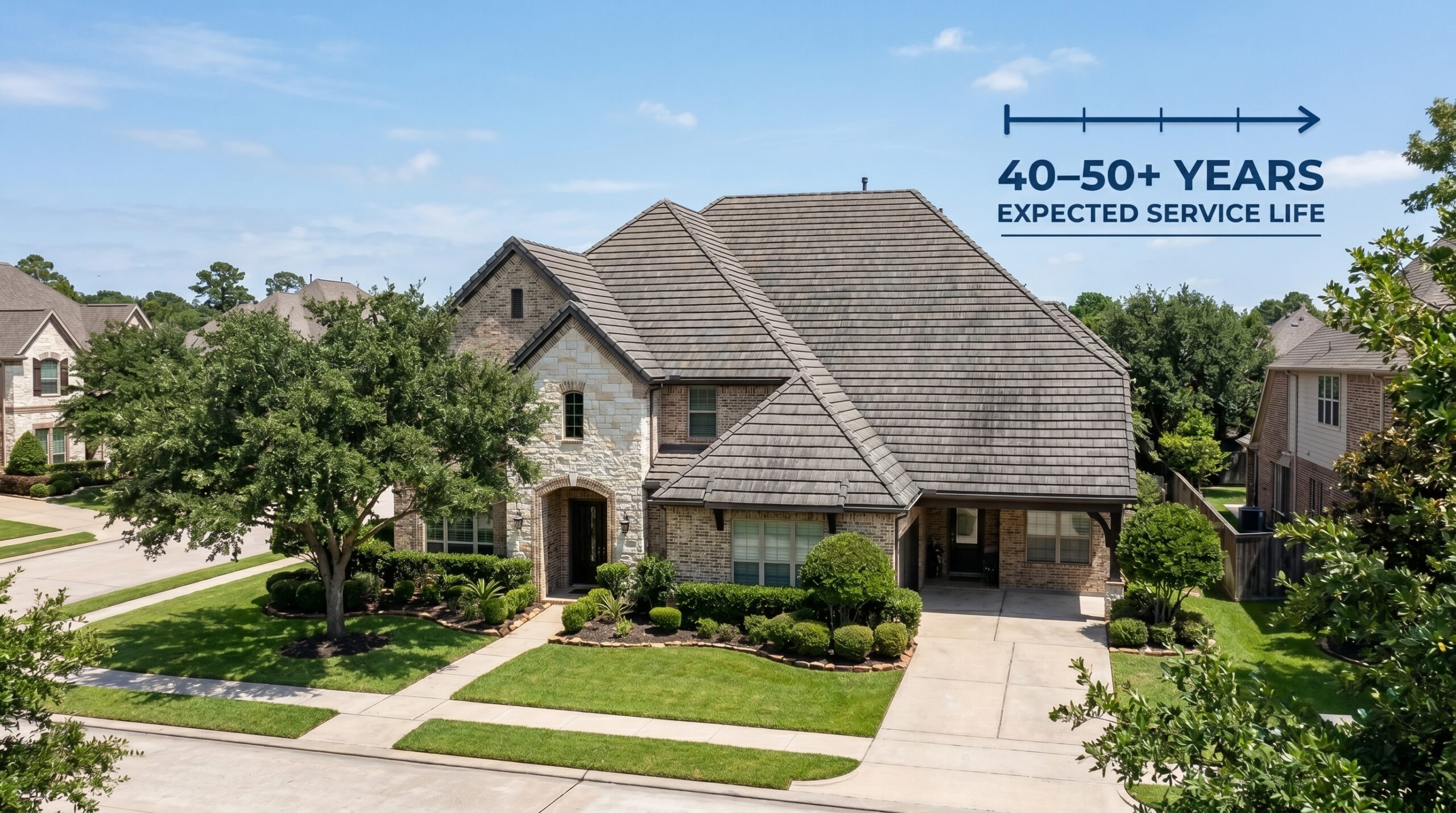
A concrete tile roof lasts 40–50+ years under normal conditions. The tiles themselves rarely fail first — underlayment, flashing, and ridge mortar typically reach end-of-life at the 20–25 year mark. This means most concrete tile roofs require one major maintenance intervention (underlayment replacement) before the tiles themselves need replacing.
The most important thing Houston homeowners misunderstand about concrete tile lifespan is that there are two distinct timelines running simultaneously:
- Tile lifespan: 40–50+ years. The cementitious body of a concrete tile is UV-stable, rot-proof, and does not degrade from moisture or heat cycling in the way asphalt does. Tiles fail primarily from mechanical damage — impact, improper foot traffic, or freeze-thaw cracking (rare in Houston).
- System lifespan: 20–30 years before the underlayment, flashing, and mortar require replacement or significant repair. This is what creates leaks. The water infiltration you see at year 22 is almost never a tile failure — it’s an underlayment or flashing failure underneath intact tile.
This distinction has a real financial implication: many Houston homeowners replace their entire concrete tile roof at year 25 when the actual fix was a $6,000–$14,000 underlayment and flashing refresh, not a $45,000+ full replacement.
Industry ContextThe International Residential Code (IRC), Section R802, defines the structural load requirements for roofing systems. Concrete tile’s rated lifespan assumptions are built into these structural specifications — a roof framed for concrete tile is expected to support the load for the tile’s full design life without replacement.Source: ICC IRC 2021, Chapter 8
What Actually Ends the Life of a Concrete Tile Roof?
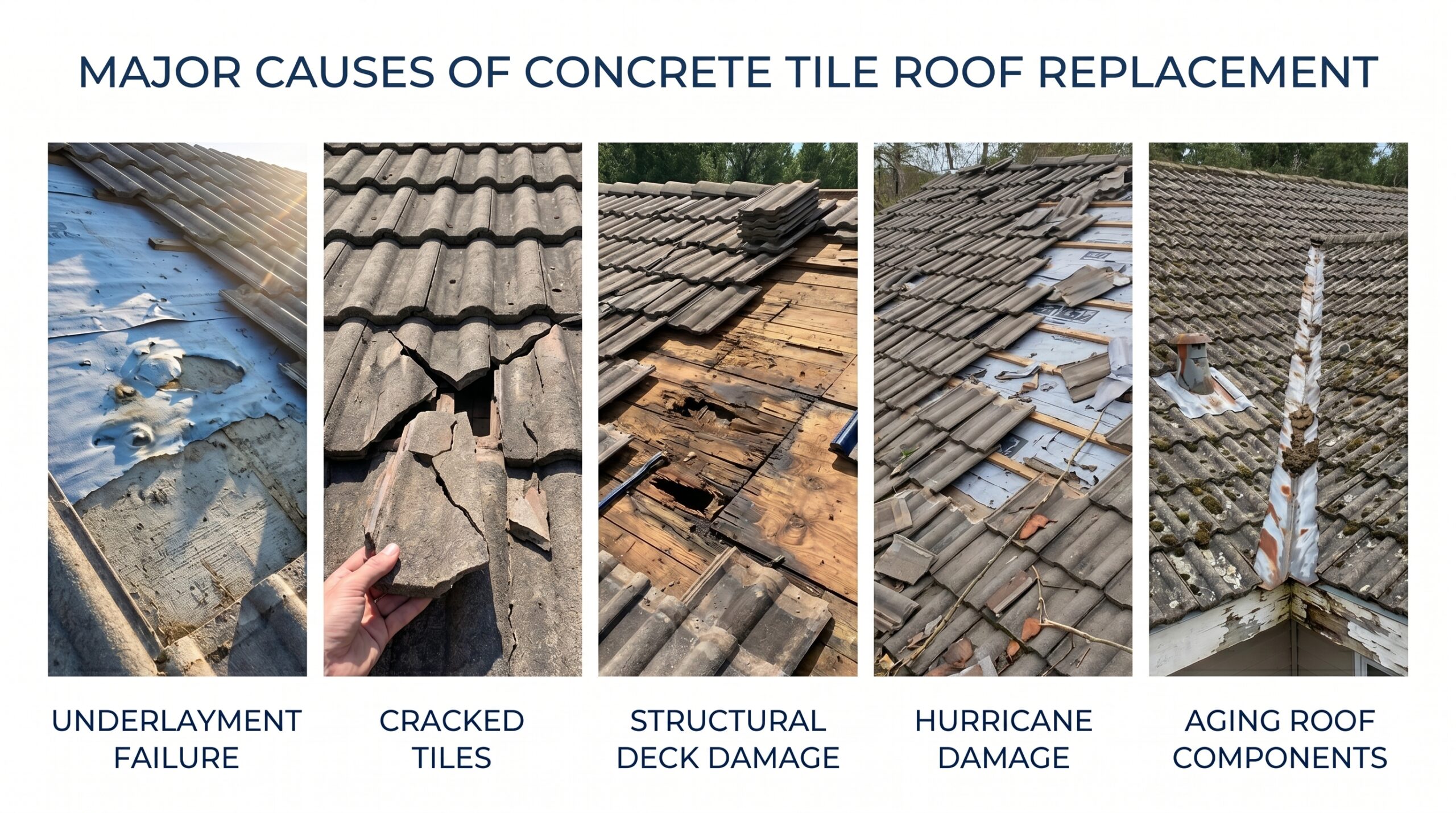
In our experience completing 800+ roofing projects across Greater Houston, the actual causes of concrete tile roof replacement — in order of frequency — are:
- Underlayment failure — moisture infiltration after the felt or synthetic membrane degrades at 20–25 years
- Cumulative tile damage — impact from hail events, falling debris, or repeated improper foot traffic exceeding 25–30% of total tile area
- Structural issues — deck rot from long-term moisture infiltration, or rafter damage from a prior storm event
- Hurricane or catastrophic storm damage — wind-uplift tile loss in excess of what spot-replacement can address
- Age-related system-wide decline — after 45–50 years, the combination of mortar degradation, flashing fatigue, and tile surface erosion makes full replacement more economical than piecemeal repair
8 Signs Your Concrete Tile Roof Needs Replacement (Not Repair)
The most reliable indicators that a concrete tile roof needs full replacement rather than repair are: widespread underlayment failure (evidenced by diffuse interior moisture staining), structural deck compromise, tile damage exceeding 25–30% of roof area, and system age beyond 45 years combined with multiple active leak sources. Single-point problems almost always warrant repair, not replacement.
The repair-vs-replace decision is the question we field most often from Houston homeowners. Here are the eight diagnostic signals that tilt the answer toward replacement:
1. Moisture Staining in Multiple Rooms or Across Multiple Roof Planes
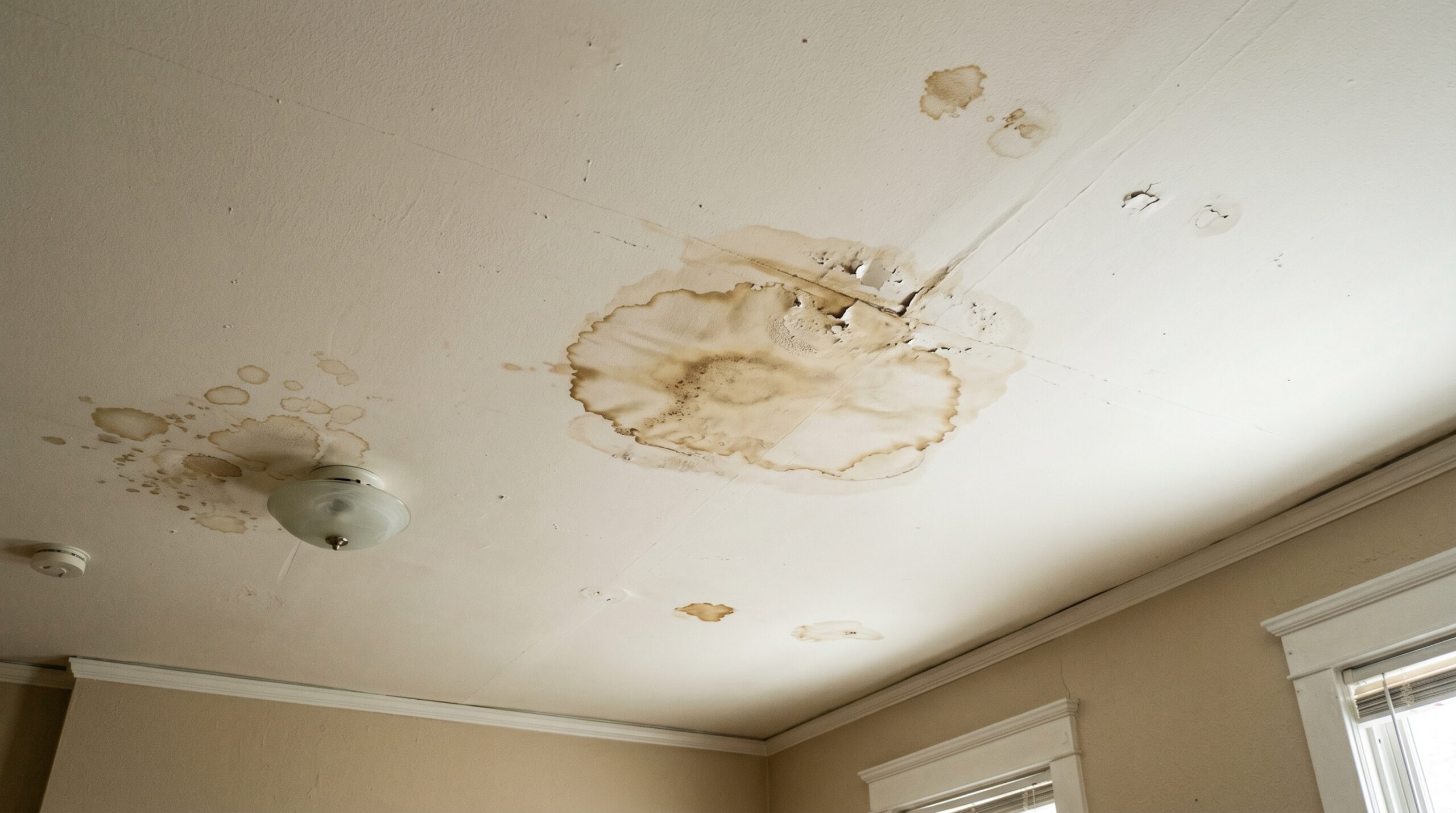
A single leak traces to a single failure point — a cracked tile, failed flashing, or punctured underlayment. Multiple leaks in different areas of the home are a system-wide signal. When moisture is infiltrating from several points simultaneously, the underlayment has reached end-of-life across large portions of the roof — not just where you see the staining.
2. More Than 25–30% of Tiles Are Cracked, Broken, or Missing
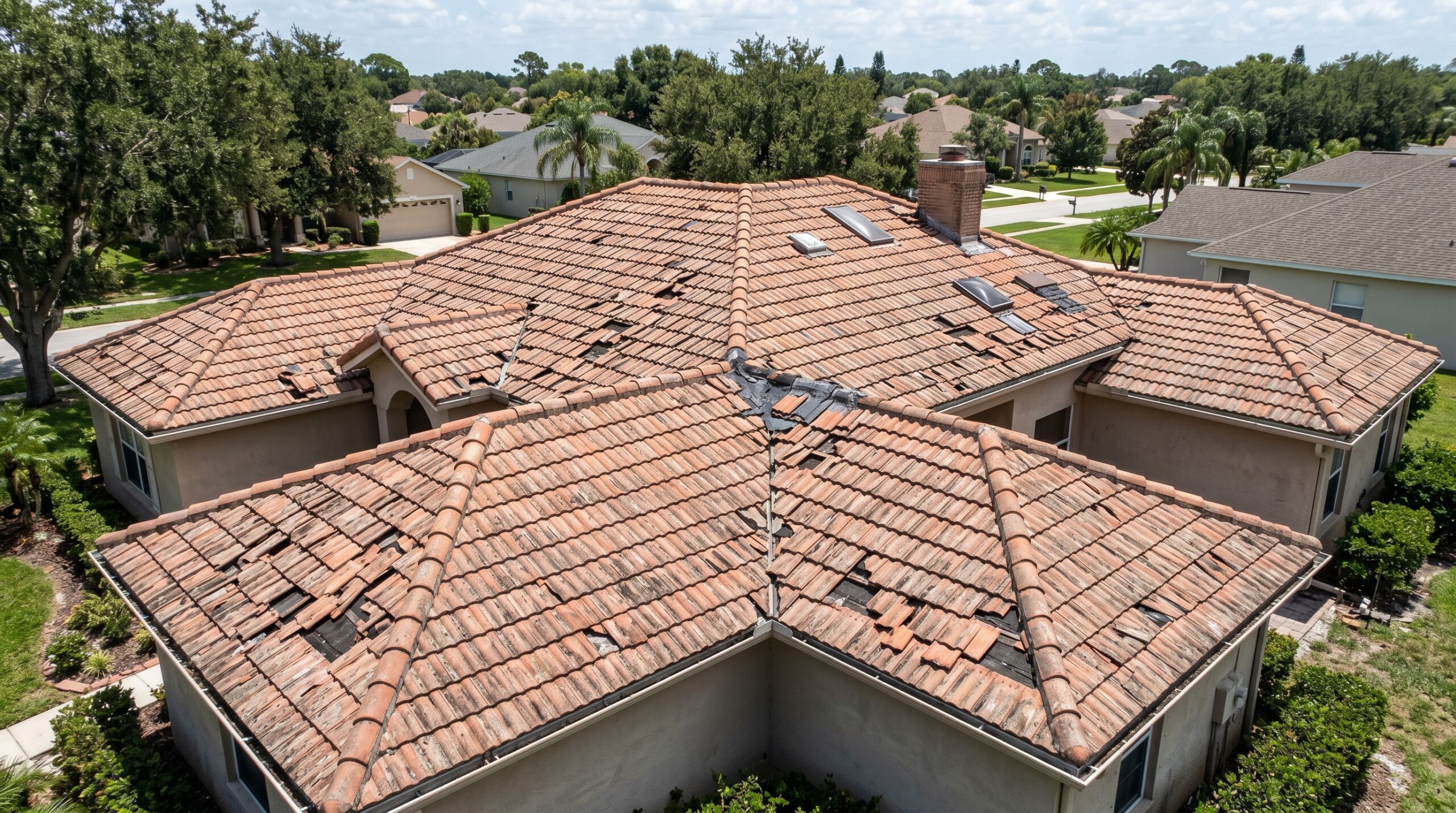
Individual tile replacement is cost-effective at small scale. Once tile damage exceeds roughly a quarter of the roof’s total area, the labor cost of individual replacement, combined with the difficulty of color-matching aged tiles, often approaches the cost of full replacement. Get a line-item quote for both options before deciding.
Key StatisticThe National Roof Certification and Inspection Association (NRCIA) documents that 28% of roofing defects stem specifically from improper flashing installation. Repeated flashing failures on an aging system are often a signal of systemic underlayment compromise, not isolated installation error.Source: NRCIA
3. Soft or Spongy Deck When Walking on the Roof
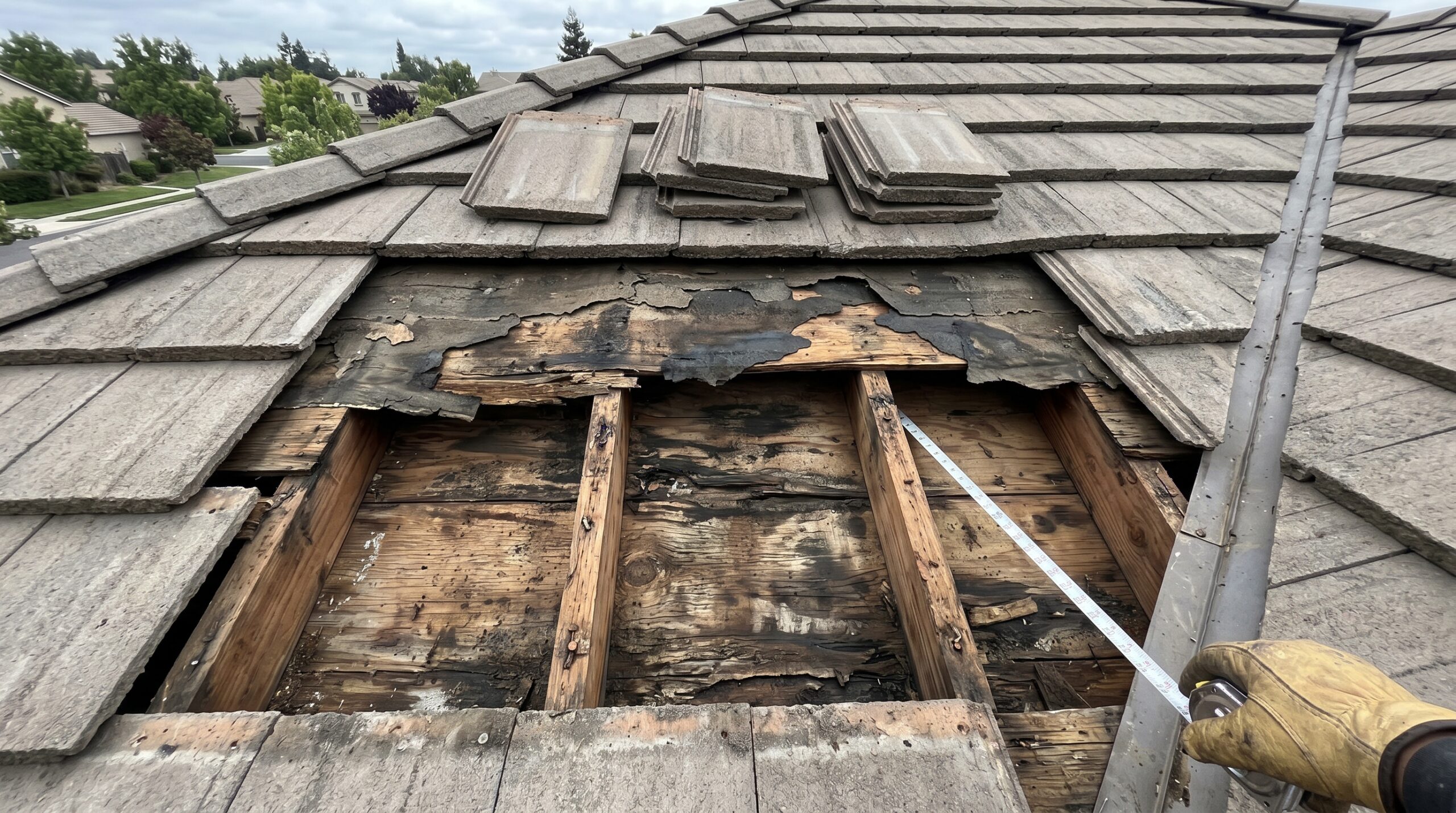
A structurally sound concrete tile roof deck (typically 5/8″ plywood or OSB) is rigid underfoot — there is no flex. If a qualified contractor reports soft spots, spongy areas, or visual deck deflection between rafters, moisture has compromised the deck substrate. This cannot be addressed without full removal of tile and underlayment, making a complete replacement the logical next step.
4. Underlayment Age Exceeds 25 Years
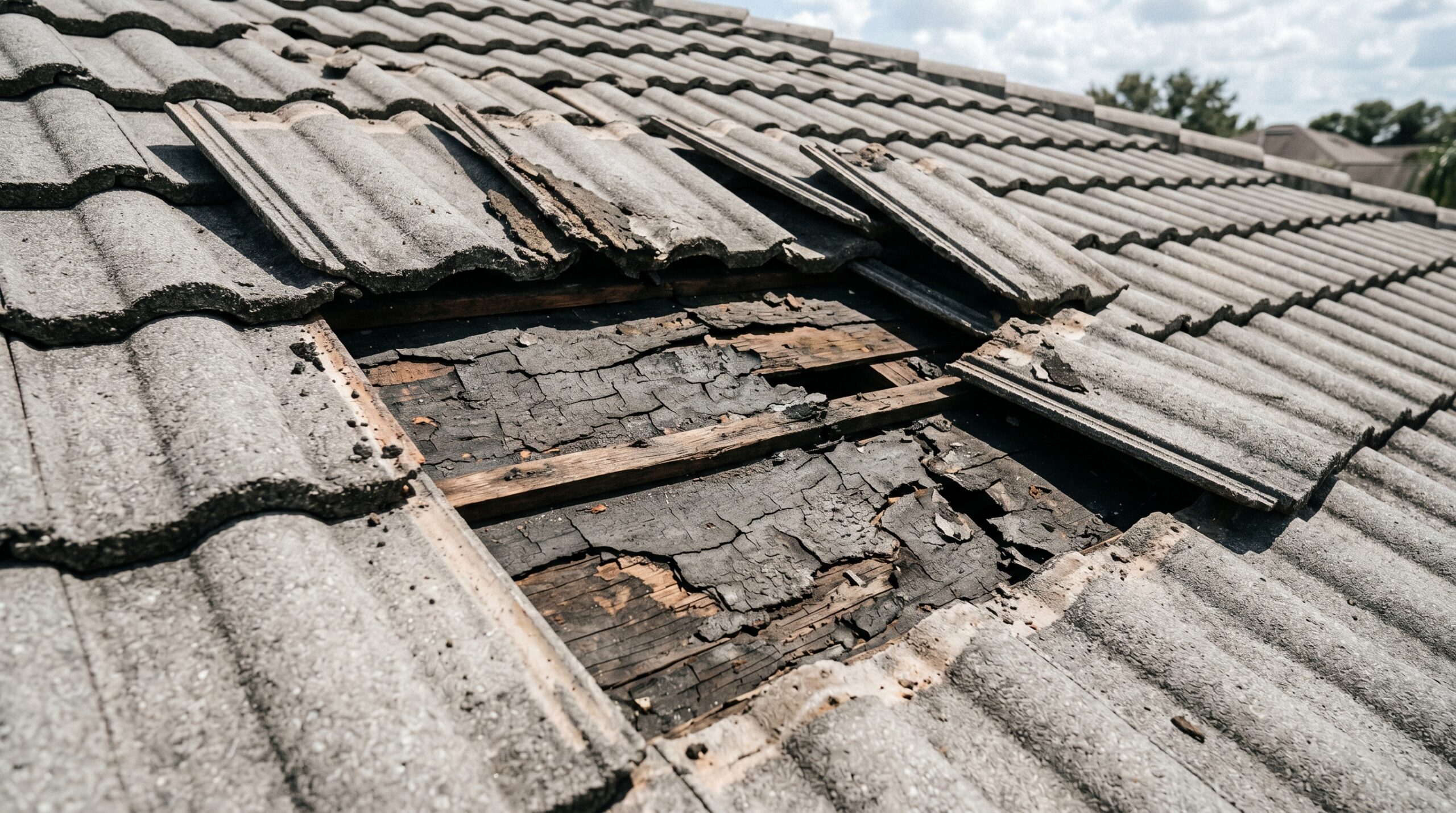
Even if the tiles look intact, felt underlayment (ASTM D226 #30) has a functional lifespan of 20–25 years in Houston’s heat and humidity environment before it begins to crack and fail. Synthetic underlayments perform better — but both have a finite service life. An underlayment inspection (which requires tile removal in a test area) is the only way to confirm condition.
5. Ridge Cap Mortar Is Crumbling or Missing in Multiple Locations
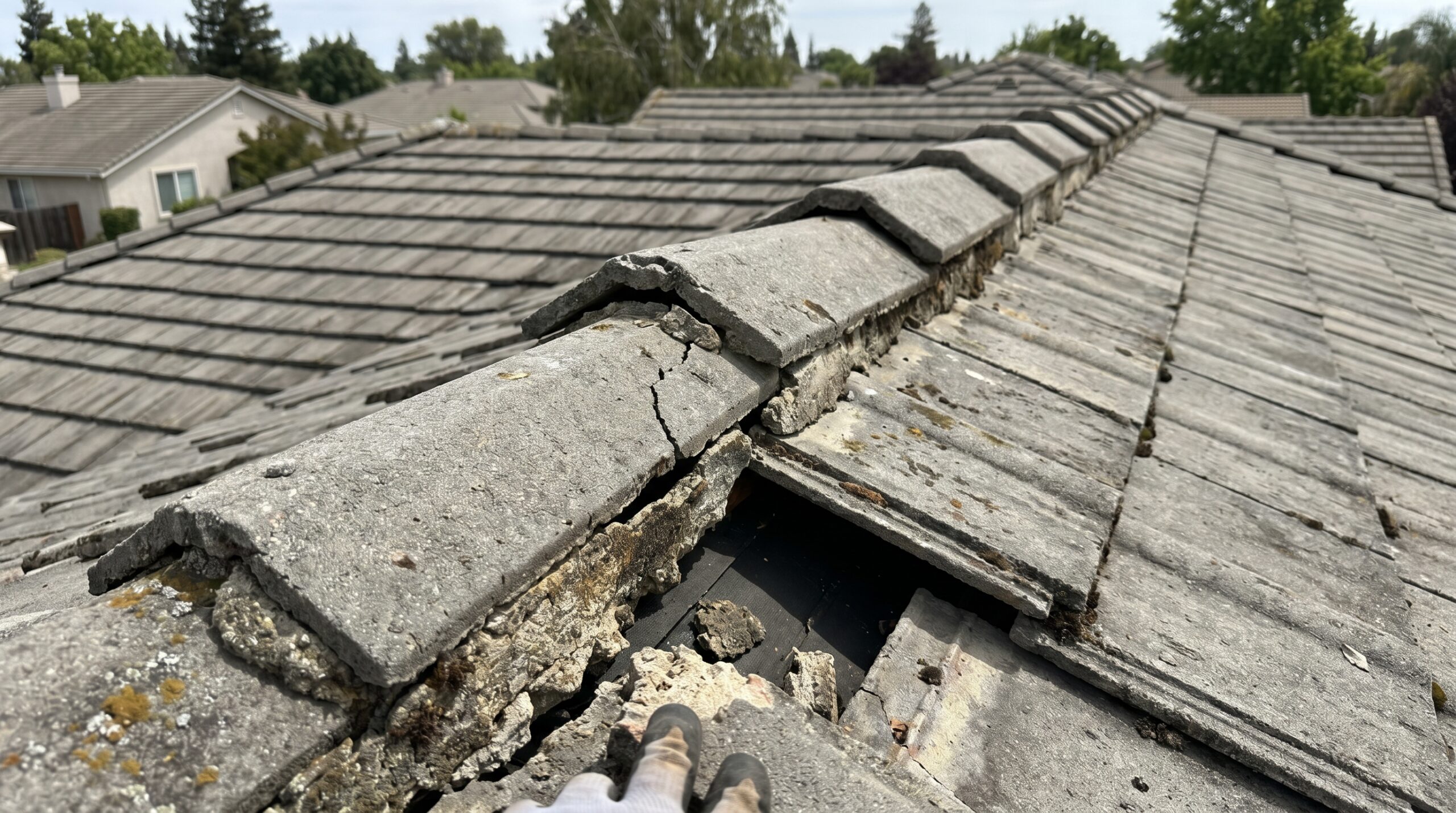
Ridge cap mortar holds the termination tiles at the peak of the roof. When mortar fails in multiple sections — not just one or two points — the ridge system has typically reached end-of-life. Repointing all sections is labor-intensive, and if the underlying tile profile has also degraded, the cost approaches full replacement.
6. Insurance Claim for Major Storm Damage
When a hurricane or major hail event causes widespread tile loss and deck damage, the adjuster’s replacement cost value (RCV) on your claim often makes full replacement financially equivalent to repair. Confirm with your contractor whether depreciation recovery on an older system makes replacement the better financial decision.
7. The Roof Has Exceeded 45 Years Without a System Refresh
After 45 years, the cumulative wear on mortar, flashing, underlayment, and tile surface erosion typically makes system-wide replacement more cost-effective than continued repair cycles. This is not a hard rule — some 50-year-old concrete tile roofs are in excellent condition — but age combined with any of the other signals above creates a strong replacement case.
8. Prior Roof-Over Installation (Tile Installed Over Existing Tile)
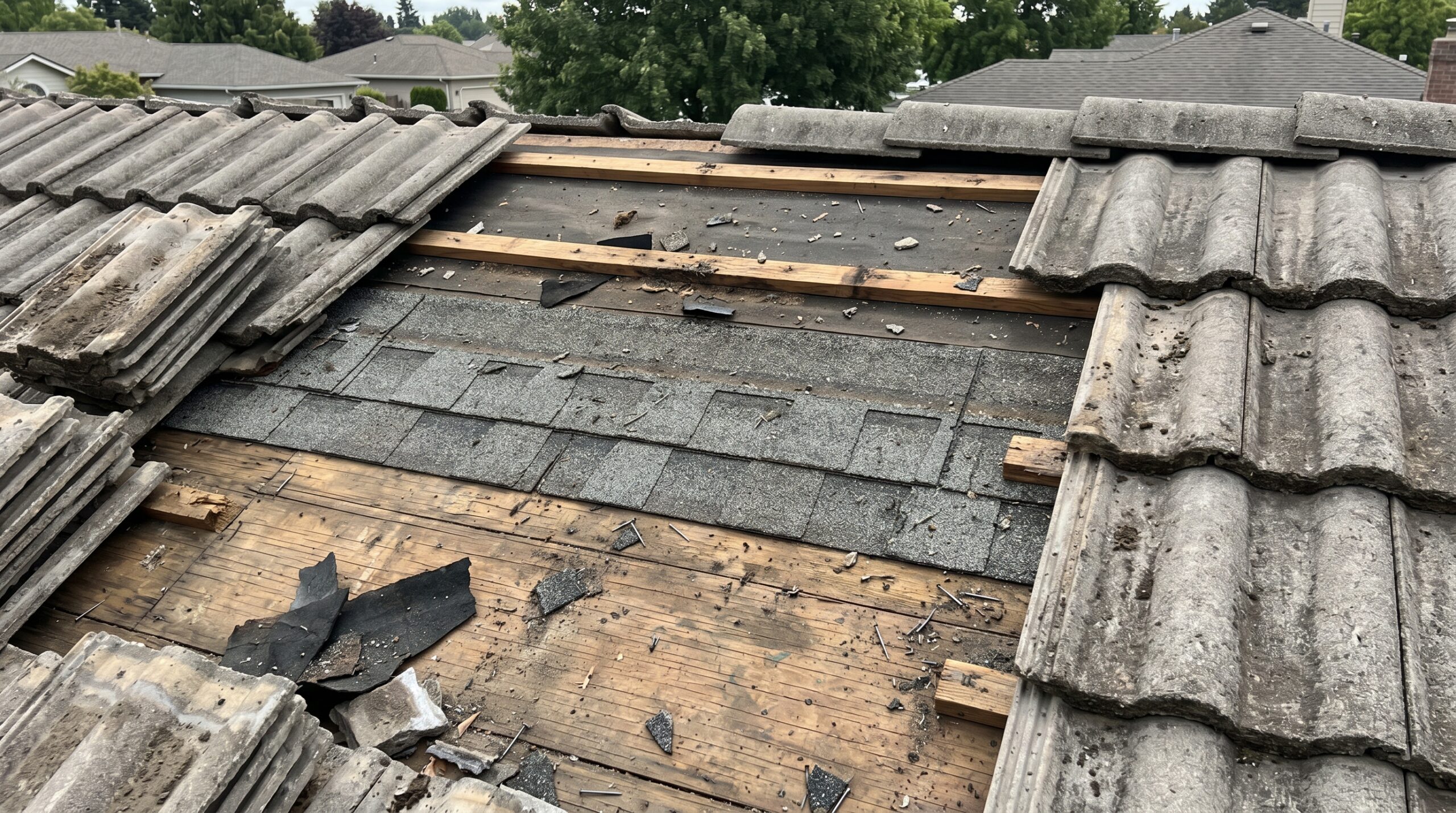
In some older Houston homes, concrete tile was installed over an existing layer of tile or shingles to save tear-off cost. This practice is now prohibited under current Houston building codes. When these systems need service, full tear-off is mandatory — which typically triggers full replacement.
Houston ContextHouston receives an average of 51.8 inches of rainfall annually — nearly 1.7 times the national average — paired with over 200 sunny days per year and sustained humidity above 75%. This combination accelerates underlayment degradation significantly faster than in drier U.S. climates, making 20–25 years the practical, not theoretical, end-of-life for felt underlayment in this market.Source: NOAA
Repair vs. Replace: A Decision Framework for Houston Homeowners
| Condition | Repair | Replace |
|---|---|---|
| Number of broken or missing tiles | < 15% of total area | > 25–30% of total area |
| Underlayment age | Under 20 years | Over 25 years, or unknown |
| Deck condition | Sound, no soft spots | Soft, rotted, or deflecting |
| Leak sources | Single point, traceable | Multiple locations, diffuse |
| Ridge mortar condition | Isolated failures, < 3 sections | Systemic failure across ridge |
| System age | Under 35 years | Over 45 years |
| Storm damage scope | Limited to one roof plane | Multiple planes, deck impact |
| Repair-to-replacement cost ratio | Repair cost < 40% of replacement | Repair cost > 50% of replacement |
The 50% Rule of Thumb
If the cost of repairing your concrete tile roof exceeds 50% of the cost of a full replacement, most experienced roofing contractors — and most insurance adjusters — will recommend replacement. You get a full warranty, fresh underlayment, and a complete system reset for roughly double the repair cost. The math almost always favors replacement past that threshold.
How to Replace a Concrete Tile Roof: The Full Process, Step by Step
A concrete tile roof replacement involves eight core phases: inspection and structural assessment, permit procurement, tile removal and disposal, deck repair, underlayment installation, batten installation, tile installation, and final inspection. In Houston, the full process typically takes 5–10 business days depending on roof complexity and crew size.
For homeowners evaluating contractors or planning project timelines, here is exactly what a properly executed concrete tile roof replacement involves and what to look for at each stage to confirm the work is being done correctly.
Step 1: Full Roof Inspection & Structural Load Assessment
Before a single tile is removed, a qualified contractor must assess the existing structural framing. Concrete tile weighs 9–12 pounds per square foot — roughly 3–4 times heavier than standard architectural asphalt shingles (2.5–4 lbs/sq ft). If the existing structure was framed for asphalt, it may require reinforcement before the new tile system can be safely installed.
The inspection must cover:
- Rafter size, spacing, and span (compared against IRC R802 dead load limits)
- Ridge board and purlin structural integrity
- Deck substrate condition (plywood or OSB thickness, moisture damage)
- Existing dead load capacity relative to the proposed tile system
- Flashing condition at all penetrations, valleys, and wall junctions
Code RequirementConcrete tile roofing systems typically exceed the prescriptive dead load limit of 15 pounds per square foot outlined for conventional light-frame wood construction in Section R802 of the International Residential Code (IRC). Switching from a lighter material (such as asphalt shingles) to concrete tile during a re-roofing project generally triggers a code-mandated engineering review of the existing structural framing.Source: IRC 2021, Section R802
Step 2: Permit Procurement
In Houston and Harris County, a re-roofing permit is required for full roof replacement. Your contractor should pull the permit — not you — and the permit number should be posted visibly at the job site. Any contractor who asks you to pull your own permit or suggests skipping permits entirely is transferring legal liability to you and almost certainly cutting corners on inspections.
Texas has no statewide roofing contractor licensing requirement, which makes permit compliance one of the few external accountability mechanisms available. Insist on it.
Step 3: Tile Removal & Disposal
Concrete tile tear-off is labor-intensive. Each tile must be removed individually or in sections — unlike asphalt shingles, you cannot use a roofing shovel to bulk-strip the surface. Ridge caps and hip tiles require careful hand-removal to avoid damaging the substrate. Plan for 1–2 full days of tear-off on a standard 2,000–2,500 sq ft Houston home.
All tile debris goes into roll-off dumpsters. Confirm dumpster placement and removal are included in your contract — some contractors charge separately for disposal or leave the dumpster on-site past agreed timelines.
Step 4: Deck Inspection & Repair
With the tiles and old underlayment removed, the contractor has full visual access to the deck for the first time. This is when hidden rot, soft spots, and prior water damage are confirmed. Budget 10–15% contingency for deck repair on any Houston re-roofing project — especially on homes where the old underlayment was felt-based and has been in place for 20+ years.
Standard deck requirements for concrete tile in Texas:
- Minimum 5/8″ plywood or OSB (7/16″ is not adequate for concrete tile fastening)
- All rotted or delaminated sections replaced in-kind
- Deck must be flat, sound, and free of protruding fasteners before underlayment installation
Step 5: Underlayment Installation
This is one of the most consequential decisions in the entire project — and one most homeowners don’t think to ask about.
Texas code requires a minimum of ASTM D226 #30 felt underlayment under concrete tile systems. However, in Houston’s climate — with 51.8 inches of annual rainfall, sustained humidity, and extreme UV exposure during the installation window — synthetic underlayment is strongly preferred by contractors with experience in this market.
| Underlayment Type | Material Cost Adder | UV Exposure Tolerance | Expected Service Life (Houston) |
|---|---|---|---|
| ASTM D226 #30 Felt | Baseline | Low (degrades in days if exposed) | 15–20 years |
| Synthetic (e.g., CertainTeed DiamondDeck, GAF Tiger Paw) | +$0.50–$0.75/sq ft | High (rated for weeks of exposure) | 25–50 years (CertainTeed DiamondDeck: 30-year standalone warranty; GAF Tiger Paw: rated for full system lifespan of 25–50 years; Epilay Protectite Platinum: 40-year warranty). Source: CertainTeed, GAF, Epilay |
| Self-adhering modified bitumen (at eaves, valleys) | +$0.30–$0.50/sq ft (zones only) | Moderate | Same as primary underlayment system |
Step 6: Batten Installation
Concrete tile is installed over a horizontal batten system — pressure-treated wood strips fastened to the deck at intervals that align with the tile profile. Battens serve two functions: they create the air gap that reduces attic heat load, and they provide a fastening surface that prevents tiles from sliding on steep pitches.
Batten sizing and spacing must match the specific tile manufacturer’s installation requirements. Non-compliance voids the manufacturer warranty. Confirm your contractor is installing to the manufacturer’s specifications, not a generic batten pattern.
Step 7: Tile Installation
Concrete tile installation is a skilled trade. Tile is installed in overlapping courses from the eave to the ridge, with each course lapped over the one below per manufacturer specification. Fastening method — mechanical fastening, foam adhesive, or a combination — must meet the local wind speed requirements.
In Houston and coastal Harris County:
- Texas Department of Insurance Windstorm territory requirements apply in Tier 1 coastal counties
- Most concrete tile systems require two fasteners per tile minimum in high-wind zones
- Foam adhesive systems can meet HVHZ (High Velocity Hurricane Zone) wind ratings when applied correctly
- Hip and ridge tiles require mortar bedding or approved mechanical fastening — not foam-only in most manufacturer specs
Wind ContextTexas ranks #1 nationally for total annual hail events and is one of the most active hurricane-landfall states. The Texas Department of Insurance Windstorm Inspection Program exists specifically because standard installation methods used in other states are insufficient for Texas coastal conditions.Source: Texas Department of Insurance
Step 8: Flashing, Ridge & Final Inspection
Flashing at all penetrations (plumbing boots, vent pipes, HVAC curbs), valleys, and wall junctions is installed last, before the ridge cap course is mortared and set. This is the most failure-prone phase of a tile roofing project and the one most frequently cut short by contractors under schedule pressure.
Every penetration must receive:
- Metal flashing — not foam sealant alone
- Properly lapped underlayment integration (not just surface-applied flashing)
- Compatible sealant at metal-to-tile interfaces
After installation, a municipal inspector will verify code compliance as part of the permit close-out. A qualified contractor will also conduct their own final walkthrough, photographically documenting the completed installation for warranty records.
2026 Full Breakdown — Concrete Tile Roof Replacement Cost in Houston
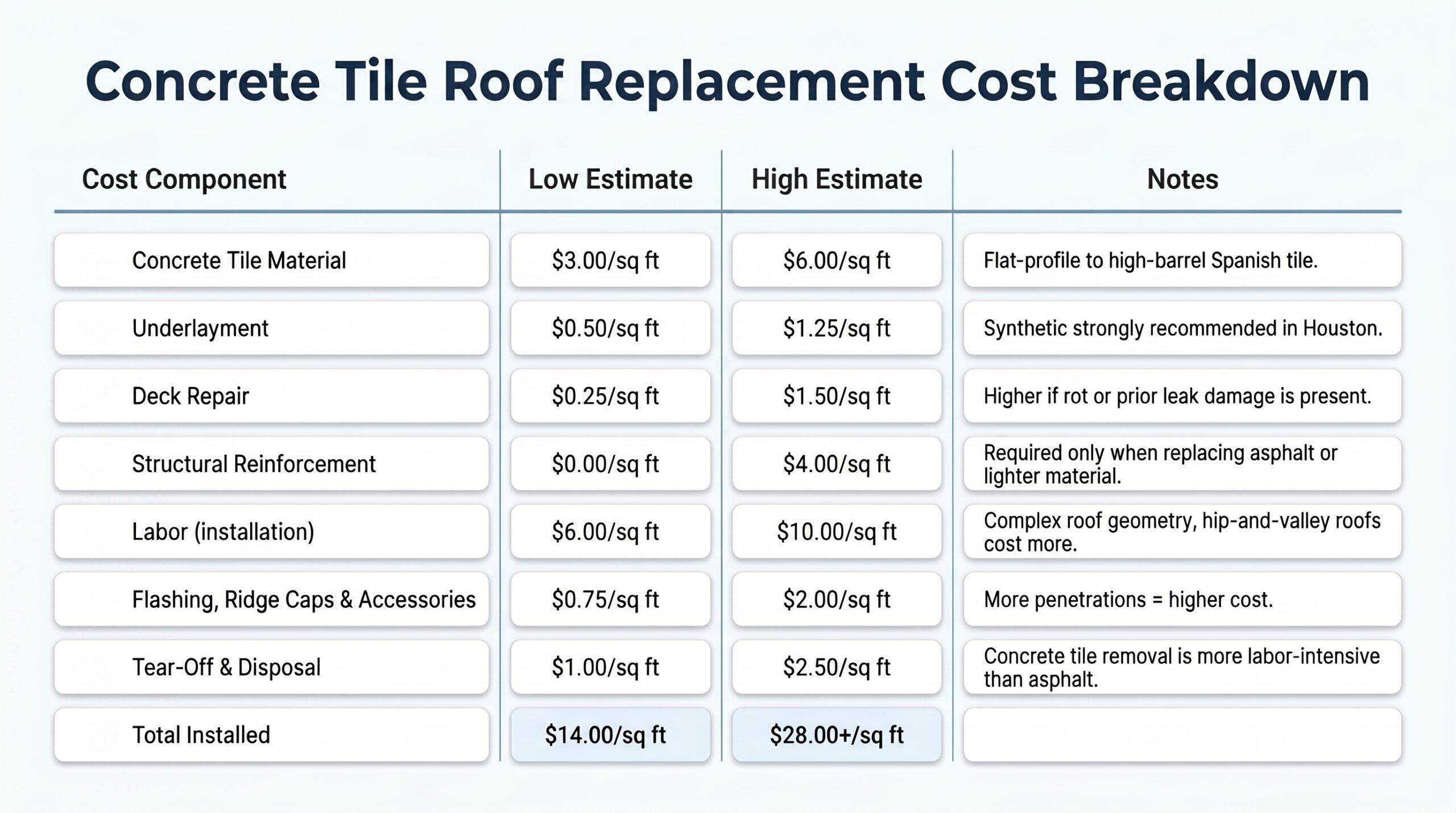
| Houston Home Size | Approx. Roof Area | Low Estimate | High Estimate |
|---|---|---|---|
| 1,500 sq ft home | ~1,700 sq ft | $23,800 | $47,600 |
| 2,000 sq ft home | ~2,200 sq ft | $30,800 | $61,600 |
| 2,500 sq ft home | ~2,800 sq ft | $39,200 | $78,400 |
| 3,000 sq ft home | ~3,400 sq ft | $47,600 | $95,200+ |
Labor Cost ContextAccording to the U.S. Bureau of Labor Statistics, construction wage growth surged 5–6% annually during peak recent years, and labor costs continue to compound. For Houston homeowners facing a replacement decision, deferring a necessary replacement by 2–3 years can add $3,000–$8,000 to the final project cost in labor-escalation alone on a mid-size home.Source: BLS Occupational Employment and Wage Statistics (OEWS)
The Hidden Cost: Structural Reinforcement
The line item most online cost calculators omit entirely: structural reinforcement for homes not originally engineered for concrete tile. In Houston, a significant portion of the housing stock built between the 1980s and 2010s was framed to asphalt-rated dead load specifications. These homes require engineering review and often physical rafter sistering or purlin additions before concrete tile can be legally and safely installed.
Structural reinforcement adds:
- Engineering review: $500–$1,500
- Rafter sistering or purlin work: $2,000–$6,500 depending on scope
- Deck upgrade from 7/16″ to 5/8″ OSB: $1,200–$3,000 on a standard home
If you’re replacing an existing concrete or clay tile roof with new concrete tile, structural reinforcement is typically not required — the framing was already built for the load.
Insurance, Permits & Financing for Concrete Tile Roof Replacement in Houston
In Texas, a full concrete tile roof replacement typically requires a city or county building permit, which your contractor must pull. If replacement is triggered by storm damage, your homeowner’s insurance claim process governs the scope and pricing. Concrete tile with a Class 4 impact rating can qualify for 20–35% homeowner’s insurance premium reductions in Texas.
Filing an Insurance Claim for Tile Roof Damage
If your replacement is storm-triggered, the insurance claim process works as follows:
- Document the damage — photograph everything before any work begins, including interior moisture staining, displaced tiles, and visible deck damage.
- Contact your insurer to open a claim — do not begin repair or replacement work until you have a claim number and adjuster assignment.
- Get an independent contractor inspection — the adjuster works for the insurance company. Your contractor’s scope may differ from the adjuster’s initial assessment. Discrepancies are common and negotiable.
- Review the Actual Cash Value (ACV) vs. Replacement Cost Value (RCV) — older roofs receive ACV payouts initially, with RCV recoverable after work is completed. Understand this distinction before signing anything.
- Supplement if necessary — if the adjuster’s scope misses structural reinforcement, underlayment upgrades, or code-required work, your contractor can file a supplement. This is standard practice, not unusual.
Texas Insurance ContextAverage homeowner’s insurance premiums in Texas reached approximately $3,900 per year — among the top six most expensive in the country — driven primarily by severe wind and hail exposure. Texas ranks #1 nationally for total hail events annually. Concrete tile with a Class 4 impact rating (UL 2218) can qualify for 20–35% premium reductions with many Texas carriers.Source: Texas Department of Insurance
Financing Options for Houston Homeowners
For projects not covered by insurance, financing options available in the Houston market include:
- GreenSky and similar home improvement lenders: 0% promotional periods (12–18 months) for qualified applicants. Monthly payments starting around $199/month on a $40,000 project with a 10-year term at prevailing rates.
- PACE (Property Assessed Clean Energy) financing: Available in Texas for qualifying energy-efficient roofing systems. Repaid through property tax assessments — no monthly loan payment.
- Contractor-arranged financing: Many established Houston roofing contractors maintain relationships with specialty lenders. Ask what financing programs the contractor can offer before assuming you must self-finance.
How to Choose a Concrete Tile Roof Replacement Contractor in Houston
For concrete tile replacement in Houston, require: manufacturer-certified installer status, documented structural load assessment capability, a written line-item estimate (not a ballpark), separate material and workmanship warranties, and current General Liability plus Workers’ Compensation certificates. Texas has no statewide roofing contractor licensing — certification and insurance are your primary vetting tools.
Concrete tile installation is not a skill all roofing contractors possess. It requires specialized training in tile-walking technique, batten system layout, mortar application, and high-wind fastening compliance. Choosing a contractor without this experience is the most common cause of premature concrete tile system failure.
Questions to Ask Every Contractor Before Signing
- Are you a manufacturer-certified installer for the specific tile brand you’re recommending?
- Does this estimate include a structural load assessment? What does it cover, and who performs it?
- What underlayment system are you specifying, and why — felt or synthetic?
- How are penetrations handled — metal flashing at every penetration, or foam sealant at any point?
- What is the manufacturer warranty period, and is there a separate workmanship warranty? What does it cover?
- Can I see your current General Liability and Workers’ Compensation insurance certificates?
- Who pulls the building permit, and will the permit be closed out with a final inspection?
- What does your quote include for structural reinforcement if the assessment finds it’s needed?
Quality RiskAccording to the National Roof Certification and Inspection Association (NRCIA), improper installation is one of the leading causes of premature roof failure — capable of negating the benefits of even the highest-quality materials. The NRCA separately documents that 28% of all roofing defects stem specifically from improper flashing installation alone.Source: NRCIA
Red Flags to Walk Away From
- Estimates delivered without a physical roof inspection (“drive-by” quotes)
- No mention of structural assessment or load review
- Pressure to sign before the permit is pulled
- Quotes that are unusually low and don’t include tear-off, structural work, or synthetic underlayment
- No separate workmanship warranty — only the manufacturer’s tile warranty
- Request for more than 25–30% upfront payment before work begins
Maintaining Your New Concrete Tile Roof After Replacement
| Maintenance Task | Frequency | Estimated Cost (Houston) |
|---|---|---|
| Professional visual inspection | Annually (post-storm season) | $150–$350 |
| Algae/moss soft-wash cleaning | Every 3–5 years | $400–$800 |
| Individual tile replacement | As needed (after hail or foot traffic) | $75–$200 per tile (including labor) |
| Flashing resealing at penetrations | Every 10–15 years | $200–$600 |
| Ridge cap mortar repointing | At 20–25 years | $500–$1,500 |
Total estimated 50-year maintenance cost on a properly installed concrete tile system: $8,000–$18,000. Compare this to architectural asphalt, which requires two full replacements and escalating maintenance costs over the same period, with a 50-year total commonly exceeding $80,000–$130,000 on a mid-size Houston home when future labor inflation is factored in.
Heat Performance DataResearch from the Florida Solar Energy Center — whose climate closely mirrors Houston’s in humidity, UV intensity, and rainfall — found that concrete tile roofs reduced attic temperatures by up to 16°F compared to directly-nailed asphalt shingle systems, due to the air gap created by the tile profile and batten system.Source: University of Central Florida / Florida Solar Energy Center
The Replacement Readiness Checklist: What We Use Before Every Quote
Before recommending replacement vs. repair, experienced contractors evaluate six variables simultaneously: tile damage percentage, underlayment age and condition (via test lift), deck integrity, flashing system condition, ridge mortar state, and structural framing adequacy. A contractor who recommends replacement without checking all six is guessing, not assessing.
After completing 800+ roofing projects in Greater Houston, Achilles Roofing developed an internal assessment framework that we use on every concrete tile evaluation before issuing a replacement recommendation. We’re publishing it here because most homeowners don’t know what a thorough assessment actually looks like and should be able to hold any contractor accountable to this standard.
The 6-Point Concrete Tile Replacement Readiness Assessment
- Tile Damage Survey (visual + physical): We count damaged tiles across every roof plane — cracked, broken, missing, and severely efflorescent. If damage exceeds 25–30% of total tile count on more than one plane, replacement becomes the primary recommendation.
- Underlayment Test Lift: In a non-visible location (typically near a hip or valley), we lift one course of tile to inspect the underlayment condition directly. Crumbling, brittle, or moisture-saturated underlayment is a replacement signal regardless of tile condition.
- Deck Tap Test: Walking the roof with deliberate foot pressure, we identify soft spots, flex, and areas of deck delamination. Any localized softness gets marked for closer inspection during the estimate.
- Flashing Audit: Every penetration, valley, and wall junction is visually inspected for rust, separation, improper lap, or foam-only sealing. More than two compromised flashings on a system over 20 years old is a system-wide signal.
- Ridge Mortar Assessment: We physically test ridge cap adhesion by applying hand pressure. Mortar that moves, crumbles, or releases at more than three sections indicates system-wide ridge failure.
- Structural Framing Review: For any home where concrete tile is replacing a lighter material, or where the existing tile shows signs of framing stress (cracked ridge board, visible rafter deflection), we require a structural review before issuing a replacement scope. This protects both the homeowner and the integrity of the new system.
Any contractor who quotes a concrete tile replacement without conducting all six assessments is issuing a guess estimate — and guess estimates almost always result in change orders, cost overruns, or missed structural issues that create liability after the job is complete.
Frequently Asked Questions
How do I know if my concrete tile roof needs to be replaced or just repaired?
Replace when: more than 25–30% of tiles are cracked or missing, the underlayment is over 25 years old, leaks appear in multiple locations simultaneously, or the deck has soft spots. Repair when: damage is isolated, the underlayment is under 20 years old, and leaks trace to a single identifiable failure point. The 50% rule applies: if repair costs exceed 50% of replacement cost, replace.
How long does a concrete tile roof replacement take in Houston?
A standard concrete tile roof replacement on a 2,000–2,500 sq ft Houston home takes 5–10 business days under normal conditions. Complex roof geometry (multiple hips, valleys, dormers), structural reinforcement, or extensive deck repair can extend the timeline to 2–3 weeks. Weather delays are common during Houston’s spring storm season (March–June).
What is the best underlayment for concrete tile roofs in Houston?
Synthetic underlayment (such as CertainTeed DiamondDeck or GAF Tiger Paw) outperforms standard ASTM D226 #30 felt in Houston’s climate due to superior UV resistance during installation exposure, better moisture resistance in high-humidity conditions, and a longer service life. The cost premium is $0.50–$0.75 per square foot — a worthwhile investment in this market.
Does a concrete tile roof replacement require a permit in Houston?
Yes. Full roof replacements in Houston and Harris County require a building permit. Your contractor must pull the permit — not you. The permit closes out with a municipal inspection that verifies code compliance. Avoid any contractor who suggests skipping the permit; doing so transfers legal liability to the homeowner and typically voids manufacturer warranties.
Will my homeowner’s insurance cover concrete tile roof replacement in Houston?
If replacement is triggered by a covered storm event (hail, wind, hurricane), yes — subject to your deductible and the policy’s coverage terms. Texas is the most hail-active state in the U.S., making storm-damage claims common. Ensure you get an independent contractor inspection alongside the insurer’s adjuster, as adjuster scopes frequently underestimate structural and code-required work.
How much does a concrete tile roof replacement cost in Houston in 2026?
$14–$28 per square foot installed, or $30,800–$78,400 for a typical 2,000–2,500 sq ft Houston home. Structural reinforcement (if replacing asphalt) adds $2,000–$8,000+. Complex roof geometry or premium tile profiles push costs toward the upper range. Get three written line-item bids from manufacturer-certified installers before committing.
Can I replace a concrete tile roof myself?
Technically possible but not advisable. Concrete tile installation requires specialized skills in batten layout, tile-walking technique, high-wind fastening compliance, and mortar application that are not transferable from general construction experience. More importantly, DIY installation voids manufacturer warranties, fails municipal inspection, and is not eligible for insurance claim reimbursement. Hire a manufacturer-certified installer.
What tile profile should I choose for a replacement in Houston?
Flat-profile and low-slope concrete tile is the most cost-effective option and suits a wide range of Houston home styles. High-barrel Spanish tile is 40–60% more expensive in material and slower to install (higher labor cost), but is the appropriate choice for Mediterranean, Spanish Colonial, and traditional Southwestern architectural styles. Choose based on your home’s architecture first, then optimize for budget.
How do concrete tile roofs perform in Houston hurricanes?
When installed with approved mechanical fastening or foam adhesive systems per manufacturer specifications, concrete tile systems are rated for 125–150 mph wind resistance. Houston falls under Texas Department of Insurance Windstorm territory. Ensure your contractor installs to TDI windstorm specifications — not just the base manufacturer spec — for maximum performance and insurance compliance.
Considering a Concrete Tile Roof Replacement in Houston?
Achilles Roofing provides full on-site assessments for Greater Houston homeowners — structural load review, deck inspection, and written line-item estimates. No ballpark ranges over the phone.
Written fixed-price estimate · GAF Certified Plus · 800+ Houston projects · Financing from $199/mo
 Call (832) 346-8021
 Sources & References
-
Florida Solar Energy Center. (2026). Roof assembly: Roof finish. University of Central Florida. https://energyresearch.ucf.edu/research/buildings-research/roof-assembly/roof-finish/
-
International Code Council. (2021). 2021 International Residential Code (IRC): Chapter 8, roof-ceiling construction. International Code Council. https://codes.iccsafe.org/content/IRC2021P2/chapter-8-roof-ceiling-construction
-
National Oceanic and Atmospheric Administration. (2022). Houston IAH extremes, normals, and annual summaries. National Weather Service. https://www.weather.gov/hgx/climate_iah_normals_summary
-
National Roof Certification and Inspection Association. (2026). What causes roof material failure? National Roof Certification and Inspection Association. https://www.nrcia.org/what-causes-roof-material-failure/
-
National Roofing Contractors Association. (2026). National Roofing Contractors Association home page. NRCA. https://www.nrca.net/
-
Texas Department of Insurance. (2026a). Texas homeowners insurance market overview. Texas Department of Insurance. https://www.tdi.texas.gov/general/texas-homeowners-insurance-market-overview.html
-
Texas Department of Insurance. (2026b). Windstorm inspections. Texas Department of Insurance. https://www.tdi.texas.gov/wind/index.html
-
U.S. Bureau of Labor Statistics. (2026). Occupational employment and wage statistics. U.S. Department of Labor. https://www.bls.gov/oes/