Quick Answer: Which Premium Roof Material Is Best for Houston Homes?
For most homeowners in The Woodlands, Cypress, and Spring: standing seam metal or fired clay tile. Metal wins on hail resistance, insurance premium relief, and low maintenance. Clay tile wins on thermal mass, curb appeal in master-planned communities, and material lifespan (50–100+ years). Copper and genuine slate are best-in-class but cost $50,000–$120,000+ and suit a narrower profile of home. Synthetic slate is the budget-friendly Class 4 option for homeowners who want impact resistance without a premium price tag. Concrete tile is the workhorse — underrated and underspecified in this market.
What Counts as a Premium Roofing Material?
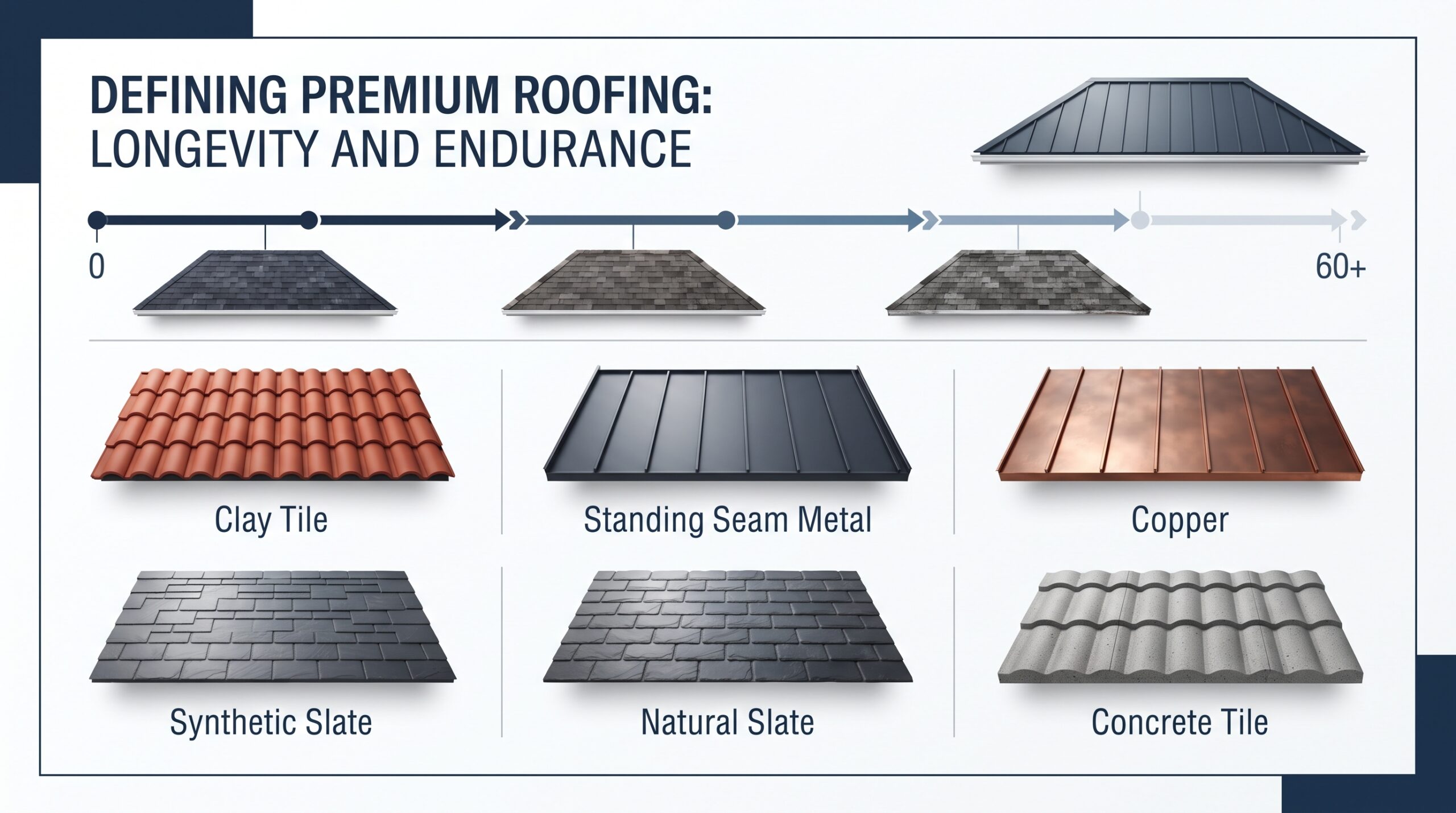
A premium roofing material is any system whose material body is rated to last 40+ years under the climate conditions of Harris and Montgomery Counties. It is not a brand tier or price point. The defining characteristic is that the surface material itself outlasts multiple asphalt replacement cycles — typically three to four over 60 years in Houston’s climate.
Standard architectural asphalt shingles — the default for most Houston replacements — carry a 25–30-year warranty but realistically need replacement at year 15–22 in this market due to UV-driven granule loss, thermal cycling, and accelerated hail damage. Premium materials do not share this vulnerability to the same degree because they contain no volatile organic component to degrade under heat.
The six premium categories covered here are:
- Fired clay tile (Spanish and flat profile)
- Standing seam metal (aluminum, steel, zinc)
- Copper
- Synthetic slate (Class 4 polymer composite)
- Genuine slate (natural stone)
- Concrete tile
Source: National Association of Home Builders (NAHB)
Premium Roofing Materials: 2026 Side-by-Side Comparison
The table below is specific to the Houston metro market — cost ranges reflect Harris and Montgomery County project complexity premiums, not national averages.
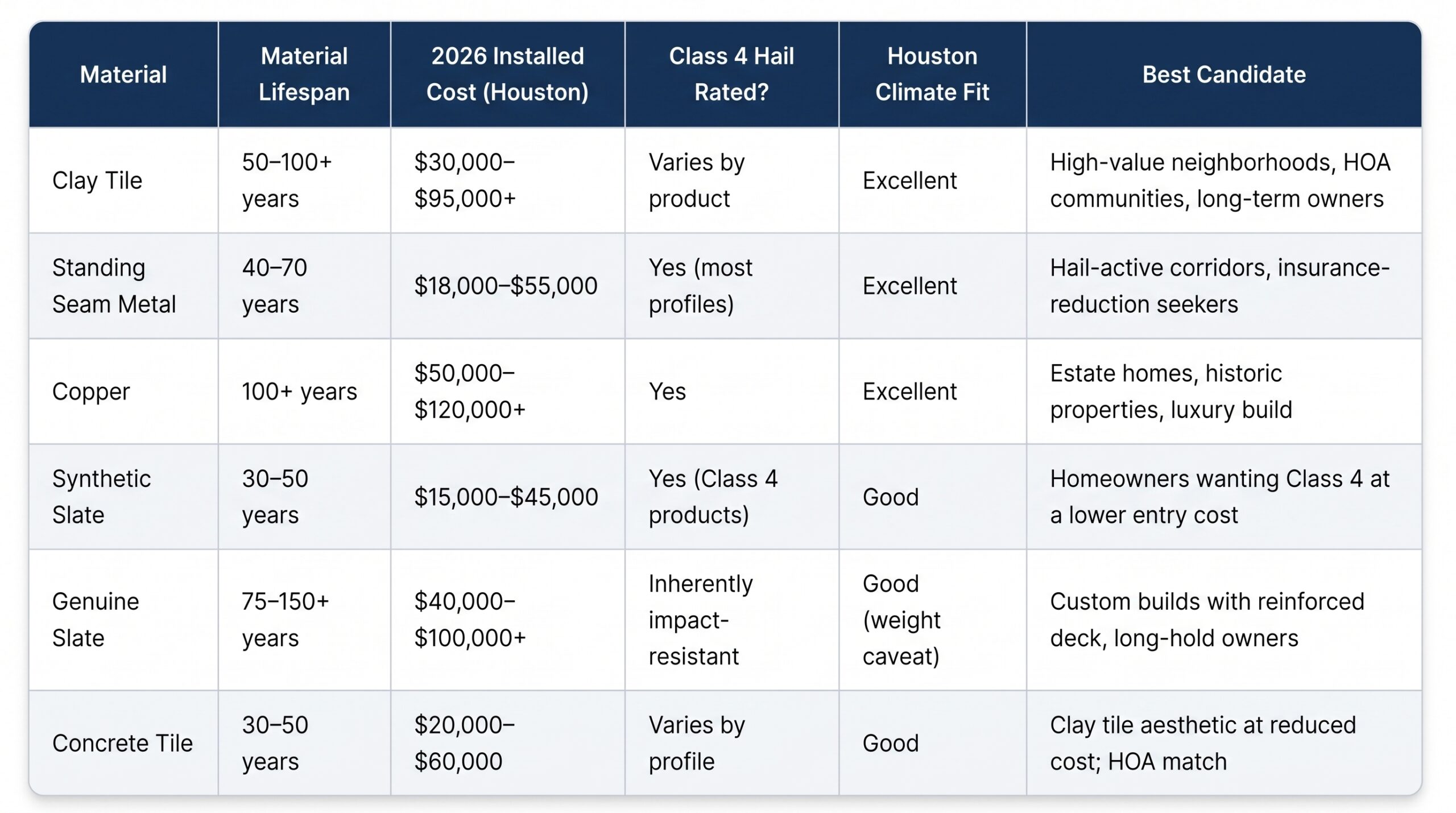
Cost ranges reflect 2026 Angi and Modernize data for the Houston metro, adjusted for complexity premiums common in The Woodlands, Cypress, and Spring projects.
Sources: Angi, Modernize
Clay Tile Roofing in Houston: Pros, Cons, and What Most Guides Get Wrong
Clay tile is the highest-performing premium roofing material for Houston’s combination of extreme heat, humidity, and hail — but only when installed over the correct underlayment system. The tile body itself is nearly indestructible under Houston’s climate conditions. The underlayment underneath it is not.
This distinction matters more in Houston than almost anywhere else. Clay tile installed over a single-layer synthetic underlayment — the most common shortcut in this market — will fail at year 12–18 when the underlayment breaks down under 130–150°F attic temperatures. The failure is misdiagnosed as tile failure by contractors who prefer the $50,000+ replacement revenue over a $15,000 restoration.
What Clay Tile Actually Delivers
- Material lifespan: 50–100+ years for the tile body (NAHB)
- Thermal performance: Natural thermal mass moderates attic temperature swings — a passive cooling benefit metal cannot replicate
- Biological resistance: Fired clay is structurally inhospitable to algae, lichen, and moss that colonize asphalt within 3–5 years in Houston’s humidity
- HOA compatibility: The dominant premium material in The Woodlands’ master-planned villages (Carlton Woods, Creekside Park, Sterling Ridge) where deed restrictions specify tile profiles
- Resale signal: Local appraisers and realtors treat a new clay tile roof as resetting a 50–100-year asset — a selling point standard asphalt cannot match
The One Specification That Changes Everything
A proper clay tile installation in Houston requires a two-layer modified bitumen underlayment system — not standard synthetic. This is not a preference; it is a climate necessity. Green Builder Media’s building-science reporting places tile roof underlayment service life at roughly 20–25 years in hot climates before restoration is needed — precisely because Houston attic conditions accelerate degradation faster than manufacturer test conditions assume.
Before signing any clay tile contract, require the underlayment specification in writing. If it reads “standard synthetic underlayment,” the system is under-specified.
Source: Green Builder Media
Clay Tile: Best For
- Homeowners in The Woodlands, Carlton Woods, Bridgeland, or Harmony planning to stay 15+ years
- Mediterranean, Spanish, or transitional architectural profiles
- Communities with tile-specific HOA requirements
- Owners of 15–22 year old clay roofs approaching their first underlayment restoration window (do not replace — restore)
Standing Seam Metal Roofing: The Strongest Hail Case in This Market
Standing-seam metal is the premium material with the strongest ROI case, specifically in the Cypress and Spring hail corridors. It is Class 4 UL 2218 impact-rated at the system level — not just in select profiles — and qualifies for the largest insurance premium discounts available under Texas DOI guidelines.
Unlike clay tile, steel or aluminum has no volatile component that degrades under Houston’s heat. No granule loss, no thermal cracking, no biological colonization. The maintenance profile over a 40-year lifespan is materially lower than any other premium option.
Why Standing Seam Outperforms Exposed-Fastener Metal
Standing seam panels interlock at concealed seams — no exposed screws, no gasket degradation points, no penetrations for moisture entry at fastener locations. Exposed-fastener metal roofing (R-panels, corrugated panels) is a commercial-grade product often mis-sold as a premium residential option. The performance difference over 20 years in a humid climate like Houston is significant.
Insurance Impact — The Math That Closes the Premium Gap
Class 4 UL 2218 or FM 4473 impact-rated materials qualify for premium credits with Texas carriers. Discounts on the dwelling coverage (Coverage A) portion typically run 15–35% annually, set carrier-by-carrier. On a home with $500,000 in Coverage A at a 1.5% annual rate, a 25% discount represents roughly $1,875/year in premium savings — or $75,000+ over a 40-year roof lifespan.
To activate the credit, your contractor must complete TDI Form PC068 (Impact-Resistant Roofing Installation Form) at project completion.
Important caveat: Most carriers require you to accept Endorsement HO-145 (cosmetic damage exclusion) to receive the full discount. Cosmetic hail dents that don’t structurally penetrate the panel won’t be covered. Verify the specific terms with your carrier before committing.
Source: Texas Department of Insurance
Standing Seam Metal: Best For
- Homeowners in Cypress’s hail-active Cypress-Fairbanks to Tomball corridor
- Modern, transitional, or industrial-aesthetic architectural profiles
- Homeowners who have filed two or more hail claims on asphalt
- Anyone whose current carrier has non-renewed or increased premiums after hail events
Copper Roofing: When and Why It’s Worth $50,000–$120,000+
Copper is the longest-lasting roofing material available — 100+ years with no painting, no coating, and no granule loss. Its patina is self-protecting. It is also the most expensive, and it is right for a narrow profile of Houston homeowner.
Copper Metal roofing is most commonly used in this market as a full-roof system on estate homes in Carlton Woods and The Woodlands, or as premium accent elements (valley flashing, dormers, cupolas) on clay tile installations. In top-tier clay tile projects, copper flashing at all valleys and penetrations is the specification marker that separates a 40-year system from a 20-year one.
What You Get With Copper
- Material lifespan: 100–200+ years — well-documented on historic buildings throughout the U.S.
- Zero maintenance painting or coating: Patina is the protection layer, not a cosmetic byproduct
- Incompatible with dissimilar metals: Galvanic corrosion is a real risk if copper touches aluminum or galvanized steel — requires a qualified installer who understands metal compatibility
- Weight: Light relative to tile — approximately 1–1.5 lbs/sq ft, eliminating structural upgrade concerns that affect genuine slate
Copper: Best For
- Estate properties on 10,000+ sq ft homes in Carlton Woods, Grogan’s Mill, or Creekside Park
- Historic or custom builds where longevity is the primary objective
- Accent applications on clay tile roofs where flashing quality is the single biggest performance variable
Note: Copper’s documentation is available from copper roofing manufacturers including Revere Copper Products and Aurubis.
Synthetic Slate: The Class 4 Option at a Lower Entry Cost
Synthetic slate is a polymer composite or rubber-composite product engineered to replicate the aesthetic of genuine slate at roughly 40–60% of the installed cost. The best Class 4-rated synthetic products offer genuine impact resistance — tested to UL 2218 or FM 4473 standards — making them the most accessible entry point into impact-rated premium roofing.
In Cypress and Spring, synthetic slate is gaining market share not because of aesthetics but because of the insurance math: Class 4 impact rating plus a per-square-foot cost of $7–$14 (versus $15–$30+ for genuine slate) makes it the most cost-efficient path to TWIA and carrier-mandated premium credits.
What to Watch For
- Not all synthetic slate is Class 4. The label “synthetic slate” does not guarantee a UL 2218 Class 4 rating. Require product-specific documentation — not a generic claim — before committing.
- Lifespan varies by manufacturer: Well-manufactured Class 4 synthetic products are rated at 30–50 years. Lower-cost products without UV stabilizer packages degrade faster in Houston’s UV-intense climate. Ask for 10-year field performance data, not just lab ratings.
- Color consistency over time: Synthetic products can fade unevenly in direct sun exposure. Ask to see a 10-year-old installed sample in the Houston climate before selecting a color.
Synthetic Slate: Best For
- Homeowners who want Class 4 impact protection and insurance credits without the clay tile or metal price point
- Homes in Cypress and Spring where the ROI case is more insurance-driven than aesthetics-driven
- Architectural profiles that require a slate aesthetic but cannot support the dead load of genuine stone
Source: Texas Department of Insurance
Genuine Slate Roofing: The 150-Year Material With One Structural Caveat
Genuine slate is natural stone — it does not degrade under UV, heat, humidity, or hail the way organic materials do. Properly installed, a genuine slate roof can outlast the building beneath it. The caveat in Houston is structural: slate weighs 7–9 lbs per square foot, requiring deck reinforcement that most homes built after 1980 were not designed for.
This structural consideration eliminates genuine slate from consideration on most standard-construction homes in The Woodlands, Cypress, and Spring without a meaningful structural upgrade investment. On custom builds or homes with reinforced framing systems, it remains the longest-lasting roofing material available.
Genuine Slate in Houston: Practical Constraints
- Dead load requirement: Standard residential framing supports 10–15 lbs/sq ft. Slate at 7–9 lbs/sq ft approaches or exceeds that range before accounting for the deck, underlayment, and fasteners. A structural engineer review is mandatory before any slate installation.
- Installer scarcity: Qualified genuine slate installers are rare in the Houston metro. Incorrect fastening — using galvanized nails instead of copper or stainless in a humid climate — is the leading cause of early slate failure and is common when general roofing contractors attempt slate installations.
- Underlayment specification: Same as clay tile — two-layer modified bitumen is required in Houston’s climate. Single-layer synthetic underlayment under slate will fail long before the slate itself shows any wear.
Genuine Slate: Best For
- Custom-build homes with engineered structural systems that accommodate the dead load
- Long-hold homeowners (20+ years) on high-value properties where a 150-year asset makes financial sense
- Properties where authentic natural stone appearance is a non-negotiable design requirement
Concrete Tile: The Most Underrated Premium Option in Houston
Concrete tile is the most underspecified premium material in the Houston market — typically recommended only when a homeowner can’t afford clay tile, rather than on its own merits. That framing underserves the product. Concrete tile offers a 30–50-year lifespan, the same profile options as clay tile, HOA compatibility, and a 25–30% lower installed cost than fired clay at comparable quality levels.
The primary trade-off versus clay: concrete tile is approximately 30% heavier per square foot than clay tile and is more susceptible to color fade over time, as the pigment is an applied coating rather than fired into the material body. A 15-year-old concrete tile roof showing color variance is common; a 15-year-old clay tile roof retains its color because the color is the material itself.
Concrete Tile: Best For
- HOA-governed communities where the tile profile standard must be met but budget is a constraint
- Homeowners who plan to sell within 10–15 years — concrete tile provides the HOA-compliant aesthetic at a lower capital outlay, with meaningful resale value improvement
- Homes where structural load prevents clay tile (concrete tile is still heavier than metal or synthetic, but lighter than genuine slate)
*Cost data: Angi (2026) benchmarks concrete tile at $8–$16 per square foot installed in the Houston metro, compared to $11–$22 per square foot for fired clay tile. Source: Angi (2026)*
The Achilles Houston Climate Compatibility Matrix: How Each Material Performs Against This Market’s Four Stress Factors
Most roofing comparison guides rate materials against national averages. This matrix rates them specifically against the four climate stressors that terminate roofs in Harris and Montgomery Counties: extreme heat, hail impact, sustained humidity, and tropical wind. No other market combines all four at this intensity simultaneously.
Ratings are Achilles Roofing’s own assessment based on 18+ years of installation and inspection experience in this market, combined with published manufacturer performance data and third-party testing standards (UL 2218, FM 4473, ASTM C1167). This is original market-specific interpretation, not a published industry standard.
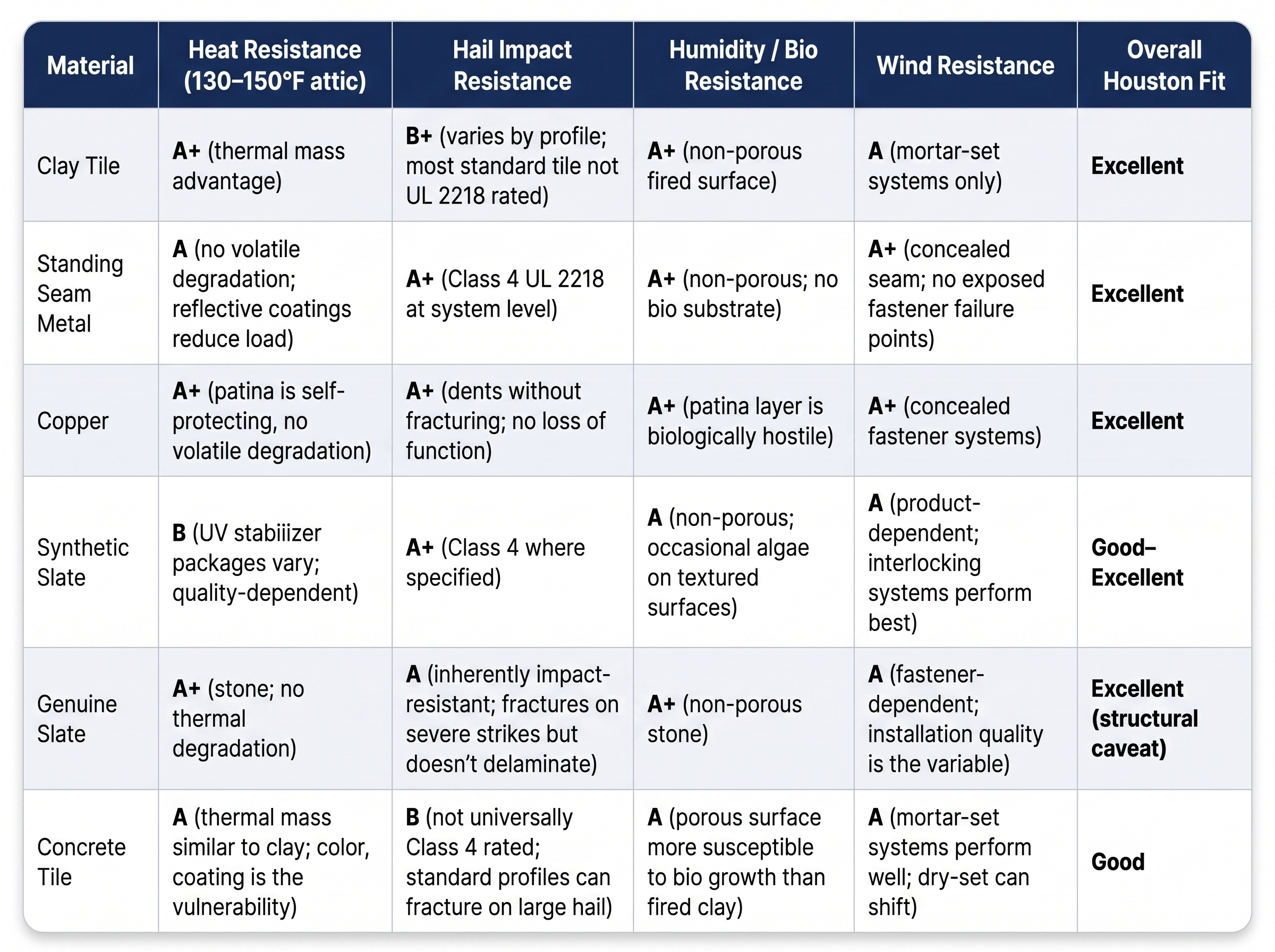
Key finding: Standing seam metal is the only material in this market that scores at the top tier on all four stressors simultaneously. Clay tile and copper match it on heat, humidity, and wind — but most clay tile profiles do not carry a UL 2218 Class 4 rating at the product level. Metal’s combination of Class 4 certification, insurance relief, and low-maintenance profile makes it the most complete performer in Houston’s specific climate context.
How Much Does Premium Roofing Cost in The Woodlands, Cypress, and Spring in 2026?
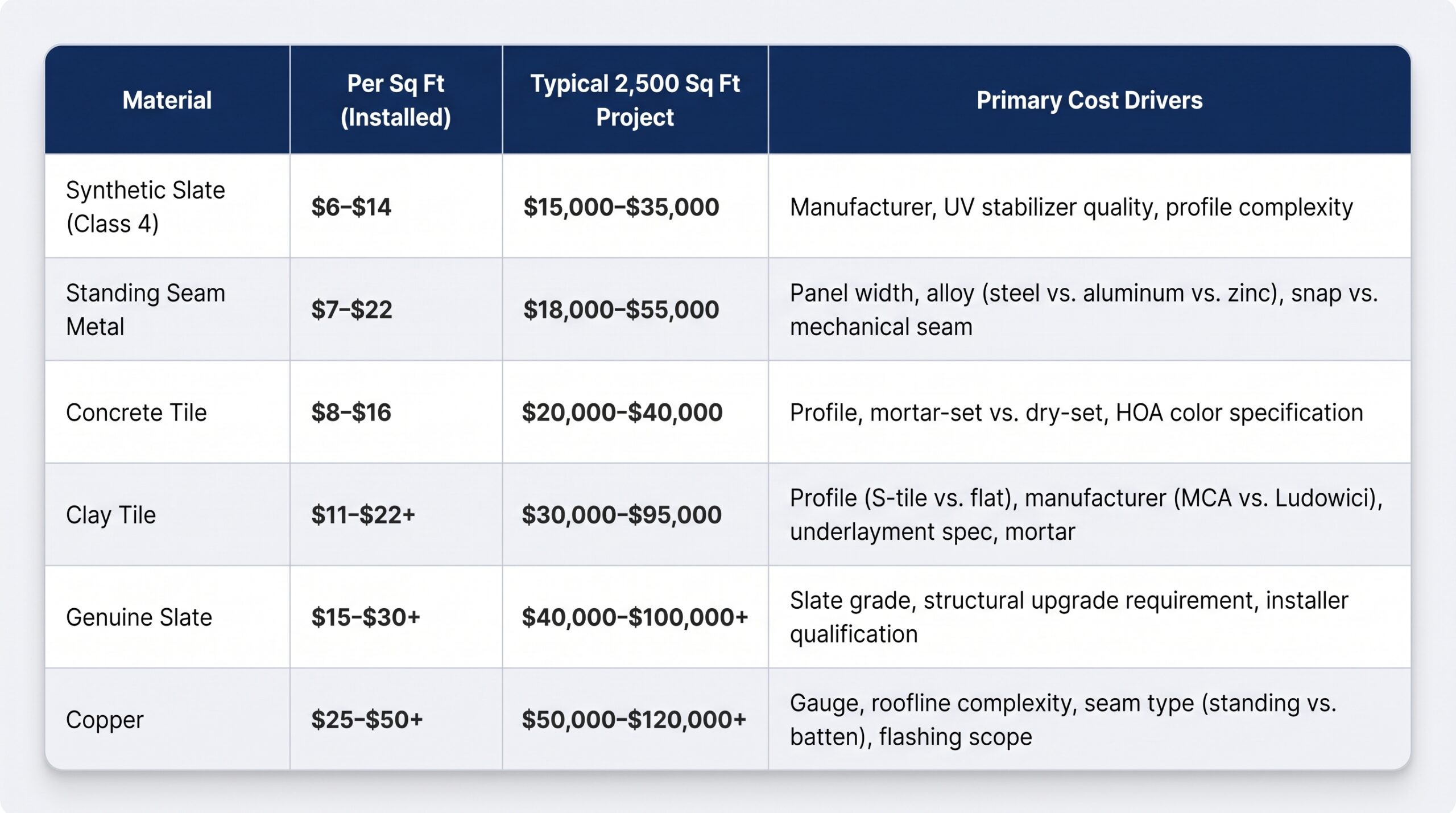
Premium roofing in this market costs $15,000–$120,000+ installed in 2026. The range reflects the difference between synthetic slate on a simple gable and copper on a complex multi-hip estate roofline — both legitimate options in these communities, aimed at very different homeowner profiles.
2026 Cost Ranges by Material — Houston Metro
Source: Angi, Modernize
The Lifetime Cost Calculation Most Contractors Skip
Standard architectural asphalt in Houston needs replacement at year 15–22 — well before its 30-year warranty date. Two replacement cycles at $8,000–$18,000 each cost $16,000–$36,000 over 40 years. Add 4–6% annual labor cost inflation that has compounded in the Houston construction market, and that 40-year asphalt cost is actually $22,000–$48,000 in nominal terms.
A clay tile or standing seam metal system installed once at $30,000–$55,000, with one underlayment restoration at year 20–25 ($12,000–$28,000), delivers a 40-year total cost that is comparable to or lower than two asphalt cycles — while the surface material still has 20–60+ years of service life remaining.
Texas has led all 50 states in hail damage frequency for 11 consecutive years. In 2025, it logged 902 major hail events — more than double the second-place state. Each hail event on an aging asphalt roof compresses the replacement timeline further and increases the probability of an insurance claim. The cost model for asphalt in Houston is not a 30-year straight line — it’s a compressed 15-year accelerated cycle.
Source: National Insurance Crime Bureau (NICB)
8 Signs Your Home Is Ready for a Premium Roof Replacement
Most homeowners in The Woodlands, Cypress, and Spring discover they’re a premium roofing candidate at their second asphalt replacement — not before it. These signs let you identify the inflection point earlier, while you still have the cost-rational window to act.
- You’ve filed two or more hail claims in the last 10 years. Repeated claims on asphalt create a compounding deductible exposure problem. On a 2% hail deductible with a $600,000 home, each claim triggers a $12,000 out-of-pocket cost before insurance pays a dollar. Class 4 materials break this cycle structurally — not by insurance sleight of hand.
- Your home is in a high-value neighborhood. In Carlton Woods, Bridgeland, Harmony, or Gleannloch Farms, a standard asphalt roof on a $700K+ home is an appraisal liability. Buyers in these communities actively notice roofing materials at listing.
- You’re 50+ and planning to age in place. A 50–100-year material lifespan removes re-roofing from your lifetime maintenance budget — a meaningful quality-of-life and estate planning outcome.
- Your current roof is 15–18 years old and has already absorbed at least one significant hail event. In one of the most active storm corridors in the country, that roof is approaching functional end-of-life faster than its warranty date suggests. An inspection now — before a second event — is the cheapest possible intervention.
- Your HOA has tile or metal material standards. Many master-planned communities in The Woodlands and Cypress have deed-restriction language governing roofing material. Replacing with asphalt when the community standard is tile can trigger compliance issues and HOA notices.
- Your homeowners insurance has been non-renewed or significantly increased after hail claims. Texas carriers are aggressively tightening underwriting on repeated-claim properties. A Class 4 roof is the most reliable tool available to stop that trajectory.
- You’re listing the home within 3–5 years. A new clay tile or metal roof resets a 50–100-year asset on the MLS sheet. Standard asphalt cannot deliver the same positioning in the master-planned community market.
- You have an existing premium roof at year 18–22. Clay tile and concrete tile roofs at this age don’t need full replacement — they need underlayment and mortar bed restoration at $12,000–$28,000. Misdiagnosing restoration as replacement is the most expensive single mistake in premium roofing — and it happens routinely.
*The Insurance Institute for Business & Home Safety (IBHS) notes that roof failures account for approximately 25–40% of residential hurricane insurance claims, with flashing and penetration failures — not the surface material — as the leading mechanism. Source: IBHS*
Homeowner Inspection Checklist Before Calling Any Contractor
Run this 20-minute ground-level assessment before accepting any contractor’s recommendation. It rules out the most common false replacement triggers on premium roofing systems in Houston.
Exterior (Ground Level / Binoculars or Drone Footage)
- Scan all tile courses or metal panel runs for visible spalling, cracking, or displacement
- Confirm the roofline is visually straight — sagging or waving is a structural issue that no surface material replacement will fix
- Check ridge cap and mortar bed for gaps or missing sections across multiple roof sections (isolated gaps are normal; widespread gaps indicate system-level failure)
- Look for color or profile mismatch between original material and any prior patch repairs — a sign of spot-replacement rather than systematic maintenance
- Note whether any downspout or gutter area shows abnormal granule accumulation (asphalt-specific indicator)
Attic Interior — The Most Diagnostic Check Available
- Inspect decking for soft spots, discoloration, or active moisture — this single check differentiates a system-level failure from a surface material failure
- Confirm no daylight is visible through the ridge line
- Note whether staining is isolated to one or two bays (localized penetration failure, likely repairable) or widespread across multiple rafters (system or tile-body failure, may justify restoration or replacement)
- If you can access the attic after a major rain event, check within 24 hours — active drip or staining locates the failure zone more accurately than any contractor’s walk-around
When to Call a Professional Immediately
- Any active interior water intrusion after a rain event
- Visible roofline sag or wave observable from the street
- Spalling or cracking visible from the ground across more than one slope section
- The roof is 40+ years old with no documented underlayment or flashing restoration on record
How to Vet a Premium Roofing Contractor in The Woodlands, Cypress, or Spring
Most roofing contractors in the Houston metro can install asphalt shingles competently. Far fewer have the trade-specific experience required for clay tile, copper, or genuine slate. Selecting the wrong contractor on a $50,000+ premium job is a compounding mistake that voids manufacturer warranties and turns a 100-year material into a 15-year leak source.
Verify the following before signing any contract:
- Manufacturer certification for the specific material proposed. Ludowici, MCA, and Entegra (clay tile); Berridge, McElroy, and ATAS (standing seam metal) all operate certified contractor programs with installation training. Ask for documentation — not a verbal claim.
- Two-layer modified bitumen underlayment specification in writing. If the written scope reads “standard synthetic underlayment” on a clay tile or slate project, the system is under-specified for Houston’s climate. Do not accept this.
- No deductible waivers — zero tolerance. Texas Insurance Code §707.005 explicitly prohibits contractors from waiving, absorbing, or subsidizing your insurance deductible. Any such offer is an immediate disqualifier and a reportable offense to TDI. Source: Texas Department of Insurance, storm fraud resources
- Documented test-square inspection methodology. A qualified contractor uses Haag Engineering-compliant test-square sampling — a marked 10 ft × 10 ft area documenting damage points per 100 sq ft — not a visual walk-around, to justify any replacement recommendation. Haag’s methodology sets 6–10 confirmed damage points per test square as the functional damage threshold. Source: Haag Global
- UL 2218 or FM 4473 Class 4 documentation for any impact-resistance claim. Generic “impact-resistant” claims without product-specific test documentation cannot be verified with your insurance carrier and will not activate TDI discount eligibility.
- Written fixed-price scope naming specific materials. The estimate must name the specific underlayment product, flashing material and gauge, mortar mix specification, and a clear written rationale for why restoration was ruled out in favor of replacement.
- TDI-verified insurance certificates. Texas does not license roofing contractors at the state level, but contractors in the Houston metro should carry a minimum of $500,000 general liability and active workers’ compensation. Verify certificates directly with the issuing insurer — do not accept photocopies or expired certificates.
Why Premium Roofing Performance in Houston Is Not Comparable to National Averages
Most national premium roofing comparison guides are calibrated for Southern California or the Mountain West: low humidity, minimal hail, no hurricane exposure, and flat-dollar insurance deductibles. The Woodlands, Cypress, and Spring invalidate all four of those assumptions simultaneously.
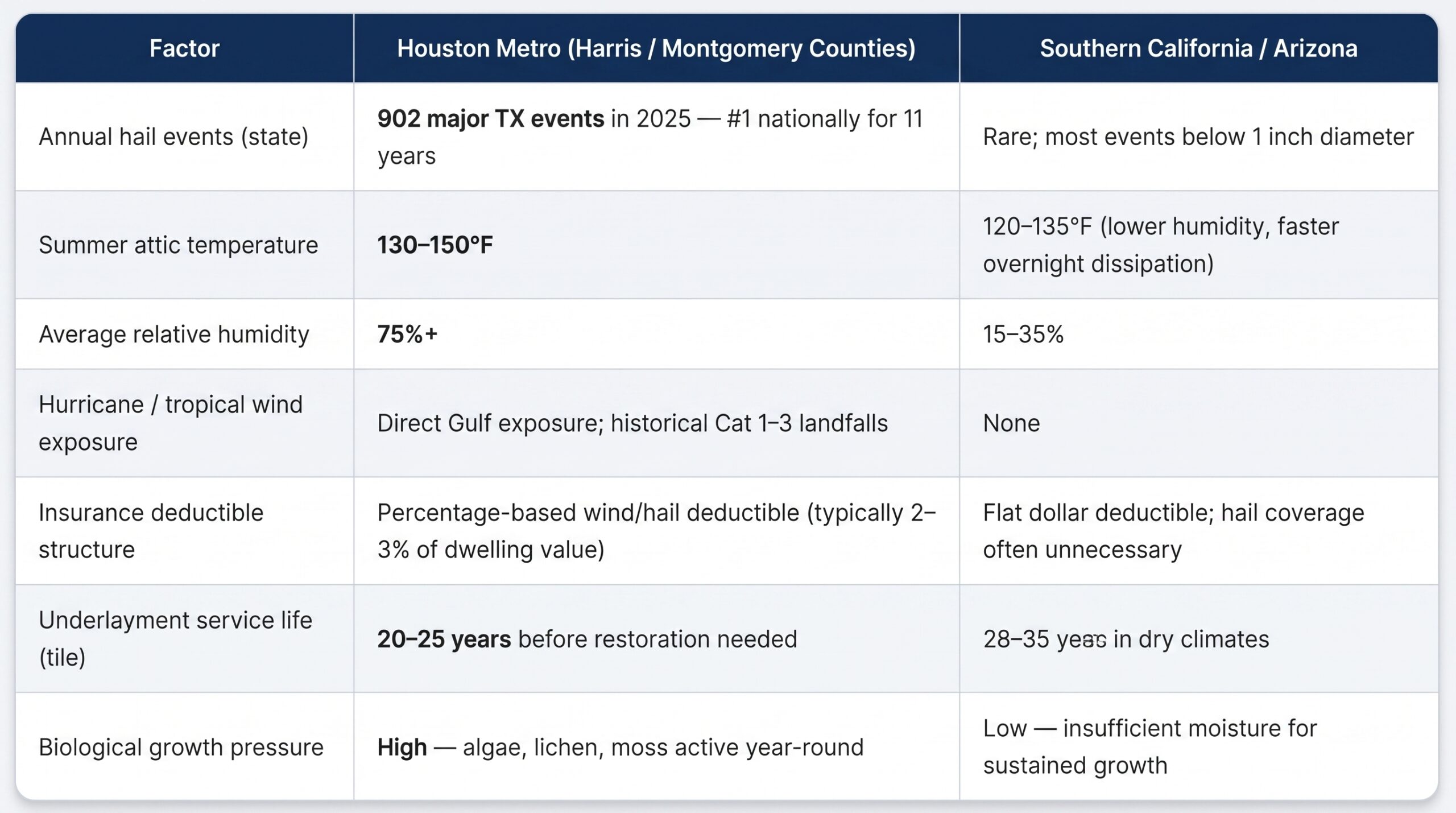
This is why premium roofing assessment protocols, underlayment specifications, and material selection priorities here differ materially from what national guides recommend. A guide written for Phoenix does not apply in Cypress.
*Source: NICB (2026); Green Builder Media (2025); IBHS (2026)*
Frequently Asked Questions
What is the longest-lasting roofing material for Houston homes?
Copper and genuine slate have the longest material lifespans — 100–200+ years for copper, 75–150+ years for genuine slate. For most homeowners in The Woodlands, Cypress, and Spring, fired clay tile (50–100+ years per NAHB) or standing seam metal (40–70 years) offers the most practical combination of lifespan, climate compatibility, and cost. Copper and slate suit a narrower profile of estate property or custom build.
Which premium roofing material is best for hail resistance in Houston?
Standing seam metal is the strongest option for hail resistance — it carries a Class 4 UL 2218 rating at the system level and dents without fracturing or losing weatherproofing function. Class 4 synthetic slate products are the next most accessible option. Standard clay tile profiles are not universally Class 4 rated; verify the specific product against the TDI-approved impact-resistant roofing products list before relying on a tile product for insurance discount purposes.
Is clay tile or metal roofing better for Houston’s climate?
Both are excellent — they lead the Achilles Houston Climate Compatibility Matrix in different categories. Metal wins on hail resistance (Class 4 UL 2218), insurance premium reduction, and wind resistance. Clay tile wins on thermal mass (passive cooling benefit), HOA and aesthetic compatibility in master-planned communities, and material lifespan. The choice depends on your primary driver: insurance optimization favors metal; long-term HOA aesthetic and thermal performance favor clay tile.
How much does a premium roof cost in The Woodlands, Cypress, or Spring in 2026?
Premium roofing in this market costs $15,000–$120,000+ installed. Synthetic slate (Class 4) starts at $15,000–$35,000; standing seam metal at $18,000–$55,000; concrete tile at $20,000–$40,000; clay tile at $30,000–$95,000+; genuine slate at $40,000–$100,000+; copper at $50,000–$120,000+. Projects in these communities carry complexity premiums versus the broader Houston metro: larger footprints, multi-hip rooflines, HOA specification requirements, and longer lead times for specialty materials.
Can a premium roof lower my homeowners insurance in Houston?
Yes. Class 4 UL 2218 or FM 4473 impact-rated materials qualify for premium credits with Texas carriers — typically 15–35% on the dwelling (Coverage A) portion of the policy. To activate the credit, your contractor must complete TDI Form PC068 at project completion. Most carriers require acceptance of Endorsement HO-145 (cosmetic damage exclusion) to receive the full discount — meaning cosmetic hail dents that don’t crack or penetrate the material won’t be covered under your policy. Verify terms with your specific carrier before committing.
What is the difference between a premium roof restoration and a full replacement?
A restoration removes the surface material, replaces the underlayment, flashing, and mortar bed, and resets the original tile or panel — preserving the material body. A full replacement removes and discards the surface material because the material body itself has failed. Restoration costs $12,000–$28,000; full replacement costs $30,000–$120,000+. The most expensive single mistake in Houston premium roofing is accepting a full replacement recommendation when a restoration was the correct diagnosis.
Does synthetic slate qualify for insurance discounts in Texas?
Yes — but only if the specific product and color are listed on the Texas Department of Insurance’s approved impact-resistant roofing products list and carry a documented Class 4 UL 2218 or FM 4473 rating. “Synthetic slate” as a category does not automatically qualify. Your contractor must complete TDI Form PC068 with the product-specific information to activate any discount.
How do I know if my premium roof needs replacement or just restoration?
A qualified contractor should perform Haag Engineering-compliant test-square sampling (documenting damage points per 100 sq ft across each slope), tap-test results for hollow or delaminated tiles logged by location, and moisture-meter readings on the deck. If the tile body shows fewer than 6–10 confirmed damage points per test square and deck moisture readings are localized rather than widespread, restoration is the likely correct diagnosis. A verbal walk-around recommendation for full replacement is not a qualified assessment for a $30,000–$120,000 decision.
How long does a clay tile roof last in Houston?
The tile body itself: 50–100+ years (NAHB). The underlayment and flashing system underneath it: 20–25 years before restoration is needed in Houston’s hot climate (Green Builder Media, 2025). This is the most misunderstood distinction in Houston premium roofing — and the most exploited one. An aging underlayment causes leaks that get misdiagnosed as tile failure, triggering unnecessary full replacements on tiles with decades of service life remaining.
Which premium roofing material has the best resale value in The Woodlands, Cypress, and Spring?
The JLC Cost vs. Value Report benchmarks standard asphalt roofing at 60–70% cost recovery at resale nationally. Premium materials are not separately tracked in published national data, but local appraisers and realtors in The Woodlands, Cypress, and Spring treat a new clay tile or metal roof as resetting a 50–100-year asset — a materially stronger selling point than asphalt in master-planned communities where buyers expect premium materials. Source: JLC Cost vs. Value Report
Get a Premium Roofing Assessment in The Woodlands, Cypress, or Spring
Achilles Roofing serves The Woodlands, Cypress, Spring, and surrounding communities. We evaluate your current system using documented test-square methodology, provide a written fixed-price scope with specific material and underlayment specifications, and give you a clear reseal / restore / replace determination — no default push toward the highest-priced option.
Written fixed-price estimate · GAF Certified Plus · 800+ Houston projects · Financing from $199/mo
Explore your options: premium roofing solutions from Houston’s specialists in clay tile, metal, copper, and high-end exterior systems.
About Achilles Roofing & Exterior
Houston’s specialist in full roof replacements, Spanish tile, clay tile, copper, and high-end exterior systems. Founded 2017. 800+ completed projects · 4.90-star Google · 5.0 Thumbtack · Founded by Ahmad Faiz.
Sources
- National Association of Home Builders. (2026). NAHB.org — component life-expectancy research: clay and concrete tile roofing (50–100+ year category).
- National Insurance Crime Bureau. (2026). For the 11th straight year, Texas is the hail damage capital of the U.S. — 902 major Texas hail events in 2025.
- Green Builder Media. (2025, May 22). Roof underlayments: Can they take the heat? — Tile roof underlayment service life: 20–25 years in hot climates.
- Angi. (2026). How Much Does a Clay Tile Roof Cost? — $11–$22/sq ft installed, Houston metro.
- Modernize. (2026). Clay Tile Roof Costs in 2026 — concrete tile $8–$16/sq ft.
- Insurance Institute for Business & Home Safety. (2026). IBHS.org — roof failures account for 25–40% of residential hurricane insurance claims.
- Haag Global (Haag Engineering). (2024). Haag’s Test Square Method; Protocol for Assessment of Hail-Damaged Roofing — 6–10 damage points per 100 sq ft = functional damage threshold.
- JLC (Journal of Light Construction). (2025). 2025 Cost vs. Value Report — standard roofing 60–70% cost recovery at resale.
- Texas Department of Insurance. (2026). Products qualifying for impact-resistant roofing credits; TDI Form PC068; Storm fraud resources — Texas Insurance Code §707.005 (deductible waiver prohibition).
- National Roofing Contractors Association (NRCA) / National Roofing Authority — workmanship warranty baseline guidance; 2-year common standard.
- UL Standards. UL 2218 — Standard for Impact Resistance of Prepared Roof Covering Materials (Class 4 = highest impact resistance rating). FM Approvals FM 4473 — Standard for Impact Resistance Testing of Rigid Roofing Materials.
- ASTM International. ASTM C1167 — Standard Specification for Clay Roof Tiles. Referenced for material performance and testing standards applied to clay tile in Houston climate conditions.