Quick Answer: What are Aluminum Metal Roof Pros and Cons?
The primary advantages of an aluminum metal roof are corrosion resistance through a self-healing oxide layer, a 40–70 year service life that holds in Houston’s coastal climate, solar reflectance of 50–95% that cuts cooling load, Class 4 wind and hail ratings, near-zero maintenance requirements, and full recyclability at end of life. The tradeoffs are a higher upfront cost than asphalt, cosmetic denting from hailstones larger than 1.5 inches, visible oil canning on flat panels, and thermal expansion that requires proper installation technique.For most Houston homeowners, the performance case for aluminum is strong — particularly on corrosion resistance and maintenance. The upfront cost is the primary barrier, not the material itself.
Most aluminum roofing articles are written from a distance. This one is not. Achilles Roofing & Exterior installs and tears off metal roofs every week across greater Houston — in Katy, Cypress, Sugar Land, and the core city — and what those tear-offs reveal tells a different story than what spec sheets and marketing materials describe.
The honest version of this conversation is about material behavior, not price alone. Aluminum does specific things that other roofing materials cannot replicate. It also has specific weaknesses that are rarely explained honestly. Below is both sides — how the material actually performs over time, where it fails, and what determines whether it is the right fit for a given Houston home.
Houston averages 49.77 inches of rainfall per year, 75%+ annual relative humidity, and Gulf Coast salt air within 50 miles of most of the metro. Those three environmental forces are the lens through which every aluminum roofing advantage and disadvantage should be evaluated in this market.Source: National Oceanic and Atmospheric Administration (NOAA)
What Makes Aluminum Metal Roofing Fundamentally Different From Other Materials
Aluminum is not simply “steel that doesn’t rust.” It is a structurally different material with a fundamentally different mechanism of protection, a different weight profile, different thermal properties, and different failure modes than every other mainstream roofing option. Understanding those differences — not just comparing price tags — is the correct starting point for evaluating it.
Most roofing materials protect against the environment through surface treatment: asphalt’s bitumen layer, Galvalume steel’s zinc-aluminum coating, painted concrete tile’s sealer. When those surface treatments degrade — through UV exposure, thermal cycling, hail impact, or salt-air consumption — the substrate underneath becomes vulnerable. Aluminum does not follow this pattern. Its corrosion resistance is a property of the metal itself, not a coating applied over it.
The Three Aluminum Roof Profiles and What Each One Delivers
Aluminum roofing is available in three distinct profiles, each with different performance characteristics and installation requirements:
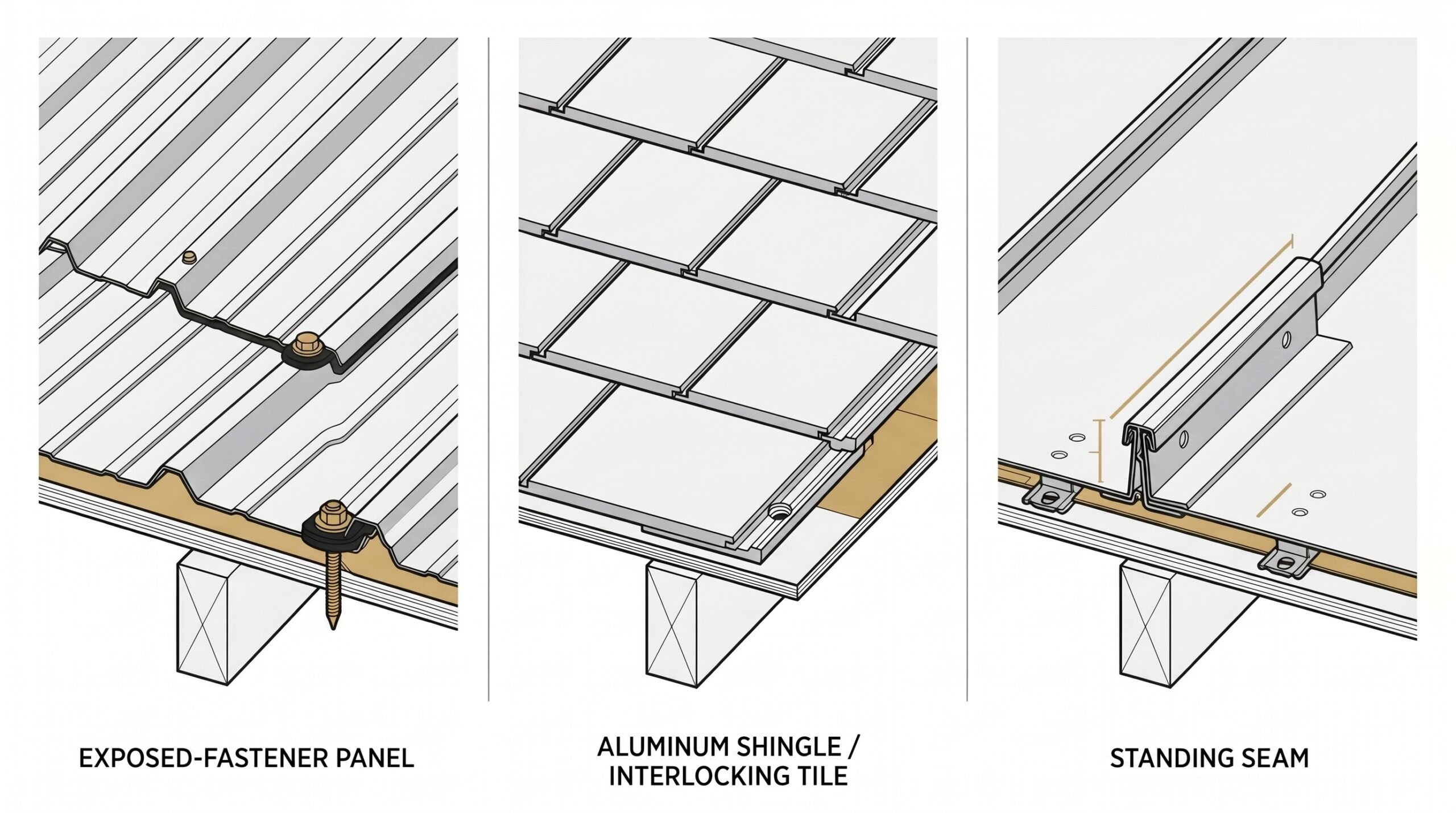
- Exposed-fastener panels: Fastest to install, suitable for lower pitches. Fasteners are visible and penetrate the panel face. Requires periodic fastener inspection to maintain watertight performance.
- Aluminum shingles and interlocking tiles: Designed to mimic the look of asphalt, slate, or cedar shake. Interlocking edges create a tight weather seal. Well-suited to neighborhoods with aesthetic requirements or HOA review.
- Standing seam: Concealed fasteners, panels locked at raised seams, floating clip attachment that allows thermal movement. The strongest wind-uplift resistance of the three and the least maintenance-intensive profile. The benchmark for residential aluminum roofing performance.
The profile choice affects not just aesthetics but maintenance frequency, wind resistance, thermal performance, and noise characteristics. It is one of the most important specification decisions in an aluminum roofing project — and it should be made before selecting a color or gauge.
Aluminum Metal Roof Pros in Houston — 2026
Eight advantages distinguish aluminum from every other mainstream residential roofing material in this market. The first two — corrosion resistance and lifespan — are the structural argument. The next three — thermal performance, wind/hail resistance, and maintenance — are the practical argument. The last three are secondary benefits that compound over time.
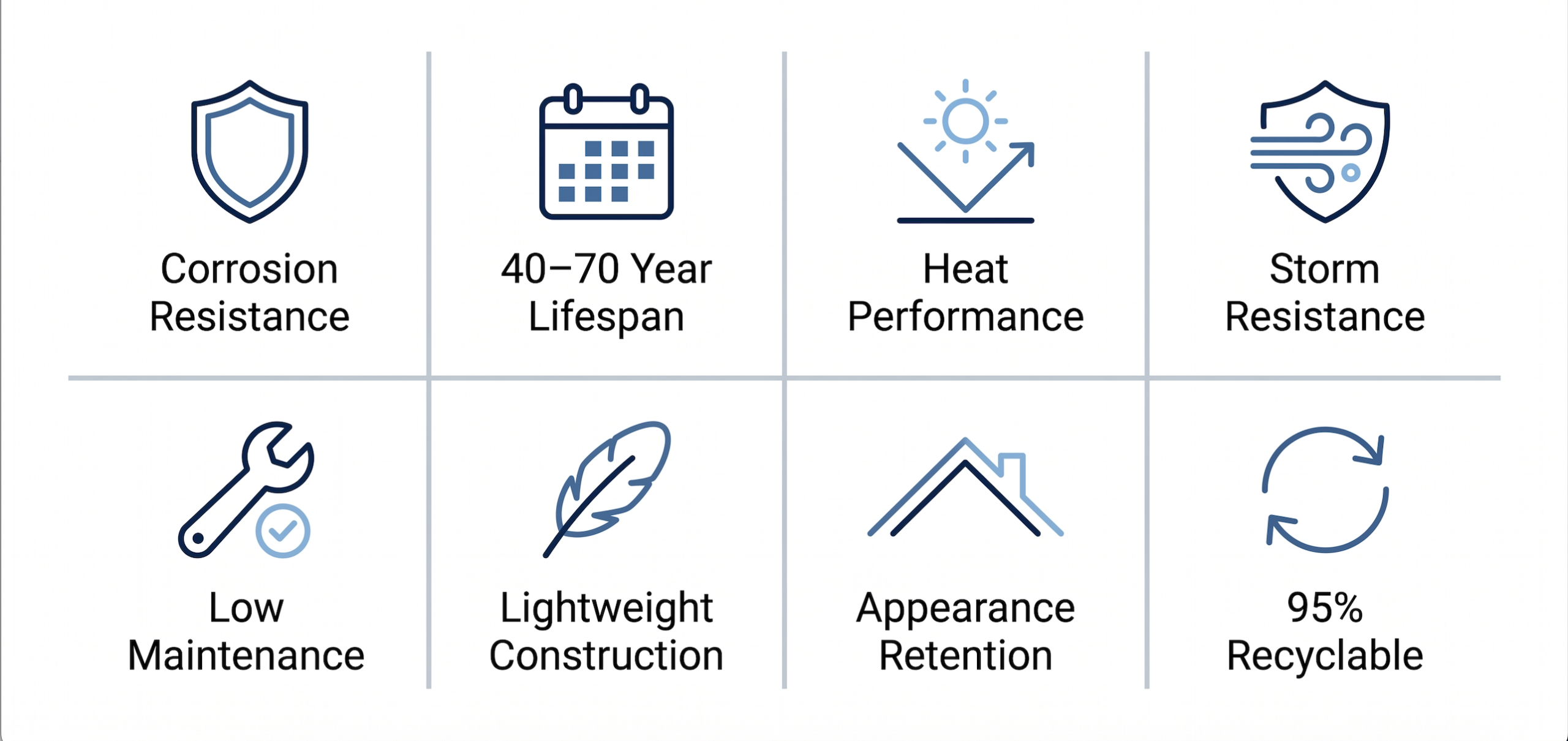
Pro 1: Corrosion Resistance Built Into the Metal, Not Applied Over It
When aluminum is exposed to air, it immediately forms a thin aluminum oxide layer on its surface. That layer is the material’s natural corrosion barrier — and unlike a paint coating or galvanic treatment, it regenerates automatically when scratched, abraded, or struck by hail. There is no primer to fail. No edge cut to rust. No coating to be consumed by salt air over time.
In Houston, this matters more than almost anywhere in the country. Galvalume steel — the most common aluminum alternative — relies on a zinc-aluminum alloy coating for corrosion protection. That coating performs well in dry or temperate climates, but in near-coastal environments with sustained humidity above 75%, coating consumption at cut edges, fastener holes, and hail-strike locations accelerates. SINTEF’s long-term marine atmospheric research and industry reporting from Metal Construction News both identify aluminum as the preferred metal for coastal construction specifically because it eliminates the coating-degradation failure mode entirely.
In the worst coastal environments, galvanized steel can develop red rust in under three years. Metal Construction News identifies aluminum, stainless steel, and copper as the three metals preferred for coastal construction — with aluminum’s self-regenerating oxide layer cited as the defining property that separates it from coated steel products in high-humidity environments.Sources: SINTEF, Metal Construction News
Pro 2: A 40–70 Year Service Life That Actually Holds in Houston’s Climate
Every roofing material carries a rated lifespan. The gap between what the rating says and what the material delivers in Houston is one of the most significant and least-discussed variables in residential roofing decisions. Aluminum’s rated lifespan of 40–70 years holds in Houston conditions. Most others’ do not.
Asphalt shingles carry manufacturer ratings of 20–30 years. In Houston’s combination of UV intensity, thermal cycling, humidity, and hail, that rating shrinks to 12–18 years in real-world performance — a 30–40% reduction. Galvalume steel holds closer to its rating in most of Houston but degrades faster in coastal zones and on properties with frequent hail exposure.
Aluminum installations from the 1970s and 1980s are still performing on structures across coastal Texas. We have torn off roofing from every era — and the aluminum always outlasts what was installed around it. The oxide layer does not weaken under UV. It does not lose adhesion in humidity cycling. It does not crack under thermal stress.
The Aluminum Association confirms that aluminum’s oxide layer reforms within minutes of air exposure, providing continuous corrosion protection without degradation — a property that directly supports the material’s 40-to-70-year residential service life in high-humidity coastal markets like Houston.Source: The Aluminum Association
Pro 3: Thermal Performance — Reflects Heat Rather Than Absorbing It
Standard architectural asphalt shingles absorb 85–95% of incoming solar radiation and convert it to heat that transfers into the roof deck, attic, and living space below. Aluminum roofing — depending on finish color and coating type — reflects 50–95% of that same solar radiation into the atmosphere. In Houston, where air conditioning runs eight to nine months per year, and cooling dominates residential energy spend, that reflectivity is a genuine and measurable performance advantage.
The mechanism behind the reflectivity is the combination of solar reflectance (SR) and thermal emittance (TE). High SR means the surface reflects incoming energy rather than absorbing it. High TE means the surface releases absorbed heat efficiently rather than storing it. Aluminum performs well on both measures. ENERGY STAR designates aluminum roofing products that meet minimum SR and TE thresholds as Cool Roof certified — those products are eligible for utility rebates through CenterPoint Energy and Entergy Texas in some service areas.
The cooling benefit is greatest on homes with lower attic insulation levels and on south- and west-facing roof planes that receive the highest direct sun exposure during Houston’s peak summer heat.
The U.S. Department of Energy and the Cool Roof Rating Council both report that cool roofs reduce cooling energy consumption by 7–15% in hot climates. Savings are greatest in high-solar-gain environments like Houston where cooling demand dominates the annual energy budget.Sources: U.S. Department of Energy, Cool Roof Rating Council
Pro 4: Structural Wind and Hail Resistance — Not Just Certification Numbers
Standing seam aluminum systems regularly achieve FM 4473 wind uplift ratings at 130+ mph and UL 2218 Class 4 impact ratings — the highest classification for hail resistance in residential roofing. Those are numbers on paper. What they mean in practice is the difference between a roof that stays on during a Category 2 hurricane and one that doesn’t.
The structural basis for aluminum’s wind resistance is the concealed-fastener standing seam clip system. Each panel floats in a clip that is mechanically attached to the deck — the panels themselves have no exposed fasteners for wind to engage. Wind uplift loads are distributed across the entire panel length rather than concentrated at fastener points. The result is a roof assembly that resists uplift far more effectively than any exposed-fastener system, and far more effectively than asphalt, which relies entirely on the bond strength of adhesive strips between shingles.
Most aluminum standing seam systems are pre-approved for Texas WPI-8 windstorm certification in coastal counties, which means installation in Harris, Galveston, and surrounding counties can proceed without individual engineering review. That pre-approval is the product of the system’s demonstrated performance record — not a regulatory shortcut.
UL 2218 Class 4 roofing systems — the impact rating most aluminum standing seam products achieve — qualify for 20–35% wind and hail premium discounts under Texas Department of Insurance guidelines, with savings of $500–$1,500 annually for most Houston homeowners depending on home value and coverage.Source: Texas Department of Insurance (TDI), Metal Roofing Alliance, 2025
Pro 5: Near-Zero Maintenance — The Advantage Nobody Talks About
Asphalt roofing requires active management. Granule loss from UV and hail exposure needs to be monitored because granule loss is the leading indicator of reduced weather protection and shortened lifespan. Sealants at pipe boots, skylights, and ridges dry out and require periodic reapplication. Algae and moss growth on shaded north-facing slopes is common in Houston’s humidity and requires treatment to prevent accelerated shingle degradation. Most manufacturers recommend professional inspections every 3–5 years.
Aluminum requires none of this. There are no granules to lose. The oxide layer does not dry out or require reapplication. Aluminum’s pH-neutral surface chemistry does not support algae or moss growth the way organic-content asphalt does. Standard PVDF paint coatings on aluminum panels carry 40-year fade-resistance warranties without requiring re-coating. Routine maintenance on a properly installed aluminum standing seam roof is limited to clearing debris from valleys and gutters, and checking sealant integrity at penetration flashings.
The maintenance difference is not just a convenience argument. It is a performance argument. A roof that requires no active management to maintain its weather resistance is more reliable than one that degrades silently between inspections.
Pro 6: Lightweight Construction — 1–1.5 Lbs Per Square Foot
Aluminum roofing weighs 1–1.5 lbs per square foot. Concrete tile weighs 9–12 lbs/sq ft. Natural slate weighs 7–9 lbs/sq ft. Clay tile weighs 6–8 lbs/sq ft. Asphalt shingles, by comparison, weigh 2–4 lbs/sq ft depending on the product. Aluminum is the lightest full-coverage residential roofing material available.
That weight difference matters practically on replacement projects, which represent the majority of residential roofing work. Installing a heavier material over an existing structure may require structural engineering review and potential rafter reinforcement. Aluminum installs over most existing roof decks without either. On older Houston homes with original framing from the 1960s through 1980s, that distinction eliminates a potential cost and timeline complication entirely.
Pro 7: Aesthetic Longevity — Appearance That Does Not Degrade With the Material
Asphalt shingles change appearance as they age — granule loss exposes darker asphalt beneath, UV bleaches original color, thermal cycling causes shingles to cup and curl at edges. An asphalt roof installed in 2026 will look noticeably different by 2036, even on a well-maintained home. The visual degradation is a direct expression of the material’s physical degradation.
Aluminum does not behave this way. Panels do not cup, curl, or warp. The substrate does not lose surface material over time. PVDF (polyvinylidene fluoride) coatings used on residential aluminum roofing products carry 40-year warranties against chalking and fading — the two most common paint degradation modes in high-UV environments like Houston. A properly specified aluminum roof installed today should look essentially the same in twenty years, with the same color depth and panel geometry it had on installation day.
PVDF coatings — the industry standard for residential metal roofing paint systems — retain color and gloss in high-UV, high-humidity environments where standard polyester coatings begin chalking within 5–10 years. Most major manufacturers warranty PVDF against chalking and fading for 40 years.Source: Metal Roofing Alliance
Pro 8: 95% Recyclable at End of Life — With Scrap Value
Approximately 75% of all aluminum ever produced is still in active use worldwide. Recycling aluminum requires only 5% of the energy needed to produce primary aluminum from ore. At the end of a 50–70 year service life, an aluminum roof is not a disposal problem — it is a commodity with positive scrap value at any metal recycling facility.
Over 15 million tons of asphalt shingles enter U.S. landfills every year, with only 9–20% currently recycled. The petroleum-based material takes an estimated 300–500 years to decompose. A homeowner who installs aluminum and never replaces it generates none of that waste over the same period.
The Aluminum Association reports that recycling aluminum requires approximately 5% of the energy needed to produce primary aluminum from ore — making it one of the lowest embodied-energy metals available for construction. Over 15 million tons of asphalt shingles enter U.S. landfills annually; aluminum roofing eliminates that waste stream entirely over its lifespan.Sources: The Aluminum Association, EPA, ShingleRecycling.org
Aluminum Metal Roof Cons in Houston — The Honest Version
Every contractor selling aluminum has a financial incentive to minimize its tradeoffs. A homeowner who understands the actual weaknesses of this material makes a better decision than one who buys it on a salesperson’s word. Below is what aluminum does not do well, and what to do about it at the specification stage.
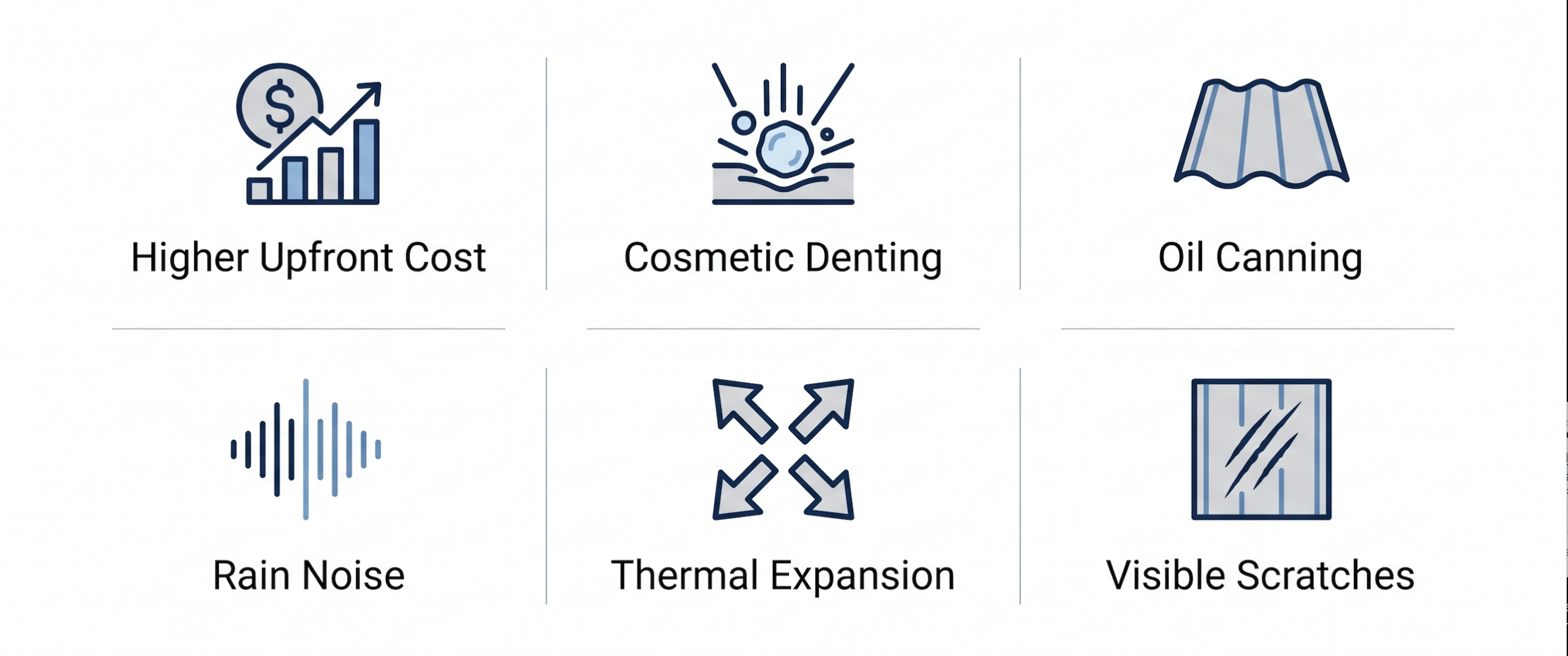
Con 1: Higher Upfront Cost Than Asphalt or Steel
Aluminum costs more to purchase and install than any other mainstream residential roofing material. That is a real constraint, not a perception to be overcome. For homeowners with tight cash flow or a short time horizon on the property, the upfront gap may legitimately make asphalt or steel the right decision regardless of long-term performance differences. For a detailed breakdown of installed price ranges by profile type and house size, see our aluminum metal roof cost guide.
Con 2: Cosmetic Denting From Hailstones Larger Than 1.5 Inches
Aluminum is softer than steel. Hailstones larger than 1.5 inches in diameter can leave cosmetic dents on standard 0.032-inch aluminum panels. The dents do not compromise waterproofing or structural performance — the roof continues to function correctly. But they are visible and may affect insurance claims and property value at resale.
The practical response is gauge selection. Upgrading from 0.032″ to 0.040″ aluminum adds approximately $1.30–$1.70 per square foot to standing seam installation cost but meaningfully increases dent resistance. In Houston zip codes with documented histories of 2-inch or larger hail events, specifying 0.040″ gauge upfront is the correct decision.
The important distinction: asphalt shingles struck by the same hail suffer structural failure — granule loss that accelerates aging, breach of the weather barrier, and an accelerated path toward replacement. A dented aluminum roof is an aesthetic issue. A hail-struck asphalt roof is a performance issue. They are not equivalent problems, and should not be treated as equivalent in a comparison.
Doppler radar has detected hail at or near Houston on 272 occasions in recorded history, including 28 occasions in the past year. Spotter-confirmed hail reports within 10 miles of the city center total 69 since 2004 — averaging roughly 3 significant events per year. The Gulf Coast receives fewer severe hail days than North Texas due to warm maritime air, but events still occur with enough frequency to make gauge selection a relevant specification decision for Houston homeowners.Sources: Interactive Hail Maps, National Weather Service Houston/Galveston
Con 3: Oil Canning — A Visual Characteristic of All Light-Gauge Metal Panels
Oil canning is a visible waviness or rippling on the flat areas of metal roof panels. It is caused by minor internal stresses introduced during the rolling process or by uneven substrate conditions during installation. It is an industry-accepted characteristic of all light-gauge metal roofing — acknowledged in writing by every major aluminum roofing manufacturer — and it is not a defect or an installation error in most cases.
Oil canning is most visible on low-pitch roofs, south- and west-facing planes, wide-pan standing seam panels, dark colors, and high-gloss finishes — conditions where the panel surface catches low-angle light that reveals even subtle waviness. It is least visible, or entirely invisible, on striated or pencil-ribbed panel profiles, aluminum shingle products, matte or textured PVDF finishes, and standing seam systems with narrower pan widths.
Addressing oil canning is a specification decision, not an installation correction. If oil canning visibility is a concern — particularly on street-visible roof planes — the correct response is to select a profile and finish combination that minimizes it before installation begins.
Con 4: Rain Noise — Real on Barn-Style Installations, Not on Properly Built Residential Ones
The metal roof noise stereotype is legitimate for one specific installation type: exposed-fastener panels installed over open purlins with no decking or insulation, which is how agricultural metal buildings are built. Apply that construction method to a residence and it is loud in rain. Apply residential construction standards — solid OSB decking, heavy underlayment, closed-cell spray foam attic insulation — and the noise profile changes entirely.
Research from the Acoustic Group at the University of Luleå, Sweden, measured rain on asphalt shingles at 46 dBA and rain on a properly assembled metal roof at 52 dBA. The 6-decibel difference falls below the 8-decibel threshold at which most humans can detect a perceptible change in sound level. Rain on metal over open framing measures 61 dBA — the number that originated the stereotype and that has no relevance to a code-compliant residential installation.
The practical guidance: specify solid decking, a minimum 30-pound felt or synthetic underlayment, and adequate attic insulation. If rain noise is a concern, add a secondary layer of closed-cell spray foam directly beneath the roof deck. That combination eliminates the noise issue for the overwhelming majority of homeowners.
The Acoustic Group at the University of Luleå, Sweden, measured rain noise at 46 dBA on asphalt shingles versus 52 dBA on a properly assembled metal roof over complete decking and insulation. The 6 dB gap falls below the 8 dB human perception threshold — making the sound difference between properly installed metal and asphalt effectively undetectable to most occupants.Sources: Acoustic Group, University of Lulea, McElroy Metal
Con 5: Thermal Expansion Requires Proper Installation Technique
Aluminum expands and contracts with temperature changes at approximately 13.1 × 10⁻⁶ per °F — a higher rate than most roofing materials. In Houston, where roof surface temperatures swing from the low 30s in winter to over 150°F in direct summer sun, aluminum panels move measurably across every seasonal cycle. Improperly fastened panels buckle. Rigid point-fastening causes fastener fatigue and eventually fatigue failure.
Standing seam systems with floating clip attachments are the engineering solution to this property. Panels are secured to the deck through a clip that allows the panel to slide freely along its length as it expands and contracts. No fastener stress accumulates. The system can accommodate the full range of Houston’s temperature swings without any component being placed in tension.
The problem occurs almost exclusively when installers use rigid fastening methods designed for steel or asphalt applied to aluminum panels. This is not a material flaw — it is an installer quality issue. It is also the most important argument for choosing a contractor with demonstrated aluminum roofing experience rather than a general roofer who occasionally works in metal.
Con 6: Scratches on Painted Panels Are Visible and Require Touch-Up
Aluminum panels do not scratch easily under normal conditions. But foot traffic during installation or maintenance, tree branch contact, and debris impacts from severe weather can scratch the PVDF finish on painted panels. Unlike asphalt, which can hide localized damage in its granule texture, a scratch on a gloss or semi-gloss aluminum panel is visible — particularly on lighter colors and on planes with direct sun exposure.
The mitigation is straightforward: manufacturers provide PVDF touch-up paint in matched colors with every panel order. Scratches addressed promptly with matched touch-up paint are essentially invisible from normal viewing distances. The substrate itself — aluminum — will not corrode at a scratch location even without touch-up paint, because the oxide layer reforms beneath any surface damage. The concern is cosmetic, not structural.
Aluminum vs. Steel vs. Asphalt — How the Materials Actually Compare
The most useful comparison between roofing materials is not price — it is performance across the dimensions that determine how the material behaves on your home over 20, 30, and 50 years. The table below compares aluminum, Galvalume steel, and architectural asphalt on seven performance criteria.
| Performance Factor | Aluminum | Galvalume Steel | Architectural Asphalt |
|---|---|---|---|
| Corrosion protection | Self-healing oxide layer; no coating required | Zinc-aluminum alloy coating; consumed over time in salt-air environments | None — asphalt oxidizes and becomes brittle |
| Houston service life | 50–70 years | 35–50 years (coastal) / 40–60 years (inland) | 12–18 years (Houston real-world, vs. 20–30 yr rated) |
| Solar reflectance | 50–95% depending on finish | 25–70% depending on finish | 5–15% for standard shingles |
| Wind uplift resistance | 130+ mph (FM 4473, standing seam) | 130+ mph (FM 4473, standing seam) | 110–130 mph (Class H, with proper nailing) |
| Hail resistance | UL 2218 Class 4; dents cosmetically at 1.5″+ but maintains waterproofing | UL 2218 Class 4; more dent-resistant than aluminum at same gauge | Class 3–4 on impact-rated products; granule loss and structural compromise |
| Maintenance requirements | Near-zero — debris clearing, flashing inspection only | Low — same as aluminum except edge/fastener monitoring in coastal zones | Active — granule monitoring, sealant reapplication, algae treatment, inspection every 3–5 yrs |
| Weight | 1–1.5 lbs/sq ft | 1.5–2.5 lbs/sq ft | 2–4 lbs/sq ft |
| End-of-life recyclability | 95% recyclable; positive scrap value | 95%+ recyclable; positive scrap value | Less than 20% currently recycled; 300–500 yr landfill decomposition |
The Maintenance Reality Nobody Discusses — and Why It Changes the Comparison
Roofing decisions are usually made at the purchase point and evaluated at the replacement point. The years in between — the maintenance cycles, the inspections, the sealant reapplication, the algae treatment, the granule-loss monitoring — rarely appear in comparison articles. They should, because they represent real time and real cost, and they are distributed very differently between aluminum and asphalt.
An asphalt shingle roof is a system that degrades actively and continuously from the day it is installed. UV radiation begins breaking down the asphalt binder. Thermal cycling causes dimensional movement that stresses adhesive bonds. Hail accelerates granule loss. Humidity promotes algae growth on shaded planes. Houston’s climate accelerates all four processes simultaneously. Keeping an asphalt roof performing at its designed capacity across its 12–18 year Houston lifespan requires active attention — inspection, early intervention at problem areas, and sealant maintenance at penetrations.
An aluminum roof is a system that does not degrade in the same way. The oxide layer does not weaken. The panels do not curl or cup. The finish does not lose adhesion. Algae does not find a biological foothold on aluminum’s surface chemistry. The maintenance list is short: clear debris from valleys and gutters, inspect sealants at pipe boots and skylights, check fastener integrity on exposed-fastener profiles. Standing seam systems with concealed fasteners require even less.
Our PositionThe maintenance difference between aluminum and asphalt is not a minor quality-of-life benefit. It is a performance advantage that compounds over decades. A material that maintains its weather resistance without active intervention is more reliable than one that requires monitoring to function correctly. We see the consequences of deferred asphalt maintenance in tear-offs every week — roofs that were sound two years ago and are now failing at sealants, ridges, and valleys because the maintenance cycle was skipped or delayed.
Aluminum does not ask you to stay ahead of its degradation. That is not a marketing claim. It is a consequence of what the material is and how it protects itself.
The 5 Performance Factors That Determine Whether Aluminum Is Right for Your Houston Home
The pros and cons above do not apply with equal weight to every property. Five variables determine whether aluminum’s performance profile matches a specific Houston home’s conditions and the homeowner’s priorities.
| # | Factor | Aluminum Is the Stronger Fit If… | Another Material May Be the Stronger Fit If… |
|---|---|---|---|
| 1 | Proximity to Gulf Coast salt air | Property is within 50 miles of Gulf Coast — most of the Houston metro | Far inland with minimal humidity and no coastal salt exposure |
| 2 | Roof pitch and profile compatibility | Pitch of 2:12 or greater; standing seam or shingle profiles available | Pitch under 2:12 — profile options narrow significantly for aluminum |
| 3 | Hail zone and gauge tolerance | Typical hail under 1.5″ diameter — or homeowner willing to specify 0.040″ gauge for larger events | Frequent 2″+ hail, no budget for gauge upgrade, and cosmetic denting is unacceptable |
| 4 | Aesthetic requirements | HOA allows metal roofing; homeowner prefers clean panel profiles or metal-shingle aesthetics | HOA prohibits metal roofing, or strict neighborhood aesthetic requires traditional shingle appearance aluminum shingles cannot replicate |
| 5 | Maintenance tolerance | Homeowner wants a roof that requires minimal active management over its lifespan | Short ownership horizon — maintenance tradeoffs are less relevant if the property sells before they compound |
Aluminum Metal Roof Pros and Cons — Full Summary
| Category | Pro or Con | Verdict | Houston-Specific Notes |
|---|---|---|---|
| Corrosion resistance | Pro | Excellent | Self-healing oxide; best-in-class for Gulf Coast salt air and humidity |
| Service life | Pro | 40–70 years actual | Rated lifespan holds in Houston; asphalt’s rated lifespan does not |
| Thermal performance | Pro | High solar reflectance | Reflects 50–95% solar radiation; ENERGY STAR eligible; 7–15% cooling savings |
| Wind and hail resistance | Pro | FM 4473 / UL 2218 Class 4 | Floating-clip standing seam resists 130+ mph; WPI-8 pre-approved |
| Maintenance requirements | Pro | Near-zero | No granules, no coatings to reapply, no algae vulnerability; debris clearing only |
| Weight | Pro | 1–1.5 lbs/sq ft | No structural reinforcement needed on most Houston homes |
| Aesthetic longevity | Pro | High | Panels do not cup, curl, or bleach; PVDF coatings warranted 40 years against fade |
| Recyclability | Pro | 95% recyclable | Positive scrap value at end of life; no landfill disposal burden |
| Upfront cost | Con | Higher than alternatives | Real gap vs. asphalt; may not suit short ownership horizons or tight cash flow |
| Hail denting | Con | Cosmetic at 1.5″+ | Waterproofing unaffected; manageable with 0.040″ gauge upgrade |
| Oil canning | Conditional | Cosmetic only | Eliminated by ribbed profiles, matte finishes, narrower pan widths |
| Rain noise | Conditional | Installation-dependent | Non-issue with solid decking + underlayment + insulation; 6 dB from asphalt (below perception threshold) |
| Thermal expansion | Conditional | Installer-dependent | Solved entirely by floating-clip standing seam systems; not a material flaw |
| Paint scratching | Conditional | Cosmetic only | Matched PVDF touch-up paint provided with panels; oxide layer protects substrate regardless |
Frequently Asked Questions
What are the pros of an aluminum metal roof?
The primary pros of an aluminum metal roof are: a self-healing oxide layer that provides corrosion resistance without coatings; a service life of 40–70 years that holds in humid and coastal climates; solar reflectance of 50–95% that reduces cooling load; UL 2218 Class 4 impact and FM 4473 wind uplift ratings; near-zero maintenance requirements with no granule loss or coating degradation to monitor; light weight of 1–1.5 lbs/sq ft; aesthetic longevity through PVDF coatings warranted 40 years against fading; and full recyclability with scrap value at end of life.
What are the cons of an aluminum metal roof?
The primary cons are: higher upfront cost than asphalt or steel; cosmetic denting from hailstones larger than 1.5 inches on standard 0.032″ panels (waterproofing is unaffected); oil canning — visible waviness on flat panel surfaces — on certain profile types; rain noise on installations without adequate decking and insulation; thermal expansion that requires floating-clip fastening systems to accommodate properly; and visible scratches on painted panels that require touch-up paint. Three of the six cons (oil canning, rain noise, thermal expansion) are fully manageable through installation specification choices.
How long does an aluminum metal roof last?
An aluminum metal roof lasts 40–70 years under typical conditions. In high-humidity, near-coastal climates like Houston, aluminum’s rated lifespan holds better than any other mainstream residential roofing material. Asphalt shingles rated at 20–30 years last 12–18 years in Houston’s real-world conditions. Galvalume steel performs at or near its rated lifespan inland but shows accelerated coating degradation within 50 miles of the Gulf Coast.
Do aluminum roofs require a lot of maintenance?
No. Aluminum metal roofing requires near-zero maintenance compared to asphalt shingles. There are no granules to monitor for loss, no coatings to reapply, no UV degradation to track, and no algae vulnerability to manage. Routine maintenance is limited to clearing debris from valleys and gutters, and checking sealant integrity at pipe boots, skylights, and chimneys every few years. Standing seam systems with concealed fasteners require even less routine attention than exposed-fastener profiles.
Does an aluminum roof dent from hail?
Standard 0.032″ aluminum panels can show cosmetic dents from hailstones 1.5 inches or larger. The dents do not compromise waterproofing or wind resistance. Upgrading to 0.040″ gauge adds $1.30–$1.70/sq ft to installed cost but meaningfully increases dent resistance. The relevant distinction: asphalt struck by the same hail suffers structural failure — granule loss, accelerated aging, and a breach of the weather barrier. A dented aluminum roof is an aesthetic issue. A hail-struck asphalt roof is a performance issue.
Is aluminum or steel better for a Houston roof?
Aluminum outperforms Galvalume steel specifically in Houston’s near-coastal, high-humidity environment. Steel’s protective coating degrades faster than aluminum’s self-healing oxide layer when exposed to salt air and sustained humidity above 75% — particularly at cut edges, fastener holes, and hail-strike locations. Inland in lower-humidity conditions, Galvalume steel is a strong competitor to aluminum and typically less expensive. Within 50 miles of the Gulf Coast — which includes most of Houston — aluminum is the stronger long-term material.
Are aluminum roofs loud when it rains?
Not on properly installed residential systems. Research from the Acoustic Group at the University of Luleå, Sweden, measured rain on asphalt shingles at 46 dBA and rain on a properly assembled metal roof at 52 dBA — a 6-decibel difference that falls below the 8-decibel threshold at which most humans detect a change in sound level. Metal roofing over open framing (agricultural buildings) measures 61 dBA, which is the origin of the noise stereotype. Residential installation over solid decking with underlayment and attic insulation eliminates the noise concern.
What is oil canning on an aluminum roof and can it be avoided?
Oil canning is a visible waviness or rippling on the flat areas of metal roof panels, caused by minor internal stresses introduced during manufacturing or installation. It is an industry-accepted characteristic of all light-gauge metal roofing — not a defect — but it is cosmetically undesirable on some applications. It can be minimized or eliminated by specifying striated or ribbed panel profiles instead of flat-pan standing seam, choosing matte or textured PVDF finishes rather than gloss, using narrower panel widths, and selecting aluminum shingle profiles rather than large-format flat panels.
How does an aluminum roof perform in Houston’s heat and humidity?
Very well — better than any other mainstream residential roofing material in this specific climate. The oxide layer is indifferent to UV radiation, humidity, and salt air. The high solar reflectance (50–95%) reduces attic heat gain and HVAC load. PVDF coatings maintain color and gloss in high-UV environments where standard polyester coatings begin chalking within 5–10 years. Houston’s combination of heat, humidity, and coastal salt air is precisely the environment aluminum’s material properties are best suited to.
Get a Roof-Specific Number
Ranges are useful; your roof isn’t a range. Achilles Roofing installs aluminum standing seam and shingle systems across Houston — with written fixed-price estimates before any contract is signed. Written fixed-price estimate · GAF Certified Plus · 610+ reviews · 4.9 star-rated on Google · Financing from $199/mo
 Call (832) 346-8021
 About Achilles Roofing & Exterior
Houston’s specialist in full roof replacements, Spanish tile, clay tile, copper, and high-end exterior systems. Founded 2017. 610+ reviews · 4.90-star Google · 5.0 Thumbtack · Founded by Ahmad Faiz.
Sources
- Angi. (2026). Angi home page. Angi. https://www.angi.com/
- ATAS International. (2018). Sound emission of metal roofing [PDF file]. ATAS International Technical Briefs. https://www.atas.com/wp-content/uploads/2018/06/Sounds-Emission-Metal-Roofing.pdf
- Cool Roof Rating Council. (2020, November 12). Determining the energy savings of a cool roof [PDF file]. Cool Roof Rating Council Documents. https://coolroofs.org/documents/Determining_the_Energy_Savings_of_a_Cool_Roof_2020-11-12.pdf
- Energy Star. (2026). Energy Star home page. U.S. Environmental Protection Agency & U.S. Department of Energy. https://www.energystar.gov/
- Interactive Hail Maps. (2026). Houston, TX local hail map and storm tracker. Interactive Hail Maps Portal. https://www.interactivehailmaps.com/local-hail-map/houston-tx/
- McElroy Metal. (2023, April 11). Are metal roofs noisy when it rains? McElroy Metal Roofing and Siding Blog. https://blog.mcelroymetal.com/metal-roofing-and-siding/are-metal-roofs-noisy-when-it-rains
- Metal Construction News. (2024, May 14). Using metal in coastal environments. Metal Construction News Architecture Insights. https://www.metalconstructionnews.com/articles/using-metal-in-coastal-environments/
- Metal Roofing Alliance. (2026). Metal Roofing Alliance home page. MRA. https://www.metalroofing.com/
- National Roofing Contractors Association. (2026). Shingle recycling initiatives. NRCA Resource Center. https://shinglerecycling.org/
- SINTEF. (2021). Corrosion of aluminum in marine environments (SINTEF Report No. 2021-00342) [PDF file]. SINTEF Industry Material Physics. https://www.sintef.no/contentassets/adf31392734e496c805e9cbfad888c2f/report—corrosion-of-al-in-marine-environments.pdf
- Texas Department of Insurance. (2026). Texas Department of Insurance home page. TDI. https://www.tdi.texas.gov/
- The Aluminum Association. (2026). The Aluminum Association home page. The Aluminum Association. https://www.aluminum.org/
- U.S. Department of Energy. (2026). Cool roofs. Energy Saver. https://www.energy.gov/energysaver/cool-roofs
- U.S. Environmental Protection Agency. (2020, March). Advancing sustainable materials management: 2015 fact sheet [PDF file]. Office of Resource Conservation and Recovery. https://www.epa.gov/sites/default/files/2020-03/documents/final_cd-eol-management_2015_508.pdf
- U.S. National Oceanic and Atmospheric Administration. (2026). National Oceanic and Atmospheric Administration home page. U.S. Department of Commerce. https://www.noaa.gov/
- U.S. National Weather Service. (2026). Houston/Galveston local quick storm data and preliminary reports. National Oceanic and Atmospheric Administration. https://www.weather.gov/hgx/quick_stormdata