QUICK ANSWER
Need a complete roof upgrade? Check out our main page for professional Spanish tile roof installation.
- When estimating your Spanish tile roof upgrade costs in Cypress, expect a full Spanish tile roof replacement to run $12.50-$25.00 per square foot installed, or roughly $31,000-$62,000 on a 2,500 sq ft roof.
- The tile usually outlasts the roof. Clay tile carries a 50-100 year service life, while the underlayment beneath it fails at 15-25 years in Gulf Coast humidity.
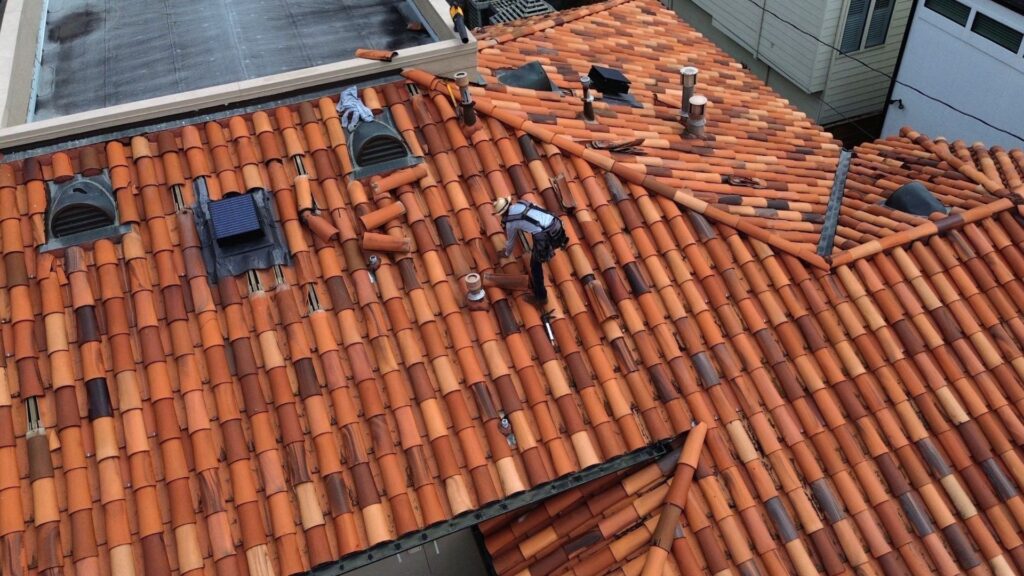
- A “relay”—removing existing tile, replacing underlayment and flashing, then reinstalling the same tile—costs roughly 40-55% less than full tile replacement.
- Cypress sits inside the most active hail corridor in the United States; Texas led the nation with hail events in 2023.
- HOAs in most Cypress master-planned communities restrict tile color and profile changes. Verify before ordering material.
What Does a Spanish Tile Roof Cost in Cypress in 2026?
A Spanish tile roof upgrade in Cypress, Texas, runs $12.50 to $25.00 per square foot installed in 2026, putting a typical 2,500 sq ft home between $31,000 and $62,000. Clay tile sits at the top of that range; concrete “Spanish profile” tile sits at the bottom. When determining your overall Spanish tile roof upgrade costs, the single largest variable is not the tile—it is the underlayment system and the structural deck beneath it.
According to industry pricing data aggregated by HomeAdvisor, clay tile averages $8-$25 per square foot nationally for materials and installation, while concrete tile averages $9-$18 per square foot. Cypress pricing trends 15-25% above national averages because of Harris County permit overhead, hurricane-zone fastening requirements, and a tile-trained labor pool that is smaller than the asphalt-shingle labor pool.
Source: HomeAdvisor
Cypress Spanish Tile Roof Costs by Scope
| Scope of Work | Typical Cypress Cost (2,500 sq ft roof) |
|---|---|
| Spot tile repair (broken tiles, isolated flashing) | $650 – $2,400 |
| Relay (lift existing tile, replace underlayment, reinstall) | $14,000 – $26,000 |
| Concrete Spanish-profile full replacement | $22,000 – $38,000 |
| Authentic clay barrel tile full replacement | $42,000 – $72,000 |
| Structural deck reinforcement (if engineering required) | +$6,000 – $18,000 |
Figures reflect Achilles Roofing pre-job estimates issued across Cypress ZIP codes 77429, 77433, and 77410 between Q4 2025 and Q1 2026.
Why Cypress Spanish Tile Roofs Fail (Despite Lasting a Century)
When considering your long-term Spanish tile roof cost, keep in mind that these roofs in Cypress rarely fail because the tile wears out. They fail because the underlayment, fasteners, and flashing beneath the tile degrade at Gulf Coast humidity levels two to three times faster than they would in California or Arizona. The tile is the protective shell. Everything underneath it is the actual waterproof roof, and that system has a 15-25 year clock.
Houston metro averages 49.77 inches of annual rainfall, roughly 1.6 times the U.S. national average, with attic temperatures regularly exceeding 140°F in summer. (Sources: NOAA National Climatic Data Center; U.S. Department of Energy attic-temperature guidance.) That heat-plus-moisture cycle accelerates the failure mode unique to tile systems: underlayment desiccation. The asphalt-saturated felt beneath the tile dries out, cracks, and stops shedding water — while the visible tile above looks identical to its installation day.
Source: NOAA National Climatic Data Center via PubMed Central
The Three Hidden Failure Modes Under Cypress Tile Roofs
Based on Achilles Roofing’s inspections of more than 200 Cypress tile homes since 2022, three failure patterns account for roughly 90% of tile-roof leak calls in the area:
- Underlayment desiccation. The 30-pound felt installed beneath tile in the late 1990s and early 2000s reaches end-of-service at 18-22 years in Cypress. By year 25, leak risk approaches certainty.
- Valley metal corrosion. Out of sight shouldn’t mean out of mind. In Southeast Texas, galvanized roof valleys can slowly form tiny pinhole leaks—damage that a tile roof’s high-profile design completely hides from a standard ground-level view. While local rainfall is much cleaner today than it was decades ago (recovering from a historical 4.6–5.0 pH up to a milder 5.2–5.6 today, thanks to federal emissions programs), the combination of coastal moisture and age can still quietly compromise your roof deck right under your nose. Source: National Atmospheric Deposition Program
- Fastener pull-through. Original copper or hot-dipped galvanized nails relax over multiple thermal cycles. Tiles do not slide off; they lift microns at every wind event, breaking the underlayment seal at the nail penetration.
None of these is visible from the curb. None of them set off the moisture meter in a standard real-estate inspection. All three are why a 30-year-old Spanish tile roof in Cypress can look pristine in photos and still be one storm from a ceiling stain.
Clay Tile vs. Concrete Tile vs. Synthetic Spanish-Profile Tile in the Gulf Coast Climate
For Cypress homeowners preserving a Mediterranean aesthetic, the choice between clay, concrete, and synthetic Spanish-profile tile is decided by three factors in this order: HOA approval, structural load capacity, and hail performance. Your total Spanish tile roof cost ranks fourth. Clay offers the longest service life; concrete offers the lowest installed cost; synthetic composites offer the best impact resistance.
According to the Tile Roofing Industry Alliance, a properly installed tile roof offers unmatched longevity. Concrete tiles are engineered to deliver a lifespan of 50+ years, with most manufacturers providing product warranties to match. Synthetic Spanish-profile tiles (composite polymer products such as those carrying UL 2218 Class 4 ratings) are newer to the market and carry manufacturer warranties of 30-50 years.
Source: Tile Roofing Industry
Material Comparison for Cypress Roofs
| Property | Clay Barrel | Concrete Spanish | Synthetic Composite |
|---|---|---|---|
| Service life | 75-100+ yrs | 50+ yrs | 30-50 yrs (warranty) |
| Weight (psf) | 9.5-12 | 9-12 | 1.5-3 |
| Hail impact rating | Class 3 typical | Class 3-4 | Class 4 common |
| Cypress installed cost (psf) | $16-$25 | $10-$16 | $12-$18 |
| Structural retrofit usually required? | Yes (if replacing shingle) | Yes (if replacing shingle) | No |
| HOA approval likelihood (master-planned Cypress) | High | High | Variable—confirm before ordering |
The weight question matters. A 2,500 sq ft clay or concrete tile roof adds roughly 22,500-30,000 pounds of dead load to a home originally framed for an asphalt shingle. Homes in Cypress built before 2005 and originally roofed in shingles frequently require sistered rafters or engineered ridge beams before tile can be installed legally under International Residential Code Chapter 9 provisions.
The Cypress Hail Problem: Why Impact Rating Belongs at the Top of Your Spec Sheet
Cypress sits inside the Texas hail corridor, the most active hail region in the United States. In 2023, Texas led the nation with hail at least one inch in diameter striking an estimated 2 million homes in a single year, according to property analytics firm Cotality (formerly CoreLogic). While it may increase your initial Spanish tile roof cost, specifying a Class 4 impact-rated tile or synthetic product is not a premium upgrade in Cypress—it is the threshold for insurability discounts and warranty validity.
Texas insurance carriers offer premium discounts of 20-35% for verified Class 4 impact-resistant roof coverings, per Texas Department of Insurance guidance. Concrete Spanish-profile tile generally tests at Class 3; specific concrete and synthetic products achieve Class 4. Authentic clay barrel tile rarely reaches Class 4 ratings, which is the central trade-off for homeowners committed to historical authenticity.
Source: Texas Department of Insurance
One frequently overlooked detail: most homeowner policies in Texas now carry a 2% wind/hail deductible, separate from the standard deductible. On a $500,000 Cypress home, that is $10,000 out of pocket before insurance pays a dollar on storm damage. The discount on Class 4 materials often pays back the upgrade cost within six to nine years.
Relay vs. Full Replacement: How Cypress Homeowners Should Decide
To significantly lower your Spanish tile roof cost, a “relay” preserves the existing Spanish tile and replaces only the underlayment, flashing, and fasteners beneath it. It is the right move when the tile itself is in good condition, but the system is reaching the 20-year underlayment threshold. Full Spanish tile roof replacement is the right move when more than 15% of tiles are cracked, when HOA-approved replacement profiles are still available, or when structural reinforcement is required, regardless.
The Relay-or-Replace Decision Framework
| Condition | Recommended Path | Rationale |
|---|---|---|
| Tile intact, <5% damaged, roof 18-25 yrs old | Relay | Underlayment at end-of-life; tile is the expensive part and still serviceable |
| 15%+ tile cracked or color-faded inconsistently | Full replacement | Sourcing a matching legacy tile is often impossible |
| Active interior leaks, multiple locations | Full inspection first, then likely full replacement | Indicates systemic underlayment + flashing failure |
| Recent hail event, insurance claim filed | Full replacement (typical claim outcome) | Adjusters routinely total tile roofs above 8 hits per 100 sq ft |
| HOA requires a profile change for the whole community | Coordinated full replacement | Group purchasing often unlocks material discounts |
The economic case for a relay is straightforward when evaluating your total Spanish tile roof cost: the tile represents 55-70% of the material cost of a new tile roof. Preserving and reinstalling that tile turns a $50,000 full replacement into a $20,000-$26,000 system refresh, with the same 20-year forward service life on the new underlayment.
HOA Approval and Permit Requirements in Cypress Master-Planned Communities
Most Cypress master-planned communities, including Bridgeland, Towne Lake, Coles Crossing, Fairfield, and Stable Gate, enforce architectural review board approval for any roof material, color, or profile change visible from the street. Approval timelines run 14 to 45 days, and unapproved installations can trigger remediation orders that force the homeowner to remove and reinstall the roof at their own expense, effectively doubling their Spanish tile roof cost.
Harris County and the City of Houston both require permits for tile roof replacement when structural changes are involved. Standard residential roof permit fees in unincorporated Harris County run $67-$150, with engineering review for structural retrofits adding $400-$1,200.
Pre-Installation Checklist for Cypress Homeowners
- Pull the original ARC application from your HOA portal to confirm the approved tile profile, color code, and any subsequent amendments.
- Request the manufacturer’s current available color/profile match in writing. Discontinued legacy tiles are the #1 cause of stalled relay projects.
- Obtain a written engineering letter if changing the material weight class.
- Pull the Harris County permit before the tear-off, not after. Mid-project permits incur up to 4—standard fees.
- Verify your contractor’s GAF or Boral/Eagle Roofing tile certification at the manufacturer’s contractor locator before signing.
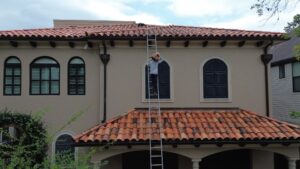
How Achilles Roofing Approaches Cypress Spanish Tile Upgrades
To guarantee an accurate Spanish tile roof cost, Achilles Roofing & Exterior approaches Cypress Spanish tile work with a fixed-contract, inspection-first model: every project begins with a full deck and underlayment assessment before a price is quoted, and every quoted price is the price the homeowner pays. The pre-job inspection identifies the structural, flashing, and ventilation conditions that turn into change orders on lower-bid contracts.
Standard Practices on Every Achilles Tile Project
- Self-adhered, high-temperature peel-and-stick underlayment rated to 240°F+, replacing the legacy 30-pound felt standard.
- Stainless-steel or copper valley flashing with hemmed edges, replacing original galvanized in every relay or replacement.
- Mechanical fastening to the current International Residential Code uplift schedules for Wind Zone IV (Harris County).
- Documented attic ventilation assessment, soffit-to-ridge airflow verified before tile reinstalls, since trapped attic heat is the leading cause of tile-roof underlayment failure in Cypress.
- Written 5-year workmanship warranty independent of the manufacturer’s material warranty.
“In Cypress, we replace far more underlayment than tile. The owner usually arrives convinced they need a new roof; they actually need the same roof, professionally relaid. That conversation saves the average homeowner $20,000.”
Senior Inspector, Achilles Roofing & Exterior
Get a Fixed-Price Spanish Tile Assessment—No Surprises
Achilles Roofing’s pre-job inspection identifies underlayment condition, valley flashing integrity, and structural load capacity before any contract is signed. What you are quoted is what you pay.
Schedule Your Fixed-Price Inspection.
Visit achillesroofinghouston.com
Or call (832) 346-8021 to get started.
Frequently Asked Questions
How long does a Spanish tile roof last in Cypress, Texas?
The tile itself lasts 50-100+ years. The underlayment beneath it lasts 15-25 years in the Gulf Coast humidity-and-heat cycle. Most Cypress Spanish tile roofs need their underlayment replaced once or twice during the lifetime of the original tile, which is why “relay” service is the most common tile project in Harris County.
Is clay or concrete tile better for Cypress homes?
In terms of lowering your Spanish tile roof cost, concrete tile is the better value choice for most Cypress homes built after 2000: it matches the Spanish profile, costs 30-40% less than authentic clay, and is available in Class 4 hail-rated formulations. Authentic clay barrel tile remains the right choice for homes where historical authenticity is non-negotiable, and HOA documents specify clay.
Do I need to upgrade my roof structure to install Spanish tile?
If the home was originally framed for tile, no. If the home was originally framed for asphalt shingles and you are converting to clay or concrete tile, almost certainly yes. Tile adds 22,500-30,000 pounds of dead load on a typical 2,500 sq ft roof. An engineering letter is required by Harris County permitting in this scenario.
Will my insurance company cover a Spanish tile roof replacement after a hail storm?
Texas insurance carriers generally cover like-for-like replacement when hail damage exceeds the policy threshold, typically 8+ impact hits per 100 sq ft. The 2% wind/hail deductible, separate from the standard deductible, applies first. On a $500,000 Cypress home, that is $10,000 out of pocket before coverage begins. File the claim within the Texas statute of limitations (2 years from date of loss).
Can I install Class 4 impact-rated Spanish tile in Cypress?
Yes. Class 4 ratings are available in specific concrete Spanish-profile tiles and in synthetic composite Spanish-profile products. Authentic clay barrel tile rarely achieves Class 4. Class 4 installation typically qualifies for a 20-35% Texas homeowner insurance premium discount, which often pays back the upgrade cost in 6-9 years.
How much does it cost to relay an existing Spanish tile roof in Cypress?
When calculating the Spanish tile roof cost for a relay, expect a 2,500 sq ft Cypress roof to typically run $14,000-$26,000, compared with $31,000-$62,000 for full replacement. The relay preserves existing tile (55-70% of total material cost) and installs new underlayment, flashing, and fasteners for a 20-year forward service life.
How do I find a qualified Spanish tile contractor in Cypress?
Verify three credentials before hiring: (1) manufacturer tile certification with Boral, Eagle Roofing, or Ludowici (depending on the tile brand), (2) Texas Department of Licensing and Regulation (TDLR) registration, and (3) active general liability and workers’ compensation insurance certificates. Ask for project photos of completed Cypress tile work, not stock images.
Does Achilles Roofing service Cypress, Texas?
Yes. Achilles Roofing & Exterior serves Cypress (77429, 77433, 77410), Houston, Sugar Land, Spring, Katy, and Pearland. The company holds TDLR registration and carries both general liability and workers’ compensation insurance, with project portfolios available for the Bridgeland, Towne Lake, Coles Crossing, and Fairfield communities.
Sources & References:
- HomeAdvisor. (2024). How much does it cost to install or replace a tile roof?
- National Atmospheric Deposition Program. (2022). Hydrogen ion concentration as pH from measurements made at the Central Analytical Laboratory [Map]. National Trends Network.
- Smith, R. K. (2015). Changing rainfall and humidity within Southeast Texas. SpringerPlus, 4, Article 445. (Note: This is the peer-reviewed publication for PMC4547975). Cited by: 5
- Texas Department of Insurance. (n.d.). Insurance discounts for total roof replacement.
- Tile Roofing Industry Alliance. (n.d.). Frequently asked questions about tile roofing.